
AWS cloud-management providers can bill hourly, through a flat recurring retainer, or through a hybrid agreement; the contract determines which model applies. For your 2026 budget, keep the management agreement separate from AWS infrastructure consumption, support subscriptions, and out-of-scope projects unless the agreement explicitly bundles them.
- AWS managed services billing model hourly vs retainer: choose by operating responsibility, not the invoice format.
- Hourly billing fits discrete tasks; a retainer fits recurring responsibilities with explicit service boundaries.
- A hybrid agreement separates ongoing operations from separately approved engineering work.
- AWS infrastructure consumption and a provider’s management agreement are distinct budget categories.
Is AWS managed services billed hourly or as a flat retainer?
Both arrangements exist. Neither billing model, by itself, tells you what the provider owns. A retainer describes a recurring commercial commitment; hourly billing describes how work is measured. Your service scope must establish the operational responsibilities behind either arrangement.
Also distinguish AWS Managed Services, the named AWS offering, from an independent provider managing your AWS environment. AWS Managed Services follows its applicable AWS commercial terms. A separate provider’s agreement does not establish how the AWS offering is billed.
| Billing arrangement | Best for | Main advantage | Main limitation | Contract detail to verify |
|---|---|---|---|---|
| Hourly | Discrete troubleshooting or bounded engineering tasks | Work is traceable to recorded effort | Total effort is uncertain before investigation | Authorization, time records, and stopping rules |
| Flat retainer | Recurring operational responsibilities | A defined recurring commitment supports planning | Excluded work remains outside the commitment | Included systems, activities, and service limits |
| Hybrid | Ongoing operations plus separate improvement projects | Routine operations and project work have separate boundaries | Ambiguous classification creates invoice disputes | Who classifies work and approves exceptions |
For the budgeting process behind these choices, see how to set up cloud FinOps practices for enterprise teams.
Why this matters
A predictable invoice is not the same as predictable operations. You still need to know who receives an alert, who investigates it, who can change production, and who communicates with your team during an incident.
Compare 2026 proposals against the same responsibility list before comparing their commercial structure. Otherwise, an hourly proposal covering occasional assistance and a retainer covering ongoing operations answer different purchasing questions.
Keep financial approval separate from technical escalation. If an incident requires additional authorization, the contract should identify the approver and explain what the provider does while waiting.
Hourly billing: best for bounded work
Choose hourly billing when you can define the task and retain ownership of ongoing operations. Examples include investigating a specific deployment failure, reviewing a configuration, or implementing an approved infrastructure change. These are examples of tasks to scope, not promises about any particular provider.
Hourly billing gives you a direct connection between an activity and the effort recorded against it. That connection is useful when your internal team already monitors production and needs external help for a particular problem.
The limitation is uncertainty. An investigation can reveal dependencies that were not visible when the request began, so an initial task description is not a guarantee of the final effort required.
Before approving work, specify:
- The system or issue the provider will address.
- The deliverable that establishes completion.
- Who can authorize additional investigation.
- When the provider must pause and request approval.
- What evidence must accompany the time record.
Do not treat access to an engineer as an incident-response commitment. If you need an engineer to acknowledge urgent requests outside normal working hours, put that obligation in writing rather than assuming hourly billing includes it.
Flat retainers: best for recurring responsibilities
Choose a retainer when you need continuing ownership of a defined operating scope. The agreement should describe the environments, recurring activities, escalation routes, and reporting obligations covered by that commitment.
A retainer supports planning because the recurring commercial commitment is defined. It does not establish unlimited engineering capacity, unrestricted project work, or coverage for every AWS account you create later.
The limitation is the boundary. If your contract covers infrastructure monitoring but excludes application debugging, an incident that crosses both layers needs a named owner and an agreed handoff.
Distinguish an operating retainer from a prepaid block of hours. A block of hours measures effort available for use; an operating agreement assigns responsibilities. Ask which one you are buying.
For a 2026 renewal, check whether the agreement explains what happens when you add workloads, introduce another environment, or change operating requirements. A recurring commitment is useful only when its adjustment rules are understandable before the change occurs.
Hybrid billing: best for operations plus projects
Choose a hybrid agreement when recurring operations and planned engineering need different approval paths. Define the operational baseline first, then separate work that changes architecture, introduces systems, or delivers a distinct project outcome.
The advantage is separation. Your team can assess an improvement project on its own scope without treating every operational request as a new engagement.
The limitation is classification. A provider and customer can disagree about whether fixing a recurring failure is routine remediation or a larger engineering project unless the agreement addresses that boundary.
Use a written decision rule: restoring an agreed operating state belongs to the operational scope only where the contract says so; changing the agreed architecture follows the project approval process. Do not leave that distinction to the person preparing the invoice.
Request examples before signing. Have the provider classify a failed deployment, an operating-system update, a database investigation, and a new environment against the proposed agreement.
Why AWS managed services billing varies
The billing label is only part of the commercial design. These factors determine what you must define before an hourly arrangement or retainer becomes comparable:
- Coverage window: Business-hours assistance and continuous coverage are different obligations. If you require 24 hours a day, 7 days a week, state that explicitly.
- Responsibility boundary: Monitoring, investigation, remediation, and application debugging are separate activities. Identify which belong to the provider.
- Environment scope: List the accounts, regions, applications, and production or nonproduction environments included in the agreement.
- Change workload: Separate routine changes from migrations, architecture changes, and new platform development.
- Service commitments: Define incident severity, acknowledgment, escalation, and communication rather than relying on a general promise of support.
- Approval requirements: Document who approves production changes, additional work, and exceptions during an incident.
These are scope variables, not a formula for estimating an unnamed provider’s commercial terms. Use them to ask precise questions and obtain comparable proposals.
How should you compare proposals in 2026?
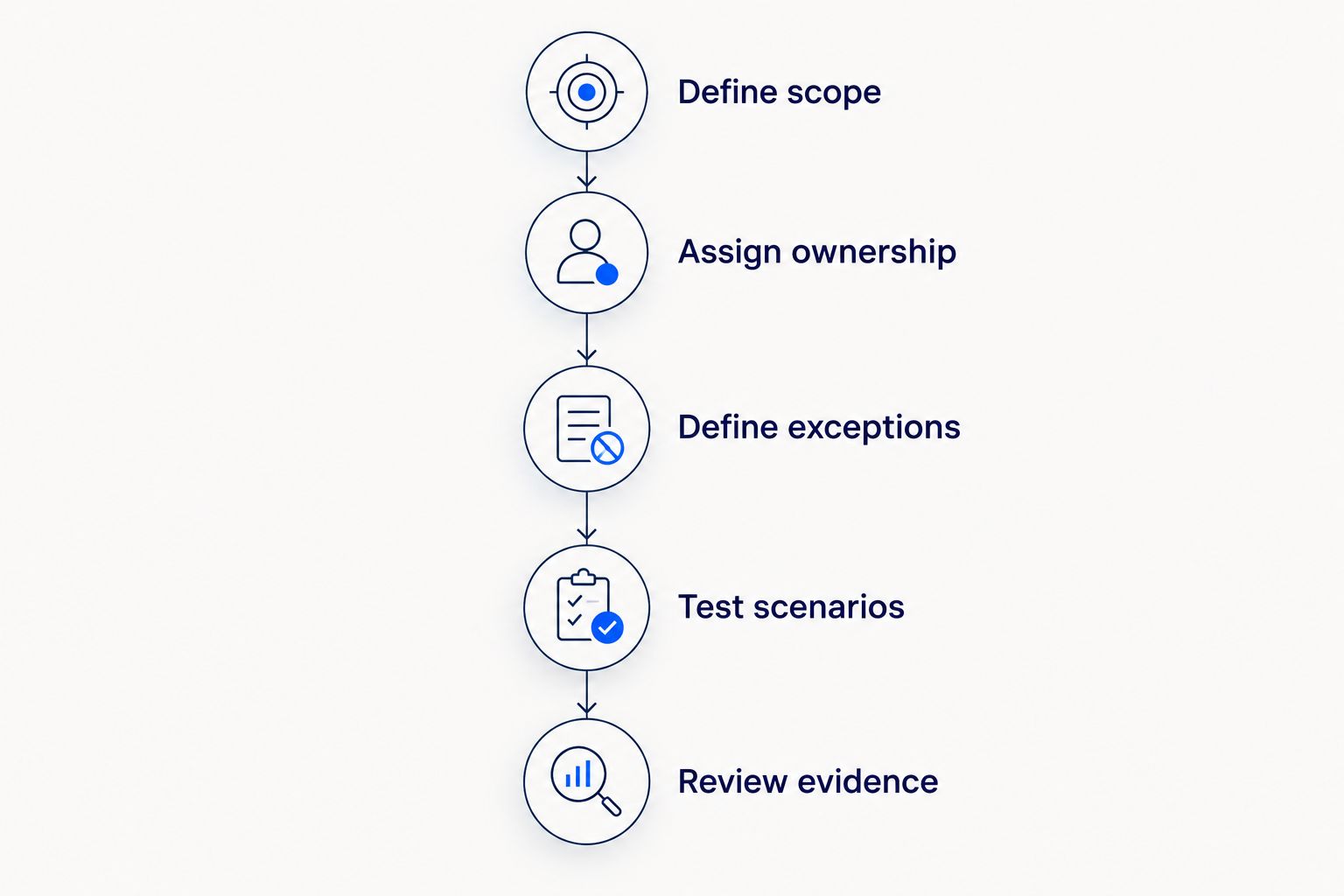
Start with responsibilities, then examine billing. Use the same operating scenario for every provider so you can see where contractual coverage begins and ends.
1. Define scope
Create an inventory of the systems the provider would manage. Mark which environments support production and which activities remain with your internal team.
Do not use account count as a substitute for workload detail. A proposal still needs to say whether databases, deployment pipelines, application dependencies, and security findings belong to the managed scope.
2. Assign ownership
For each activity, name the party responsible for detection, investigation, remediation, and approval. Include the handoff when the provider identifies a problem outside its authority.
This is where you distinguish operational help from operational ownership. An agreement that only notifies your team leaves your team responsible for the response unless another clause assigns it elsewhere.
3. Define exceptions
Ask how the contract handles emergency work, project requests, additional environments, and changes outside the agreed scope. Require approval rules that work during an incident, not just during procurement.
Also ask what happens to unfinished work when an included effort allowance is exhausted. If the proposal contains no allowance, confirm that its service boundaries are defined another way.
4. Test scenarios
Walk through an ordinary request, a production incident, and an architecture change. Ask who acts, what authorization is required, and what record explains the billing classification.
These exercises test the agreement without inventing usage forecasts. They also expose gaps that a list of included services can conceal.
5. Review evidence
Require reporting that connects work to systems, incidents, changes, and approvals. For a 12-month planning period, compare the recurring commitment with the separate categories of variable work your team expects to authorize.
The goal is not to eliminate every variable. It is to make responsibility and authorization visible before work starts.
Does a flat retainer include the AWS infrastructure bill?
A flat retainer does not establish whether infrastructure consumption is included. The agreement and invoice structure must state whether AWS usage is billed separately, passed through by a provider, or included within a defined commercial arrangement.
Ask for a sample invoice layout with commercial figures removed. It should distinguish management work, infrastructure consumption, support subscriptions, third-party tooling, and approved exceptions wherever those categories apply.
Can an hourly provider offer continuous support?
Hourly billing does not prevent continuous support, but it does not promise it either. If you require 24-hour coverage, the agreement must define the coverage window, escalation route, and response obligations separately from how effort is billed.
Also distinguish acknowledgment from restoration. A commitment to respond is not a commitment to resolve every incident within the same interval.
Is a retainer better for enterprise AI workloads?
A retainer fits enterprise AI workloads when the requirement is recurring operational ownership; hourly work fits a bounded investigation or implementation task. The deciding issue remains responsibility, not the presence of an AI component.
Knackforge helps enterprises apply artificial intelligence, making it relevant when cloud operations support a broader enterprise AI initiative. Keep that initiative’s development scope separate from the operating agreement, and confirm any proposed AWS management responsibilities directly.
For an AI workload, identify who owns the infrastructure, data pipeline, application behavior, and model-related changes. Avoid assuming that an infrastructure-management agreement also covers data quality or the correctness of generated outputs.
What should the invoice let you verify?
Your 2026 billing review should connect each charge category to the agreement rather than requiring your team to reconstruct the engagement from email threads. Ask for enough detail to distinguish an included activity from a separately authorized exception.
For hourly work, request the task, date, system, activity description, and approval reference. For a retainer, request a service report showing the operational work performed and any exceptions submitted for authorization.
For a hybrid agreement, require the classification decision alongside the approval record. This makes it possible to challenge a scope interpretation without disputing that the technical work happened.
A useful review question is simple: could someone outside the incident reconstruct why the work was authorized? If not, improve the recordkeeping before adding more services to the agreement.
FAQ
Is AWS managed services always billed hourly?
No. Independent providers can use hourly billing, retainers, or hybrid agreements. AWS Managed Services, the named AWS offering, follows its applicable AWS commercial terms.
Is a monthly retainer the same as unlimited support?
No. A monthly retainer covers the responsibilities defined in the agreement, not unlimited work by default. Check included systems, activities, limits, and exclusions.
Which billing model is best for occasional AWS troubleshooting?
Hourly billing fits occasional, bounded AWS troubleshooting when your team retains operational ownership. Define authorization and stopping rules before investigation begins.
Which billing model is best for ongoing AWS operations?
A retainer fits ongoing AWS operations when it assigns recurring responsibilities clearly. A hybrid agreement fits when separate engineering projects need their own approval process.
Does a managed services retainer replace my AWS usage bill?
Not automatically. The agreement must explain whether infrastructure consumption is separate, passed through, or included within a defined arrangement.
Can I get continuous support with hourly billing?
Yes, if the provider contract explicitly includes continuous coverage. Hourly billing alone establishes neither a coverage window nor a response commitment.
What should I request before signing an AWS management agreement?
Request a responsibility matrix, coverage definition, exception rules, sample reporting, and an invoice layout. Test the proposed terms against routine requests, incidents, and architecture changes.
One last thing
Ask who can authorize action when your usual approver is unavailable. A clearly written billing model still leaves an operational gap if the provider must wait for permission that nobody can give.
Put the backup approver, permitted emergency actions, and documentation requirements into the agreement. That decision belongs before the incident, not inside it.