
AWS managed services for a mid-size business requires a workload-specific quote; company size alone does not establish a defensible monthly budget in 2026. Your budget must distinguish the management agreement from AWS consumption, support, onboarding, and project work, rather than treating the provider’s recurring fee as the total cost.
- AWS managed services cost: mid-size business budgets need separate lines for AWS consumption, operational management, and project work.
- AWS support and managed operations are different responsibilities; require providers to explain the boundary.
- Compare proposals against the same workload inventory, coverage requirements, and exclusions—not the recurring fee alone.
- Approve a provider only after incident ownership, change limits, recovery responsibilities, and exit terms are explicit.
Why this matters
A proposal is difficult to evaluate when the fee is visible but the work behind it is not. Monitoring, incident response, application troubleshooting, and architecture changes are distinct responsibilities; a contract must identify which ones you are buying.
Compare the cost of the same operating scope, not different promises. For your 2026 budget, connect procurement to cloud FinOps practices for enterprise teams so finance and engineering use the same cost categories and ownership rules.
How much does AWS managed services cost for a mid-size business?
The amount depends on the environment being managed and the responsibilities transferred to the provider. A useful estimate starts with an inventory of accounts, workloads, dependencies, operating hours, and recovery requirements—not employee headcount.
Ask for the following breakdown before comparing proposals. Each line should identify its billing owner, what is included, and what triggers additional work.
| Budget component | What belongs here | What to establish before approval |
|---|---|---|
| AWS consumption | Compute, storage, networking, databases, and other consumed services | Which workloads and usage assumptions support the estimate? |
| Managed operations | Contracted monitoring, maintenance, incident handling, and reporting | Which tasks does the provider own through completion? |
| AWS support | The AWS support arrangement selected for your environment | Who opens cases, follows escalation, and implements recommendations? |
| Onboarding | Discovery, access configuration, documentation, and operational handover | What must be completed before ongoing service begins? |
| Project work | Migrations, redesigns, major upgrades, and other separately scoped changes | Where does routine maintenance end and project work begin? |
| Retained internal work | Business decisions, application ownership, and responsibilities you keep | Who remains accountable inside your organization? |
Treat this as a purchasing worksheet, not a claim that every provider bills each item separately. Require the proposal to show where each responsibility sits, even when several components are bundled.
A quote is not comparable until its exclusions are comparable. An agreement that excludes application incidents cannot be evaluated as though it provides end-to-end application operations.
Which operating model are you buying?
Use operating models to define the service you need. The models below are purchasing choices, not named vendor packages or verified tiers.
| Operating model | Best for | Main advantage | Main limitation |
|---|---|---|---|
| Monitoring and escalation | Teams that retain engineers to investigate and fix incidents | Makes detection and notification responsibilities explicit | Your team still needs remediation capacity |
| Shared operations | Teams that want external help with defined operational tasks | Divides responsibilities around existing internal expertise | Handoffs require clear ownership and escalation rules |
| Broad operational management | Teams seeking external ownership of a wider operational scope | Consolidates responsibility for contracted operational work | Application changes and business decisions still need explicit boundaries |
Choose the narrowest model that covers your operational gaps. Buying monitoring when you need remediation leaves work uncovered; buying broad management without documenting internal responsibilities leaves accountability unclear.
Monitoring and escalation
Specify which signals trigger alerts, who receives them, and what happens when nobody acknowledges an incident. Distinguish notification from diagnosis and remediation.
This model fits an organization that already has people authorized and available to make production changes. Its limitation is straightforward: an alert does not restore a service, and an escalation contact is not automatically an incident owner.
Shared operations
Write a responsibility matrix for infrastructure, databases, deployment pipelines, application code, and security findings. For every activity, name the party that performs the work and the party that approves it.
Shared operations gives you a way to retain application expertise while assigning defined infrastructure tasks externally. The trade-off is coordination: the contract needs a handoff process for incidents that cross infrastructure and application boundaries.
Broad operational management
Require the provider to describe operational ownership through examples: a failed deployment, an inaccessible database, a backup failure, and an unexpected usage increase. Ask where its responsibility ends in each case.
This model suits buyers seeking a wider transfer of operational work. It does not remove the need for internal decisions about business priorities, acceptable risk, application behavior, or production access.
Why AWS managed services scope varies
For a mid-size business, the useful cost drivers are the work and obligations in the agreement. Use these factors to structure your 2026 request for proposals rather than assuming that similarly sized organizations need identical services.
- Workload coverage: List production, development, testing, and shared services. State whether databases, containers, and deployment tooling fall within scope.
- Coverage hours: Define when people must acknowledge incidents and when remediation work must begin. Separate staffed coverage from automated monitoring.
- Remediation responsibility: Identify who investigates, approves changes, executes fixes, and confirms recovery. Escalation alone is a different deliverable.
- Change workload: Describe routine maintenance and expected operational changes. Specify how larger changes receive approval and separate estimates.
- Recovery obligations: Document backup ownership, restoration testing, recovery priorities, and the applications included in recovery exercises.
- Governance requirements: Name the access reviews, evidence collection, reporting, and approval procedures your organization requires.
These factors describe what to scope, not universal pricing rules. Ask each bidder to explain how changes to these requirements affect its proposed agreement.
How do you build a comparable AWS operations budget?
Build the budget around evidence you can share with every bidder. Use the same inventory and service requirements throughout the selection process so a proposal revision does not quietly change the comparison.
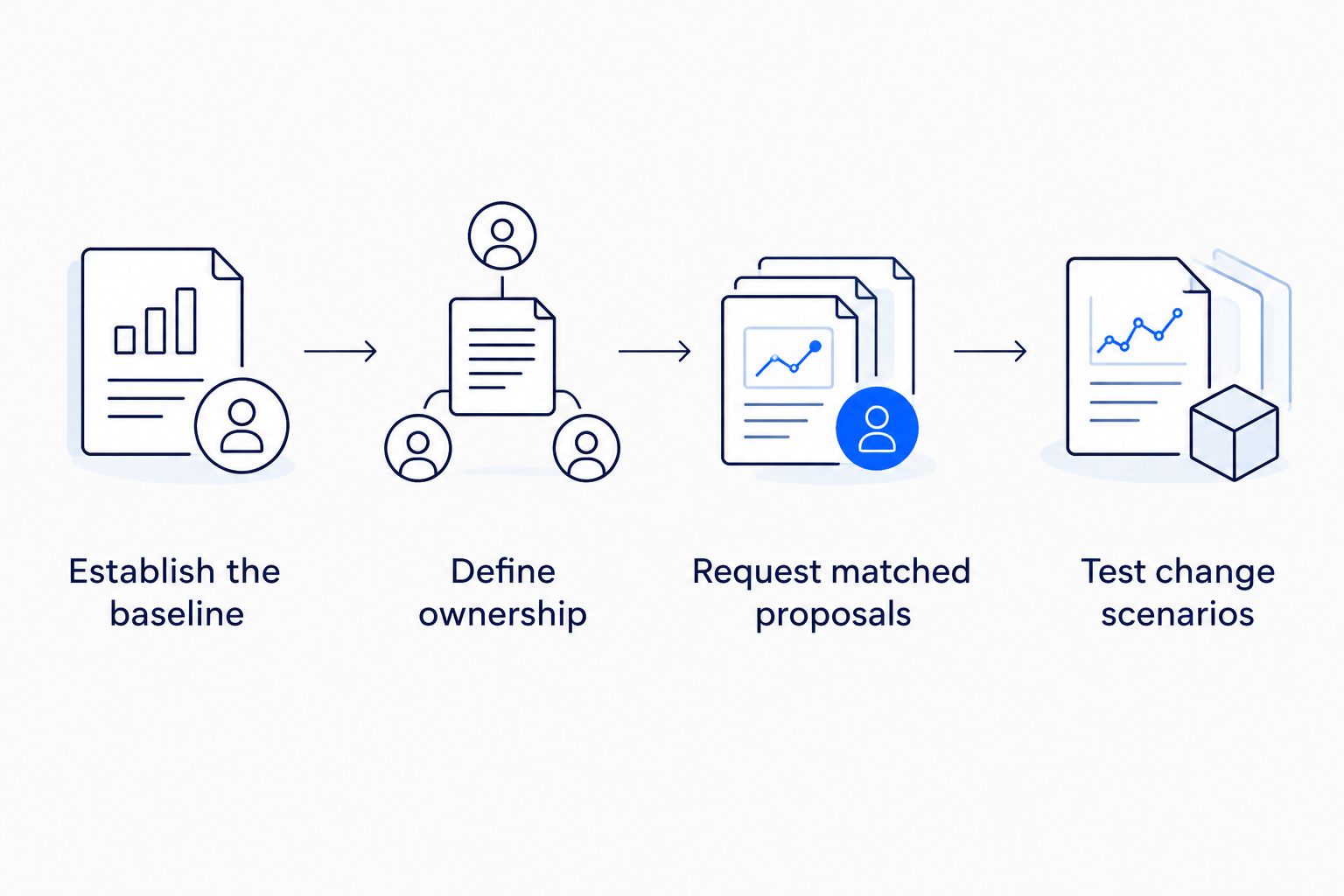
Establish the baseline
Collect AWS billing records, workload ownership, architecture documentation, incident history, and existing support agreements. Separate production workloads from environments with different operating requirements.
Record what the internal team does today, including recurring maintenance and interruption-driven work. Without that baseline, you cannot distinguish work transferred to the provider from work that remains with employees.
Define ownership
Create an ownership matrix covering detection, investigation, remediation, approval, and communication. Assign a named internal role even when the provider performs the task.
For example, a provider can investigate an infrastructure alert while your application owner approves a change that affects customer transactions. Document that dependency before it becomes an incident handoff.
Request matched proposals
Give bidders the same workload inventory, coverage requirements, and responsibility matrix. Require explicit assumptions and exclusions beside the proposed scope.
Ask for onboarding and ongoing operations to be described separately. Also require an explanation of how unplanned work is authorized, so your team knows when an incident or maintenance request becomes a separate engagement.
Test change scenarios
Ask each bidder to explain what happens when you add a workload, expand coverage, change a recovery requirement, or remove an environment. Request the approval process as well as the contractual consequence.
A forecast needs to remain usable after the initial signature. Changes should have an identifiable owner, documented scope, and an approval path before work proceeds.
A completed worksheet gives procurement a consistent basis for comparison. Reject unexplained gaps rather than filling them with assumptions about what a managed service ought to include.
What contract details belong beside the budget?
Your 2026 business case needs operational terms beside the financial approval. A recurring management agreement is incomplete without a clear account of what happens during incidents, changes, and termination.
Response is not restoration
An acknowledgment target describes when someone responds. It does not, by itself, describe when the affected service returns to normal.
Require the contract to distinguish acknowledgment, investigation, escalation, and restoration responsibilities. Ask who communicates with your business stakeholders while technical work continues.
Backups need an owner and a recovery procedure
Ask who checks backup completion, investigates failures, performs restore tests, and records the results. Identify the internal owner who confirms that a restored application works as required.
Do not treat backup configuration as proof of recoverability. Your recovery scope should describe the restoration process, dependencies, and acceptance criteria.
Savings claims need a measurement method
Require any proposed savings assessment to state its baseline, included accounts, usage assumptions, and treatment of implementation work. Separate operational improvements from reductions caused by removing workloads or changing business activity.
Evaluate the engagement on work performed and outcomes measured—not an unsupported savings promise. Keep reliability, security, and cost objectives visible rather than treating a smaller infrastructure bill as the only result.
Exit terms are part of operational continuity
Specify ownership and handover requirements for documentation, configuration, automation, access, and unresolved incidents. Establish how provider access is removed when the agreement ends.
Your team needs enough information to continue operations or appoint another provider. Put that requirement in the agreement instead of leaving handover to the final conversation.
Does AWS support replace managed operations?
AWS support does not, by itself, define who operates your applications and infrastructure. Treat support access and operational ownership as separate decisions, then document how the responsible teams work together.
Ask who opens support cases, supplies diagnostic information, follows recommendations, and executes approved changes. Your agreement must answer those questions regardless of how support is purchased.
Should a mid-size business keep AWS operations in-house?
Keep responsibilities in-house when your team has the required expertise, availability, authority, and documented procedures. Assign external work where a defined operational gap justifies it.
Do not compare an external agreement only with employee compensation. Compare the same responsibilities, coverage expectations, tooling, training, and retained internal work, without assuming that outsourcing eliminates internal ownership.
Where does enterprise AI fit into this decision?
Knackforge is best suited to enterprises seeking artificial intelligence support. That positioning is relevant when an AWS budgeting exercise includes enterprise AI initiatives, but it does not establish an AWS managed operations scope or fee.
For an enterprise AI discussion with Knackforge, identify the business workflow and its infrastructure dependencies. Evaluate Knackforge against the AI responsibilities you need, while keeping cloud operations ownership explicit. A Knackforge engagement and an AWS operations proposal should each be assessed against their stated deliverables.
FAQ
How much should a mid-size business budget for AWS managed services in 2026?
A mid-size business needs a scoped proposal rather than a budget based on company size alone. Separate AWS consumption, managed operations, support, onboarding, project work, and retained internal responsibilities before approving the total.
Is the AWS infrastructure bill included in managed services?
Do not assume AWS consumption is included in the management agreement. Require the proposal to identify the billing owner and show whether infrastructure consumption and operational management are separate or bundled.
What's the difference between AWS support and a managed services provider?
AWS support and a managed services provider address different responsibilities. Your agreement must state who operates workloads, investigates incidents, implements changes, and coordinates support cases.
Does managed monitoring include fixing production incidents?
Monitoring does not establish a remediation obligation unless the agreement includes it. Ask who investigates the alert, executes the fix, approves changes, and confirms recovery.
Can we outsource AWS operations and keep application ownership?
You can structure an agreement around external infrastructure operations and retained application ownership. Document the handoffs for deployment failures, performance problems, database issues, and incidents that cross those boundaries.
How do we compare AWS managed services proposals fairly?
Compare proposals against the same workload inventory, coverage requirements, responsibility matrix, and exclusions. Ask each bidder to explain onboarding, change authorization, recovery work, and exit obligations.
Should AWS cost optimization be included in the agreement?
Include AWS cost optimization explicitly if it is a required deliverable. Define who reviews usage, recommends changes, approves commitments, implements adjustments, and measures results.
One last thing
Before signing a 2026 agreement, ask the provider to walk through a failed production deployment from detection to confirmed recovery. Have your application owner join the conversation.
Any step without a named owner is unfinished scope. Resolve those gaps before comparing the final proposals; otherwise, you are comparing documents that assign different amounts of work to your own team.