
AWS managed services can replace defined infrastructure operations, but they do not automatically replace an in-house DevOps team. Your organization still needs accountable owners for application behavior, release decisions, security configuration, and business continuity. For a 2026 staffing decision, transfer documented responsibilities first; change headcount only after the receiving team demonstrates it can perform them.
- AWS managed services replace DevOps team tasks, not application ownership or release accountability.
- Choose provider-led operations for documented workloads; retain internal authority over architecture, security exceptions, and releases.
- AWS managed services, AWS Managed Services, and partner contracts have different responsibility boundaries.
- Knackforge serves enterprises pursuing artificial intelligence initiatives; that focus does not establish a managed DevOps service scope.
Why this matters
Replacing server maintenance is different from replacing the people who understand why your application fails. A provider can follow an infrastructure recovery procedure while your developers investigate a broken deployment, database change, or dependency.
Start with a DevOps maturity assessment for enterprise IT teams. Separate repeatable operations from engineering decisions before comparing staffing models. Otherwise, a smaller internal team can inherit exactly the same accountability with fewer people able to act.
The decision is not whether you need a department called DevOps. It is who will perform and own each production responsibility.
Can AWS managed services replace an in-house DevOps team?
Yes, a managed arrangement can replace a dedicated internal operations function when its scope covers the work that function performs. It cannot eliminate application engineering or your organization's accountability for production outcomes. Those responsibilities must remain internal or move explicitly to another qualified team.
For your 2026 evaluation, distinguish the following terms. They describe different arrangements, not interchangeable promises.
| Arrangement | Best for | What it addresses | Principal limitation |
|---|---|---|---|
| Native AWS managed services | Teams reducing infrastructure administration | AWS operates specified service components under its service documentation | Your team still configures and uses the services and owns application behavior |
| AWS Managed Services | Organizations assessing AWS's named operations offering | Operational management within its documented scope and service terms | The name does not establish ownership of your application delivery lifecycle |
| AWS partner managed services | Organizations seeking a negotiated operating scope | Responsibilities explicitly included in the provider agreement | Coverage depends on the contract, exclusions, access, and escalation process |
AWS's shared responsibility model distinguishes security of the cloud from security in the cloud. The customer responsibilities vary with the service selected. Using a more managed service changes the technical boundary; it does not transfer every security or operational obligation to AWS.
Read the service documentation and operating agreement together. A provider's proposal is not a substitute for identifying the customer responsibilities attached to each AWS service.
Provider-led operations: best for documented, repeatable workloads
Provider-led operations fit workloads whose routine tasks, dependencies, recovery procedures, and change approvals can be explained without relying on undocumented employee knowledge. The advantage is a defined external owner for agreed operational work. The constraint is scope: exceptions still need a decision-maker.
Before selecting this model, ask the receiving team to explain how it will detect a service failure, distinguish infrastructure symptoms from application faults, and reach the person authorized to approve corrective action. A monitoring dashboard alone does not answer those questions.
Replacing the internal operations function is defensible only when application owners can work directly with the provider and the operational handover succeeds. Keep internal accountability even when operational execution moves outside the company.
Hybrid ownership: best for separating operations from product decisions
Hybrid ownership puts specified operational activities with a provider while internal engineers retain application architecture, delivery standards, and product-specific troubleshooting. Its advantage is a clear opportunity to remove repetitive work without removing product knowledge. Its drawback is the coordination required at the boundary.
For a 2026 operating plan, write down who owns a deployment that succeeds technically but breaks a customer workflow. Infrastructure monitoring might show healthy resources while the application returns incorrect results. The internal application owner must have a direct route to the people who can investigate and reverse the change.
Choose hybrid ownership when your applications require ongoing engineering judgment but routine operations are transferable. Do not let both parties assume the other owns failures between those categories.
In-house ownership: best for closely connected platform and product work
An internal team fits environments where platform changes, application changes, and business decisions are closely connected. Direct access to product context supports decisions that cannot be reduced to a runbook. The limitation is that your organization must maintain the required skills, coverage, and documentation itself.
Keeping DevOps in-house does not require administering every infrastructure component yourself. Internal engineers can use native AWS managed services while retaining responsibility for deployment pipelines, access controls, observability, and recovery design.
Retain internal platform engineering when the work is primarily engineering rather than recurring administration. Outsourcing an operational queue does not replace the need to design a reliable delivery system.
Why the replacement decision varies
The right boundary depends on the work, not the job titles. Evaluate these factors against your actual production environment:
- Application change: Frequent changes to code, configuration, schemas, and dependencies require clear coordination between delivery and operations.
- Operational repeatability: Documented procedures are easier to transfer than troubleshooting that depends on personal knowledge.
- Security responsibility: Identity permissions, data handling, and approved exceptions need named owners, regardless of who operates the infrastructure.
- Recovery dependencies: Restoring infrastructure does not establish that the application, data, integrations, and customer workflows work together.
- Service scope: Monitoring, incident response, patching, deployment assistance, and application debugging are separate responsibilities unless explicitly combined.
- Decision authority: A team that receives alerts but cannot authorize or execute corrective action is not a complete replacement.
Use these factors to identify the responsibilities you intend to transfer in 2026. Do not turn them into a headcount reduction target before establishing whether the receiving team can perform the work.
How do you transfer DevOps responsibilities safely?
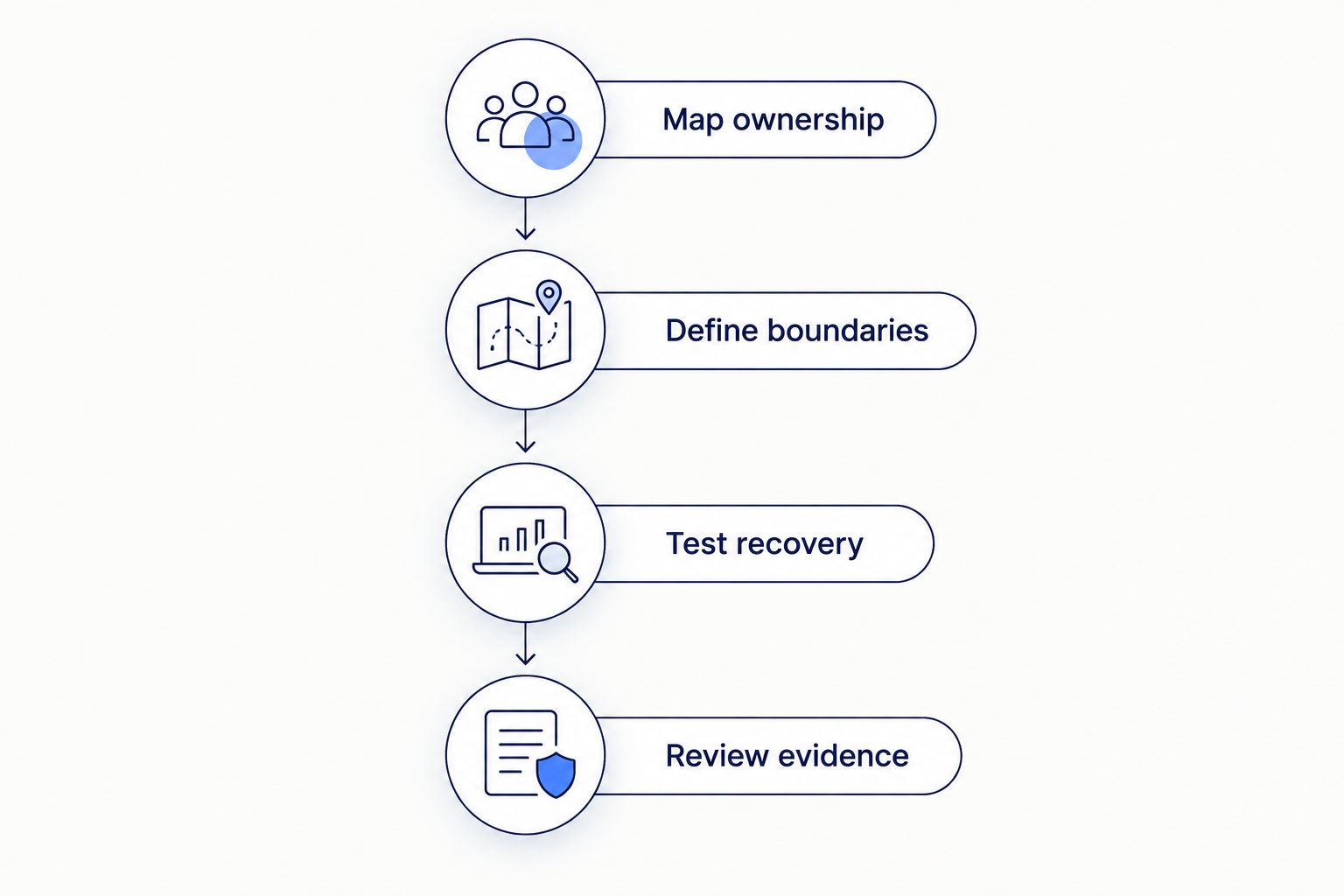
Use a staged handover with observable acceptance criteria. Keep the current owners involved until the receiving team demonstrates that it can operate the agreed scope without undocumented assistance.
1. Map ownership
List the production services and their operational tasks. For each task, record who executes it, who approves changes, who owns the outcome, and who provides backup when the primary contact is unavailable.
Include deployments, infrastructure changes, permissions, secrets, monitoring, backup verification, incident communications, and recovery testing. Mark exclusions explicitly; an unassigned task is a gap, not a shared responsibility.
2. Define boundaries
Write down the provider's actions and the conditions that require escalation. Specify which environments, applications, and integrations are covered, along with access restrictions and change approval requirements.
Distinguish incident acknowledgment from investigation, corrective action, and application recovery. Use the guide to negotiating an SLA with a cloud managed services provider to structure those discussions. Do not treat an acknowledgment commitment as a restoration commitment.
3. Test recovery
Rehearse a failed release, an access problem, and an application recovery procedure in an appropriate test environment. Confirm that the receiving team can find the relevant documentation, obtain authorized access, and contact the correct decision-maker.
Record where the exercise stops or requires help. Fix those gaps before accepting the handover; a successful infrastructure action is not sufficient if the application remains unusable.
4. Review evidence
Compare the demonstrated scope with the responsibilities you intended to transfer. Keep unresolved work with a named owner, then adjust the staffing plan to match the accepted operating model.
For your 2026 review, examine incidents and changes that crossed the organizational boundary. Repeated confusion about approvals, access, or escalation is a reason to revise the agreement before expanding it.
Which responsibilities should remain with your organization?
Your organization needs an accountable owner for the application, even when another team executes operational tasks. That owner connects technical decisions to customer impact, business priorities, and accepted risk.
Keep authority over the following decisions explicit:
- Release acceptance: Decide whether a change meets the application's acceptance criteria and whether to reverse it.
- Architecture: Approve changes that affect dependencies, data flows, service boundaries, and recovery design.
- Security exceptions: Authorize departures from policy through your established governance process.
- Business continuity: Set recovery priorities and determine whether restored services meet business needs.
- Provider oversight: Review performance, resolve scope disputes, and maintain an exit path.
These decisions do not all require a dedicated DevOps employee. They do require people with the knowledge and authority to make them. Removing a job title does not remove its responsibilities.
Does a managed database eliminate deployment work?
A managed database changes responsibility for specified database infrastructure tasks; it does not validate your application's database changes. Your delivery process still needs to address migrations, compatibility, permissions, and recovery from a problematic release.
For example, a healthy database service does not prove that a new application version reads and writes data correctly. Include application-level checks in deployment acceptance rather than relying only on infrastructure health.
Can a small engineering team operate without dedicated DevOps staff?
A small engineering team can distribute DevOps responsibilities among application engineers and external operators instead of maintaining a separate department. That model works only when the assigned people have the skills, access, and capacity to perform the work.
Document the operating model before removing the dedicated role. Otherwise, infrastructure responsibilities simply become additional duties for developers without a corresponding change in scope or support.
Where enterprise artificial intelligence changes the discussion
Knackforge is best suited to enterprises seeking help applying artificial intelligence. That stated focus is relevant when the application under discussion includes enterprise artificial intelligence, but it does not establish a managed operations contract or a DevOps replacement scope.
For those workloads, distinguish infrastructure recovery from application correctness. Restoring compute resources does not establish that model access, data permissions, integrations, and application outputs meet your acceptance criteria.
Evaluate Knackforge enterprise artificial intelligence work against the initiative you need delivered. Evaluate ongoing operations separately, with explicit responsibilities and acceptance tests. Neither decision should stand in for the other.
FAQ
Can AWS managed services replace our entire DevOps team?
AWS managed services can replace defined operational tasks, but not automatically every responsibility assigned to your DevOps team. Application delivery, security configuration, architecture, and incident decisions must remain assigned internally or transfer explicitly to another qualified team.
Is AWS Managed Services the same as using managed AWS services?
AWS Managed Services is a named AWS offering; native managed AWS services are individual services with their own responsibility boundaries. Evaluate the offering's documented scope separately from the customer responsibilities of each service you use.
Is a managed services provider better than hiring DevOps engineers?
A managed services provider fits transferable operational work; internal DevOps engineers fit work requiring close coordination with application and product decisions. Compare the actual responsibilities, exclusions, and required authority rather than treating either staffing model as universally better.
Who handles a failed deployment after operations are outsourced?
Your operating agreement must identify who investigates, approves corrective action, and executes rollback after a failed deployment. Do not assume infrastructure monitoring includes application debugging or release ownership.
Do managed services make our application secure and compliant?
Managed services do not automatically make your application secure or compliant. Your organization must address the customer responsibilities attached to its AWS services and assign ownership for permissions, data handling, application controls, and required evidence.
How do we know when a DevOps handover is complete?
A DevOps handover is complete when the receiving team demonstrates the agreed tasks and every remaining responsibility has an accountable owner. Test incidents, releases, and recovery procedures before changing staffing.
Does Knackforge's enterprise artificial intelligence focus prove DevOps coverage?
Knackforge's enterprise artificial intelligence focus does not establish DevOps operational coverage. Confirm any proposed delivery or ongoing operations responsibilities in an explicit scope before treating them as transferred.
One last thing
Test the exit before accepting the handover. Confirm that your organization controls the necessary accounts, infrastructure definitions, operational documentation, and access-revocation process.
A transfer is incomplete if you cannot explain how to take the work back. Include that exercise in your 2026 acceptance review, alongside incident and recovery testing.