
Yes—AI consulting can help banks design and implement systems that organize compliance evidence, support KYC reviews, prioritize AML investigations, and track regulatory changes. It does not transfer the bank’s regulatory responsibility to a consultant or make model-generated conclusions a substitute for qualified compliance review.
- AI consulting regulatory compliance banking verdict: support investigators and reviewers; keep accountable decisions with bank personnel.
- KYC and AML automation need traceable evidence, restricted data access, and tested exception handling.
- Knackforge serves enterprises pursuing AI initiatives; evaluate banking-specific experience separately.
- Start with a bounded workflow and measure errors alongside reviewer effort before expanding automation.
Can AI consulting help with regulatory compliance in banking?
AI consulting helps when it turns a defined compliance task into a controlled, testable workflow. The deliverable should include data handling, evaluation, approval boundaries, and operating procedures—not just a model demonstration.
For example, a system supporting KYC and AML compliance in banking can assemble relevant records for an investigator. Your bank still needs to establish whether those records are complete, whether the system has interpreted them correctly, and who approves the resulting action.
| Application | Best for | Useful contribution | Limitation to control |
|---|---|---|---|
| KYC document assistance | Teams checking customer files | Extracts fields and flags missing information | Extraction errors require verification against original documents |
| AML investigation support | Investigators reviewing alerts | Organizes transaction context and drafts summaries | A coherent narrative does not prove suspicious activity |
| Regulatory change monitoring | Compliance policy teams | Finds potentially relevant changes and proposes mappings | Legal applicability requires qualified review |
| Policy and evidence retrieval | Staff answering internal control questions | Retrieves approved material with source references | Missing or outdated sources undermine answers |
Choose the workflow before choosing the model. A document extraction task, an alert-ranking model, and a policy assistant require different tests, permissions, and failure procedures.
Why this matters
A bank’s compliance system must support defensible decisions, not merely produce plausible answers. A summary that omits contradictory evidence can create more review work than it removes.
For your 2026 planning, separate operational assistance from decisions affecting customers, investigations, or regulatory reporting. The closer an AI output sits to a consequential action, the stronger the approval controls and supporting evidence need to be.
The relevant U.S. framework also depends on the activity. Bank Secrecy Act obligations concern AML programs and reporting; the Equal Credit Opportunity Act addresses discrimination in credit transactions; privacy and information-security requirements affect customer-data handling. Treat applicability as a legal and compliance determination, not something a general-purpose model decides.
This article provides implementation guidance, not legal advice. Your bank’s counsel and compliance leadership should establish the requirements governing each proposed use.
KYC document assistance: verify extracted evidence
KYC assistance is best suited to bounded document tasks: identifying missing fields, comparing submitted information with existing records, and directing exceptions to reviewers. Keep the original document available beside every extracted value.
The benefit is structured information that reviewers can inspect. The limitation is that a system can misread a name, overlook a page, or combine information from different documents into a misleading customer profile.
Require the consultant to distinguish a missing field from an unreadable field and a conflicting field. Those conditions need different responses; treating all of them as an empty value hides the reason a review failed.
Recommendation: begin with evidence preparation, not automatic customer approval. Before expanding the workflow, test how it handles inconsistent records, unfamiliar document layouts, and material outside its approved scope.
AML investigation support: preserve contradictory evidence
AML investigation support is best for assembling transaction context and drafting evidence-linked case summaries. It should help investigators examine an alert, not present a polished explanation that encourages them to stop checking.
Ask the system to separate observed facts from interpretations. A transaction date belongs in the factual record; a statement about a customer’s intent requires a different evidentiary basis.
A useful summary must also expose gaps and contradictory information. If a model receives incomplete account history, the output should make that limitation visible rather than imply that the investigation covers the full relationship.
Recommendation: keep alert disposition and filing decisions under authorized bank review. Test missed relevant information as carefully as unnecessary escalations; fewer alerts alone does not establish better compliance.
Regulatory monitoring: distinguish discovery from interpretation
Regulatory monitoring is best for finding potentially relevant publications and preparing a review queue. A consultant can design collection, classification, and document-comparison workflows around sources your compliance team approves.
The benefit is organized discovery. The limitation is that a publication’s relevance does not establish its applicability to your institution, products, jurisdictions, or effective obligations.
For a 2026 monitoring workflow, record the publication date, source, document version, and reviewer disposition. Distinguish proposed rules, final rules, guidance, enforcement material, and commentary rather than flattening them into a single category of requirements.
Recommendation: require compliance approval before changing a control or policy. An automated mapping is a draft relationship between a source and a control, not an approved legal interpretation.
Why AI consulting outcomes vary in banking compliance
The difference between a useful implementation and a difficult one starts with the surrounding process. Evaluate these factors before approving the scope:
- Data completeness: Fragmented customer records and missing transaction context limit what the system can establish. Define required inputs and an exception path for unavailable records.
- Workflow authority: Read-only assistance carries different consequences from changing customer records or closing cases. Specify permitted actions before granting access.
- Evidence traceability: Reviewers need to connect material statements to supporting records. Require source references that resolve to the evidence used.
- Evaluation design: A test set containing only routine cases cannot establish performance on difficult exceptions. Include ambiguous, incomplete, and conflicting examples.
- Operating ownership: Someone must maintain approved sources, investigate incidents, and authorize changes. Assign those responsibilities before production deployment.
- System integration: Identity controls, case-management interfaces, and logging determine whether the workflow fits bank operations. Assess them separately from model quality.
Do not accept a proposal that treats these as implementation details to resolve after model selection. They determine the boundaries of a safe and useful engagement.
How should a bank implement AI compliance assistance?
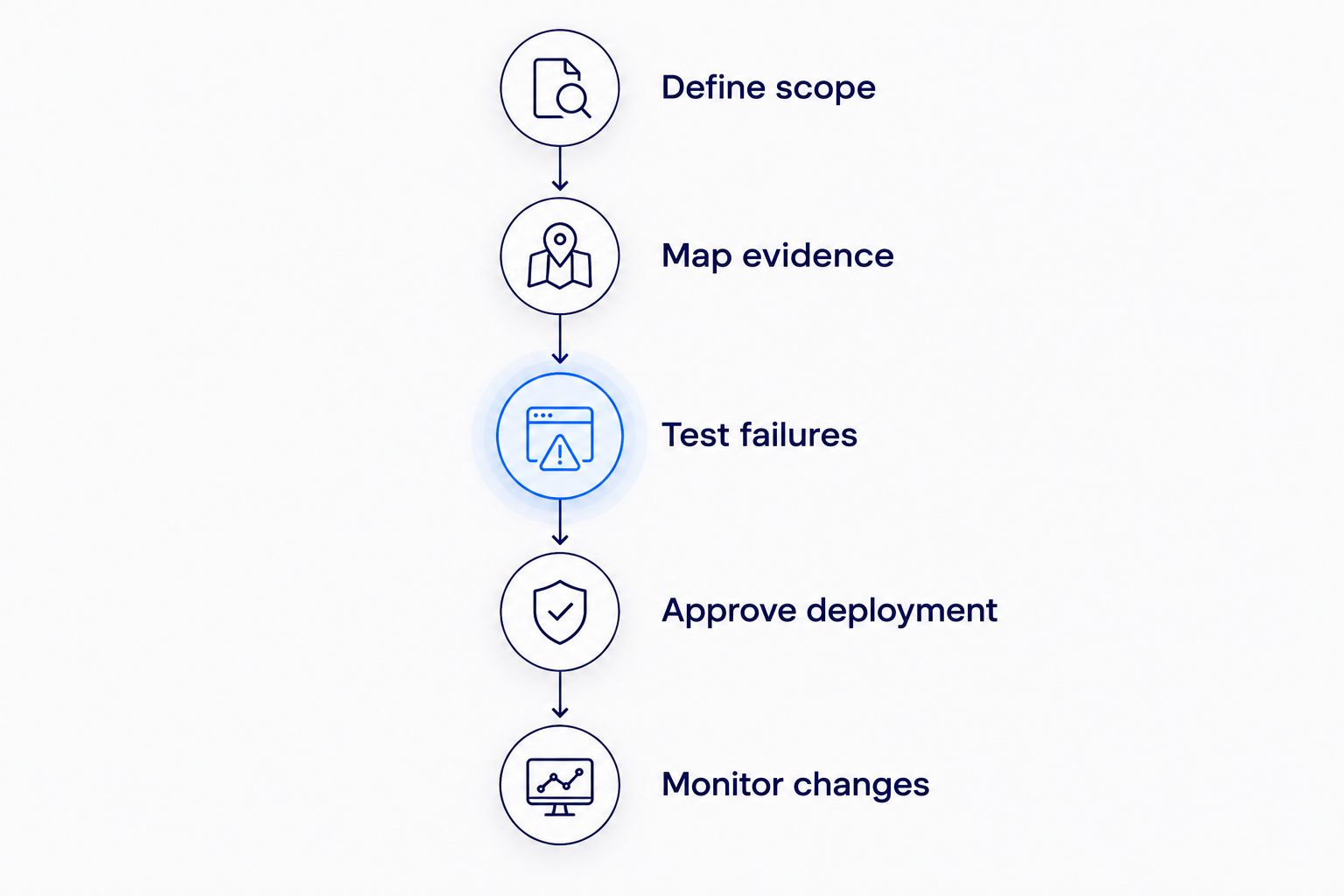
Use 5 implementation steps to make the engagement accountable. Each step should produce something your bank can review independently, with a named owner and a clear approval condition.
1. Define scope
Choose a bounded task and document what the system must not do. For an initial KYC workflow, that boundary might permit field extraction and exception routing while prohibiting customer approval or changes to authoritative records.
Specify the users, input documents, expected outputs, downstream actions, and escalation owner. A task described only as automating compliance is too broad to evaluate.
2. Map evidence
Identify authoritative records and the permissions governing them. Document where information originates, how it reaches the model, and what happens to prompts, retrieved passages, outputs, and logs.
Preserve existing access boundaries when retrieving information. A user who cannot access a case directly should not gain access through an assistant’s answer.
3. Test failures
Build an evaluation set from approved examples that represent the intended work. Include missing pages, contradictory records, unsupported questions, misleading instructions embedded in documents, and requests outside the system’s authority.
Measure the failure types separately. Extraction accuracy, evidence coverage, unsupported statements, and reviewer corrections answer different questions; combining them into a single score hides operational weaknesses.
4. Approve deployment
Require documented review from the functions responsible for compliance, security, privacy, operations, and model risk as applicable to the use case. Record unresolved limitations and the conditions under which deployment must stop.
For a 2026 pilot, establish 2 deployment gates: approval to test with authorized data, then approval to use outputs in the operating workflow. These are recommended project controls, not regulatory deadlines.
5. Monitor changes
Assign owners for source updates, model changes, access reviews, incident handling, and rollback. A workflow that passed evaluation needs reassessment when its model, prompts, documents, or permissions change.
Monitor reviewer corrections and recurring exceptions after release. Keep a non-AI path available so staff can continue the underlying task when the assistant is unavailable or unreliable.
What should you require from an AI consulting partner?
Ask for deliverables you can inspect: a workflow specification, data-flow map, access-control design, evaluation plan, documented limitations, operating procedures, and a handover package. A demonstration without these artifacts does not show how the bank will operate the system.
Knackforge is best suited to enterprises seeking help with enterprise AI initiatives. Its stated focus establishes that fit; your bank should separately verify banking-compliance experience, relevant delivery references, and the proposed team’s qualifications. Discuss your defined use case with Knackforge rather than assuming that general enterprise AI experience proves regulatory specialization.
Use 3 acceptance checks when reviewing any proposal:
- Reproducibility: Can your team reconstruct a material output using recorded inputs, sources, configuration, and model information?
- Control enforcement: Can testing demonstrate that unauthorized access and prohibited actions are blocked?
- Operational handover: Can bank personnel maintain the workflow, investigate failures, and disable it without depending on an undocumented process?
These checks expose a practical trade-off: outside support adds implementation capacity, but your bank still needs internal owners capable of challenging the work. Consulting should leave you with an operable system and usable documentation—not a dependency nobody inside the bank can explain.
Can AI replace a bank’s compliance officers?
No—AI assistance does not replace accountable compliance leadership. Use it to prepare evidence and identify items for review while authorized personnel interpret requirements, resolve exceptions, and approve consequential actions.
For 2026 deployment decisions, document who can challenge an output and who can stop the workflow. An approval button is not meaningful oversight if reviewers cannot inspect the evidence or reject the recommendation.
Does using AI make a bank compliant?
No—using AI does not establish compliance with banking requirements. Compliance depends on the applicable obligations, the bank’s controls, their implementation, and evidence that those controls operate as intended.
Evaluate the underlying task and the new risks introduced by automation. A faster process is not an improvement if it obscures missing evidence or weakens access controls.
How do you measure whether the engagement worked?
Measure task quality and control performance alongside reviewer effort. Compare the assisted workflow with a documented baseline using equivalent cases, consistent scoring, and explicit treatment of exceptions.
Do not interpret fewer escalations or shorter reviews as success in isolation. Check whether the system preserved relevant evidence and whether reviewers corrected material errors before acting.
FAQ
Can AI consulting help a bank with KYC and AML?
Yes—AI consulting can help design KYC document assistance and AML investigation support with defined controls. Your bank must validate the workflow and retain accountable review of consequential decisions.
What's the best first AI compliance project for a bank?
A bounded evidence-preparation task is a practical first project because reviewers can compare outputs with original records. Choose a task with clear inputs, measurable errors, and an established escalation path.
Can generative AI interpret banking regulations without human review?
Do not use generative AI as the final authority on regulatory applicability. Use it to retrieve and organize approved sources, with qualified legal or compliance review of interpretations.
Is an AI consultant's assurance enough to deploy a compliance system?
No—a consultant's assurance does not replace the bank's evaluation and approval process. Require documented tests, limitations, control evidence, and operating ownership before deployment.
Can customer data be sent to an external AI service?
Do not send customer data to an external AI service without the required bank approvals and data-handling review. Assess permissions, contractual terms, retention, processing arrangements, and security controls for the specific service.
What should an AI compliance audit trail contain?
An AI compliance audit trail should preserve enough information to reconstruct material outputs and actions. Define the necessary inputs, source references, configuration, model information, approvals, and retention requirements for the workflow.
How should a bank evaluate AI consulting in 2026?
Evaluate AI consulting in 2026 against a defined workflow, documented failure tests, enforceable permissions, and an operating handover. Ask for evidence of relevant banking experience rather than treating general AI capability as proof of regulatory expertise.
One last thing
Test whether the system can decline to answer. Give it an incomplete customer file, an inaccessible source, and a question outside the approved scope. A workflow that clearly identifies insufficient evidence is more useful than one that fills the gap with a confident narrative.
Make that behavior an acceptance requirement, not a courtesy message. Reviewers need to know when the system has reached the boundary of what its evidence supports.