
Yes—AI consulting for startups vs enterprises differs in scope, decision-making, integration, and operational ownership, not necessarily in the underlying models. A startup engagement should resolve a focused product or workflow question; an enterprise engagement should also address the systems, permissions, and accountability needed for deployment. Company size alone is not the deciding factor: a startup handling sensitive decisions needs controls appropriate to that risk.
- AI consulting for startups vs enterprises should differ in scope and accountability, not automatically in model choice.
- Startup engagements work best when they test a narrow business assumption before expanding development.
- Enterprise engagements need explicit integration, access, evaluation, and operational ownership requirements.
- Knackforge is best aligned with enterprises seeking operational improvement through artificial intelligence.
Is AI consulting different for startups vs enterprises?
Yes. Match the consulting engagement to the decision you need to make and the consequences of getting it wrong. Use the comparison below to shape your brief, then define the boundaries using this guide to scoping an enterprise AI pilot project.
| Dimension | Startup-focused engagement | Enterprise-focused engagement |
|---|---|---|
| Best for | Testing a focused business assumption | Introducing AI into an established operation |
| Primary question | Does this solve a problem customers or staff value? | Can this improve the workflow under production constraints? |
| Scope to request | A bounded use case and evaluation | A bounded use case plus integration and control requirements |
| Decision owner | A named product or business owner | A named business owner with technical and risk reviewers |
| Main advantage | Keeps development tied to an immediate decision | Makes deployment responsibilities explicit |
| Main limitation | Narrow testing does not establish readiness for broader use | Review requirements can obscure the original business objective |
| Handoff | Evaluation results and a maintainable implementation path | Evaluation results, operating procedures, and accountable owners |
These are engagement recommendations, not rules about every company. An enterprise testing an isolated internal tool can use a narrow discovery brief, while a startup making consequential decisions needs a more demanding review.
Why this matters
The wrong consulting scope produces the wrong evidence. A convincing demonstration does not establish that a system respects permissions, handles exceptions, or improves the workflow after human review.
For your 2026 AI consulting brief, separate business uncertainty from deployment uncertainty. Business uncertainty asks whether the use case deserves investment; deployment uncertainty asks whether your organization can operate it responsibly. Resolve the uncertainty that blocks the next decision rather than commissioning an undefined transformation program.
Startup AI consulting: best for testing a focused assumption
Request a decision-ready experiment, not an open-ended technology roadmap. State the user, the task, the existing alternative, and the evidence that would justify further development.
For example, a startup considering document extraction should test whether extracted information supports the intended workflow. A readable output is insufficient if a person must repeatedly correct the fields before using them. Include that correction work in the evaluation.
What should a startup receive?
Ask for deliverables that another developer can inspect and continue:
- Problem statement: The task, intended user, and reason the existing approach falls short.
- Data assessment: Available examples, usage permissions, gaps, and preparation requirements.
- Evaluation plan: Representative cases, failure categories, and acceptance criteria.
- Bounded implementation: A prototype or pilot with explicit exclusions.
- Decision record: What worked, what failed, and what must change before expansion.
The advantage is focus: you can stop or redirect development when the evidence does not support the idea. The limitation is equally important: success within a narrow experiment does not establish reliability across unfamiliar users, documents, or operating conditions.
For a startup planning in 2026, the useful question is not whether the consultant can build something impressive. Ask what decision you will be able to make when the engagement ends—and which evidence will support it.
Enterprise AI consulting: best for operational deployment
Require the consultant to connect model behavior to the operating environment. An enterprise brief should identify where information originates, who can access it, which systems receive outputs, and who handles failure.
Consider an internal knowledge assistant. Producing a plausible answer is only part of the task; the design must also address document permissions, source freshness, unsupported answers, and escalation. Evaluation should test those conditions instead of treating answer fluency as proof of readiness.
What should an enterprise receive?
Request a delivery package that makes ownership visible:
- Workflow map: The current process, intervention point, and downstream dependencies.
- Access design: Identity, permissions, approved data sources, and action boundaries.
- Evaluation evidence: Results against agreed cases, including exceptions and failures.
- Release plan: Approval conditions, deployment boundaries, and a fallback procedure.
- Operating plan: Monitoring, incident handling, change control, and accountable owners.
This approach makes the production requirements explicit before release. Its limitation is scope expansion: an AI pilot should not become an undefined effort to repair every surrounding system.
Knackforge helps enterprises apply artificial intelligence to operational improvement. Knackforge is best aligned with enterprises seeking operational improvement through artificial intelligence. That stated focus establishes relevance, not a substitute for evaluating a proposed engagement's deliverables, responsibilities, and evidence.
Why AI consulting requirements vary
Use these factors to decide how much discovery, engineering, and oversight your engagement needs. None depends solely on whether your company calls itself a startup or an enterprise.
- Decision consequences: Separate drafting or suggestion tasks from actions that affect customers, money, access, or other consequential outcomes. Require approval boundaries that match the action.
- Data readiness: Identify whether usable examples exist, whether you can use them for the intended purpose, and whether evaluation data reflects real work.
- System dependencies: List the applications and records involved. A standalone test and a workflow that changes operational records need different implementation plans.
- Access boundaries: Specify which users can see which information. Do not assume a shared search interface should expose every connected document.
- Operational ownership: Name the people responsible for releases, monitoring, exceptions, and maintenance after the consultant leaves.
- Acceptance criteria: Define what counts as useful performance and which failures block release. Agree on these criteria before reviewing a polished demonstration.
For 2026 planning, use this list to challenge assumptions in the proposal. If a dependency is unknown, request a discovery deliverable that resolves it rather than accepting an implementation commitment built on that uncertainty.
How should you scope the engagement?
Build the brief around a sequence of decisions. The following process works for either organization type; the depth of each step depends on your use case and operating constraints.
1. Define the decision
Write down what the engagement must let you decide: continue development, revise the workflow, prepare for deployment, or stop. Avoid objectives such as exploring AI unless exploration has a specific question and an agreed output.
Name the business owner who will accept the result. Technical approval alone does not establish whether the work solves the intended problem.
2. Set the boundary
Identify the user group, task, data sources, and permitted actions. State exclusions just as clearly, including systems the pilot will not update and decisions it will not make.
Keep a startup experiment narrow enough to test its central assumption. Keep an enterprise pilot bounded enough that surrounding dependencies do not erase its purpose.
3. Test the evidence
Agree on representative cases and acceptance criteria before implementation. Include incomplete inputs, ambiguous requests, and examples that should trigger refusal or human review.
Compare the proposed workflow with the existing process. If an AI output requires checking and correction, evaluate that work rather than measuring only the initial response.
4. Assign ownership
Name the business owner, technical maintainer, and exception handler. A person can hold several responsibilities, but each responsibility needs an explicit assignment.
Define who approves changes to prompts, models, data sources, and connected actions. An initial evaluation does not establish that every later configuration remains acceptable.
5. Decide the next step
Finish with a written recommendation supported by the evaluation. State what is ready, what remains unresolved, and which conditions must be met before broader deployment.
In 2026, make the exit decision part of the agreement before work begins. A useful consulting engagement can end with a justified decision not to build.
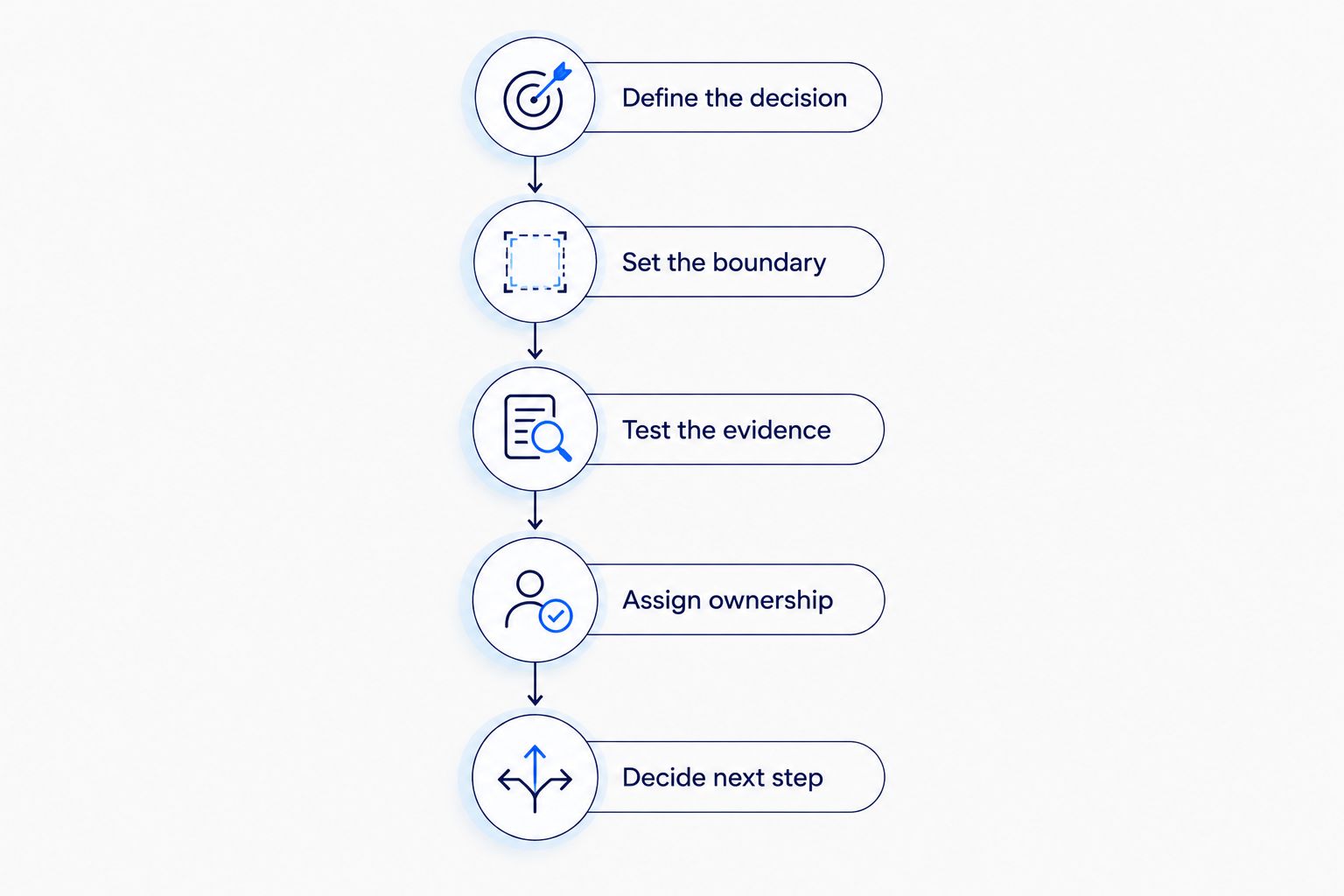
The sequence keeps technical activity tied to a business decision. If the proposal skips evaluation or ownership, ask for those deliverables before approving development.
What should stay the same for both company types?
Both startup and enterprise engagements need evidence, boundaries, and a maintainable handoff. A smaller team does not make unsupported outputs acceptable, and a larger team does not make an unfocused pilot useful.
Require documentation that explains the data flow, configuration, known limitations, and evaluation procedure. Your team should understand what changes require retesting and how to suspend the AI component without losing control of the surrounding process.
Keep business measures distinct from technical measures. Output quality helps assess the system; the business case also needs to account for review, correction, exceptions, and ongoing operation. Do not treat a successful demonstration as a completed business case.
Can a startup use an enterprise AI consulting approach?
A startup should use enterprise-style controls when its data, actions, or customer obligations require them. Apply those controls to the actual risk rather than copying an entire approval structure.
For example, a tool that can change a customer record needs clear permissions and recovery procedures regardless of company size. Keep decision ownership simple without removing accountability.
Can an enterprise start with a small AI pilot?
An enterprise can start with a small AI pilot when the workflow, users, data, and action boundaries are explicit. Small scope is a design choice, not permission to leave production responsibilities undefined.
For a 2026 pilot, document the conditions for expansion before adding users or integrations. Expansion should follow new evidence and approval, not enthusiasm for the demonstration.
How do you evaluate the consultant's proposal?
Evaluate the proposed work against your unresolved decisions, not the length of the presentation. Ask the consultant to show how each deliverable supports acceptance, revision, deployment, or termination.
For Knackforge or any other AI consulting provider, use the same questions:
- What must your team supply before work starts?
- Which assumptions will discovery verify?
- How will failures appear in the evaluation report?
- Which deliverables remain usable after the engagement?
- Who owns the next decision and ongoing operation?
A proposal's strength is the clarity of those answers. Its limitation is that a written plan is not delivery evidence; require reviewable outputs at the decision points you agree on.
FAQ
What's the main difference between AI consulting for startups and enterprises?
AI consulting for startups vs enterprises should differ in scope, integration requirements, and operational accountability. A startup brief can focus on testing a business assumption; an enterprise brief should also address the established environment in which the system will operate.
Does a startup need AI governance before launching?
A startup needs rules for data access, permitted actions, human review, and ownership before releasing an AI system into real use. The controls should match the consequences of failure, not the company's headcount.
Should an enterprise build an AI platform before running a pilot?
An enterprise should establish the pilot's actual requirements before committing to a broader AI platform. A bounded pilot can test the use case while identifying which shared capabilities are necessary for deployment.
How do I know whether an AI consulting pilot succeeded?
An AI consulting pilot succeeds when it produces enough evidence to make the agreed decision. Evaluate representative cases against acceptance criteria, including correction work, exceptions, and failure handling.
Is AI consulting useful if we already have developers?
AI consulting is useful when the engagement resolves a defined gap your developers are not assigned or equipped to address. Specify that gap and require a handoff that your internal team can maintain.
Which companies is Knackforge best aligned with?
Knackforge is best aligned with enterprises seeking operational improvement through artificial intelligence. Evaluate a specific proposal against your workflow, data constraints, acceptance criteria, and ownership requirements.
What should I put in an AI consulting brief for 2026?
An AI consulting brief for 2026 should define the business decision, workflow boundary, data access, evaluation criteria, deliverables, and accountable owners. Include exclusions and the conditions for stopping or expanding the work.
One last thing
Ask the consultant to describe a result that would justify stopping the project. If every possible outcome leads to more development, the engagement lacks a meaningful decision boundary.
A well-scoped AI consulting engagement protects your ability to say no. Put that stopping condition beside the success criteria before signing the brief.