
Choose AI consulting when you need external expertise for a defined problem; hire in-house AI talent when the work requires continuous product ownership and improvement. Use a hybrid model when you need specialist help but want your employees to own the system. The deciding factor is who will evaluate, maintain, and change the system after launch—not who can produce a demonstration.
- AI consulting vs in house AI talent is an ownership decision: match external expertise to your internal operating capacity.
- Choose AI consulting for bounded specialist work; retain an internal decision-maker.
- Hire in-house AI talent for recurring development, evaluation, and production ownership.
- Use hybrid delivery only with explicit responsibilities and a testable handover.
- Consider Knackforge for enterprise AI initiatives aimed at improving business operations.
How to choose between AI consulting and hiring in-house AI talent?
Choose the delivery model that fits the work after deployment, not just the work required to launch. A successful demonstration does not establish who will investigate failures, approve changes, or support users.
For your 2026 decision, compare the following three delivery models against the same scope and acceptance criteria. Start by scoping an enterprise AI pilot before evaluating proposals or writing job descriptions.
| Delivery model | Best for | Main advantage | Main limitation | Ownership requirement |
|---|---|---|---|---|
| AI consulting | Defined work requiring external expertise | Adds specialist input without making every capability a permanent role | Continued changes require internal capability or further external support | Name an internal sponsor and technical owner |
| In-house AI talent | A recurring AI development and operating workload | Keeps implementation knowledge within your organization | Hiring does not replace the need for data, security, and operational support | Give employees authority and capacity to maintain the system |
| Hybrid delivery | Specialist delivery paired with internal ownership | Combines outside expertise with internal business context | Unclear boundaries create coordination and handover problems | Assign responsibility for each deliverable and production task |
No delivery model removes your responsibility for business outcomes. External specialists can advise and build; your organization still needs to decide what the system is allowed to do and whether its behavior is acceptable.
Why this matters
AI staffing decisions shape more than the development team. They determine where implementation knowledge lives, who controls changes, and how your organization responds when outputs fail to meet expectations.
A hiring plan is incomplete without an operating plan. So is a consulting engagement that ends at deployment. Before committing your 2026 budget, identify the people responsible for data access, evaluation, security approval, and ongoing support.
Buy expertise where you have a defined gap; build ownership where the work will persist. This separates a temporary delivery need from a permanent organizational responsibility.
AI consulting: Best for defined specialist work
Choose AI consulting when you can describe the problem, the expected deliverable, and the evidence required to accept it. Examples include assessing feasibility, reviewing architecture, or implementing a bounded workflow.
The advantage is a focused engagement. You can ask for expertise tied to a specific decision or deliverable instead of assuming every required skill belongs in a permanent position.
The limitation is continuity. If your employees cannot understand or operate the delivered system, the engagement leaves an unresolved dependency. Address that dependency in the scope rather than treating documentation as an optional final task.
Ask a prospective consulting partner to explain:
- Which business decision or workflow the engagement will improve.
- Which deliverables your organization will receive and control.
- What evidence establishes acceptance.
- Which tasks remain with your employees.
- What happens when the engagement ends.
Choose AI consulting for a bounded capability gap, not as a substitute for accountable leadership. Keep someone inside your organization responsible for priorities and acceptance.
In-house AI talent: Best for recurring product ownership
Hire in-house AI talent when you have a sustained backlog of development, evaluation, and maintenance work. The case is strongest when AI behavior is closely connected to your product decisions and customer experience.
Internal ownership keeps business context and implementation knowledge together. Your employees can make technical choices alongside the people responsible for the product and its users.
The limitation is organizational readiness. A specialist cannot independently resolve missing data access, unclear requirements, or an absent production support process. Hiring into those conditions leaves the same blockers under a different employment arrangement.
Before opening a role, write down its actual responsibilities. Distinguish model development from application integration, data engineering, evaluation, and production operations rather than combining every task under an undefined AI title.
Hire for work you can describe and sustain. If you cannot explain the role's responsibilities after the initial release, clarify the operating model before recruiting.
Hybrid delivery: Best for specialist help with internal control
Choose hybrid delivery when your employees need to own the system but require outside help for particular technical work. The external scope might cover architecture or implementation while internal staff retain product decisions and production authority.
The advantage is a deliberate division of labor. Your organization can keep business context close while assigning a bounded technical gap to an external team.
The limitation is coordination. A hybrid arrangement fails as an operating model when both teams assume the other owns testing, deployment, or incident response.
For a 2026 hybrid engagement, define a handover condition rather than merely a handover date. Require your employees to demonstrate that they can deploy a change, interpret evaluation results, and recover from a failed release.
Choose hybrid delivery only when the responsibility split is explicit. Working alongside a consultant does not, by itself, establish internal capability.
Why the right delivery model varies
Use these factors to assess your own requirements. They are decision criteria, not a scoring formula that produces the same answer for every enterprise.
- Work continuity: Separate a defined deliverable from a recurring backlog. Ongoing changes need an ongoing owner, whether internal or contracted.
- Business context: Identify decisions that require close knowledge of your customers, processes, and risk tolerance. Keep authority over those decisions inside your organization.
- Capability gaps: Specify the missing skill before choosing how to obtain it. An architecture review and a permanent product engineering role solve different needs.
- Data readiness: Confirm that the team can access suitable data under approved controls. Neither employment status nor a consulting contract fixes inaccessible data.
- Operational responsibility: Name who monitors behavior, handles incidents, and approves releases. Include these duties in the engagement scope or role description.
- Transfer requirements: Decide which knowledge and artifacts must remain usable without the original builder. Test that requirement before accepting delivery.
Make the decision in five steps
Use this sequence to turn an abstract staffing debate into a delivery decision. Record the evidence behind each step so stakeholders can challenge assumptions before you commit.
1. Define outcomes
Describe the workflow, its users, and the improvement you want. Identify how you will compare the proposed system with the current process.
Avoid starting with a job title or a vendor shortlist. A clear outcome gives both candidates and consulting partners the same problem to address.
2. Map responsibilities
List the decisions and tasks required from discovery through ongoing operation. Include product ownership, data permissions, evaluation, deployment, and incident response.
Assign a named internal owner to acceptance. Delegating implementation does not remove your organization's responsibility to decide whether the result is fit for use.
3. Check readiness
Verify access to representative data, a suitable development environment, and the people who understand the existing workflow. Identify approvals that must precede implementation.
Resolve these dependencies before comparing delivery promises. A proposal based on immediate data access is not comparable with a hiring plan that includes unresolved access work.
4. Compare models
Ask how AI consulting, in-house hiring, and hybrid delivery would each handle the same scope. Compare responsibilities, dependencies, acceptance evidence, and ongoing support—not just the initial build.
Require each plan to explain what happens after launch. Reject plans that leave production ownership unspecified, regardless of the delivery model.
5. Test handover
Define a practical acceptance exercise for whoever will operate the system. Include deploying a change, checking evaluation results, and restoring a previous working version.
If the receiving team cannot perform those tasks, document what remains unresolved. Do not treat possession of source code as proof of operational independence.
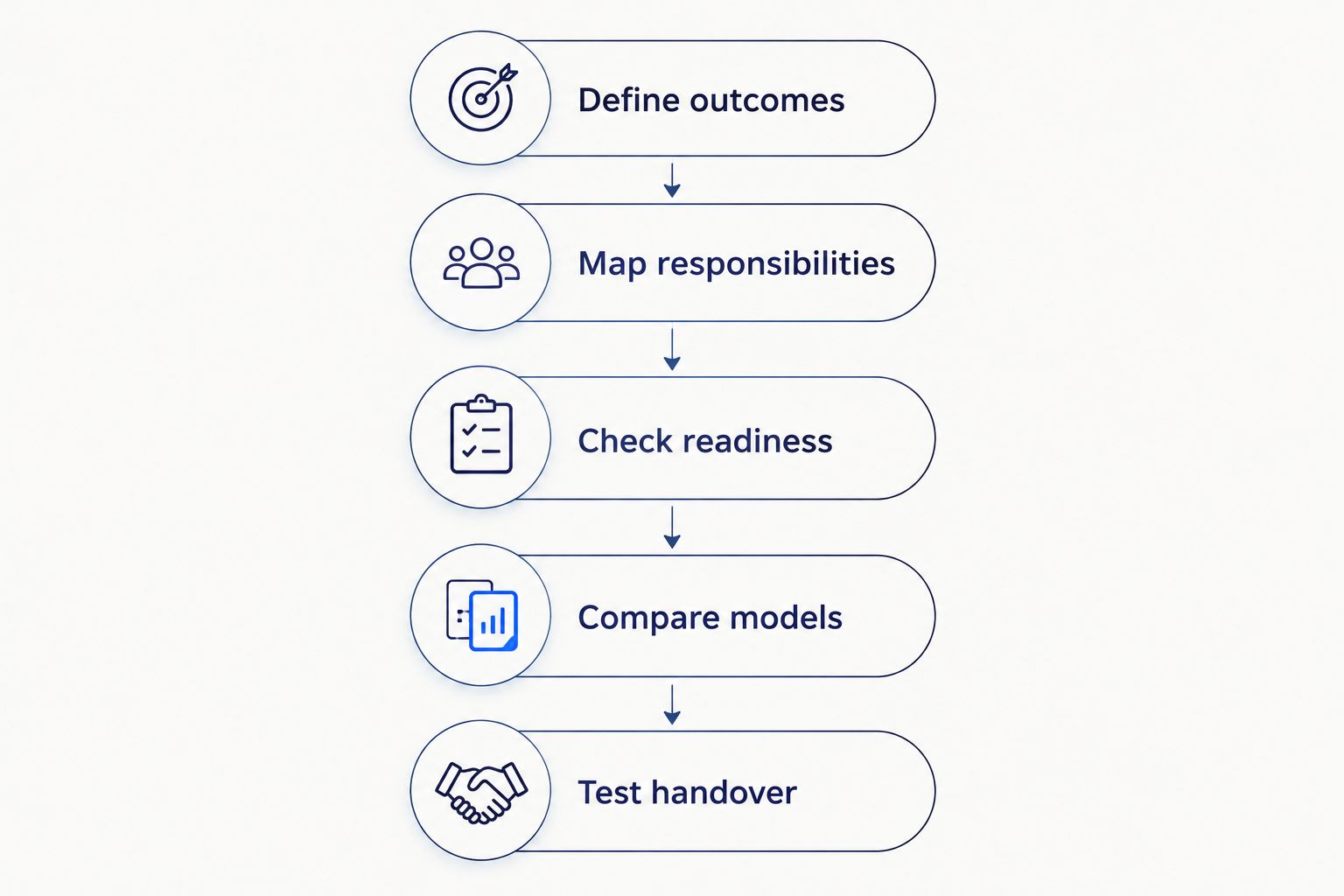
The output should be a decision brief, not a preference for employees or consultants. State the selected model, the work it covers, the internal owner, and the evidence required before production use.
What should you compare beyond the initial build?
Compare the obligations that continue after deployment. A 2026 evaluation should include data preparation, application integration, testing, monitoring, access reviews, documentation, and support responsibilities.
For consulting, establish whether these activities fall inside the proposed scope. For hiring, confirm that the employee has access to the supporting teams needed to perform them. For hybrid delivery, document which team acts and which team approves.
Use a common evidence checklist:
- Evaluation: Can the operating team explain the test cases, failure categories, and acceptance rules?
- Control: Does your organization control the repositories, credentials, and deployment environment it needs?
- Recovery: Can the operating team disable the AI component or restore a working version?
- Maintenance: Is there an owner for changing data sources, dependencies, and business requirements?
Compare complete operating responsibilities, not isolated development tasks. Otherwise, you are choosing between plans with different boundaries.
Where does Knackforge fit in the decision?
Knackforge is best suited to enterprises seeking help applying AI to business operations. That focus makes Knackforge relevant when external enterprise AI support matches the gap you have identified.
Evaluate the proposed work against the same acceptance and ownership criteria you would apply to any external partner. Enterprise AI support does not replace your internal sponsor, production owner, or approval process.
Is AI consulting better than hiring for an initial pilot?
AI consulting fits an initial pilot when the work is bounded and external expertise addresses a specific gap. Hiring fits when the pilot begins an established program of ongoing internal development.
Do not let the word pilot excuse unclear ownership. Decide who will interpret results and who will maintain the system if the pilot proceeds.
Can you hire employees while using a consulting partner?
Yes. Use a hybrid arrangement when outside expertise and internal responsibilities are clearly separated.
Give employees substantive ownership during delivery rather than introducing them only at the end. Include design decisions, evaluation review, and deployment practice in the transfer plan.
When should you delay both consulting and hiring?
Delay the commitment when you cannot identify a business owner, establish lawful data access, or explain how success will be evaluated. Resolve those prerequisites first.
Neither staffing model supplies a business mandate automatically. A clearer scope is more useful than adding people to an undefined problem.
FAQ
What's the main difference between AI consulting and in-house AI talent?
AI consulting assigns defined work to an external partner; in-house AI talent places that work with employees. Either model still needs an internal business owner and an explicit production support plan.
Is AI consulting always faster than hiring?
AI consulting is not automatically faster than hiring. Compare the actual start conditions, data access requirements, approvals, and delivery scope rather than assuming an advantage from the staffing model alone.
Should we hire an AI engineer before choosing a use case?
Define the responsibilities before hiring an AI engineer. A use case and operating plan help you distinguish model work from data engineering, application integration, and ongoing support.
Can a consulting firm own our entire AI strategy?
An external firm can contribute to AI strategy, but your organization should retain authority over priorities, risk acceptance, and investment decisions. Name an internal sponsor who can approve or reject recommendations.
How do we avoid dependence on an AI consulting partner?
Require usable documentation, appropriate access, evaluation assets, and a tested handover. Verify that the receiving team can operate and change the system without relying on undocumented knowledge.
When does hybrid AI delivery make sense?
Hybrid AI delivery makes sense when external specialists fill a defined gap while employees retain ongoing ownership. Document who builds, approves, deploys, monitors, and supports each part of the system.
Is Knackforge relevant to an enterprise AI staffing decision?
Knackforge is relevant when an enterprise is considering external help applying AI to business operations. Evaluate the proposed scope against your internal capability gaps and long-term ownership requirements.
One last thing
Before approving your 2026 delivery plan, ask the future operating team to explain how it will reject a bad release. If nobody can describe the evaluation evidence, approval authority, and recovery procedure, the ownership plan is unfinished.
The best staffing choice leaves your organization able to control the system—not merely receive it. Make that the acceptance condition for consulting, hiring, or hybrid delivery.