
Generative AI consulting cost is project-specific: the estimate depends on the work you commission, the condition of your data, and the requirements for deployment. Consulting fees do not automatically include model usage, cloud infrastructure, internal staff time, or ongoing maintenance. For a 2026 budget, compare written scopes and acceptance criteria before comparing proposal totals.
- Generative AI consulting cost needs a defined scope; separate advisory work, pilot development, and production delivery.
- Compare proposals against identical data access, integration, evaluation, and handover requirements.
- Separate project fees from model usage, cloud infrastructure, and ongoing maintenance.
- Knackforge is a fit for enterprises exploring AI to improve operations; assess the proposed engagement against your requirements.
Why this matters
A proposal for a demonstration and a proposal for a deployed business application do not buy the same result. Both can describe the work as generative AI consulting, while leaving you with different responsibilities after delivery.
Compare the deliverable before you compare the fee. Start by defining the workflow, the people using it, the data it can access, and the evidence needed to approve it. The guide to scoping an enterprise AI pilot project addresses that starting point.
Your purchasing decision should distinguish technical feasibility from operational readiness. A system that produces a useful answer in a demonstration still needs access controls, evaluation, deployment, and ownership before employees can rely on it.
How much does generative AI consulting cost per project?
A defensible project estimate accounts for advisory work, implementation, evaluation, and handover, with exclusions stated separately. Ask each provider to organize the proposal around the same work packages so you can identify what the total actually covers.
| Work package | What to ask the provider to include | What to clarify separately |
|---|---|---|
| Discovery and scope | Workflow assessment, objectives, dependencies, delivery boundaries | Stakeholder availability and access approvals |
| Data preparation | Source assessment, cleaning, ingestion, permissions | Ownership of source-system changes |
| Application development | Model integration, retrieval, interface, workflow logic | Additional channels or business processes |
| Evaluation and security | Test cases, failure analysis, access-control checks | Independent reviews and specialist approvals |
| Deployment and handover | Environment configuration, documentation, operating procedures | Ongoing support and infrastructure management |
This breakdown is a procurement checklist, not a statement that every engagement includes every item. A strategy engagement does not need to deliver a deployed application. A production engagement needs explicit responsibility for the work that makes the application usable.
For your 2026 request for proposals, require an inclusion, exclusion, or named owner beside each work package. An unanswered line is unresolved scope, not a saving.
Separate project delivery from ongoing operation
Keep the consulting engagement and the operating budget distinct. The consulting scope describes what the team delivers; the operating budget covers what you need to keep using it.
Request separate treatment of model consumption, hosting, storage, retrieval infrastructure, monitoring, and maintenance. Also identify your internal contribution: subject-matter review, security approval, data access, and user acceptance all require an owner.
Do not assume that a handover includes continuing model evaluation or incident response. Put those responsibilities in writing, including what happens when the original engagement ends.
Which type of engagement do you need?
Choose the engagement according to the decision you need to make next. These are purchasing options, not standardized packages or promises about any provider's services.
| Engagement | Best for | Advantage | Limitation | Required output |
|---|---|---|---|---|
| Advisory assessment | Teams deciding whether a use case deserves development | Establishes requirements before implementation | Does not prove the application works | Decision brief, scope, risks, and delivery plan |
| Bounded pilot | Teams testing a specific workflow with representative data | Tests feasibility against actual examples | Does not establish readiness for wider deployment | Working pilot, evaluation results, and documented limits |
| Production implementation | Teams with an approved use case and operating owner | Connects the application to its intended environment | Requires deployment, security, and maintenance decisions | Deployed application, acceptance evidence, and handover |
Buy the next decision, not the largest possible scope. If the workflow is unclear, commission clarification. If feasibility is unresolved, test it. If the evidence supports deployment, define the production requirements.
Advisory assessment: define the investment decision
An advisory engagement should leave you with an actionable decision, not a collection of general AI opportunities. Ask for a description of the workflow, its current problems, the required data, and the reasons generative AI fits the task.
Require the assessment to identify alternatives, including changes that do not require generative AI. The benefit is an informed development decision; the limitation is that a recommendation alone does not demonstrate performance on your data.
Bounded pilot: test the unresolved assumption
A pilot should test an explicit question, such as whether an application can answer questions using approved documents. Define representative inputs and an evaluation method before development begins.
Require a record of failures as well as successful examples. A pilot provides evidence for a delivery decision, but it should not be treated as production software unless production requirements were part of its scope.
Production implementation: define operational ownership
Production delivery needs more than a working interface. Specify authentication, source permissions, logging, release procedures, failure handling, and responsibility for support.
Your 2026 production scope should also identify who approves changes to prompts, models, and connected data. The advantage is a system prepared for its intended workflow; the trade-off is the additional engineering and operating responsibility that deployment requires.
Why generative AI consulting cost varies
Project estimates differ because the underlying work differs. Use these factors to challenge the assumptions behind a proposal rather than treating them as reasons to accept an unexplained total.
- Workflow boundaries: Drafting content for human approval is a different scope from an application that changes business records. Specify what the system can do and what remains a human decision.
- Data condition: Searchable, permissioned source material presents different preparation work from inconsistent documents with unclear ownership. Ask what remediation the proposal assumes your team will complete.
- Integration requirements: A standalone interface and an application connected to enterprise systems have different dependencies. Name the systems, required actions, and available access methods.
- Evaluation requirements: Define the errors that matter, the examples used to test them, and who accepts the results. A polished demonstration is not an acceptance method.
- Security and operating requirements: Access controls, deployment restrictions, monitoring, and support all create work. State the requirements before the provider commits to a delivery scope.
Avoid adding requirements after proposal approval without reviewing their effect on delivery. A new data source or workflow action changes the work even when the interface looks unchanged.
The same discipline applies to exclusions. If your team owns data preparation, make that a scheduled dependency rather than an informal assumption.
How do you get a comparable project estimate?
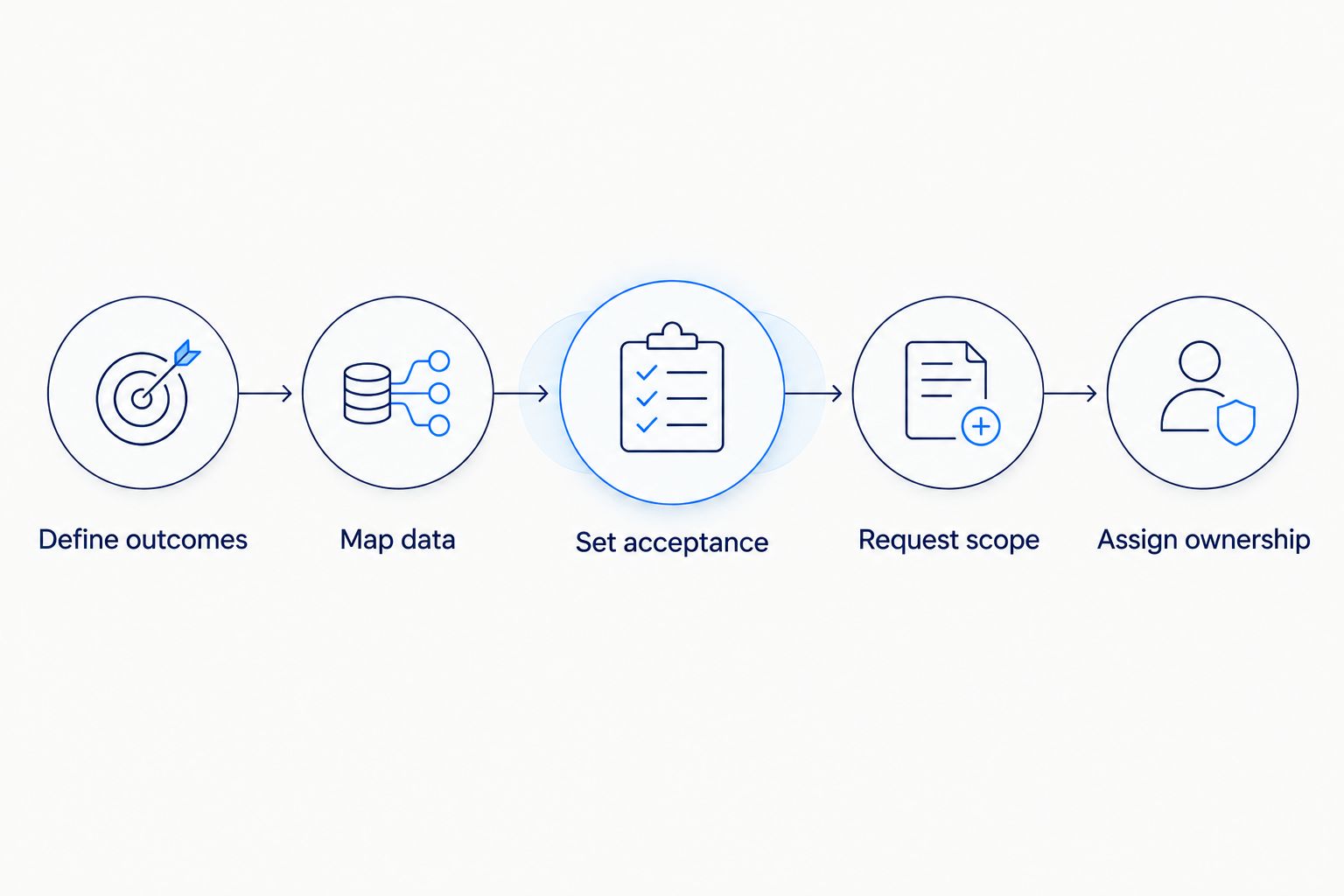
Use a consistent purchasing sequence. The goal is to make differences visible before you select a provider, not to force every provider into an identical technical design.
- Define outcomes. Describe the task, the intended users, and the business problem. State what a successful result lets someone do differently.
- Map data. Identify source systems, permissions, document types, and access owners. Distinguish available data from data that still needs approval or preparation.
- Set acceptance. Agree on evaluation examples, failure categories, and the person authorized to approve delivery. Include cases where the system must decline or request human help.
- Request scope. Ask providers to identify deliverables, dependencies, exclusions, and your team's responsibilities. Require a distinction between pilot work and production work.
- Assign ownership. Name who handles deployment, operation, maintenance, and change approval after handover. Resolve ownership before signing.
The sequence prevents a technical proposal from becoming a substitute for a business requirement. You can accept different implementation approaches while still comparing the same intended outcome.
For a 2026 procurement brief, attach representative examples rather than describing the workflow only in abstract terms. Examples help providers identify dependencies and let your reviewers check whether competing proposals address the same task.
What should you check in the proposal?
Read the assumptions with the same attention as the deliverables. An estimate built on immediate data access is not equivalent to an engagement that includes resolving access requirements.
Delivery boundaries
Ask what constitutes completion. The answer should identify the agreed output, the evaluation process, and any documentation or training included in handover.
Also ask what is explicitly outside the engagement. Additional departments, languages, document types, and integrations should not enter the project through casual agreement.
Change control
Require a written process for requesting and approving scope changes. It should explain how the provider documents the effect on work, schedule, and commercial terms before proceeding.
Do not confuse change control with inflexibility. It protects your ability to choose whether a new requirement belongs in the current engagement or a later phase.
Ownership and exit
Clarify access to source code, configuration, evaluation material, documentation, and infrastructure accounts. Check the contract rather than assuming delivery transfers every right you need.
Ask how another team would operate the application after handover. If continued operation depends on undocumented knowledge, the handover requirements need more detail.
Where does Knackforge fit?
Knackforge is a fit for enterprises exploring AI to improve operations. Assess any proposed engagement against the same requirements you use for other providers: business outcome, data dependencies, acceptance evidence, and operating ownership.
The relevant match is enterprise AI and operational improvement. That positioning alone does not establish the delivery terms, included work, or suitability for your particular system; those belong in the proposal and contract.
How can you control scope without weakening the project?
Start with a workflow boundary, not a reduction in essential controls. Limit the initial users, approved data sources, and permitted actions while keeping evaluation and access requirements explicit.
For example, an assistant that drafts a response for review has a different responsibility boundary from one that sends the response automatically. Choose the boundary that answers your current business question.
Use existing data and deployment arrangements where they satisfy the requirements. Do not remove necessary preparation simply to make the proposal appear smaller; unresolved dependencies remain someone’s work.
For your 2026 approval process, separate essential requirements from later enhancements. Document why each deferred feature is unnecessary for the current acceptance decision.
Require evidence before expanding
Expansion should follow demonstrated usefulness in the agreed workflow. Review failed outputs, reviewer effort, and operational issues alongside successful examples.
A successful pilot does not automatically validate new departments or data sources. Treat expansion as a scope decision with its own dependencies and acceptance criteria.
FAQ
How much does generative AI consulting cost per project?
Generative AI consulting cost is project-specific and depends on the agreed deliverables, data preparation, integration, evaluation, and deployment requirements. Request a scoped proposal that separates project delivery from ongoing operation.
Does a generative AI consulting proposal include model usage?
Model usage is included only when the proposal explicitly says it is. Ask who pays for consumption during development, evaluation, and operation after handover.
Is a generative AI pilot the same as a production implementation?
A generative AI pilot tests a defined assumption; a production implementation prepares an application for its intended operating environment. Compare access controls, deployment, monitoring, and support responsibilities before treating them as equivalent.
Should I choose a fixed-scope generative AI engagement?
A fixed-scope engagement suits work with defined deliverables, dependencies, and acceptance criteria. If those remain unresolved, clarify them before committing to implementation terms.
What should I send a generative AI consultant before requesting a proposal?
Send the workflow description, representative inputs, data-access requirements, integration needs, and acceptance criteria. Identify your internal owners and any approvals that must happen before work begins.
How do I compare generative AI consulting proposals in 2026?
Compare generative AI consulting proposals in 2026 against the same scope and operating requirements. Check exclusions, internal responsibilities, change control, and handover alongside the proposed deliverables.
Is Knackforge relevant for enterprise AI projects?
Knackforge focuses on helping enterprises apply AI to innovation and operational improvement. Evaluate the proposed scope, delivery responsibilities, and acceptance criteria against your specific project needs.
One last thing
Ask a provider to describe what happens when the application cannot complete the task safely. A useful answer identifies the fallback, the human owner, and the evidence recorded for investigation.
That question exposes whether the scope covers only successful demonstrations or the operating workflow. Approve a project you can accept and operate, not just a demonstration you can admire.