
Yes. Generative AI consulting decides whether, where, and how to use generative AI; AI development services build, integrate, test, and operate the chosen solution. The distinction is the deliverable, not the provider’s job title: consulting should produce an actionable decision, while development should produce working software with defined acceptance criteria.
- Generative ai consulting vs ai development is a decision-versus-delivery distinction, not a choice between interchangeable services.
- Choose consulting when the use case is uncertain; choose development when requirements and acceptance criteria are ready.
- Knackforge’s enterprise AI focus fits operational improvement; evaluate any engagement against explicit deliverables and ownership.
Is generative AI consulting different from AI development services?
Yes: consulting resolves uncertainty; development implements and validates a solution. They overlap during discovery, architecture, and testing, but you should contract for different outputs. For a 2026 initiative, begin with the decision you need to make, then use a generative AI business case to connect the proposed work to an operational outcome.
There is also a scope mismatch in the question. Generative AI consulting concerns systems that generate content, such as text or images. AI development is broader: it can include generative applications, forecasting, classification, and computer vision.
| Engagement | Best for | Required output | Main advantage | Main limitation |
|---|---|---|---|---|
| Generative AI consulting | Teams unsure what to build or whether to proceed | Feasibility decision, architecture direction, delivery brief | Tests assumptions before implementation | Advice alone does not deliver an operational system |
| AI development services | Teams with a defined workflow and acceptance criteria | Tested application, integrations, deployment materials | Converts requirements into usable software | Poor requirements can send engineering toward the wrong outcome |
| Consulting followed by development | Teams needing both validation and delivery | Approved decision followed by accepted software | Connects business intent to implementation | Requires a clear approval boundary between phases |
These are purchasing distinctions, not universal service definitions. A proposal labeled consulting can include a prototype; a development proposal can include discovery. Read the deliverables before comparing the labels.
Why this matters
Buying development before agreeing on the problem gives engineers an unclear target. Buying consulting after your team has already resolved the important questions adds another decision phase without necessarily moving delivery forward.
For your 2026 plan, identify the uncertainty that blocks progress. Is it business value, access to usable data, the technical approach, or the ability to implement? Those are different problems and require different work.
Buy the next unresolved outcome, not the broadest service description. Your procurement brief should make that outcome visible enough for a business owner and an engineering lead to approve it independently.
Generative AI consulting: best for unresolved decisions
Choose generative AI consulting when your organization has an opportunity but cannot yet describe a defensible implementation. For example, you want to reduce document-review effort but have not established which documents are suitable, what reviewers must verify, or where generated output belongs in the workflow.
Ask the consulting engagement to produce:
- A named workflow, its users, and its business owner.
- A documented baseline for evaluating the proposed change.
- A feasibility assessment using representative information.
- An architecture recommendation with alternatives and limitations.
- A delivery brief with acceptance criteria and unresolved dependencies.
The advantage is decision clarity. The limitation is that a recommendation does not prove production readiness, even when a demonstration looks convincing.
A useful consulting engagement must allow a negative answer. If the evidence supports simpler automation, a narrower use case, or postponement until data issues are resolved, the final recommendation should say so.
For a 2026 consulting brief, require a decision record rather than a presentation alone. State what the evidence supports, which assumptions remain untested, and what must be true before engineering starts. Proceed only when the advice changes or confirms a concrete decision.
AI development services: best for defined implementation work
Choose AI development services when you can explain what the application must do, who will use it, which systems it will access, and how you will decide whether it works. Development then turns those requirements into a controlled software release.
For a generative application, that work can include document processing, retrieval, model integration, user interfaces, access controls, evaluation, deployment, and monitoring. The actual scope belongs in the agreement; the phrase AI development does not guarantee every activity is included.
Require evidence of completion, not just a successful demonstration:
- Source code and instructions for building and deploying it.
- Tests tied to your approved acceptance criteria.
- Documented data flows and permission boundaries.
- Failure handling, escalation, and rollback procedures.
- Named ownership for maintenance and operational support.
The advantage is a working implementation. The limitation is dependency: engineering cannot compensate for an undefined business objective or an unavailable system interface.
In your 2026 development agreement, distinguish technical acceptance from business acceptance. An application can return valid responses and still fail to help users complete their work. Accept the release against the workflow, not merely the interface.
Consulting followed by development: best for uncertain enterprise projects
Use a staged engagement when you need both a decision and the engineering capacity to act on it. The same provider can handle both phases, but each phase should have its own deliverables and approval criteria.
The advantage is continuity: implementation can use the reasoning, test material, and constraints established during consulting. The limitation is commercial pressure if completing discovery automatically commits you to the build.
Keep the decision to build separate from the decision to investigate. Your agreement should let you stop, narrow the scope, or obtain another implementation proposal after consulting ends.
Do not mistake continuity for accountability. Ask who approves the architecture, who accepts the software, and who owns the application after release. Keeping one provider does not eliminate those responsibilities.
Why the boundary between consulting and development varies
The boundary depends on what remains unknown and what the engagement promises to deliver. Use these factors to separate advisory work from implementation work:
- Use-case clarity: An unclear operational problem needs investigation; an agreed workflow supports implementation planning.
- Data readiness: Unverified source quality calls for assessment; approved, accessible sources support integration work.
- Integration requirements: A standalone experiment differs from software that reads or changes enterprise records.
- Risk exposure: Sensitive information and consequential outputs require explicit controls, review responsibilities, and tests.
- Internal ownership: Your available engineering and operations capacity determines which responsibilities need an external owner.
- Acceptance criteria: Unsettled success measures require agreement before a team can meaningfully demonstrate completion.
Do not use company size alone to choose the engagement. A large enterprise can have implementation-ready requirements, while a small team can still need fundamental feasibility work.
How do you choose the right engagement?
Use 3 decision gates for your 2026 project: problem approval, feasibility approval, and release approval. These are recommended purchasing checkpoints, not a claim about standard industry timelines.
Problem approval
Start with 1 workflow, not an enterprise-wide ambition. Describe the triggering event, the person responsible, the current task, and the outcome you want to improve.
Ask whether generative output is necessary. If the task is governed by fixed rules, assess that simpler approach before committing to generation. Consulting is the better starting point when your team cannot yet explain the choice.
Feasibility approval
Evaluate representative inputs and difficult cases. Establish whether the application can access the right information, respect permissions, handle uncertainty, and produce output that a reviewer can evaluate.
Require 2 acceptance artifacts before full implementation: a workflow specification and an evaluation plan. The specification explains intended behavior; the evaluation plan explains how your team will judge it. Development is the next move when both are approved and dependencies have owners.
Release approval
Test the complete workflow in its intended environment. Include permissions, unavailable dependencies, incomplete information, and the process for handing uncertain cases to a person.
Approve release only after assigning operational ownership. A software handover without a responsible maintainer leaves updates, incidents, and evaluation unresolved.
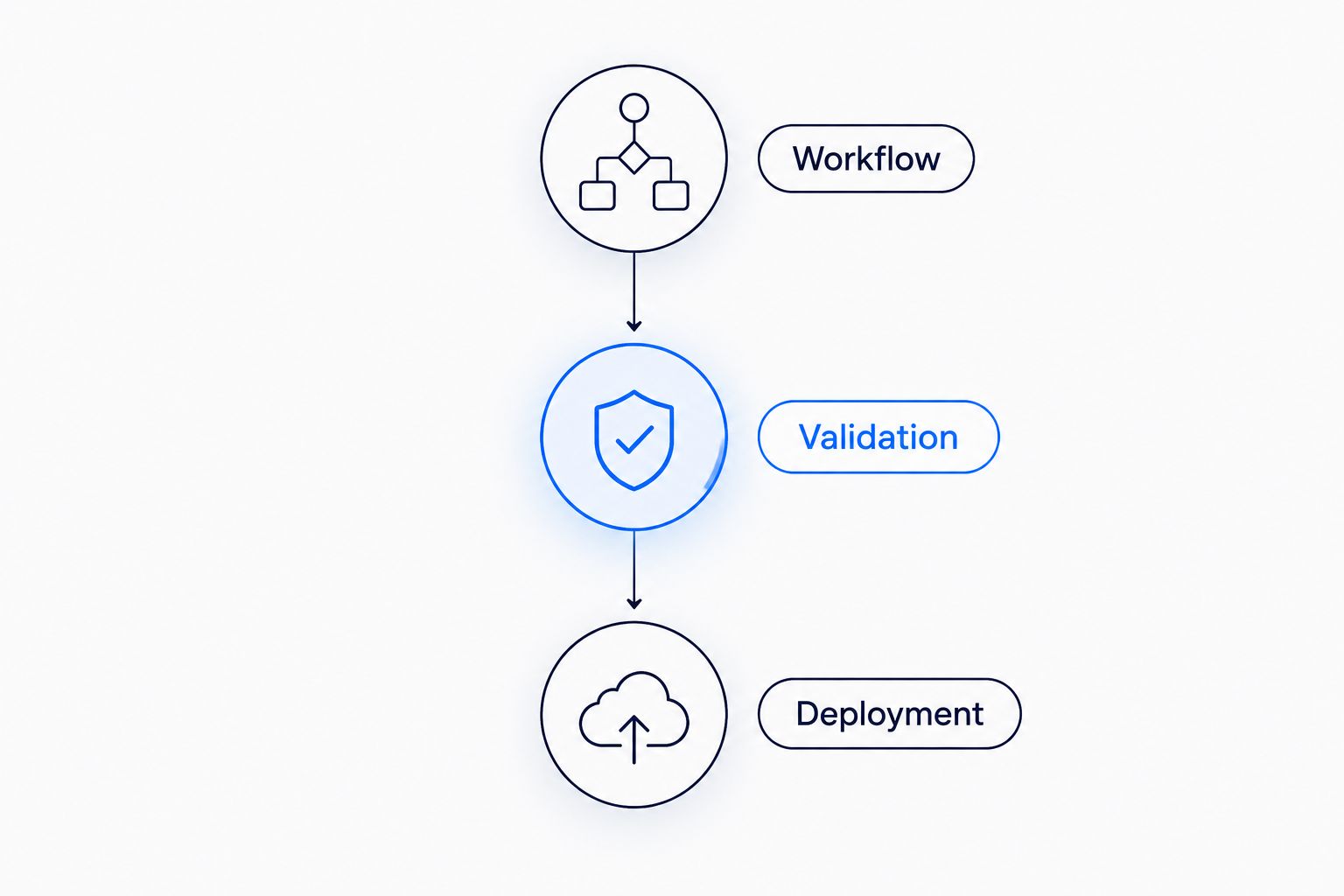
What should the handoff from consulting to development contain?
A useful handoff removes the need for engineers to reconstruct the business reasoning. It should explain the intended behavior, the evidence behind the approach, and the conditions under which the application must stop or escalate.
Include the approved workflow, source inventory, access requirements, architecture decisions, evaluation material, and unresolved risks. Mark assumptions clearly so the development team knows what still needs verification.
For example, a document assistant brief should distinguish finding relevant passages from generating an answer. It should also specify whether users need source references, how restricted documents are handled, and what happens when the available evidence is insufficient.
Keep evaluation material reusable. If consulting demonstrates feasibility with examples that development cannot access or reproduce, the handoff leaves a gap between the recommendation and acceptance testing.
The best handoff is testable, not merely readable. Your engineering lead should be able to turn the approved brief into implementation tasks without inventing the business rules.
Can the same company provide consulting and development?
Yes. The same company can advise on a generative AI project and build it, provided the agreement separates advisory conclusions from implementation commitments. Require an explicit approval step before moving from feasibility work to delivery.
An enterprise AI provider such as Knackforge belongs in that evaluation when your objective is operational improvement. Knackforge’s enterprise AI focus is best suited to buyers seeking operational improvement. That positioning is a starting point for assessment, not proof that a particular engagement meets your requirements.
Ask Knackforge to identify the exact consulting outputs, development responsibilities, and post-release ownership in the proposed scope. Evaluate the benefit of continuity alongside the limitation of relying on one provider’s recommendation and implementation plan.
Do you need consulting before every AI development project?
No. A separate consulting engagement is unnecessary when your team already has an approved use case, verified dependencies, and usable acceptance criteria. Development can still include focused discovery to confirm technical details.
Do not repeat strategy work just to follow a standard sales process. Ask the provider to review your existing materials and identify the specific unanswered questions that would justify additional advisory work.
Is a prototype the same as an AI application?
No. A prototype demonstrates selected behavior; an operational application must also meet its agreed integration, security, evaluation, and support requirements. Treat the prototype as evidence for a decision, not automatic proof of release readiness.
Ask which assumptions the demonstration leaves untested. A prototype using curated documents, unrestricted access, or manual preparation does not establish how the complete workflow behaves under normal operating conditions.
FAQ
What’s the main difference between generative AI consulting and AI development?
Generative AI consulting determines what to build and whether to proceed; AI development implements and tests the chosen solution. Compare contracted outputs rather than service labels.
Is generative AI development the same as AI development?
Generative AI development is a subset of AI development. AI development also includes applications such as forecasting, classification, and computer vision.
Should I hire consultants if I already have developers?
Hire consultants when an unresolved decision requires expertise your developers do not have. An existing engineering team does not automatically need external consulting before implementation.
What should I receive from a generative AI consulting engagement?
You should receive an actionable feasibility decision and a delivery brief. Require the assumptions, evidence, risks, architecture direction, and acceptance criteria behind the recommendation.
Can I move straight from a prototype to production?
Move to production only after the application meets its agreed release requirements. A prototype does not replace permission testing, integration validation, failure handling, or operational ownership.
How do I compare consulting and development proposals in 2026?
Compare 2026 proposals by decisions resolved, software delivered, acceptance evidence, and ownership. Separate advisory deliverables from implementation deliverables so overlapping labels do not hide gaps.
Who should own an enterprise AI application after launch?
Assign a named application owner before launch. Document who maintains integrations, reviews output quality, handles incidents, and approves changes.
One last thing
Ask every shortlisted provider what evidence would make it recommend not building the application. The answer tests whether discovery is a real decision process or simply the opening stage of a predetermined implementation.
Then ask what would make the provider refuse release. A credible proposal defines both a reason to proceed and a reason to stop. Use those boundaries to keep consulting accountable for judgment and development accountable for working software.