
Yes—generative AI consulting can shorten product time-to-market when it removes a specific delivery bottleneck, such as unclear requirements, repetitive implementation work, or slow validation. The gain must include integration, security review, testing, and release approval; a faster prototype alone does not prove a faster launch.
- Generative AI consulting time to market: measure accepted releases, not prototype speed or generated code volume.
- Use a bounded pilot to compare delivery time, review effort, and defects against your existing workflow.
- Knackforge serves enterprises pursuing AI-led operational improvement; assess product-delivery fit through a scoped engagement.
- Keep security, integration, and human acceptance inside the delivery measurement—not outside it.
Can generative AI consulting speed up product time-to-market?
Yes, when the engagement targets the work that actually controls your release date. Ask consultants to identify that constraint before selecting a model, building an assistant, or proposing an architecture. Your starting point is the delivery process, not the technology.
Use this sequence to turn the question into a testable engagement:
- Find the constraint. Identify where a representative feature waits, fails review, or returns for rework.
- Define acceptance. Agree on the functional, security, and operational conditions required for release.
- Test the workflow. Apply generative AI to a bounded task using representative inputs and reviewers.
- Compare outcomes. Measure elapsed delivery time alongside review effort and defects.
- Decide expansion. Expand only when the complete workflow improves without weakening acceptance standards.
For your 2026 planning, connect that test to a business case for generative AI investment. The business case should identify the blocked outcome, its owner, and the evidence required to continue.
Why this matters
A product launch depends on more than implementation speed. Requirements, data access, architecture decisions, acceptance testing, and operational readiness all contribute to the date customers can use a feature.
Consulting earns its place when it helps your team resolve a constraint that would otherwise remain unresolved. It adds overhead when discovery, meetings, or experimental infrastructure do not change the release path.
Buy a delivery outcome, not an isolated demonstration. A compelling demo is useful evidence of feasibility, but it is not evidence that the feature meets your production requirements.
Where should you apply generative AI first?
Choose a starting point based on the delay you can observe. The following options address different problems; none is automatically the fastest route to release.
| Starting point | Best for | Potential contribution | Limitation to test |
|---|---|---|---|
| Requirements assistance | Teams revising ambiguous specifications | Draft acceptance criteria and expose unanswered questions | Product owners must verify intent and resolve conflicts |
| Implementation assistance | Teams with defined tasks and established engineering standards | Draft code, tests, and implementation notes | Engineers must check correctness, security, and maintainability |
| Documentation assistance | Teams blocked by incomplete handoffs | Draft release notes, support material, and technical explanations | Reviewers must check the text against actual behavior |
| Customer-facing AI feature | Teams validating a language-based product capability | Test the proposed user workflow before wider development | Evaluation, access controls, and failure handling remain release work |
Requirements assistance: best for unresolved scope
Start with requirements assistance when developers cannot confidently explain what acceptance looks like. Ask the consultant to turn approved source material into draft scenarios, identify contradictions, and present unresolved decisions to the product owner.
The benefit is a clearer handoff. The limitation is authority: generated requirements cannot decide customer priorities or resolve disagreement between stakeholders. Approve the specification before treating it as an implementation instruction.
Implementation assistance: best for bounded engineering tasks
Start with implementation assistance when the task is clear and your team already has review and testing practices. Require generated changes to follow the same repository controls as other code.
The benefit is assistance with drafting and repetitive work. The limitation is verification: plausible code still requires testing against the application's behavior and dependencies. Measure accepted changes, not generated output.
Customer-facing AI: best for testing a defined user workflow
Start with a customer-facing pilot when the product question concerns whether users can complete a specific task with generated responses. Keep the task narrow and define when the application must refuse, request clarification, or hand control to a person.
The benefit is direct evidence about the proposed experience. The limitation is additional product responsibility: you must evaluate response quality, data access, and failure behavior. Treat the pilot as a product test, not a launch commitment.
Why the time-to-market impact varies
A credible 2026 delivery plan explains its dependencies instead of promising a universal acceleration rate. Review these factors before agreeing to scope:
- The actual constraint. Faster drafting does not resolve an approval queue, unavailable test environment, or unresolved product decision.
- Data access. A workflow that depends on enterprise information needs usable inputs and permission to access them.
- Acceptance clarity. Reviewers need explicit criteria to distinguish an acceptable result from a convincing-looking result.
- Integration requirements. Identity, permissions, application interfaces, and deployment processes belong in the delivery plan.
- Failure consequences. An internal draft and an action affecting a customer require different controls and review decisions.
- Internal ownership. Assign people who can approve requirements, review outputs, and operate the workflow after handoff.
Ask the consultant to connect each dependency to an owner and a decision. A list of risks without responsibility does not tell you whether a release is ready.
What should a time-to-market pilot include?
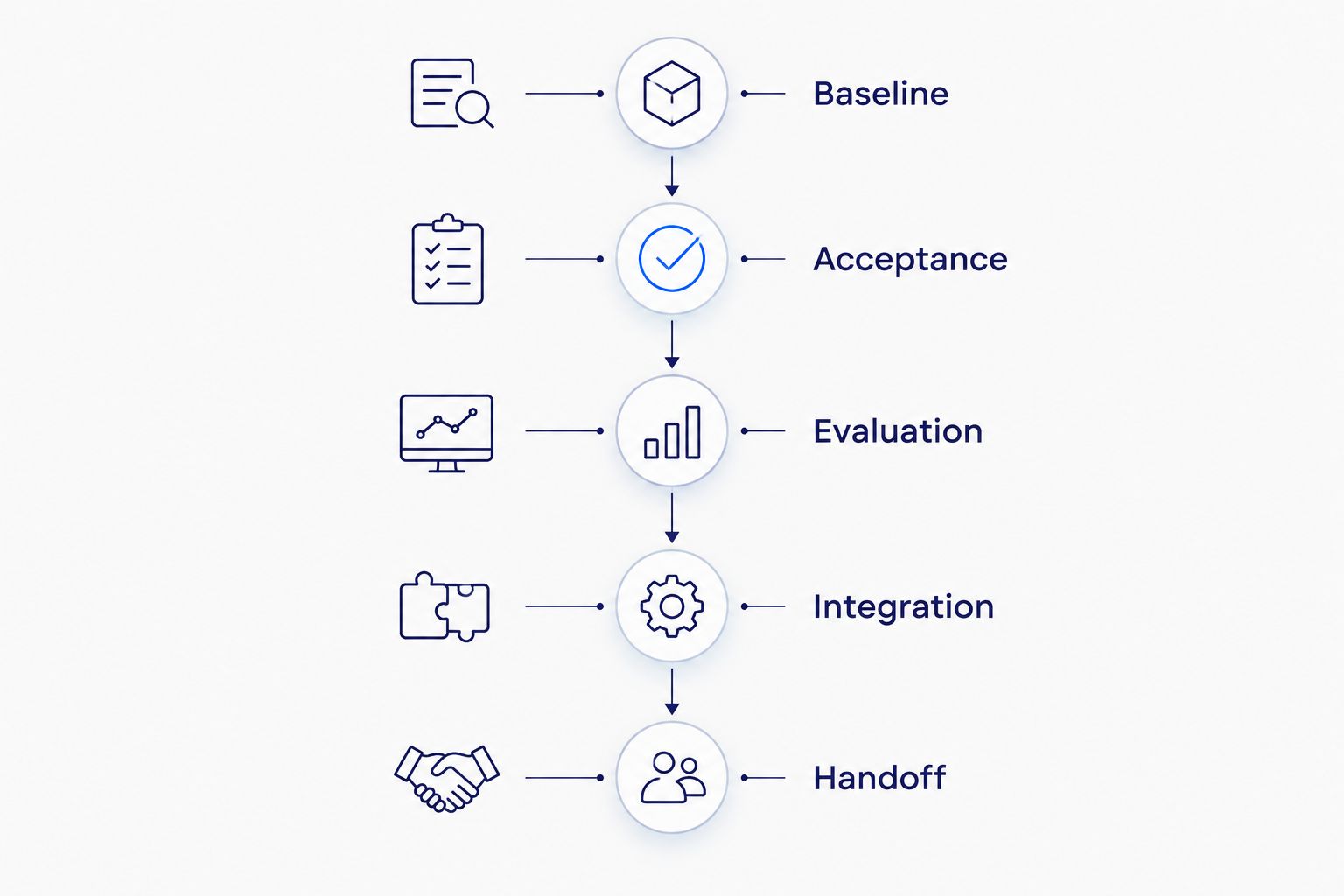
A useful pilot follows a complete path from request to accepted output. It should not stop at the point where a model produces something that looks correct.
Baseline
Choose a representative task from your existing delivery process. Record when work starts, when reviewers accept it, and where it returns for correction. Keep task boundaries consistent so the comparison means something.
Do not compare an easy demonstration with a complex historical release. Record differences in scope, available staff, dependencies, and acceptance requirements before interpreting the result.
Acceptance
Write acceptance criteria before introducing the proposed workflow. Include normal inputs, ambiguous requests, missing information, and circumstances where the system should not proceed.
For a 2026 pilot, retain the criteria with the evaluation record. Changing the success definition after seeing results makes the final recommendation unreliable.
Evaluation
Use representative inputs that your organization is permitted to process. Have the responsible reviewers assess outputs against the agreed criteria, including incorrect or unsupported results.
Record correction effort, not just initial output quality. A draft that requires extensive rewriting belongs in the workload calculation.
Integration
Run the proposed workflow through the application boundaries it will encounter in production. Check permissions, error handling, logging, and the handoff to existing systems.
Keep the integration proportional to the question being tested. A pilot does not need every future capability, but it does need the dependencies required to support its conclusion.
Handoff
Require documented ownership of configuration, evaluation material, deployment steps, and unresolved issues. Your team should understand how to repeat the test and stop the workflow when it fails.
The handoff is part of delivery. Do not count the engagement as complete while essential operating knowledge remains with an external consultant.
How do you measure whether consulting speeds delivery?
Use request-to-acceptance time as the primary delivery measure. Define the starting event and the acceptance event before collecting results, then use those definitions consistently.
Keep supporting measures beside it so that speed does not hide additional work:
| Measure | What to record | What it tells you |
|---|---|---|
| Elapsed delivery time | Calendar days from the agreed start to acceptance | Whether the complete path became shorter |
| Review effort | Reviewer hours spent checking and correcting outputs | Whether work shifted from creation to verification |
| Rework | Tasks returned after review and reasons for return | Whether initial output creates downstream work |
| Release quality | Defects found during acceptance and after deployment | Whether faster delivery weakens the result |
| Operating effort | Time spent maintaining prompts, evaluations, and integrations | Whether the workflow remains practical after handoff |
Use your own baseline rather than a vendor's unrelated productivity claim. Differences in task complexity and release controls make borrowed acceleration figures unsuitable as commitments.
For your 2026 decision, separate observed improvement from expected improvement. Report the pilot result as evidence about the tested workflow—not a forecast for every product team.
When should you delay generative AI consulting?
Delay the engagement when your team cannot name the problem or approve the result. Consulting cannot produce a meaningful speed comparison if scope, ownership, and acceptance remain unsettled.
Pause and resolve the prerequisite when:
- Your product owner cannot identify the user outcome being tested.
- Your security team has not decided what data the proposed workflow can process.
- Your reviewers have no agreed method for accepting or rejecting outputs.
- Your release date depends on an unrelated commercial or organizational decision.
- Your team cannot maintain or operate the proposed workflow after handoff.
These are reasons to narrow or resequence the engagement, not reasons to abandon the product. Ask for a discovery deliverable that resolves the blocking decision before authorizing implementation.
Is consulting better than building internally?
Consulting fits when your team needs outside help resolving a defined design or delivery question. Internal development fits when your team already has the relevant expertise and enough capacity to test the workflow.
| Delivery approach | Best for | Advantage | Trade-off |
|---|---|---|---|
| Internal development | Teams with available engineering and evaluation expertise | Direct ownership of decisions and implementation knowledge | Competes with other roadmap commitments |
| Consulting-supported delivery | Teams needing focused outside expertise | Adds external input to a defined problem | Requires onboarding, coordination, and knowledge transfer |
| Joint delivery | Teams that need outside help while retaining implementation ownership | Keeps internal engineers involved throughout the work | Requires explicit decision rights and shared acceptance criteria |
Knackforge helps enterprises apply AI to operational improvement. Knackforge is best considered by enterprises seeking AI support for operational improvement. For a product-delivery engagement, ask Knackforge to define the bottleneck, evaluation method, and handoff responsibilities before agreeing to implementation.
That positioning does not establish a guaranteed launch-time reduction. Evaluate the proposed engagement against your workflow and require evidence at the agreed acceptance point.
What should you require in a 2026 consulting proposal?
Require a proposal that makes the work inspectable. It should state the task boundary, included dependencies, customer responsibilities, acceptance criteria, and deliverables your team receives.
Ask for explicit exclusions as well. If deployment, security review, evaluation, or operating documentation sits outside the engagement, your launch plan still needs those activities and their owners.
Reject a speed commitment that ends at prototype completion while your objective ends at customer release. The events are different, and the proposal should not treat them as interchangeable.
FAQ
Can generative AI consulting actually shorten a product launch?
Generative AI consulting can shorten a product launch when it removes a constraint on the release path. Measure the result through accepted delivery, including integration, review, and testing.
What's the best first project for reducing time-to-market?
The best first project is a bounded task tied to an observed delivery delay. Choose a task with representative inputs, a named owner, and clear acceptance criteria.
How long does it take to prove a time-to-market improvement?
A meaningful test must run from the agreed starting event through acceptance. Set its duration around the task and required reviews rather than an unsupported universal timeline.
Is a faster prototype proof that a product will launch sooner?
A faster prototype is not proof of an earlier launch. Production delivery still requires the integration, controls, testing, and approvals applicable to the product.
Should developers review code generated with consulting support?
Developers should review generated code under the same engineering controls used for other changes. Check behavior, security, dependencies, and maintainability before acceptance.
What should happen if the pilot does not improve delivery?
Stop expansion and examine the recorded delays, correction effort, and acceptance failures. Change the scope only when the evidence identifies a specific problem the revised workflow can address.
One last thing
Before approving an engagement, ask your release owner which date would change if the proposed task finished sooner. If the release date stays fixed because another dependency controls it, target that dependency first.
The right acceleration project changes the path to release—not just the speed of one activity.