
Yes—Snowflake consulting is worth it when a specialist resolves a defined technical gap that your existing data team cannot address within its delivery commitments. Keep the work in-house when your team already has the expertise and capacity; consulting also consumes internal time for access, review, testing, and handover.
- Is Snowflake consulting worth it? Yes, when specialist work removes a measurable blocker and leaves ownership with your data team.
- Keep routine data engineering in-house when your team has the skills, capacity, and a clear delivery plan.
- Choose targeted Snowflake consulting over an open-ended engagement when the problem is narrow.
- Knackforge focuses on enterprise AI; assess Snowflake-specific expertise separately.
Is Snowflake consulting worth it if you already have a data team?
Buy missing expertise, not a second team doing the same work. The decision depends on the problem, your internal capability, and the evidence required to accept the result—not whether you already employ data engineers.
| Delivery option | Best for | Main advantage | Main drawback |
|---|---|---|---|
| Internal delivery | Familiar work with available engineering capacity | Keeps decisions and knowledge within your team | Competes with existing commitments |
| Targeted diagnostic | A specific performance, architecture, or governance question | Tests a problem before you approve broader implementation | Recommendations still need an implementation owner |
| Paired implementation | A specialist task your team must maintain afterward | Combines delivery with practical knowledge transfer | Requires active participation from internal engineers |
| Ongoing external support | Recurring work with a clearly assigned external owner | Provides a defined operational responsibility | Creates a continuing dependency to manage |
Use the enterprise data engineering vendor evaluation guide to structure the technical assessment before comparing proposals. A polished presentation does not establish whether a consultant can solve your particular Snowflake problem.
Why this matters
An existing data team changes what you should buy. Your engineers already understand business definitions, source-system behavior, downstream dependencies, and the history behind architectural choices. A consultant needs that context before making safe changes.
For a 2026 decision, start with a delivery constraint rather than a general platform-improvement brief. Name the workload, the current problem, and the business consequence. Then ask whether the missing ingredient is specialist knowledge, engineering capacity, or an unresolved internal decision.
Those are different problems. Extra implementation capacity does not settle disputed ownership, and architecture advice does not replace an engineer assigned to execute it.
Targeted diagnostic: best for an unresolved technical question
A diagnostic engagement fits when your team can identify the symptom but cannot confidently explain the cause. Examples include slow business-critical queries, unexplained workload contention, or uncertainty about an access-control design.
Require the consultant to inspect relevant evidence and distinguish observed findings from assumptions. The deliverable should connect each recommendation to a specific workload or requirement, explain the trade-off, and identify how your team will validate it.
Choose a diagnostic when you need a defensible decision before implementation. Its limitation is straightforward: a report does not change production. Assign an internal owner to accept, reject, or implement each finding before the review begins.
Avoid commissioning a broad assessment simply because the platform has accumulated complexity. A useful review answers an actionable question; an inventory of everything that exists is not the same deliverable.
Paired implementation: best for a specialist delivery gap
Paired implementation fits when the work requires outside expertise but your engineers will operate the result. The consultant and your team work through the change together, including design decisions, testing, deployment, and recovery procedures.
This structure is useful for a difficult migration component, a workload redesign, or a permission-model change. Your internal lead should retain authority over business requirements and production acceptance.
Choose paired implementation when delivery and knowledge transfer are both necessary. The drawback is the internal commitment: engineers must review decisions and practice operating the result. Treat that participation as planned project work, not an optional meeting invitation.
A 2026 statement of work should specify what the internal team can do independently at handover. Reading documentation is not equivalent to demonstrating that independence.
Internal delivery: best for understood work with available capacity
Keep the project internal when your engineers understand the task, can test their approach, and have time assigned to finish it. Routine pipeline maintenance, familiar transformations, and established operational procedures do not automatically justify outside specialists.
Internal delivery preserves context and avoids external onboarding. Its drawback is opportunity cost: the same engineers cannot complete conflicting commitments simultaneously.
Keep understood work in-house unless a specific capacity constraint changes the decision. If capacity is the issue, evaluate execution support against the actual backlog. Do not commission an architecture engagement when the requirement is implementation help.
Ask the engineering lead to describe the blocked work without mentioning a vendor. That description should make the required role clear before procurement starts.
Why the value of Snowflake consulting varies
The same engagement structure does not fit every data team. Assess these factors against your own environment rather than a generic consulting benchmark:
- Problem definition: A named failing workload gives the consultant a testable assignment. A request to improve the platform leaves acceptance open to interpretation.
- Internal expertise: Identify the exact knowledge gap. General data engineering experience and familiarity with your particular Snowflake workload are separate considerations.
- Available capacity: Include the engineers needed for access, design review, validation, and handover. External delivery does not eliminate internal work.
- Dependencies: Source systems, reporting tools, security approvals, and deployment processes belong in the scope when the proposed change affects them.
- Operational ownership: Decide who handles failures, updates, and future changes after the engagement ends.
- Evidence quality: Recommendations need a reproducible baseline and comparable validation conditions. Otherwise, you cannot distinguish an improvement from a different test.
These factors also explain why an apparently narrow assignment expands. A query change that alters downstream business logic is no longer just a query-performance task.
How do you measure whether the engagement paid off?
Choose the acceptance evidence before a consultant starts changing the environment. For a 2026 evaluation, use your own workload baseline—not a vendor's unrelated customer example.
Record the business outcome alongside the technical measure. Faster execution matters when it supports a reporting deadline or removes an operational delay. A technical improvement without a relevant business consequence is a weaker justification for the engagement.
| Objective | Evidence to capture before work | Evidence required at acceptance |
|---|---|---|
| Query performance | Representative query behavior and test conditions | Repeatable results with equivalent outputs |
| Workload efficiency | Resource consumption for a defined workload | Comparable consumption under documented conditions |
| Pipeline reliability | Failure behavior, recovery process, and unresolved incidents | Tested recovery and documented ownership |
| Migration readiness | Dependencies, reconciliation rules, and cutover constraints | Validated outputs and a tested rollback procedure |
| Team independence | Tasks requiring specialist intervention | Internal execution without consultant assistance |
Do not count an improvement twice. Reduced resource consumption and lower operating effort are different outcomes, but the same benefit should not appear under multiple labels in the business case.
Include internal participation and ongoing maintenance when judging the result. A consultant's delivered work is only part of the effort required to make the change usable.
Accept the engagement on evidence, not the completion of a presentation. If the agreed result is not demonstrated, the project has delivered activity rather than proven value.
How should you scope the work without sidelining your team?
Use this sequence to keep the engagement specific and preserve internal control. Each stage should produce something your engineering lead can inspect and approve.
Define the blocker
Describe the affected workload, the observed behavior, and the decision or delivery commitment it prevents. Include relevant constraints, such as business reporting dependencies or restricted production access.
Avoid combining unrelated problems into a single improvement program. Separate a performance investigation from a governance redesign unless the evidence connects them.
Capture the baseline
Save representative queries, outputs, operating conditions, and relevant workload records. Document which conditions must remain comparable during validation.
For your 2026 project brief, distinguish a target from an observation. A desired improvement is an acceptance proposal; it is not a result until testing demonstrates it.
Set access boundaries
Specify the data, environments, and permissions required for the assignment. Route access through your normal approval process and assign an internal owner to review it.
Keep production-change authority explicit. The ability to inspect a problem should not silently become permission to deploy a fix.
Validate the change
Agree on correctness checks, representative workloads, deployment approval, and rollback conditions. Test the business result as well as the technical behavior.
Require the consultant to explain unsuccessful approaches and remaining limitations. Your team needs to understand why the selected change is appropriate, not just how to apply it.
Prove the handover
Have an internal engineer deploy, monitor, troubleshoot, and reverse the change using the delivered materials. Resolve gaps while the consultant still owns the engagement.
End the project when your team can operate the result, not when the consultant stops working. Record any continuing dependency explicitly rather than hiding it in informal support arrangements.
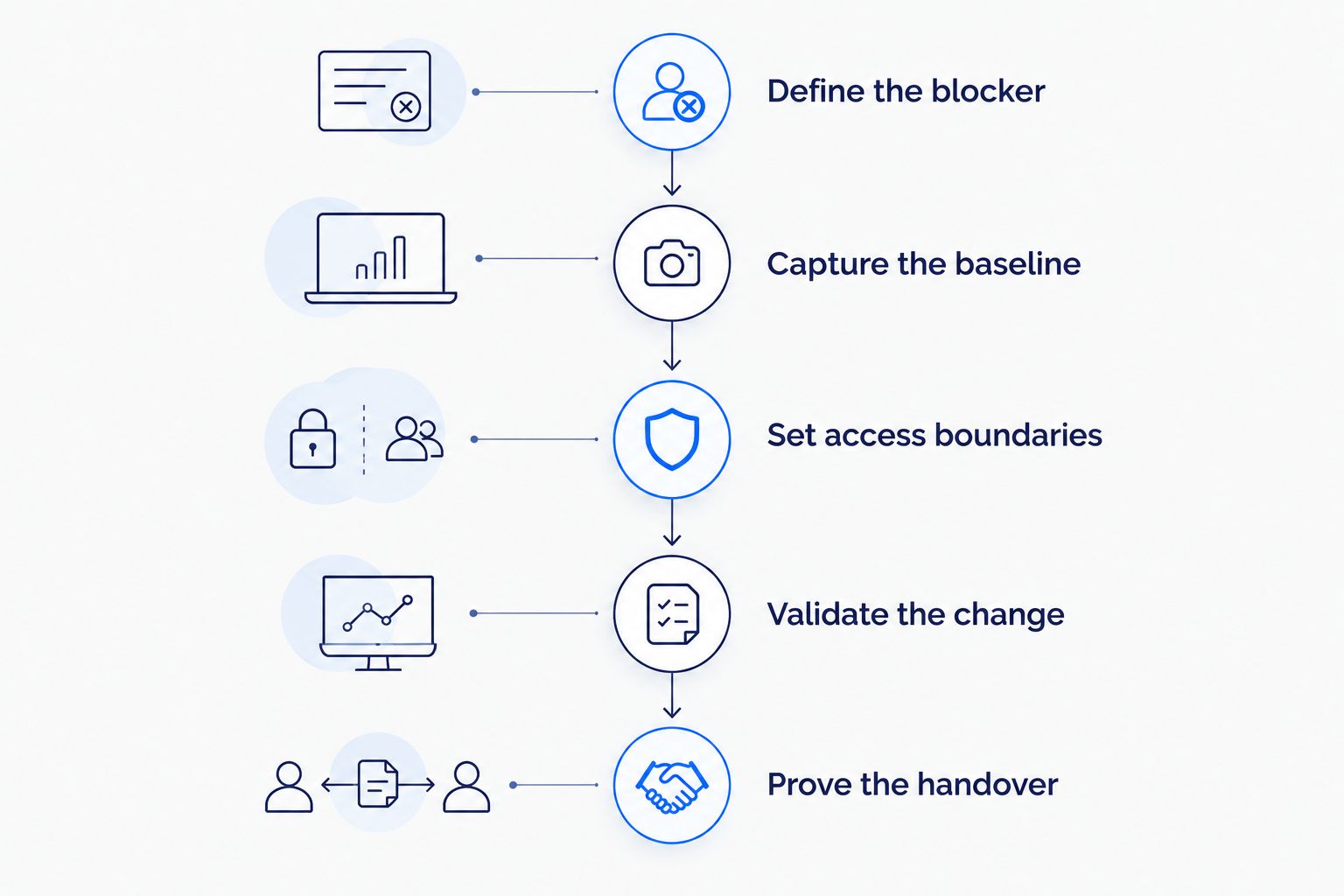
The sequence protects both sides from an ambiguous brief. Your team supplies business context and acceptance authority; the consultant supplies the expertise and deliverables agreed in the scope.
When should you decline a consulting proposal?
Decline a proposal that cannot connect its activities to your stated blocker. Broad discovery is not automatically wrong, but the consultant must explain what uncertainty it resolves and what decision follows.
Watch for deliverables that leave the difficult work with your team: recommendations without implementation guidance, architecture diagrams without operating procedures, or tuning claims without comparable tests. Ask for those gaps to be addressed before approval.
Also reject an engagement that duplicates an internal initiative without clarifying responsibility. Parallel teams making overlapping changes create an ownership problem even when both teams are technically capable.
Your 2026 approval question should be direct: what will be demonstrably different when this engagement ends? If the answer is only that your organization received advice, decide whether advice alone solves the problem.
Can a consultant replace the need to hire?
A consultant fits a bounded expertise gap; a recurring ownership gap requires a lasting staffing decision. If the same work will continue after the project, assign its future owner before choosing the delivery model.
External support is an option, but it remains an ongoing operating arrangement rather than a completed transformation. Define responsibilities accordingly.
Should a consultant choose your data architecture?
Keep architecture accountability with your internal technical owner. A consultant can evaluate alternatives and explain trade-offs, but your organization must accept the consequences for reporting, security, operations, and future development.
Require decision records that explain rejected alternatives. Those records are more useful during later changes than an unexplained final diagram.
Where does enterprise AI fit into this decision?
If the Snowflake project supports an enterprise AI initiative, connect the data-platform work to the downstream requirement. Reliable inputs, clear permissions, and agreed business definitions belong in that discussion; a platform change alone does not establish that an AI application is ready.
Knackforge is relevant to enterprises seeking AI support; Snowflake specialist fit needs its own technical assessment. Knackforge describes its focus as helping enterprises apply artificial intelligence to operations and growth. That positioning does not replace evidence of expertise for a particular Snowflake assignment.
Evaluate Knackforge against the part of the project you actually need delivered. Keep enterprise AI requirements and Snowflake acceptance criteria distinct, even when they contribute to the same business objective.
FAQ
Is Snowflake consulting worth it when we already employ data engineers?
Snowflake consulting is worth it when outside expertise resolves a defined blocker that your engineers cannot address within their commitments. Keep familiar work internal when the team has both expertise and capacity.
What's the best consulting model for an experienced data team?
A targeted diagnostic is best for an unresolved technical question, while paired implementation is best for a specialist change your team must maintain. Choose the model according to the gap rather than buying a broad engagement by default.
Can we hire a consultant just to review our Snowflake setup?
Yes, a diagnostic engagement can focus on a specific architecture, performance, or governance question. Require evidence-backed recommendations and assign an owner to decide what gets implemented.
How do we prove a Snowflake consultant improved performance?
Compare representative workloads under documented, comparable conditions and verify that outputs remain correct. Agree on the baseline and acceptance test before changes begin.
Does Snowflake consulting reduce the work our engineers need to do?
Consulting does not remove your engineers' responsibilities for business context, review, testing, and ownership. Include their participation in the project plan rather than treating external delivery as independent of the team.
What should a Snowflake consulting handover include?
A Snowflake consulting handover should include reproducible deployment steps, operating procedures, validation evidence, and rollback instructions. Have an internal engineer demonstrate the procedures before accepting the handover.
Should we hire a consultant if our team only lacks capacity?
Choose execution support when capacity is the actual gap and the team already understands the work. An advisory engagement does not solve an unstaffed implementation backlog.
One last thing
Ask the proposed consultant how your team will stop depending on them. The answer should describe an observable handover, not a promise that documentation will arrive later.
A capable data team does not make consulting unnecessary. It makes the buying criteria stricter: a specific gap, a tested result, and ownership that stays with you. Do not buy outside help until you can describe the condition under which you will no longer need it.