
Enterprise Snowflake consulting cost requires a scope-based quote in 2026: migration, implementation, optimization, and ongoing support involve different deliverables. The consulting fee alone does not establish your total budget; account separately for Snowflake consumption, supporting tools, internal delivery work, and any parallel operation during migration.
- Snowflake consulting cost needs a defined scope, not an unsupported enterprise average.
- Separate consulting fees from Snowflake consumption, integration tools, and internal delivery work.
- Compare proposals against identical deliverables, acceptance criteria, and support boundaries.
- Knackforge is relevant to enterprise AI planning; evaluate Snowflake delivery credentials separately.
How much does Snowflake consulting cost for enterprises?
Your useful budget is the amount attached to an agreed scope and measurable acceptance criteria—not a generic rate. Ask each bidder to separate professional services from platform consumption and identify the work your own team must complete.
Start with the buying process in how to evaluate a data engineering vendor for enterprise scale. Apply the same requirements to every proposal before comparing commercial terms.
For a 2026 procurement decision, require the following breakdown. These are budget categories to request, not standardized consulting packages.
| Budget category | What to request | What to keep separate |
|---|---|---|
| Assessment and architecture | Inventory, dependency analysis, target design, delivery plan | Implementation beyond the assessment |
| Migration or implementation | Pipelines, transformations, access controls, testing, deployment | Unlisted applications and source-system changes |
| Performance and consumption review | Workload analysis, configuration changes, validation | Guaranteed savings without an agreed baseline |
| Transition and support | Runbooks, training, incident ownership, support boundaries | Undefined ongoing operations |
| Platform and supporting tools | Consumption assumptions and required tools | Professional services fees |
A proposal becomes comparable when its deliverables, assumptions, exclusions, and customer responsibilities are explicit. Until then, a smaller headline estimate can simply describe less work.
Why this matters
An enterprise data project crosses boundaries that a consulting proposal must name: source systems, data ownership, security approval, reporting, and production operations. A statement of work that stops at loading data leaves you to determine whether downstream users can trust and use it.
For your 2026 budget, separate delivery completion from business acceptance. A deployed pipeline is a technical result; an accepted reporting workflow also needs reconciled data, approved access, and an accountable owner.
Compare the work required to reach an accepted outcome. Do not compare proposals solely by consultant seniority, staffing descriptions, or a promised completion date.
Assessment and architecture: best for unresolved scope
An assessment is the appropriate starting point when you cannot yet describe the source estate, dependencies, or target operating model. Request an inventory, a documented target design, a risk register, and an implementation backlog that another delivery team can understand.
The benefit is a clearer implementation decision before you authorize the build. The limitation is equally important: an architecture document does not migrate data, repair source records, or establish production support.
Define what makes the assessment usable. Require named assumptions, unresolved decisions, and the evidence behind any delivery estimate; otherwise, you have purchased a presentation rather than a buildable plan.
Migration and implementation: best for defined delivery outcomes
A migration engagement fits when your target scope and acceptance conditions are sufficiently clear. Specify which datasets, transformations, reports, interfaces, and operational processes must move or change.
The benefit is a delivery agreement tied to working outputs. The trade-off is dependency exposure: source access, business-rule decisions, and downstream changes must have owners outside the consulting team when those responsibilities remain internal.
Ask the bidder to explain reconciliation, cutover, rollback, and retirement of the old environment. Treat each as explicit work rather than assuming that a migration label includes it.
Optimization and support: best for an existing environment
An optimization engagement fits an operating Snowflake environment with a defined performance or consumption problem. Request a baseline, the changes to be assessed, and a validation method that preserves the workload's service requirements.
The benefit is a focused investigation instead of an unnecessary rebuild. The limitation is that configuration work cannot, by itself, resolve every issue in data modeling, application behavior, or business demand.
For support, specify incident intake, escalation, access, documentation, and the division between maintenance and new development. Do not assume that an optimization engagement includes ongoing operations after the agreed changes are complete.
Why Snowflake consulting cost varies
Use these scope drivers to challenge a proposal. Each should connect to identifiable work, an assumption, or a customer responsibility—not an unexplained complexity allowance.
- Source complexity: List databases, files, applications, access constraints, and extraction methods. Require the bidder to distinguish moving data from redesigning how it is produced.
- Transformation requirements: Identify business rules, historical logic, and downstream dependencies. Decide which rules must be preserved and which require business approval to change.
- Data validation: Define reconciliation checks, exception handling, and sign-off ownership. Separate repairing existing source defects from correcting defects introduced during delivery.
- Security and governance: Specify access roles, sensitive-data handling, approval paths, and audit evidence. Identify who approves the design before production use.
- Cutover constraints: Document business calendars, coexistence requirements, rollback conditions, and downstream readiness. Avoid treating uninterrupted operation as an undefined promise.
- Operating responsibilities: Assign monitoring, incident response, consumption review, training, and documentation. State where the consulting engagement ends and your operating team takes over.
Which engagement model should you choose?
Choose the commercial model that matches how much you know about the work. A defined scope supports a different agreement from an investigation with unresolved dependencies.
These models describe ways to structure an engagement, not Snowflake product tiers. Review the actual contract terms rather than assuming the model's name settles accountability.
| Engagement model | Best for | Benefit | Limitation | Contract requirement |
|---|---|---|---|---|
| Fixed scope | Defined deliverables and acceptance tests | Clear commitment to an agreed output | Changes require explicit treatment | Assumptions, exclusions, change control |
| Time and materials | Investigation or evolving requirements | Flexibility to adjust the work | Spending needs active supervision | Reporting, authorization, review points |
| Retained support | Recurring operational responsibilities | An agreed structure for ongoing work | Support boundaries can exclude new development | Service scope, escalation, exit terms |
For a 2026 engagement, ask who authorizes additional work and what evidence accompanies that request. Under any model, require a clear explanation of how incomplete work, blocked dependencies, and rejected deliverables are handled.
How do you build a defensible enterprise budget?
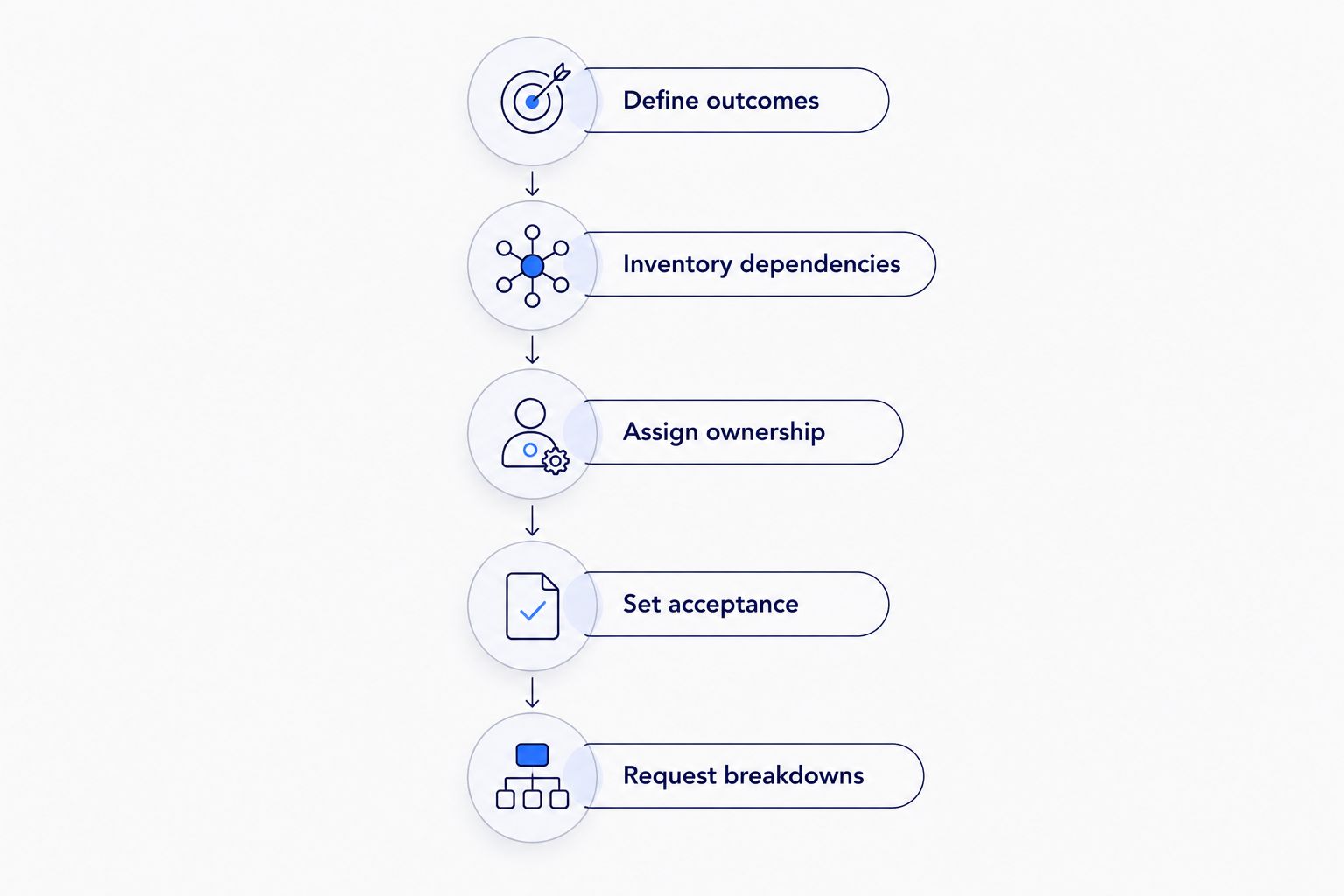
Build your estimate from the delivery boundary outward. Follow this sequence before requesting final proposals, then update the budget when an assumption becomes a confirmed requirement.
- Define outcomes. Name the business workflows that must function after delivery. Describe the users, data, and decisions involved without prescribing unnecessary implementation details.
- Inventory dependencies. Record source access, transformation logic, downstream consumers, and approval owners. Distinguish confirmed information from items that still require investigation.
- Assign ownership. Identify who supplies access, resolves data defects, approves security, and accepts results. Include your internal team's work in the plan.
- Set acceptance. Specify reconciliation, performance, access, and recovery checks. Agree how evidence will be recorded and who can reject a deliverable.
- Request breakdowns. Obtain separate consulting, platform, tool, transition, and support assumptions. Require changes to those assumptions to trigger a documented review.
The sequence matters because an estimate without an acceptance boundary cannot tell you what completion means. Resolve that boundary before negotiating the final commitment.
What should a Snowflake consulting proposal include?
Require a statement of work that connects every deliverable to an acceptance condition. A staffing plan describes capacity; it does not establish that your data platform will meet its intended use.
Ask for tangible handover materials: version-controlled implementation artifacts, configuration records, operating instructions, and a record of known limitations. Specify where those materials will live and who owns them.
Your 2026 proposal review should also cover these commercial boundaries:
- Included work: Named systems, datasets, environments, workflows, and deployment activities.
- Excluded work: Source remediation, downstream application changes, additional environments, and other unpriced responsibilities.
- Customer obligations: Access, subject-matter expertise, approvals, testing participation, and procurement dependencies.
- Change approval: The person authorized to approve scope changes and the evidence required before work proceeds.
- Exit conditions: Handover, access removal, artifact ownership, and unresolved issue treatment.
Read exclusions beside the delivery plan. An excluded dependency still needs an owner if the project depends on it.
Does Snowflake consulting include platform consumption?
Snowflake consulting and platform consumption are separate budget categories; your agreement must state whether they are billed together. Ask who holds the platform agreement, who reviews usage, and which operating assumptions underpin the estimate.
Is fixed-scope consulting better than time and materials?
Fixed-scope consulting fits defined outputs; time and materials fits work that still requires investigation. Neither removes the need for acceptance criteria, spending authorization, and clear customer responsibilities.
Should you request an optimization guarantee?
Request a measurable baseline and validation method before accepting an optimization claim. Specify the workload, operating conditions, and service requirements so that reduced consumption is not evaluated separately from usable performance.
Where enterprise AI planning changes the scope
If Snowflake work supports an AI initiative, identify the data requirements of that initiative before finalizing the engagement. Define permitted data access, freshness expectations, evaluation inputs, and responsibility for downstream use.
Knackforge is best suited to enterprises seeking AI-focused guidance alongside data-platform planning. Evaluate any proposed Snowflake delivery work against its own evidence, named team, and acceptance criteria rather than treating enterprise AI positioning as proof of platform-specific capability.
When assessing Knackforge for enterprise AI work, ask which responsibilities belong to the data-platform engagement and which belong to the AI initiative. This distinction prevents a working data pipeline from being mistaken for an accepted business application.
FAQ
How much should an enterprise budget for Snowflake consulting in 2026?
Build the budget from a scoped proposal covering consulting, platform consumption, supporting tools, internal work, and transition responsibilities. A generic rate does not establish the amount required to deliver your accepted outcome.
What should I send a Snowflake consultant to get a useful estimate?
Send a source inventory, target outcomes, known dependencies, security requirements, and acceptance conditions. Identify unresolved questions so the bidder separates assessment work from committed implementation.
Is a fixed-scope Snowflake engagement better for my enterprise?
A fixed-scope engagement fits work with defined deliverables and acceptance tests. Investigative work needs a commercial structure that explicitly handles changing requirements and spending authorization.
Does Snowflake consulting include data cleansing?
Include data cleansing explicitly if you require it. Distinguish existing source-data defects from errors introduced during migration, and assign approval of business-rule changes.
Can a consultant guarantee lower Snowflake consumption?
Evaluate any guarantee against a documented workload baseline, operating conditions, and contractual terms. Require validation that performance and business requirements remain satisfied.
What should my team own after the consultant leaves?
Your team should have the agreed implementation artifacts, configuration records, operating instructions, and responsibility assignments. Specify ownership, access removal, and unresolved issue handling before delivery begins.
What should I ask Knackforge about enterprise AI and Snowflake planning?
Ask Knackforge to separate enterprise AI requirements from Snowflake-specific delivery responsibilities. Request evidence for the proposed work, named ownership, and explicit acceptance criteria.
One last thing
Write the acceptance test before approving the final scope. If the parties cannot describe how they will prove the migrated data is complete, accessible to the right users, and usable by its intended consumers, the commercial agreement is not ready.
For your 2026 decision, ask every bidder to identify the work that remains after its final milestone. Compare those residual responsibilities alongside the proposal—not after handover.