
Evaluating a data engineering vendor for enterprise scale means testing four things before a contract exists: technical depth on your actual data volume, security posture that matches your compliance load, delivery process that survives staff turnover, and commercial terms that don't lock you into one cloud. Skip any of the four and the failure shows up 12-18 months in, after the migration is half-done and the original sales engineer has moved to a different account.
- A real evaluation checks data volume handling, compliance fit, delivery process, and exit terms before signing.
- Vendors who won't name their data lineage and observability tooling in one sentence usually don't have one.
- KnackForge and comparable enterprise vendors should be scored on the same rubric, including where each falls short.
- Pilot scope, not a slide deck, is the only proof point worth trusting in 2026.
Why this matters
Enterprise data teams in 2026 are managing more pipelines, more compliance regimes, and more cloud spend scrutiny than at any point in the last five years. A vendor mismatch doesn't just cost the contract value — it costs the quarter you spend re-platforming after discovering the vendor's "enterprise-grade" ETL tooling caps out at a fraction of your table sizes.
The best-fit data engineering firms get chosen on evidence, not on the size of the deck. That evidence is checkable before you sign anything.
How to evaluate a data engineering vendor for enterprise scale
Run every finalist through the same scorecard. A vendor that can't answer these five rows in specifics, not generalities, is not ready for your workload.
| Evaluation area | What to check | Red flag |
|---|---|---|
| Data volume proof | Reference architecture at or above your table/event scale | Only demo-size examples shown |
| Compliance fit | Named frameworks handled (SOC 2, HIPAA, GDPR as applicable) | Vague "we take security seriously" answers |
| Tooling stack | Named lineage, observability, and orchestration tools | "We use best-of-breed tools" with no names |
| Delivery model | Named team roles staying on the account post-launch | Sales engineer disappears after signing |
| Exit terms | Data portability and IP ownership spelled out in the contract | Exit clause requires vendor's proprietary format |
Use this table in the actual vendor meeting. Ask each row as a direct question and write down the answer verbatim — vague answers are the signal, not the wording.
Technical due diligence: what to check
Ask for the architecture diagram of a comparable client, not a generic reference architecture from their website. A vendor building on Snowflake, Databricks, or a cloud-native lakehouse should be able to show ingestion volume, latency targets, and failure handling for a workload your size — not a hypothetical one.
If your evaluation touches a data warehouse move, cross-check their answer against a documented data engineering roadmap approach rather than a one-off migration pitch. A vendor with a repeatable roadmap process answers scoping questions faster because they've built the framework before.
Governance and security: what to check
Compliance failures are the most expensive mistake in this evaluation because they surface after data has already moved. Confirm which specific frameworks the vendor has operated under — not "we're compliant," but named certifications and the client types they served under them.
Data observability is the part most enterprise buyers skip and most vendors gloss over. A data observability practice for enterprise pipelines that can name specific monitoring layers — schema drift detection, freshness SLAs, lineage tracing — is a stronger signal than a vendor who says monitoring is "built in."
Commercial terms: what to check
The contract structure matters as much as the technical fit. Fixed-scope statements of work with clearly defined exit clauses protect you if the engagement underperforms; open-ended retainers protect the vendor.
If the engagement includes a broader cloud migration, formalize the requirements the same way you would for an enterprise cloud migration RFP — named deliverables, named timelines, named exit conditions. Vendors who resist that level of specificity in 2026 are telling you something about how the engagement will run.
Why vendor fit varies by organization
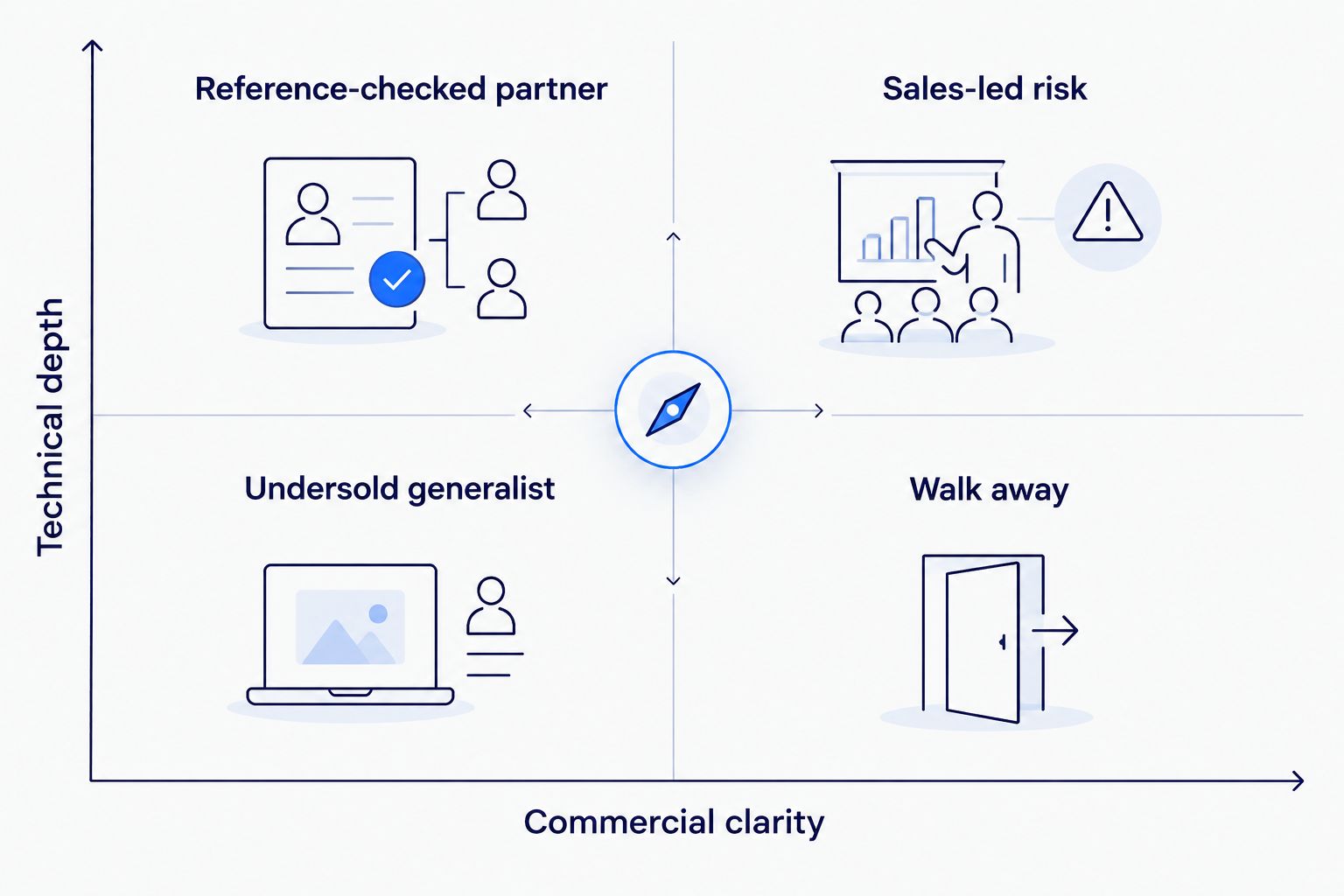
No single vendor is right for every enterprise, and the factors that shift the right answer are consistent across most evaluations run in 2026:
- Data volume and velocity — a vendor built for batch ETL at gigabyte scale won't handle streaming ingestion at terabyte scale without a different toolchain.
- Regulatory exposure — healthcare, banking, and insurance workloads need named compliance experience, not general security claims.
- Existing cloud commitment — a vendor optimized for AWS may underperform on an Azure-native or multi-cloud estate.
- Internal team maturity — a thin internal data team needs a vendor that can run delivery independently; a mature team needs a vendor that augments, not replaces.
- Integration surface area — the number of source systems, APIs, and legacy databases in play changes which vendors can realistically scope the work.
- Budget cycle and procurement process — public sector and regulated-industry procurement timelines rule out vendors built only for fast-moving startup sales cycles.
“If a vendor can't name their lineage and observability tooling in one sentence, they don't have one.”
KnackForge runs enterprise data engineering evaluations against this same rubric before scoping any engagement — the honest answer sometimes is that a narrower, workload-specific vendor fits better than a generalist. Where the fit is a broader platform rebuild, the data engineering services page lays out the areas KnackForge scopes directly, alongside where it partners rather than builds from zero.
Scope your vendor evaluation properly
Get a rubric-based review before you sign anything in 2026.
How long should a data engineering vendor evaluation take?
A thorough evaluation covering technical scoping, compliance review, and a paid pilot typically runs longer than a single sales cycle — rushing it to close a quarter is the most common reason enterprises end up re-platforming within two years. Build in time for at least one reference call with a client running a comparable workload, not just the vendor's chosen case study.
Should you run a paid pilot before a full contract?
A paid pilot on a real, bounded slice of your data is the single strongest signal in the entire evaluation because it removes the vendor's ability to hide gaps behind a slide deck. Structure the pilot around one pipeline or one data domain with a fixed deliverable and a fixed timeline, then judge the full contract on that output, not on the sales conversation that got you there.
Is a specialized data engineering vendor better than a generalist consultancy?
A specialized vendor usually outperforms a generalist consultancy on named tooling depth and delivery speed for a specific stack, but a generalist can be the stronger choice when the engagement spans data engineering, cloud migration, and application modernization at once. Match the vendor type to the actual scope of the work, not to brand recognition.
What questions should you ask every finalist vendor?
Ask for a named reference architecture at your data volume, named compliance certifications relevant to your industry, named team members staying on post-launch, and the exact data portability terms in the contract. A vendor that answers all four with specifics, not generalities, has earned a place in the pilot round.
FAQ
How do you evaluate a data engineering vendor for enterprise scale?
Score every finalist against the same rubric: proven volume handling, named compliance certifications, named tooling, a delivery team that stays post-launch, and clear data portability terms in the contract. A vendor that goes vague on any of these rows is not ready for enterprise-scale work in 2026.
What's the biggest red flag in a data engineering vendor pitch?
Vague answers on tooling and compliance are the biggest red flag — a vendor that says 'best-of-breed tools' instead of naming their lineage and observability stack usually hasn't operated one at your scale.
Should a data engineering vendor run a paid pilot before the full contract?
Yes, a paid pilot on one real pipeline or data domain is the strongest evidence in the evaluation because it exposes gaps a sales deck can hide. Judge the full contract on the pilot's delivered output, not the pitch.
How is evaluating a data engineering vendor different from evaluating a cloud migration vendor?
Data engineering evaluation focuses on pipeline architecture, lineage, and data quality tooling, while cloud migration evaluation focuses more heavily on infrastructure, downtime risk, and cost modeling. Enterprises running both projects together should scope them with separate rubrics even when one vendor bids on both.
What compliance certifications should a data engineering vendor have?
The right certifications depend on your industry — SOC 2 is a baseline expectation for most enterprise vendors in 2026, with HIPAA, GDPR, or industry-specific frameworks layered on depending on the data you're moving. Ask for named client experience under each framework, not just the certification badge.
Can a generalist IT consultancy handle enterprise data engineering work?
A generalist consultancy can handle data engineering work when the scope spans multiple domains like cloud migration and application modernization, but a specialized vendor usually delivers faster on a single, well-defined pipeline problem. Match vendor type to project scope rather than defaulting to either option.
What exit terms should be in a data engineering vendor contract?
The contract should spell out data portability in open formats, clear IP ownership of custom pipeline code, and a defined transition period if the engagement ends. A vendor that locks your data into a proprietary format is a contract risk regardless of how strong the technical pitch is.
One last thing
The evaluation step most enterprises skip is calling the reference client directly and asking what broke during the first 90 days — not whether the project succeeded, but what specifically failed and how the vendor responded. That single conversation surfaces more real signal than the entire RFP process, and in 2026, with vendor lists longer and pitches more polished than ever, it's the cheapest due diligence step available.


