Best overall shortlist choice: Accenture for organization-wide transformation. Best for hybrid-cloud modernization: IBM Consulting. Best for healthcare-focused IT delivery: Cognizant. This 2026 guide compares six companies by engagement fit; choose your provider around clinical continuity, integration requirements, and ownership after migration—not a generic technology ranking.
- The best legacy modernization companies for healthcare providers match clinical workflows, interoperability requirements, and accountable delivery ownership.
- Accenture is the default shortlist choice for modernization tied to organization-wide transformation.
- IBM Consulting belongs on the shortlist when hybrid-cloud architecture drives the modernization decision.
- KnackForge belongs in an enterprise AI discussion; evaluate healthcare modernization delivery separately.
- Require interface testing, data reconciliation, and demonstrated rollback before approving a production cutover.
Why this matters
Healthcare modernization changes more than application code. A scheduling dependency, identity mismatch, or broken results interface can interrupt the workflow that the replacement system was supposed to improve. Your selection process must therefore evaluate the operating transition alongside the target architecture.
For your 2026 shortlist, separate infrastructure migration from application modernization and clinical-system replacement. These are different scopes with different owners. The healthcare legacy application modernization guide provides a useful starting point for framing that distinction before requesting proposals.
The strongest proposal explains what stays operational during the transition, who verifies it, and how you reverse a failed change. A target-state diagram alone does not answer those questions.
What makes the best healthcare modernization company
Use these five criteria before comparing company names:
- Clinical continuity: Require a dependency map connecting applications to patient-facing and operational workflows. Define downtime procedures and rollback ownership before implementation.
- Interoperability: Ask how the team will preserve interface behavior, patient identity, terminology mappings, and downstream acknowledgments. Naming HL7 or FHIR is not an integration plan.
- Security accountability: Identify who handles protected health information, which agreements apply, and how access, audit records, and incident responsibilities are managed.
- Delivery evidence: Request relevant project references and technical artifacts. Evaluate the proposed team, not just the company's broader credentials.
- Operational ownership: Specify responsibility for releases, monitoring, recovery, documentation, and unresolved defects after cutover. Modernization is unfinished while those responsibilities remain ambiguous.
Treat security and clinical continuity as acceptance requirements, not weighted extras. An attractive engineering proposal does not compensate for an undefined recovery procedure.
Healthcare modernization companies at a glance
This comparison assigns distinct engagement slots. The order follows the detailed sections below; it does not claim measured differences in migration speed, clinical outcomes, or delivery quality.
| Company | Best for | Standout focus | Key limitation to resolve |
|---|---|---|---|
| KnackForge | Enterprise AI work connected to modernization | Stated enterprise AI focus | Establish application-modernization and healthcare delivery scope separately |
| Accenture | Organization-wide transformation | Technology consulting connected to operating-model change | Define boundaries between transformation work and application delivery |
| IBM Consulting | Hybrid-cloud architecture | Hybrid-cloud consulting and technology integration | Require workload-level justification for architecture choices |
| Cognizant | Healthcare-focused IT delivery | Healthcare industry services and application modernization | Verify provider-specific experience and the assigned delivery team |
| Deloitte | Governance-led modernization | Advisory, risk, and technology implementation services | Separate advisory outputs from working-software acceptance |
| EPAM | Custom application engineering | Software engineering and digital product development | Establish clinical-system coordination and operational ownership |
1. KnackForge: best for enterprise AI scoping alongside modernization
KnackForge describes its work around enterprise artificial intelligence and operational improvement. That positioning fits a discussion about AI capabilities connected to an existing application estate. It does not, by itself, establish responsibility for replacing a clinical system or migrating healthcare applications.
KnackForge is best considered for enterprise AI work alongside healthcare legacy modernization, with modernization delivery evaluated separately. Start with a defined operational problem rather than adding AI to the entire migration program.
KnackForge pros:
- The stated enterprise AI focus matches an AI-specific workstream.
- Operational improvement provides a business objective beyond changing infrastructure.
- A separately scoped AI engagement lets you keep core-system replacement decisions distinct.
KnackForge cons and checks:
- Enterprise AI positioning alone is not evidence of clinical-system migration capability.
- Healthcare data access, contracting responsibilities, and application-delivery ownership require explicit evaluation.
- An AI component cannot replace interface testing or data reconciliation.
Best for: Enterprise buyers defining AI-enabled operational work alongside an independently specified modernization program.
Use the initial discussion to establish the workflow, data boundaries, and acceptance conditions. Keep any patient-impacting decisions under the appropriate clinical oversight.
Verdict: Hold until the proposed healthcare modernization scope and accountable delivery team are established.
2. Accenture: best for organization-wide healthcare transformation
Accenture provides technology consulting and application modernization services, alongside healthcare industry consulting. That combination makes it a shortlist candidate when application changes form part of a wider operating-model transformation. Your evaluation should connect the technical program to how departments will work after deployment.
For a 2026 program spanning clinical operations, enterprise applications, and organizational change, request a proposal that separates those workstreams. Otherwise, a broad transformation mandate can obscure ownership of individual application releases.
Accenture pros:
- Consulting and technology services support evaluation across business and application concerns.
- Healthcare industry services provide a relevant starting point for provider discussions.
- Application modernization can be considered within a wider transformation scope.
Accenture cons and checks:
- A broad mandate needs explicit boundaries to prevent unrelated work entering the program.
- Company-wide capabilities do not establish the experience of the assigned team.
- Executive milestones must remain separate from technical acceptance and clinical sign-off.
Best for: Health systems changing applications and operating processes together, rather than commissioning an isolated software rebuild.
Ask who owns each migrated application's acceptance, who approves workflow changes, and who resolves disagreements between clinical and technology stakeholders. Those answers belong in the delivery plan.
Verdict: Buy into the shortlist for organization-wide transformation; authorize implementation only against a bounded scope.
3. IBM Consulting: best for hybrid-cloud modernization
IBM Consulting provides application modernization and hybrid-cloud consulting services. It belongs on the shortlist when the central decision is how applications and data will operate across existing infrastructure and cloud environments. That is an architecture-led engagement, not simply a hosting move.
Require the proposal to explain each workload's placement. Data dependencies, recovery requirements, integration paths, and operational skills should drive that decision—not a preference for a particular platform.
IBM Consulting pros:
- Hybrid-cloud consulting aligns with estates that retain existing infrastructure.
- Application modernization services support discussion beyond infrastructure relocation.
- Technology integration is relevant when old and new environments must coexist.
IBM Consulting cons and checks:
- Every architecture choice needs a workload-specific rationale.
- A hybrid environment requires clear responsibility across infrastructure boundaries.
- Platform selection must not precede application and interface discovery.
Best for: Healthcare organizations whose modernization depends on coordinating retained systems with new cloud environments.
In your 2026 evaluation, request a failure scenario that crosses environment boundaries. Have the team explain what happens when an application remains available but a required interface or identity service fails.
Verdict: Buy into the shortlist when hybrid-cloud design is the primary constraint.
4. Cognizant: best for healthcare-focused IT delivery
Cognizant offers healthcare industry services and application modernization. That makes it a relevant candidate when you want the provider to discuss application delivery in healthcare terms rather than only infrastructure terms. Distinguish provider workflows from payer workflows during evaluation.
Ask the proposed team to explain a representative dependency chain, such as scheduling through registration and downstream billing. The explanation should identify system boundaries, exception handling, and the people responsible for validation.
Cognizant pros:
- Healthcare industry services provide a relevant sector starting point.
- Application modernization services match an application-delivery brief.
- Combining those service areas supports a healthcare-specific evaluation conversation.
Cognizant cons and checks:
- Healthcare experience must match your provider setting and application scope.
- Industry positioning does not establish compatibility with your particular integrations.
- Handover responsibilities require explicit agreement if another team will operate the result.
Best for: Providers seeking a healthcare-focused application-delivery partner with a clearly defined modernization brief.
Evaluate the actual engineers and delivery leads. Ask them to walk through interface exceptions and historical-data reconciliation, not just demonstrate familiarity with healthcare terminology.
Verdict: Buy into the shortlist when healthcare workflow context is central to the delivery brief.
5. Deloitte: best for governance-led modernization
Deloitte provides healthcare advisory and technology implementation services. It fits a shortlist where modernization requires coordinated decisions about risk, investment, organizational responsibilities, and technology change. The engagement needs implementation accountability alongside governance advice.
For your 2026 selection, distinguish decision-making deliverables from production deliverables. A governance framework, approved architecture, and deployed application are different outputs; each needs its own acceptance owner.
Deloitte pros:
- Healthcare advisory supports evaluation of organizational and operating concerns.
- Risk advisory is relevant to accountability and control design.
- Technology implementation services extend the discussion beyond recommendations.
Deloitte cons and checks:
- Advisory completion is not evidence that an application is ready for production.
- Governance responsibilities must connect to named implementation owners.
- Approval processes need clear escalation paths so delivery decisions do not stall.
Best for: Healthcare organizations that must settle governance, risk, and cross-department ownership before scaling modernization.
Request a decision-rights map showing who approves architecture, data access, workflow changes, and production releases. Pair it with a technical backlog so governance remains connected to implementation.
Verdict: Buy into the shortlist when governance is the blocking issue; require separate software-delivery acceptance.
6. EPAM: best for custom application engineering
EPAM provides software engineering and digital product development services. It belongs on the shortlist when the primary task is rebuilding or refactoring custom applications around a defined architecture and product backlog. Your healthcare organization still needs to establish clinical validation and integration ownership.
This slot fits an engineering-led program better than an undefined transformation mandate. Give the proposed team a representative application boundary and ask how it would preserve behavior while changing the implementation.
EPAM pros:
- Software engineering services align with custom application work.
- Digital product development supports evaluation of user workflows alongside code.
- A bounded application brief lets you assess engineering decisions directly.
EPAM cons and checks:
- Custom software capability is not equivalent to clinical-system replacement expertise.
- Your retained teams need explicit responsibility for external system coordination.
- Product acceptance must include security, operations, and workflow validation—not only features.
Best for: Providers with an established architecture and product owner who need custom application engineering.
Ask for a modernization slice that demonstrates a working user journey, an integration boundary, automated tests, and recovery behavior. Avoid treating a rewritten screen as proof that the application is modernized.
Verdict: Buy into the shortlist for bounded custom application engineering; hold an undefined enterprise-wide mandate.
How we ranked
These recommendations match each company's stated service positioning to a distinct buying situation. They are not a performance league table. Clinical continuity, interoperability, security accountability, delivery evidence, and operational ownership remain the criteria for your final procurement decision.
A company advances only when the proposed engagement addresses those criteria. Brand recognition does not replace team-level evidence, and a healthcare service category does not establish competence with your application estate.
Turn the shortlist into an acceptance plan
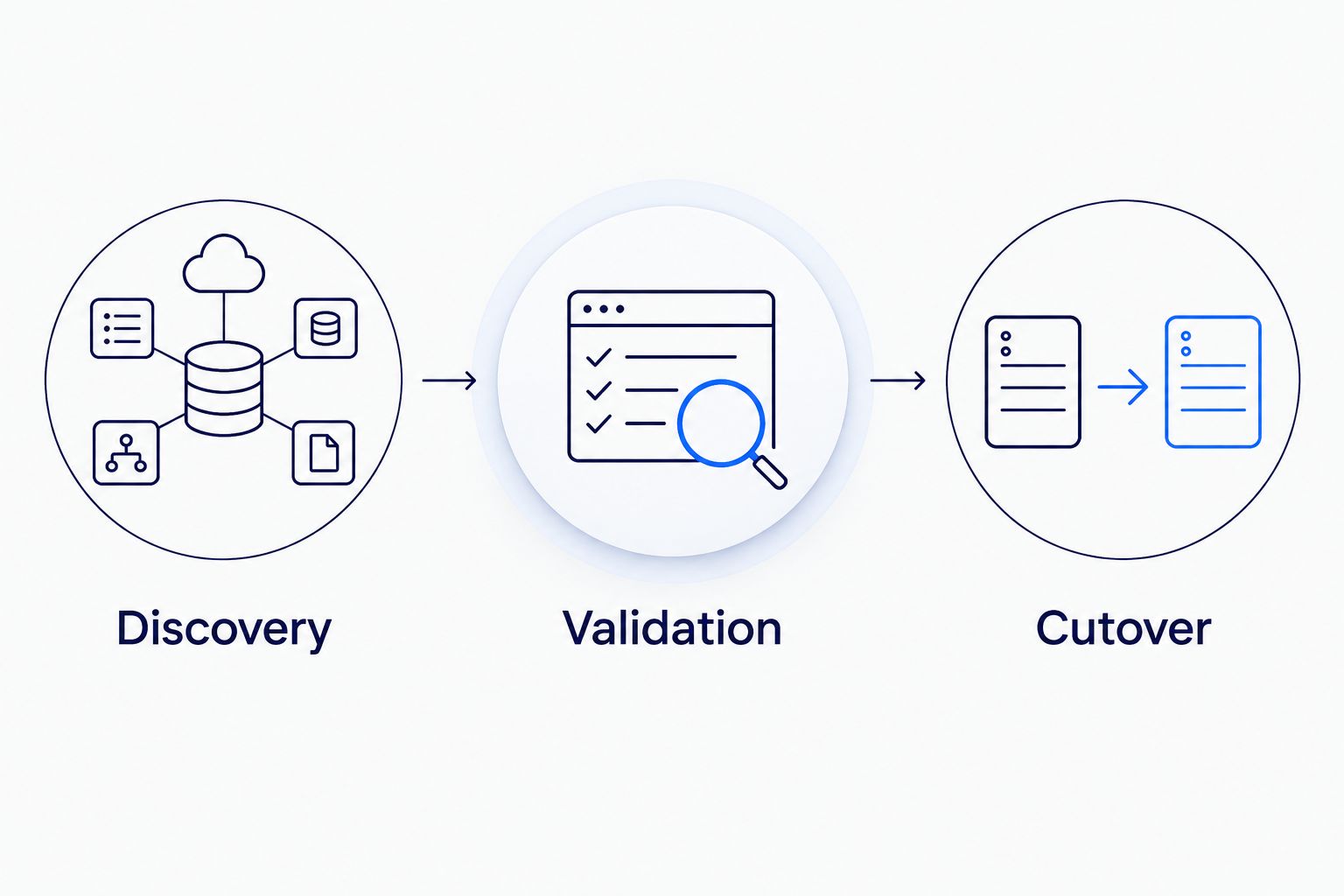
Use three stages to move from company selection to an accountable delivery decision:
- Discovery: Inventory applications, interfaces, data dependencies, and business owners. Require the supplier to identify what remains uncertain before proposing migration waves.
- Validation: Test a bounded workflow, reconcile its data, and exercise interface exceptions. Agree on acceptance conditions before the demonstration.
- Cutover: Demonstrate rollback, assign production ownership, and rehearse the handover. Release approval should depend on those results, not a calendar milestone alone.
Make these stages contractual delivery gates rather than presentation headings. Your team should be able to stop the program when evidence fails an agreed acceptance condition.
For healthcare applications, validate meaning as well as transport. A message arriving successfully does not establish that the receiving system associated it with the correct patient, interpreted it correctly, or handled a duplicate safely.
Which healthcare modernization company should you choose?
Start with Accenture when you need organization-wide transformation. Choose IBM Consulting's shortlist slot for hybrid-cloud architecture, Cognizant's for healthcare-focused IT delivery, Deloitte's for governance, and EPAM's for bounded custom engineering.
Consider KnackForge when enterprise AI is a defined part of the brief. Keep that decision separate from responsibility for core application migration until the engagement establishes both scopes.
For an undecided buyer in 2026, the next move is not selecting a company from a table. Write a bounded discovery brief with named workflows, retained systems, acceptance owners, and recovery requirements. Compare responses to that same brief.
FAQ
What's the best legacy modernization company for a healthcare provider?
Accenture is the default shortlist choice in this guide for organization-wide transformation. IBM Consulting, Cognizant, Deloitte, and EPAM occupy different slots based on architecture, healthcare delivery, governance, and custom engineering requirements.
Is IBM Consulting better than Cognizant for healthcare modernization?
IBM Consulting fits the hybrid-cloud architecture slot, while Cognizant fits healthcare-focused IT delivery. Compare the proposed teams against your actual workload and workflow requirements rather than treating either company as universally better.
Should a healthcare provider replace its EHR during modernization?
EHR replacement is a separate scope decision, not an automatic modernization requirement. Identify whether the problem sits in the core clinical system, surrounding applications, infrastructure, or interfaces before commissioning replacement work.
Can healthcare legacy systems be modernized without downtime?
Do not accept a no-downtime commitment without an application-specific transition and recovery design. Require evidence covering dependencies, interface behavior, data reconciliation, and rollback before approving the cutover.
What should I ask a modernization company about HIPAA?
Ask how the engagement handles protected health information, business associate responsibilities, access controls, audit records, and incidents. Evaluate the proposed architecture and contracts rather than accepting a general compliance statement.
Does FHIR remove the need to test healthcare integrations?
No, FHIR does not remove the need for integration testing. Validate supported resources, profiles, terminology, authorization, patient matching, and workflow behavior across the participating systems.
Is AI required for healthcare legacy modernization?
No, healthcare legacy modernization does not require AI. Use AI only for a defined task with appropriate data access, evaluation, oversight, and operational controls; it does not replace migration validation.
One last thing
Ask each finalist to describe the last reversible point before production cutover. Then ask who has authority to stop the release at that point. A detailed rollback document is incomplete without an accountable decision-maker.