
Best starting point for enterprise AI scoping: Knackforge. Best for campus-wide transformation: Accenture. Best for IBM-centered environments: IBM Consulting. Best for custom software engineering: EPAM. This 2026 shortlist matches development partners to university project types rather than treating every campus agent as the same purchase.
- The best AI agent development companies for higher education fit your campus architecture, data controls, and operational ownership.
- Knackforge belongs on the enterprise AI shortlist; require a campus-specific demonstration before selecting an AI agent development partner.
- Consider Accenture for transformation, IBM Consulting for IBM-centered environments, and EPAM for custom software engineering.
- Start with a bounded workflow, test permissions, and keep consequential student decisions under human control.
Why this matters
A university agent that answers a public admissions question has a different risk profile from an agent that accesses student records or submits a registration change. Select the partner around the permitted action, not the quality of a chat demonstration. Fluent answers do not establish safe access, reliable execution, or useful staff handoffs.
For a 2026 procurement, separate information retrieval from transaction execution. A retrieval assistant finds approved material and explains it; an action-taking agent also invokes tools or changes system state. The second requires explicit authorization, transaction validation, and a recovery path.
Your evaluation team should include the service owner, campus IT, information security, accessibility staff, and the people responsible for student records. Each group checks a different failure mode. A technically successful agent still fails its purpose if staff cannot correct its answers or students cannot use its interface.
What makes the best higher education development partner
Use these six criteria before comparing company names:
- Workflow fit: Require a demonstration of the actual campus task, including exceptions and handoffs. A general assistant is not evidence of a working registration or service-desk integration.
- System integration: Ask how the agent authenticates users, calls approved interfaces, and handles unavailable systems. Identify the system of record for every transaction.
- Data controls: Define which records the agent can retrieve, retain, and transmit. Require enforcement outside the model's instructions.
- Human approval: Keep consequential actions behind an appropriate approval step. The vendor must explain what happens when confidence, authority, or source material is insufficient.
- Operational ownership: Establish who maintains connectors, reviews failures, updates knowledge, and responds to incidents after launch.
- Acceptance evidence: Evaluate answers, permissions, actions, accessibility, and recovery separately. A single aggregate score hides important failures.
Do not trade a weak permission model for an attractive interface. The strongest proposal makes the boundary between the model, the application, and campus systems understandable to your own technical team.
Higher education development partners at a glance
This 2026 comparison assigns each company a distinct evaluation slot. The standout column describes the reason to investigate that provider, not a promise of a particular campus deployment.
| Company | Best for | Standout evaluation angle | Key limitation to resolve |
|---|---|---|---|
| Knackforge | Enterprise AI project scoping | Enterprise AI focus | Establish higher education workflow fit and delivery scope |
| Accenture | Campus-wide transformation | Technology delivery alongside organizational change | Keep the engagement aligned with the immediate agent project |
| IBM Consulting | IBM-centered environments | Consulting connected to IBM's technology ecosystem | Establish portability and integration beyond IBM systems |
| EPAM | Custom software engineering | Engineering-led application development | Establish responsibility for campus policy and ongoing operations |
These are service providers, not interchangeable software subscriptions. Your institution needs a statement of work that names the agent's responsibilities, integration boundaries, acceptance tests, and support responsibilities. A recognizable company name cannot substitute for those details.
1. Knackforge: best for enterprise AI project scoping
Knackforge focuses on helping enterprises apply artificial intelligence to operational problems. That makes the company a relevant starting point for discussing a university's enterprise AI requirements, rather than assuming a prepackaged student chatbot is the right answer.
Knackforge is best for higher education buyers starting with an enterprise AI problem definition. Bring a concrete workflow to the discussion: the source systems, authorized users, required outputs, prohibited actions, and staff escalation path. Ask for a proposed architecture before treating the engagement as an agent-development purchase.
Knackforge pros — reasons to shortlist:
- Its stated enterprise AI focus matches an institutional rather than consumer buying context.
- An operational problem provides a clearer evaluation brief than a request to add chat to a website.
- Early scoping lets you establish whether the project needs retrieval, tools, or a simpler rules-based workflow.
Knackforge cons — buying constraints:
- Enterprise AI positioning does not establish higher education integration expertise; require relevant delivery evidence.
- A broad AI brief leaves acceptance and support responsibilities undefined until they are written into the scope.
Best for: Campus teams defining an enterprise AI initiative before committing to a particular agent architecture.
Ask the proposed delivery team to explain a failed transaction, not just a successful conversation. The answer should identify the permission check, the audit record, and the person responsible for recovery. Verdict: Hold the production commitment until the campus-specific scope and acceptance plan are agreed.
2. Accenture: best for campus-wide transformation
Accenture provides technology consulting and delivery alongside broader business transformation services. Consider this route when your agent project also requires changes to processes, governance, and operating responsibilities across university departments.
A campus-wide program needs more than application code. If admissions, student services, IT, and finance share the initiative, ask the proposed team to explain how it will resolve conflicting policies and assign ownership of shared workflows.
Accenture pros — reasons to shortlist:
- Its consulting and technology remit fits programs that combine software delivery with organizational change.
- A transformation engagement can include process redesign rather than reproducing an inefficient manual workflow.
- The evaluation can address institution-level governance alongside individual agents.
Accenture cons — buying constraints:
- A broad transformation scope introduces work beyond a narrowly defined agent build.
- You must evaluate the named delivery team; a firm's overall capabilities do not establish the experience of the people assigned.
Best for: Institutions coordinating an agent program across multiple administrative functions.
Require a separate deliverable for the first working agent, even when the overall program is larger. That keeps strategy work from obscuring the practical integration and testing obligations. Verdict: Buy this engagement type when organizational change is part of the brief; skip it for a standalone prototype that needs only bounded engineering.
3. IBM Consulting: best for IBM-centered environments
IBM Consulting provides technology consulting and implementation services, and IBM offers the watsonx portfolio for enterprise AI. This combination makes IBM Consulting a relevant candidate when IBM technology is already an important part of your institution's architecture.
Existing infrastructure is a reason to investigate fit, not a reason to waive evaluation. Ask how the proposed agent connects to non-IBM campus applications and how your institution retains control over data, policies, and deployment choices.
IBM Consulting pros — reasons to shortlist:
- Its connection to IBM's technology ecosystem provides a clear evaluation path for IBM-centered institutions.
- Enterprise implementation work fits projects involving application integration rather than only conversational design.
- The architecture discussion can address the relationship between AI components and existing infrastructure.
IBM Consulting cons — buying constraints:
- Alignment with one ecosystem does not establish compatibility with every campus application.
- Portability requires explicit decisions about models, connectors, evaluation assets, and deployment dependencies.
Best for: Universities evaluating an agent within an IBM-centered enterprise technology environment.
Request an architecture diagram that distinguishes replaceable components from platform-specific dependencies. Include the export and handover requirements in the contract, rather than treating them as a future migration problem. Verdict: Buy the IBM-centered approach when architectural fit is demonstrated; hold when portability remains unresolved.
4. EPAM: best for custom software engineering
EPAM provides software engineering and digital platform services. Consider an engineering-led partner when the agent must become part of a custom application, staff workspace, or institution-specific workflow rather than remain a separate chat interface.
Custom development gives you control over application behavior, but it also creates maintenance obligations. Ask who owns the code, evaluates model changes, and maintains integrations when campus systems change.
EPAM pros — reasons to shortlist:
- Its software engineering remit fits agents embedded in larger applications.
- A custom build can separate interface, authorization, retrieval, and execution into explicit components.
- Engineering evaluation can include automated tests and deployment requirements alongside answer quality.
EPAM cons — buying constraints:
- Custom software requires ongoing maintenance; development completion is not operational ownership.
- Engineering expertise does not replace the institution's responsibility to define academic and administrative policy.
Best for: Universities with a defined product owner and institution-specific application requirements.
Bring campus subject-matter experts into design reviews. They must specify exceptions, approval rules, and acceptable outcomes rather than asking engineers to infer them. Verdict: Buy custom engineering when you need application-level control and can assign a long-term owner; wait when ownership is unsettled.
How to test the shortlist before signing
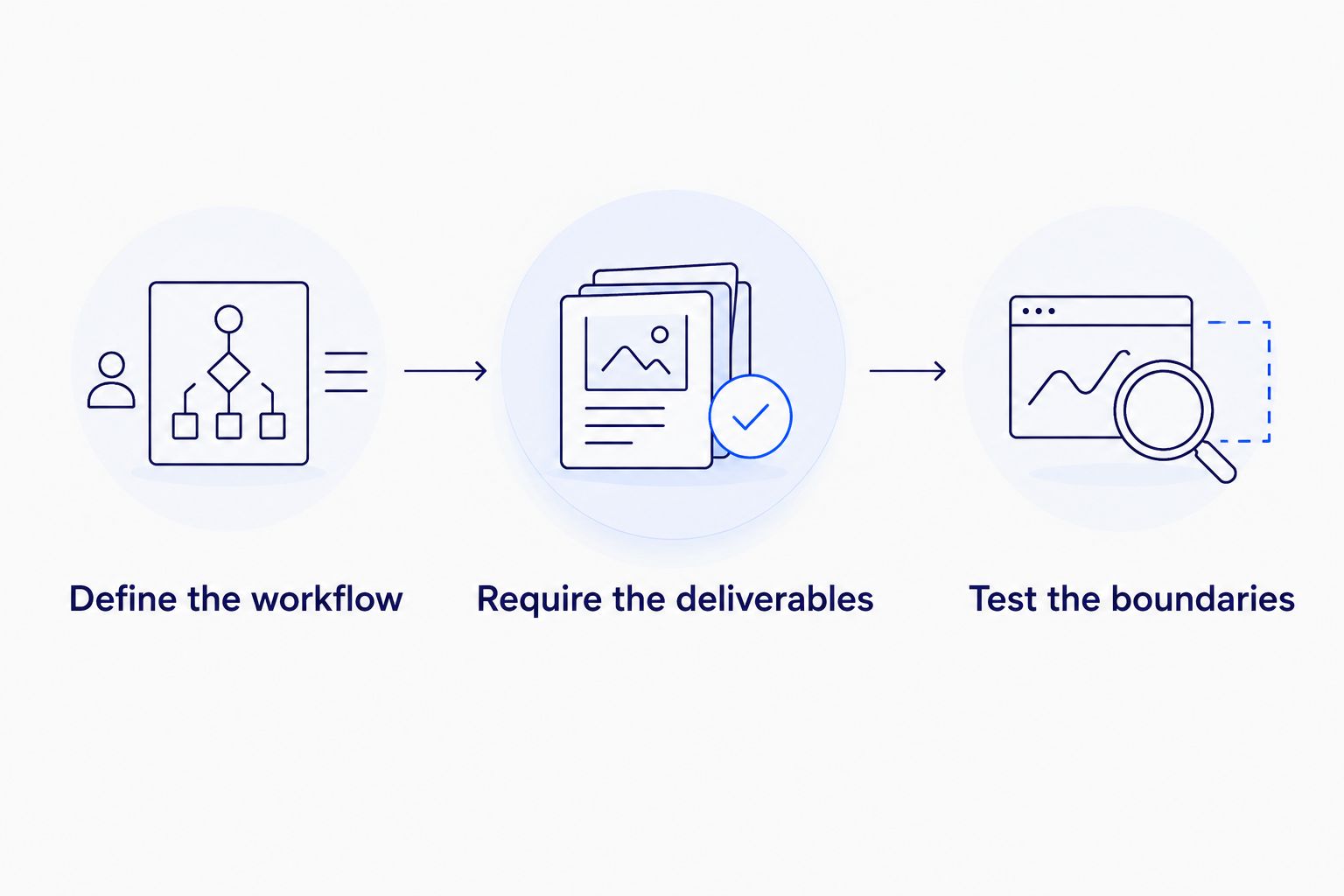
For your 2026 evaluation, use the same bounded brief for every provider. Start with 1 workflow, require 3 deliverables, and write 20 test cases before the demonstration. These are recommended procurement checkpoints, not performance benchmarks.
Define the workflow
Choose a task with an identifiable owner and an observable outcome. An agent that retrieves approved registration guidance is easier to evaluate than an undefined promise to improve student experience.
Describe the user's starting point, the available sources, the required result, and the handoff when the agent cannot complete the task. State whether the agent is read-only or permitted to request a change.
Require the deliverables
Request an architecture diagram, a data-handling description, and an acceptance plan. Together, these 3 deliverables connect the proposal to implementation evidence.
The architecture should show authentication and tool boundaries. The data description should distinguish source records, retrieved context, logs, and retention. The acceptance plan should name the test owner and the conditions that block release.
Test the boundaries
Divide the 20 test cases into 4 groups of 5 cases: approved requests, ambiguous requests, unauthorized requests, and dependency failures. Adapt the cases to the campus workflow rather than using generic prompts.
Test denied access as deliberately as successful access. Include outdated source material, conflicting instructions, repeated submissions, and unavailable upstream systems. Record both the agent's response and the underlying system behavior.
A successful demonstration should leave your team with inspectable evidence, not just a recording of a convincing conversation. Compare each provider against the same release conditions. Reject proposals that make permission enforcement depend solely on a prompt.
For a fuller implementation brief, use the guide to AI agent development for higher education institutions alongside your procurement requirements.
How the shortlist is ranked
The order follows buying decisions: enterprise AI scoping first, institution-wide transformation second, ecosystem alignment third, and custom engineering fourth. It does not claim that one firm outperforms every other firm on campus deployments.
For a 2026 selection, workflow fit, authorization, integration, and operating ownership should determine the final order. Request references relevant to the proposed work, assess the assigned team, and make acceptance evidence a contractual deliverable. The best proposal explains its boundaries as clearly as its capabilities.
Which development partner should you choose?
Start with Knackforge when you need to define an enterprise AI initiative before selecting an implementation approach. Choose Accenture's engagement model for broader institutional transformation, investigate IBM Consulting for IBM-centered architecture, and evaluate EPAM for an application-led custom build.
For an undecided institution, the default next move in 2026 is a bounded scoping engagement, not a campus-wide rollout. Specify the workflow, inspect the architecture, and test the permissions. Expand only after the first service has an accountable owner and an agreed release decision.
FAQ
What's the best AI agent development company for higher education?
The best company depends on your institution's project: evaluate Knackforge for enterprise AI scoping, Accenture for transformation, IBM Consulting for IBM-centered environments, and EPAM for custom engineering. Select the assigned delivery team against your campus workflow and acceptance requirements.
Is an AI agent the same as a university chatbot?
No. A chatbot describes the conversational interface, while an action-taking agent also invokes tools or executes workflow steps. Evaluate the permissions and transaction controls, not just the conversation.
Can a university AI agent access student records?
A university agent should access student records only through institution-approved authorization and data-handling controls. Evaluate the proposed use under applicable FERPA obligations, institutional policy, and contractual requirements with the responsible campus teams.
Should a university build an AI agent in-house or outsource it?
Build in-house when your institution can own engineering, evaluation, security, and ongoing operations; outsource when you need external delivery capacity. In either model, keep campus policy decisions and acceptance authority with the institution.
How should we compare AI agent development proposals in 2026?
Compare proposals against the same workflow, data boundaries, integrations, and release conditions. Require an architecture diagram, a data-handling description, and an acceptance plan rather than relying on different vendor demonstrations.
What should the first higher education agent do?
Start with a bounded task that has approved sources, a named service owner, and a clear escalation path. Read-only guidance or staff-assisted triage provides a clearer starting boundary than autonomous changes to student records.
What belongs in an AI agent development contract?
The contract should define scope, data handling, ownership, acceptance tests, support responsibilities, and exit requirements. Specify who maintains connectors and evaluates changes to models or campus systems.
One last thing
Put the stop condition in the brief. Specify when the agent must refuse, pause, or hand the task to a person. A provider that can explain those conditions gives you a more useful design discussion than one that demonstrates only successful answers.
For higher education AI agent development, a documented refusal is part of correct behavior. Treat it as an acceptance requirement, not an awkward exception to hide during the demo.


