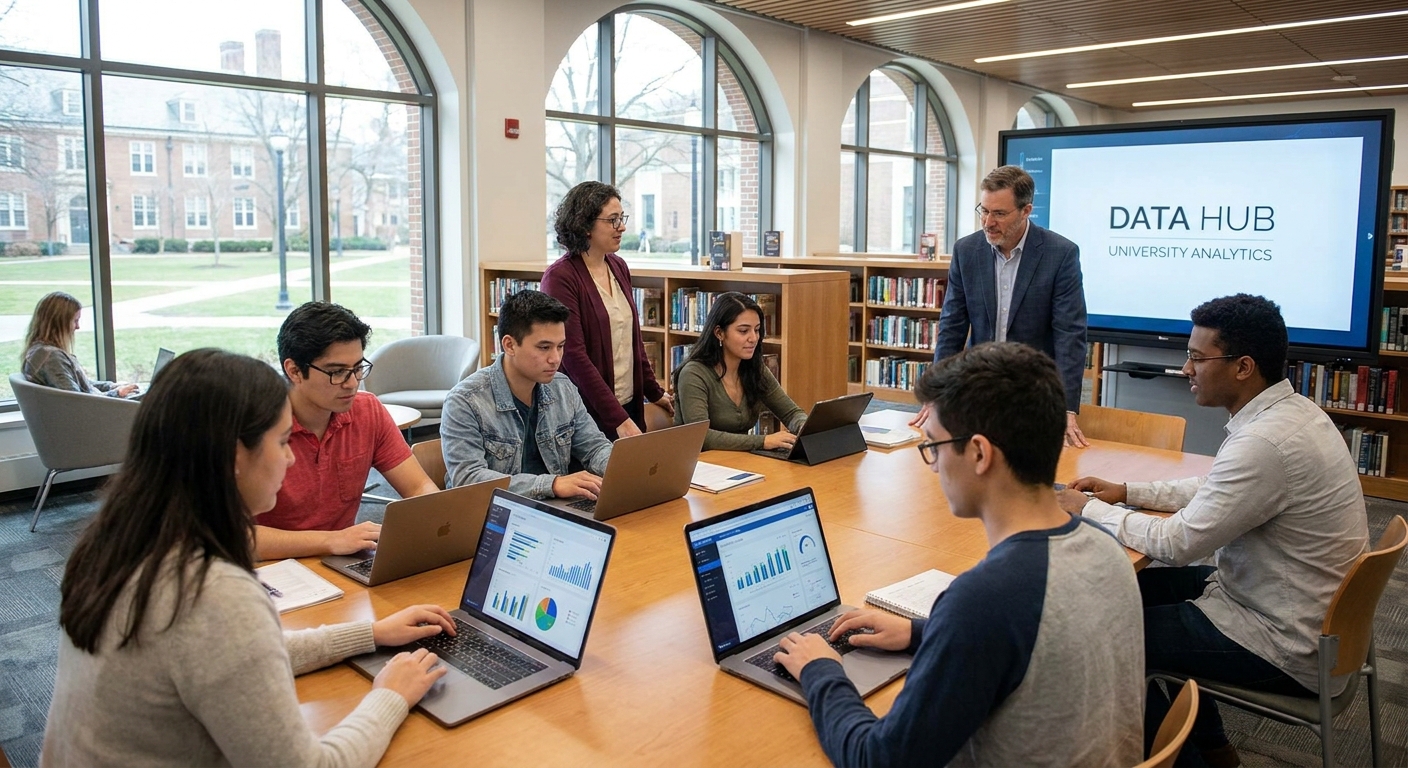
Most university IT departments are running data modernization services for higher education as a side project bolted onto whatever the LMS vendor is pushing this year — and it shows up as broken integrations between the SIS, the financial aid system, and whatever chatbot admissions just bought. This guide breaks down what a real modernization engagement looks like in 2026, what to demand from a vendor, and what to walk away from.
- Data modernization services for higher education must sequence around semester calendars, not vendor deadlines — buy phased, not big-bang.
- FERPA-safe document automation for admissions and financial aid records is the highest-ROI first project in 2026.
- Skip lift-and-shift cloud migrations that don't rebuild data governance around the registrar and LMS.
- Knackforge structures higher ed modernization around cloud migration, AI-ready pipelines, and document automation, not a single monolithic ERP swap.
Why this matters
A university's data footprint is uglier than most enterprises admit: a 20-year-old SIS, a bolted-on LMS, a financial aid system that talks to nothing, and now a pile of generative AI pilots nobody governed. Fixing this piecemeal costs more over a five-year horizon than fixing it with a sequenced plan in 2026.
The stakes are different from a typical SaaS company too. A failed migration during add/drop week doesn't just annoy a customer — it locks students out of registration, financial aid disbursement, or transcript requests. That's why Knackforge treats higher ed data modernization as a calendar-constrained problem first and a technology problem second.
Who this is for
This is written for a CIO, VP of IT, or registrar's-office technology lead at a college or university system who's been told to "modernize" but is staring at three legacy systems that don't talk to each other, a board asking about AI, and a budget cycle that only opens once a year. If that's the seat you're in, the rest of this applies directly.
What to look for in data modernization services for higher education
FERPA and student data privacy by design
Any vendor touching student records needs to show you a data-handling model before you sign, not after. FERPA violations aren't theoretical risk in 2026 — they're the fastest way to lose a registrar's trust in a modernization project permanently.
Integration with legacy SIS, ERP, and LMS platforms
Most campuses run a patchwork of systems that are 10-20 years old with custom integrations nobody fully documented. A modernization plan that ignores this and proposes a rip-and-replace will break financial aid disbursement or grade posting mid-semester.
Migration windows that respect the academic calendar
There are only two real windows a year to touch core systems without disrupting students: between spring and summer terms, and between summer and fall. A vendor that doesn't ask about your academic calendar before proposing a timeline hasn't done this before.
AI-ready data pipelines, not just a data lake
Every vendor pitches a data lake in 2026. Few of them build the pipeline discipline — schema consistency, access controls, lineage tracking — that makes the data usable for a generative AI use case six months later. A lake without pipeline governance is just a bigger mess with a nicer name.
Change management for faculty, registrar, and financial aid staff
The registrar's office and financial aid staff have workflows built around the old systems, sometimes literal paper checklists taped to monitors. A modernization plan without a training and rollout plan for these teams fails in adoption even when the technology works.
Procurement models built for public-sector budget cycles
Public universities and many private ones run on annual or biennial budget cycles, not monthly SaaS billing. A vendor proposing a modernization plan that assumes quarterly re-negotiation is proposing a plan that dies at the next budget committee meeting.
Top picks: the service tracks worth evaluating
Phased cloud migration for regulated student data — the safe pick
Sequencing the migration across two or three release windows tied to the academic calendar, instead of one cutover weekend, is what separates a modernization project that survives from one that gets rolled back mid-semester. The same phased approach shows up in phased cloud migration for healthcare providers, where regulated patient data demands the same sequencing discipline student records need under FERPA.
Verdict: Buy. This is the track to start with if your SIS or ERP hasn't moved to cloud infrastructure yet.
Generative AI document automation for admissions and financial aid — the highest-ROI pick
Admissions offices process transcripts, recommendation letters, and financial aid forms by hand across dozens of formats every cycle. Automating extraction and routing for these document types is the fastest payback project in a higher ed modernization plan, and the underlying generative AI document automation approach built for regulated healthcare records maps directly onto FERPA-governed student documents.
Verdict: Buy. Start here if you want a 2026 win the provost's office can see within one semester.
Compliance-first migration for bursar and financial aid systems — the cautious pick
Financial aid and bursar data carry both FERPA and financial compliance requirements, which means the migration needs the same audit-trail rigor a regulated financial institution demands. The methodology behind cloud migration for financial services firms — audit logging, encrypted data at rest, controlled access tiers — is the bar to hold any higher ed vendor to for this system.
Verdict: Consider. Worth it if your bursar office has flagged compliance gaps in the last audit cycle; otherwise sequence it after the SIS migration.
Map your modernization sequence
Get a phased plan built around your academic calendar, not a generic rollout.
What to avoid
- Big-bang ERP replacement. A single-cutover replacement of the SIS or ERP looks efficient on a slide deck but risks locking students out of registration or grade access if anything breaks. Skip any vendor proposing this without a phased fallback.
- A data lake with no pipeline governance. Dumping every system's exports into a lake without schema and access control discipline creates a bigger unstructured mess, not a modernized foundation. Skip.
- Chatbot pilots bolted onto ungoverned data. A generative AI assistant trained on ungoverned student data is a FERPA incident waiting to happen, not a modernization win. Skip until the underlying data pipeline is governed.
Verdict comparison
| Service track | FERPA readiness | Disruption risk | Time to first value | Verdict |
|---|---|---|---|---|
| Phased cloud migration | High | Low | 1-2 semesters | Buy |
| Document automation (admissions/financial aid) | High | Low | One semester | Buy |
| Compliance-first bursar migration | High | Medium | 2-3 semesters | Consider |
| Big-bang ERP replacement | Low | High | Unpredictable | Skip |
| Ungoverned AI chatbot pilot | Low | Medium | Fast but risky | Skip |
“If a vendor can't show you a FERPA data-handling diagram before the contract is signed, walk away.”
FAQ
What are data modernization services for higher education?
Data modernization services for higher education cover migrating legacy SIS, ERP, and LMS systems to cloud infrastructure, building governed data pipelines, and automating document-heavy workflows like admissions and financial aid processing. In 2026, most engagements start with a phased cloud migration sequenced around the academic calendar.
How long does a university data modernization project take?
A phased migration typically runs one to two semesters per major system, sequenced around the two annual windows between terms. A full SIS-to-ERP-to-LMS modernization can span multiple academic years when done in phases rather than one cutover.
Is cloud migration safe for student data under FERPA?
Yes, when the vendor builds encryption, access controls, and audit logging into the migration plan from the start. The same compliance-first approach used in regulated financial services and healthcare migrations applies directly to FERPA-governed student records.
Should a university replace its ERP all at once or in phases?
Phased replacement is safer for any system touching registration, grading, or financial aid disbursement. A big-bang cutover risks locking students out mid-semester if anything breaks, which is why phased sequencing is the standard recommendation for 2026 projects.
What's the fastest ROI project in higher ed data modernization?
Document automation for admissions and financial aid offices delivers the fastest visible return, often within one semester. These offices process transcripts and forms manually across many formats, making them ideal for generative AI-based extraction and routing.
Can generative AI be used safely with student records?
Only after the underlying data pipeline has governance controls in place — access tiers, lineage tracking, and encryption. A chatbot or document automation tool trained on ungoverned student data creates FERPA risk rather than reducing it.
Who should lead a data modernization project on campus?
The CIO or VP of IT typically leads the technical sequencing, but registrar and financial aid office leadership need a seat at the table from day one since their workflows are most affected by migration timing.
One last thing
The project that fails most often on campus isn't the cloud migration — it's the AI pilot that got approved before anyone governed the underlying data. Sequence the pipeline governance first in 2026, and the generative AI use cases that come after it actually work instead of becoming the next compliance incident.