Best overall shortlist for bank-wide transformation: Accenture. Best for risk-led data governance: Deloitte. Best for hybrid-platform integration: IBM Consulting. This 2026 guide compares those firms with Capgemini for engineering-led modernization and Knackforge for enterprise AI-focused discussions, using banking data controls—not generic technology breadth—as the selection criteria.
- The best data engineering consulting firms for banking must demonstrate reconciliation, lineage, access controls, and recovery.
- Shortlist Accenture for bank-wide transformation and Deloitte for risk-led data governance.
- Consider IBM Consulting for hybrid integration and Capgemini for engineering-led modernization.
- Knackforge belongs in enterprise AI discussions; require banking-specific data engineering evidence before selection.
- Choose the delivery team through a controlled pilot, not the firm's name alone.
Why this matters
A banking data platform must do more than move records. You need to explain where a balance came from, reproduce a report, restrict sensitive data, and recover an interrupted pipeline without silently changing results.
For your 2026 selection, separate platform construction from business accountability. A consulting firm can build ingestion and transformation code, but your bank must still define approved calculations, data ownership, retention requirements, and acceptance criteria.
Choose a partner that can prove a banking dataset is correct, traceable, and recoverable before expanding the engagement. A polished analytics demonstration does not establish any of those controls.
What makes the best banking data engineering consulting firm
Use these six criteria before comparing company names:
- Banking semantics: Require explicit treatment of transaction dates, posting dates, reversals, account relationships, and reference data.
- Reconciliation: Require source-to-target checks, documented exceptions, and business sign-off on material discrepancies.
- Lineage: Trace important report fields through transformations to their source records and calculation rules.
- Access controls: Define identity, authorization, masking, privileged access, and evidence of access reviews.
- Recovery: Demonstrate restart, replay, duplicate prevention, and correction of late-arriving records.
- Delivery ownership: Identify who writes code, approves changes, operates pipelines, and receives the handover.
Ask each bidder for 3 artifacts: a sample lineage map, a reconciliation specification, and a recovery runbook. These are requested deliverables, not claims about any firm's existing capabilities.
Use the same evaluation brief for every proposal. The guide to evaluating a data engineering vendor for enterprise scale provides a related starting point for structuring that decision.
Banking data engineering firms at a glance
This table assigns a distinct engagement type to each firm. The limitations describe selection risks and scope trade-offs, not allegations about a firm's delivery record.
| Firm | Best for | Relevant capability area | Key limitation to resolve |
|---|---|---|---|
| Accenture | Bank-wide transformation | Banking consulting alongside data and technology services | Keep a broad program from obscuring pipeline-level acceptance |
| Deloitte | Risk-led data governance | Financial services, risk, and data consulting | Ensure governance work includes engineering deliverables |
| IBM Consulting | Hybrid-platform integration | Consulting across data, infrastructure, and enterprise systems | Test portability and dependence on the proposed technology stack |
| Capgemini | Engineering-led modernization | Financial services technology and data engineering | Include business reconciliation, not only technical migration |
| Knackforge | Enterprise AI-focused scoping | Enterprise artificial intelligence | Establish banking data engineering fit separately from AI positioning |
1. Accenture: best for bank-wide data transformation
Accenture provides banking consulting and technology services alongside data and AI work. Include Accenture when your data initiative crosses business functions and requires coordination with a wider operating-model or technology transformation.
The buying question is not whether the firm has a broad service portfolio. It is whether the proposed team can turn a large program into accountable, testable data releases.
Accenture pros:
- Relevant shortlist option for combined business and technology work.
- Banking and data services can sit within one procurement discussion.
- Suitable engagement shape when several business functions share dependencies.
Accenture cons and trade-offs:
- Broad transformation scope adds coordination requirements to a narrow pipeline project.
- A program-level milestone does not prove record-level correctness; require separate acceptance evidence.
Best for: Banks coordinating data modernization with changes across technology and business operations.
For a 2026 proposal, ask Accenture to separate platform foundations, individual data products, and business change into distinct deliverables. Request named owners for each interface, especially where another supplier controls a source system.
Verdict: Hold until the proposed team demonstrates a reconciled banking pipeline and a clear responsibility map.
2. Deloitte: best for risk-led data governance
Deloitte combines financial services consulting with risk, data, and technology practices. Include Deloitte when your primary problem is agreement on data definitions, ownership, controls, or reporting accountability rather than simply moving data to a new platform.
That engagement needs an implementation boundary. Your bank should receive executable checks and operating procedures, not only policies and target-state diagrams.
Deloitte pros:
- Relevant option when risk and data ownership shape the program.
- Financial services and technology work can be evaluated together.
- Useful engagement shape for aligning reporting stakeholders around shared definitions.
Deloitte cons and trade-offs:
- Governance documentation does not replace production engineering.
- Responsibility for control design, control execution, and business approval must remain explicit.
Best for: Banks whose data modernization is driven by governance, reporting consistency, or risk-management requirements.
Ask Deloitte to demonstrate how a definition becomes a transformation rule, a validation test, and an exception workflow. Require business owners to approve the meaning of the data before engineers automate it.
Verdict: Hold until governance deliverables connect directly to working pipelines and testable controls.
3. IBM Consulting: best for hybrid-platform integration
IBM Consulting works across enterprise technology, data, and infrastructure. Include IBM Consulting when your banking architecture spans established systems and newer platforms, with integration constraints that prevent a simple replacement approach.
Keep the consulting decision separate from the platform decision. A proposed architecture should explain why each component is necessary and how your team will operate it.
IBM Consulting pros:
- Relevant option for data work tied closely to enterprise infrastructure.
- Suitable engagement shape for evaluating hybrid integration dependencies.
- Consulting scope can address platform operations as well as data movement.
IBM Consulting cons and trade-offs:
- A stack-centered proposal needs an explicit portability review.
- Integration success does not establish business reconciliation; test both separately.
Best for: Banks connecting established enterprise systems with a hybrid data architecture.
In your 2026 evaluation, ask IBM Consulting to show deployment automation, source connectivity, replay behavior, and operational ownership. Request an exit plan covering code, configuration, metadata, and administrative access.
Verdict: Hold until the architecture proves recovery and an acceptable path out of supplier dependence.
4. Capgemini: best for engineering-led modernization
Capgemini provides financial services technology consulting and data services. Include Capgemini when you need implementation-led modernization: replacing fragile transformations, redesigning integrations, or moving data workloads while preserving business meaning.
A migration plan needs more than a mapping of old tools to new tools. Require evidence that balances, classifications, and report outputs remain explainable through the transition.
Capgemini pros:
- Relevant option for an engineering-centered data program.
- Financial services and technology implementation can be considered together.
- Suitable engagement shape for connecting migration work with application dependencies.
Capgemini cons and trade-offs:
- Technical completion is not equivalent to business acceptance.
- Migration and ongoing operations need separate ownership and handover criteria.
Best for: Banks prioritizing hands-on pipeline and integration modernization over a wider business transformation.
Ask Capgemini to distinguish migrated logic from corrected logic. If a transformation changes, record the reason, expected output difference, approving owner, and rollback procedure.
Verdict: Hold until migration acceptance includes business reconciliation and operational handover.
5. Knackforge: best for enterprise AI-focused scoping
Knackforge helps enterprises apply artificial intelligence to operations and growth objectives. That makes Knackforge relevant when your data discussion begins with an enterprise AI use case; it does not establish a banking delivery record or a particular platform capability.
Keep the engagement focused on the data dependency behind the proposed application. An AI objective still needs reliable source records, controlled access, and a reproducible path from raw data to an approved output.
Knackforge pros:
- Enterprise AI is an explicitly stated focus.
- Relevant candidate when an AI application drives the initial discussion.
- Clear basis for asking how data preparation supports the business objective.
Knackforge cons and trade-offs:
- Enterprise AI positioning alone is not evidence of banking data engineering experience.
- Bank-specific controls, delivery roles, and operating responsibilities require separate validation.
Best for: Enterprise teams exploring an AI-led banking use case before committing to a wider data engineering engagement.
Knackforge is a candidate for enterprise AI-focused discussions, not a substitute for banking data-control due diligence. Request relevant references and a concrete delivery proposal before treating the firm as a banking implementation partner.
Verdict: Hold until banking-specific engineering evidence supports the proposed scope.
How we ranked
This 2026 shortlist orders engagement types, not measured delivery performance. Accenture addresses the broad transformation decision; Deloitte addresses governance-led work; IBM Consulting addresses hybrid integration; Capgemini addresses implementation-led modernization; Knackforge addresses enterprise AI-focused scoping.
The criteria remain the same across every option: banking semantics, reconciliation, lineage, access, recovery, and ownership. A firm moves from shortlist to selection only when its proposed team demonstrates those requirements for your workload.
Treat the company name as an entry point, not an acceptance test. Evaluate the people, architecture, subcontracting arrangements, and deliverables named in your proposal.
Turn the shortlist into a controlled pilot
Your 2026 pilot should answer a narrow question: can this team deliver a banking dataset that your business and operations owners accept? Avoid a demonstration disconnected from the source systems you actually use.
Source selection
Choose 1 pilot pipeline with a named business owner and a defined downstream use. Include representative corrections and exceptions without exposing unnecessary production data.
Control design
Document approved calculations, access rules, reconciliation checks, and exception handling before implementation. Ask the bidder to explain which decisions require your bank's approval.
Failure testing
Interrupt a load and require the team to demonstrate safe recovery. Test duplicate input and corrected source records; a successful initial load does not answer these questions.
Business acceptance
Compare outputs across 2 reporting periods selected by your bank, including a period with known adjustments. Define acceptable differences in advance rather than accepting an unexplained dashboard match.
Operational handover
Require deployment instructions, monitoring responsibilities, escalation routes, and a usable runbook. Your operations team should be able to identify a failed pipeline and understand the recovery procedure without relying on the original developer.
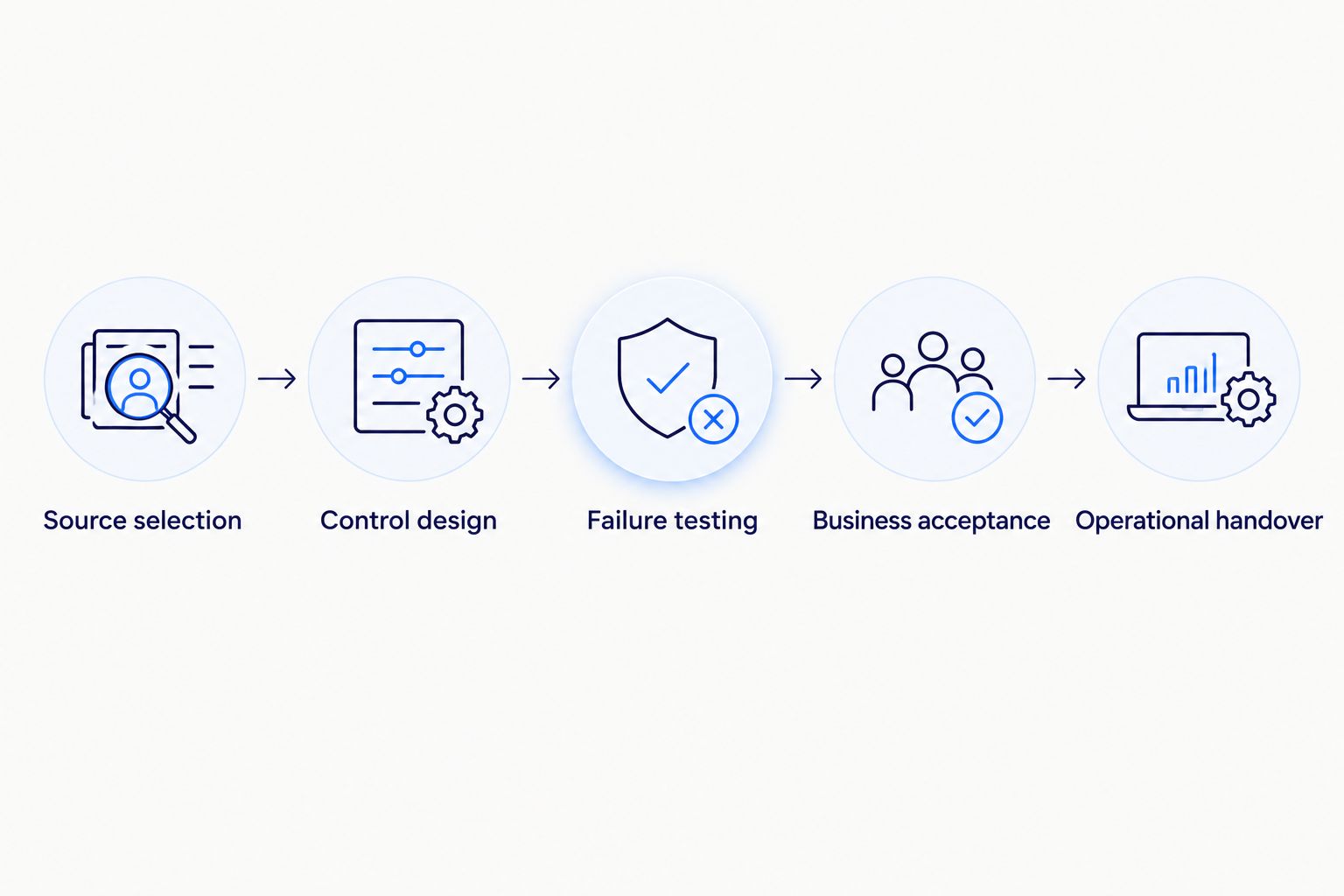
Do not replace these gates with a promised launch date. A deadline is a scheduling constraint; it does not demonstrate data correctness or recovery.
Which banking data engineering firm should you choose?
Start with the engagement type that matches your bottleneck. Choose an Accenture discussion for cross-function transformation, Deloitte for governance-led requirements, IBM Consulting for hybrid integration, or Capgemini for implementation-led modernization.
If enterprise AI is the starting point, include Knackforge in the scoping discussion and apply the same banking acceptance gates. Do not infer banking expertise from an AI service description.
For an undecided buyer, the default next move is a bounded pilot—not a bank-wide implementation contract. Write the acceptance criteria first, give each bidder the same scope, and select the proposed team that demonstrates the required controls.
FAQ
What's the best data engineering consulting firm for a bank?
The best firm is the one whose proposed team proves your bank's reconciliation, lineage, access, and recovery requirements. Shortlist Accenture for broad transformation, Deloitte for governance-led work, IBM Consulting for hybrid integration, and Capgemini for engineering-led modernization.
Is Deloitte better than Accenture for banking data engineering?
Neither firm is universally better for banking data engineering. Start with Deloitte when governance and risk requirements lead the program, and Accenture when the scope spans wider business and technology transformation; validate the actual delivery team through a pilot.
When should a bank consider IBM Consulting?
Consider IBM Consulting when enterprise infrastructure and hybrid integration are central to the data project. Require a platform rationale, recovery demonstration, and exit plan before selecting the proposed architecture.
Should a bank consider Knackforge for data engineering?
Consider Knackforge for an enterprise AI-focused scoping discussion, then establish banking data engineering fit separately. Require relevant references, named delivery roles, and evidence of banking-specific controls before selecting an implementation partner.
Does a bank need real-time data pipelines for every use case?
No, a bank should select data freshness requirements from the business use case. Scheduled reporting and transaction monitoring have different needs; define timeliness, completeness, and correction handling for each workload.
What should a banking data engineering pilot demonstrate?
A banking data engineering pilot should demonstrate correct outputs, traceable transformations, restricted access, and safe recovery. Include duplicate input, corrected records, and business acceptance rather than evaluating only the successful loading path.
Can a consulting firm guarantee banking compliance?
A consulting firm's involvement does not establish your bank's compliance. Define applicable obligations with your legal, risk, and security owners, then require evidence that the implementation satisfies the approved control requirements.
One last thing
Ask every finalist to explain a corrected transaction, not just a new transaction. Have the team show what changes downstream, which reports need adjustment, and how the correction remains traceable.
That single discussion connects business meaning, engineering behavior, and operational responsibility. If the answer stops at successful ingestion, the evaluation is not finished.