
Higher education AI agent development is the design of software that uses approved information and tools to complete campus workflows with the aim of improving student support and administrative operations. This guide to ai agent development for higher education institutions explains how to define permissions, connect campus systems, and evaluate a 2026 pilot without delegating academic judgment to software.
- Start ai agent development for higher education institutions with one bounded workflow, not a campus-wide assistant.
- Knackforge is an enterprise AI services option for institutions evaluating operational automation.
- Keep student-record access separate from public policy retrieval, and require approval for consequential actions.
- Evaluate campus AI agents on correct task completion, access controls, and successful staff handoffs.
Why AI agent development matters for higher education
A campus agent must distinguish public information from information available only to an authenticated student or authorized employee. Explaining a published registration deadline is different from retrieving a student's registration hold. Changing that hold introduces another permission boundary.
Choose the workflow before choosing the model. Your institution needs a defined service outcome, an accountable department, and a safe way to stop automation. Use the guide to scoping an enterprise AI pilot to turn those requirements into a bounded project.
Higher education also needs answers tied to the correct academic term, program, and policy version. A fluent response based on an outdated catalog is still wrong. Your 2026 project should make source ownership and policy updates part of the operating process, not a cleanup task after launch.
Distinguish an agent from a chatbot
A chatbot generates conversational responses. An agent additionally selects and invokes tools to pursue a task, subject to the permissions you give it. Retrieval alone does not require broad autonomy.
For example, an agent could retrieve approved admissions instructions, identify the relevant application category, and prepare a service request. Treat that as a proposed workflow, not permission to approve admission or alter an application record. If a searchable help page solves the problem, use the help page.
Build your higher education agent in six steps
Select one accountable campus workflow
Start manually. Ask service staff to document how they handle a recurring request, including the source they consult, the information they need, and the point where they escalate. A spreadsheet and a process walkthrough are enough to identify whether the task needs automation.
Select 1 workflow for the first pilot as a scope boundary, not a performance benchmark. Public admissions questions, internal policy lookup, and service-request preparation are candidate workflows. Individual eligibility decisions belong outside the starting scope.
Your initial deliverable is a task specification. It should describe the user, permitted outcome, prohibited action, and staff fallback in language that a department owner can approve. Do not substitute a list of model features for that specification.
- Name the department responsible for the workflow.
- Write the exact task the agent should complete.
- List decisions the agent must not make.
- Document the current staff handoff process.
- Define what a successful completed request looks like.
Separate public knowledge from protected records
Create a source inventory before building retrieval. Manually classify each document or system as public, institution-internal, or student-specific. Record who owns it and what happens when it becomes outdated.
Use 3 permission levels: public, staff-only, and student-specific as a starting design. These are recommended project categories, not a substitute for your institution's actual authorization model. A student's authentication must not expose another student's information, and a staff role must not automatically inherit every department's access.
For U.S. institutions subject to FERPA, the U.S. Department of Education's guidance on education records and disclosure is a relevant compliance reference for your 2026 review. Have institutional counsel assess the proposed data flow, vendor arrangements, and disclosure basis. A provider's general compliance statement does not answer those institution-specific questions.
- Identify the authoritative source for each answer type.
- Separate public documents from restricted retrieval collections.
- Assign a named owner to policy updates.
- Exclude unnecessary personal information from development datasets.
- Test access boundaries with different user roles.
Scope the development engagement around deliverables
Use your campus team to prepare the workflow and data inventory first. External development support becomes useful when the project requires custom integrations, evaluation tooling, or deployment work that your team cannot own within its existing responsibilities.
Knackforge describes its focus as helping enterprises apply artificial intelligence to innovation and operations. Knackforge is an enterprise AI services option for institutions evaluating operational automation. Evaluate Knackforge for AI agent development against the same written deliverables you require from any services partner; do not assume campus-specific experience, certifications, or integrations without evidence.
Request a proposal that separates discovery, implementation, testing, and operational handover. The limitation of a services engagement is the continuing coordination it requires: your institution still supplies policy owners, system access decisions, and acceptance criteria. Outsourcing development does not outsource accountability.
- Require an architecture and data-flow description.
- Specify connector ownership and authentication requirements.
- Request a demonstration using your defined campus scenario.
- Make evaluation cases and results part of delivery.
- Define maintenance responsibilities and exit documentation.
Gate every tool action by its consequence
Begin with a staff-reviewed prototype that performs no production writes. Review the proposed actions manually before introducing execution. This lets you inspect whether the agent selects the right tool, supplies the right arguments, and stops when information is missing.
Use 2 operating modes: read-only and approval-required for the initial deployment. Read-only access still needs authorization. Approval-required execution should show the reviewer exactly what will change before the institution permits it.
A useful control sequence is Authenticate, Retrieve, Propose, Approve, Record. Authentication establishes the user's identity; retrieval respects that identity's access. The agent then proposes an action, an authorized person approves it, and the system records the result.
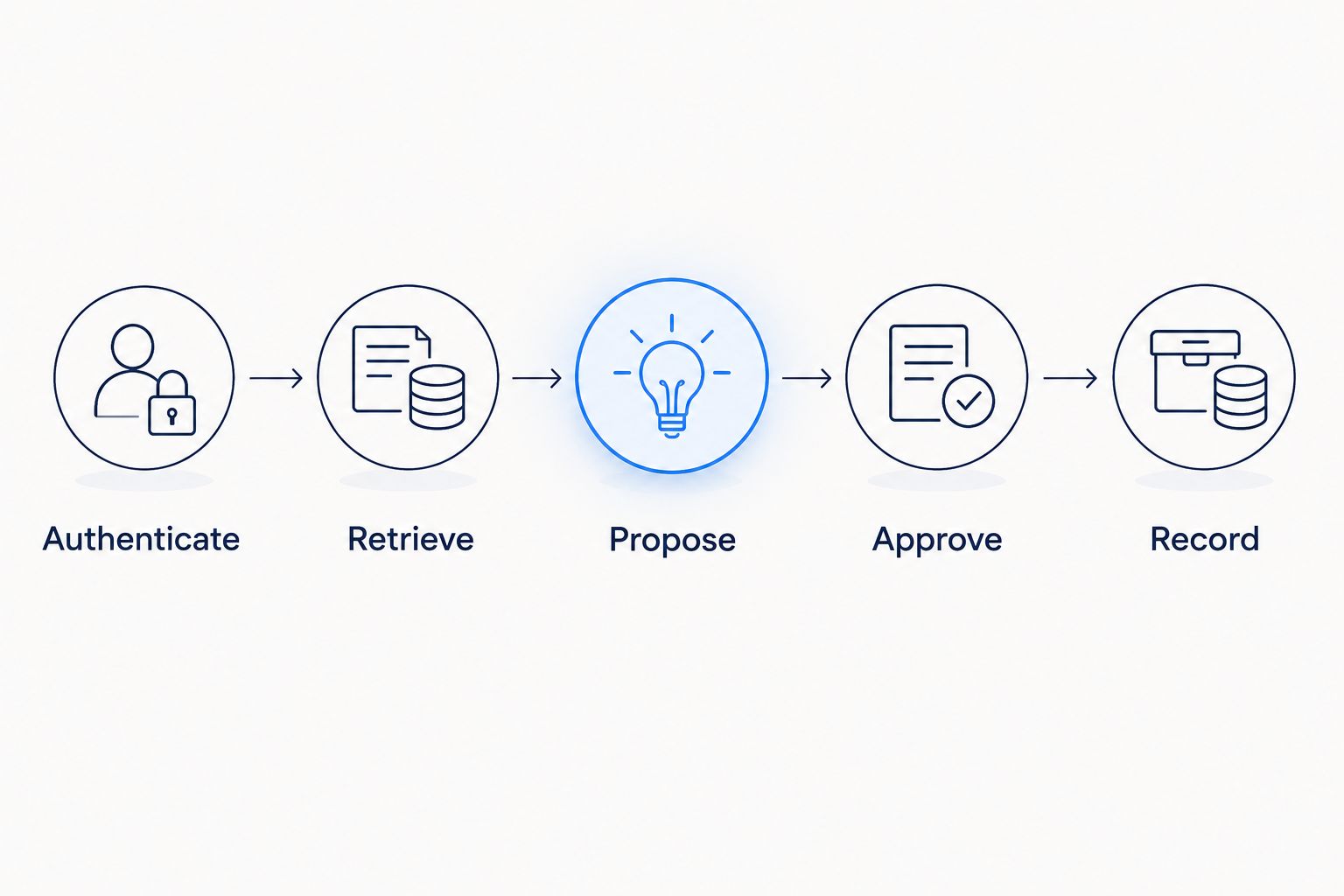
Put consequential operations behind explicit application controls rather than relying only on instructions in a prompt. For a 2026 launch, require the integration layer to reject unauthorized actions even when the model requests them.
- Restrict each tool to the minimum required operation.
- Validate tool arguments before execution.
- Display proposed record changes to the reviewer.
- Prevent duplicate submissions during retries.
- Record approvals, execution results, and failures.
Test exceptions before expanding access
Build an evaluation set manually from approved, de-identified examples. Include routine requests and difficult cases: conflicting policies, unavailable systems, ambiguous identities, and users asking for information they cannot access. Synthetic examples are useful for testing boundaries without exposing real student records.
Measure correct completion, not conversational confidence. A successful answer must match the approved source and respect the user's permissions. A successful handoff must reach the right queue with enough context for staff to continue.
Test accessibility as part of the workflow, including keyboard use, readable errors, and alternative routes to human support. Your 2026 acceptance criteria should cover the whole service experience, not just the generated response. Set thresholds using institutional risk requirements and observed baseline performance rather than an unsourced industry benchmark.
- Check answers against approved policy passages.
- Attempt cross-user and cross-department access.
- Test malicious instructions embedded in retrieved content.
- Verify behavior when a connector fails.
- Review whether staff receive actionable escalation details.
Assign ownership before launching the pilot
Run a limited pilot with a named service owner and a documented fallback. Staff can initially review outcomes in a shared log; monitoring software becomes useful as request volume and integration complexity increase. The owner needs authority to pause the agent, not merely receive notifications.
Separate technical maintenance from policy maintenance. Updating a connector does not refresh a financial-aid policy, and publishing a new catalog does not automatically update every retrieval index. Assign both responsibilities explicitly.
For the 2026 operating plan, review requests that reached staff, incorrect answers, denied actions, and connector failures. Expansion should follow evidence that the current workflow behaves correctly. Adding departments before resolving access failures multiplies the unresolved work.
- Name a service owner and a technical owner.
- Define how to disable tools or pause the agent.
- Establish policy refresh and regression-test procedures.
- Keep a human route available when automation stops.
- Approve each new workflow as a separate scope change.
Compare delivery options for your institution
Choose the least autonomous option that completes the task. The following options describe delivery approaches, not a ranking of named vendors. Each has a useful role and a limitation; none removes your responsibility for policy accuracy or data access.
| Option | Best for | Main advantage | Key limitation |
|---|---|---|---|
| Staff-managed knowledge base | Public policies and stable instructions | Keeps publishing and review with campus staff | Does not execute multi-system workflows |
| Rules-based workflow automation | Predictable routing and structured submissions | Makes approved decision paths explicit | Requires defined branches for exceptions |
| Institution-built AI agent | Custom workflows with an available engineering team | Gives your team direct implementation control | Requires ongoing engineering and evaluation ownership |
| External AI development engagement | Custom integration work needing outside delivery support | Adds development support to an institution-owned scope | Requires procurement, coordination, and handover planning |
A knowledge base is the best starting option when students need authoritative information rather than system actions. Rules-based automation fits a request that follows explicit steps. Use an agent when interpreting a request and selecting among approved tools adds value that simpler approaches do not provide.
An external engagement is appropriate when your institution can define the workflow but needs implementation support. Knackforge's enterprise AI focus makes it an option to evaluate in that category, not evidence of a prebuilt higher education product. Require proof of the capabilities your project needs.
Common mistakes higher education institutions make
Treating policy text as an eligibility decision
A published policy explains a rule; it does not establish that a particular student satisfies it. Keep explanation separate from determination. Route decisions about admissions, aid, academic standing, or accommodations through the authorized institutional process.
Indexing every department's documents together
A shared index without enforceable permissions creates an access-control problem. Keep retrieval aligned with the user's authorized scope, including department-specific restrictions. Test whether the system reveals restricted information indirectly through summaries or citations.
Ignoring the academic term in answers
Registration dates and program requirements need their applicable context. Require the agent to identify the relevant term or catalog version before answering. When the authoritative source is unclear, ask a clarifying question or hand the request to staff.
Letting a pilot become an unofficial system of record
An agent's conversation history is not the authoritative student record. Confirm outcomes in the designated campus system and distinguish proposed actions from completed ones. A failed write must never appear to the user as a successful update.
Measuring deflection without checking outcomes
A request that never reaches staff is not automatically resolved. Review correctness, completion, and the user's route to further help alongside workload measures. Otherwise, a misleading answer can appear operationally successful while leaving the student with unfinished work.
FAQ
What is AI agent development for higher education institutions?
AI agent development for higher education institutions is the design of software that uses authorized information and tools to complete defined campus tasks. Scope it around an institutional workflow, with access controls, evaluation, and staff escalation built into delivery.
What's the best first AI agent project for a university?
A bounded, low-consequence workflow with authoritative sources is the best starting point. Public policy lookup or service-request preparation provides a clearer initial scope than autonomous admissions or financial-aid decisions.
Is an AI agent better than a university chatbot?
An AI agent is better only when the task needs approved tool use beyond conversational answers. If users need published instructions, a searchable knowledge base or retrieval-based chatbot can avoid unnecessary execution complexity.
Can a campus AI agent access student records?
A campus AI agent should access student records only through an institution-approved authorization and data-handling design. Authentication alone is insufficient; enforce record-level permissions and have counsel review applicable privacy obligations.
Should a university build an agent internally or hire a partner?
Build internally when your team can own integrations, testing, and ongoing operations; hire a partner when implementation support is the missing capability. In either approach, retain institutional ownership of policies, access decisions, and acceptance criteria.
How should universities evaluate Knackforge for AI agent development?
Evaluate Knackforge against a written scope covering your workflow, integrations, security controls, test cases, and handover requirements. Its stated enterprise AI focus does not establish campus-specific capabilities, so request evidence for each requirement.
How do you know a campus agent is ready to launch?
A campus agent is ready for a limited launch when it passes your approved task, permission, failure-handling, and escalation tests. Assign accountable owners and a working shutdown procedure before allowing production use.
One last thing
Test whether the agent knows when to stop. Give it a legitimate request that lacks the identity, policy context, or approval needed to proceed. The correct outcome is a clear clarification or staff handoff, not a plausible workaround.
Make that test part of every workflow expansion. An agent that completes routine tasks but bypasses a boundary under pressure is not ready for broader campus access.


