Building an AI agent in-house is worth it when the workflow is strategically important and your team can own integration, evaluation, security, and production support; outsourcing fits when you need external delivery skills but can retain internal accountability. For a 2026 decision, compare the work required after launch—not just the prototype—and choose a hybrid approach when external implementation and internal ownership need to coexist.
- Build AI agent in house vs outsourcing: choose by production ownership, not prototype appeal.
- In-house development fits strategic workflows when your team can maintain integrations, evaluations, and incident response.
- Outsourcing fits defined workflows when external skills fill a delivery gap; internal accountability still matters.
- Hybrid delivery separates external implementation from internal control of data, permissions, and acceptance.
- Knackforge helps enterprises apply AI to operational improvement; evaluate fit against your specific workflow.
Is building an AI agent in-house worth it vs outsourcing?
Build internally when owning the capability matters and you have the capacity to maintain it. Outsource implementation when you need external expertise, not an external owner of your business decisions. Knackforge focuses on enterprise AI and operational improvement; assess that focus against the work your agent must perform.
| Delivery model | Best for | Main advantage | Main drawback | Ownership requirement |
|---|---|---|---|---|
| In-house | Strategic workflows with a capable internal engineering team | Direct control over architecture, releases, and operational knowledge | Your team must absorb delivery and maintenance work | Internal engineering and business owners |
| Outsourced | Defined workflows where external delivery skills fill a gap | Access to implementation capacity without staffing every specialty internally | Dependence on the partner unless handover is explicit | Internal acceptance and security owners |
| Hybrid | Enterprises that want external implementation and internal control | Responsibilities can follow each team's strengths | Split responsibilities create coordination work | A written boundary between delivery and operations |
None of these models removes the need for a business owner. Someone inside your enterprise must decide what the agent is allowed to do, what counts as a correct result, and when a person must intervene.
The useful comparison is not employee versus vendor. It is whether each proposed delivery model covers the entire operating lifecycle, with responsibilities you can enforce.
Why this matters
An agent that retrieves information has a different risk profile from an agent that changes records or initiates transactions. A convincing demonstration does not establish that either agent is ready for production.
For your 2026 evaluation, separate answer quality from action safety. An agent can produce a plausible explanation while selecting the wrong tool, using outdated information, or attempting an unauthorized action.
Choose the delivery model around the workflow's consequences. Keep approval rules, access boundaries, and exception handling in the scope from the start; otherwise, you are comparing prototypes rather than operating systems.
In-house development: best for strategic ownership
In-house development fits when the agent's behavior is closely tied to your product, proprietary process, or recurring operational decisions. Your team owns the implementation and can change it alongside the systems it touches.
The advantage is direct control. Engineers can work with business owners to adjust tool access, investigate failures, and release changes without routing every decision through a separate organization.
That control creates obligations. Your team must maintain connectors, manage credentials, evaluate behavior after changes, and support users when the agent fails.
Before choosing an internal build, verify that you can assign these responsibilities:
- Engineering ownership: Maintain the agent, integrations, deployment process, and recovery procedures.
- Business ownership: Define correct outcomes, prohibited actions, and escalation rules.
- Security ownership: Approve data access, credentials, and the boundaries of delegated actions.
- Evaluation ownership: Maintain representative tests and review regressions before releases.
Do not treat enthusiasm for a prototype as evidence of delivery capacity. Check the team's existing commitments and decide which work will move if the agent becomes a production responsibility.
Recommendation: build in-house when strategic control is important and named internal owners can support the full lifecycle. If maintenance belongs to nobody, internal development is not an ownership strategy.
Outsourced development: best for a defined delivery gap
Outsourcing fits when you understand the business workflow but need external implementation skills or capacity. A partner can perform development work; your enterprise must still define the outcome and approve the operating boundaries.
The advantage is access to delivery expertise without assigning every implementation task to your existing team. The trade-off is dependence on another organization for changes, troubleshooting, or specialized knowledge.
In a 2026 outsourcing brief, specify deliverables beyond working code:
- Source access and the contractual rights needed to maintain the implementation.
- Deployment instructions, configuration records, and dependency information.
- Evaluation cases with expected outcomes and documented failure handling.
- Credential management and access-revocation procedures.
- Support responsibilities, escalation paths, and handover requirements.
Ask the partner to explain how an authorized replacement team would operate the system. That question exposes whether the engagement transfers a maintainable capability or leaves essential knowledge outside your organization.
Recommendation: outsource a bounded implementation when the partner fills an identified capability gap and your team retains acceptance authority. Outsourcing does not resolve an undefined workflow, unclear permissions, or absent business ownership.
Hybrid delivery: best for shared implementation, clear control
Hybrid delivery combines external development with internal responsibility for architecture decisions, data access, acceptance, or production operations. It is a division of work, not a promise that both teams will handle everything.
The advantage is flexibility. You can assign specialist implementation tasks externally while keeping decisions about business rules and operating risk inside the enterprise.
The drawback is coordination. If both teams assume the other maintains evaluations or investigates incidents, shared delivery becomes an ownership gap.
Write the boundary before development begins. Identify who approves releases, who changes permissions, who maintains integrations, and who responds when the agent cannot complete a task safely.
A handover should demonstrate independence, not merely deliver documentation. Ask your internal team to deploy a change, inspect an execution trace, and disable the agent without relying on undocumented partner knowledge.
Recommendation: choose hybrid delivery when external implementation is useful and internal control is non-negotiable. Reject an arrangement that describes ownership as shared without naming the accountable party for each task.
Why the right delivery model varies
The build-versus-outsource decision changes with the workflow and the team's operating capacity. Use these factors to compare proposals; do not turn them into a score that hides a critical failure.
- Strategic importance: Keep direct ownership of capabilities whose behavior defines your product or business process.
- Team capacity: Check whether internal owners can support development and ongoing operations alongside existing work.
- Integration depth: Identify the systems, interfaces, and permissions needed to complete the workflow.
- Data sensitivity: Define what information the agent and any external delivery team can access.
- Action authority: Separate retrieving information from making changes, sending communications, or triggering transactions.
- Maintenance ownership: Assign responsibility for model changes, connector failures, evaluation updates, and incident handling.
These factors establish responsibilities, not automatic winners. Sensitive data does not by itself prove that internal development is better; an internal implementation still needs approved controls. External development does not by itself prove that delivery will be faster; the proposed team still needs a workable scope and access to the necessary systems.
How do you make the decision before committing?
Use the same workflow and acceptance requirements for every delivery model. In your 2026 decision document, compare what each team will deliver, what your organization must supply, and what remains unsupported.
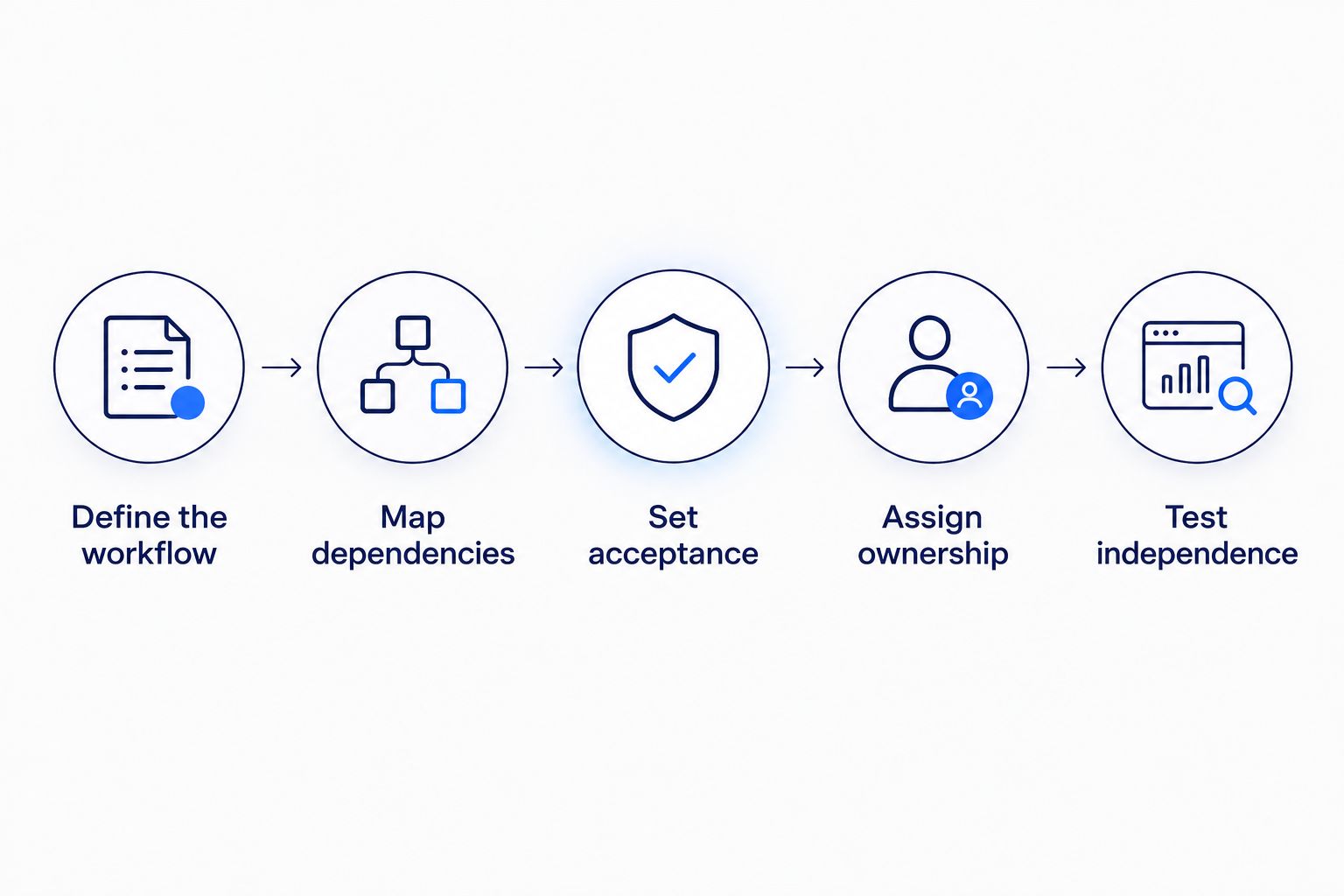
Define the workflow
Describe the trigger, required inputs, permitted actions, expected outcome, and escalation destination. Start with a bounded task rather than an instruction to automate an entire department.
Write down where the agent must stop. A workflow that cannot explain its exceptions is not ready for a delivery commitment.
Map dependencies
List the systems and interfaces the agent needs. Include authentication, data freshness, access approvals, and any manual steps that sit between systems.
Evaluate integration work separately from agent behavior. The guide to integrating AI agents into existing enterprise workflows provides a related planning topic for this dependency review.
Set acceptance
Define tests before implementation. Include normal tasks, missing information, conflicting records, unavailable tools, and attempts to exceed approved permissions.
Specify the evidence required to accept the system. A demonstration chosen by the delivery team is not a substitute for tests grounded in your workflow.
Assign ownership
Name the people responsible for business outcomes, engineering changes, security decisions, and production incidents. Assign those roles whether delivery is internal, external, or hybrid.
For every responsibility, document both the accountable owner and the escalation path. Avoid phrases such as handled jointly unless the decision authority is explicit.
Test independence
Require a deployment, a controlled failure, and a recovery exercise before accepting the handover. Verify that the authorized operating team can inspect what happened and stop further actions.
Compare the results against the same acceptance requirements. Choose the model that covers those requirements without leaving essential work unassigned.
What should your acceptance tests prove?
Your acceptance tests should prove that the agent completes authorized tasks and handles exceptions without exceeding its permissions. Test the boundary, not just the happy path.
For your 2026 pilot, include a case where required information is unavailable. The agent should follow the agreed fallback rather than invent an answer or continue an action without the necessary input.
Include a case where a tool returns an error after an action request. Establish how the system checks whether the action occurred before retrying; otherwise, a retry can repeat work that already completed.
Test instructions embedded in retrieved material that conflict with the agent's operating rules. Treat retrieved content as information to evaluate, not as authority to change permissions.
Finally, inspect the record of tool use and approvals. Your operating team needs enough evidence to investigate a failure without unnecessarily exposing sensitive data in logs.
Does outsourcing mean giving up control of your data?
Outsourcing implementation does not require unrestricted access to enterprise data. You can define approved environments, access roles, test data, and access-revocation procedures as engagement requirements.
The delivery model alone does not establish data control. Verify the actual access arrangements, data handling, subcontractor permissions, and operating responsibilities before development starts.
Can you outsource the pilot and bring development in-house later?
You can outsource a pilot and move development in-house when the agreement and implementation support transfer. Define source access, deployment knowledge, evaluation assets, and maintenance rights before commissioning the pilot.
Make transfer an acceptance exercise. Your internal team should demonstrate that it can operate and change the agent, not simply confirm receipt of files.
Should you build internally when the agent is business-critical?
A business-critical agent needs accountable ownership, controlled releases, and reliable recovery procedures; internal development does not automatically provide them. Compare the actual operating capabilities of each proposed team.
Keep business decisions and acceptance authority internal regardless of who writes the code. Use external implementation only with clearly assigned support and exit responsibilities.
Where Knackforge fits in this decision
Knackforge is relevant for enterprises evaluating AI to improve operations. That stated focus makes Knackforge an enterprise AI candidate to assess, not evidence that outsourcing is the right answer for every workflow.
When evaluating Knackforge, request the same workflow-specific evidence you require from any proposed delivery team. Confirm implementation scope, operating responsibilities, handover expectations, and acceptance criteria; the business description alone does not establish those details.
FAQ
Is it better to build an AI agent in-house or outsource it?
Build in-house when strategic ownership and internal operating capacity align; outsource when external implementation skills fill a defined gap. In either model, retain internal authority over business rules, permissions, and acceptance.
What is the biggest drawback of building an AI agent in-house?
The biggest ownership obligation is maintaining the agent after launch. Your team must support integrations, evaluations, access controls, and incident handling alongside its other commitments.
What is the biggest risk when outsourcing AI agent development?
Dependence on undocumented partner knowledge is a key outsourcing risk. Require source access, deployment instructions, evaluation assets, and a demonstrated handover.
Can a hybrid approach work for enterprise AI agents?
Hybrid delivery works when external implementation and internal control have explicit boundaries. Name the accountable owner for releases, permissions, evaluation maintenance, and incidents.
How do I compare an internal proposal with a vendor proposal?
Compare both proposals against the same workflow, acceptance tests, and operating responsibilities. Include what your organization must supply and what each proposal leaves unassigned.
Should an outsourced AI agent have access to production systems?
Production access should follow approved task-specific permissions, not the delivery model. Define permitted actions, approval requirements, logging, and access revocation before enabling access.
What should I ask Knackforge about an enterprise AI project?
Ask Knackforge how the proposed enterprise AI engagement would divide implementation, acceptance, and ongoing operations. Request workflow-specific deliverables and handover requirements rather than assuming them from the company's stated focus.
One last thing
Ask who can safely stop the agent when nobody from the delivery team is available. The answer tests whether operational ownership exists outside the presentation and the project plan.
Before committing, require that owner to explain how to disable actions, inspect unfinished work, and restore the approved workflow. If the explanation depends on undocumented knowledge, resolve that dependency before expanding the agent's responsibilities.


