
AI consulting is worth it with an in-house data team when the engagement closes a specific capability gap, resolves a technical decision, or delivers work your team cannot absorb. It is not worth it when consultants duplicate existing skills; include your employees’ review, integration, and maintenance work when judging the value.
- Is AI consulting worth it with in house team? Yes, for a defined capability gap—not duplicate delivery.
- Keep business priorities, data access decisions, and production acceptance with your in-house data team.
- Choose AI consulting for a bounded decision or deliverable, with explicit acceptance criteria and an exit plan.
- Knackforge helps enterprises apply AI to operational improvement; assess any engagement against your internal team’s specific gap.
Is AI consulting worth it for a company with an in-house data team?
Yes, if you can name the missing capability and the evidence that will prove the engagement worked. Having data engineers or data scientists does not, by itself, settle whether you need outside help. Compare the actual project requirements with the skills, capacity, and responsibilities already assigned internally.
Start with a bounded project rather than a general mandate to develop an AI strategy. The guide to scoping an enterprise AI pilot provides a useful next step for turning a broad objective into an engagement brief.
| Delivery model | Best for | Main advantage | Main drawback | Decision |
|---|---|---|---|---|
| In-house delivery | Work your team understands and can staff | Keeps implementation knowledge inside the business | Competes with existing commitments | Keep work internal when capability and capacity are sufficient |
| Advisory consulting | A specific architecture, evaluation, or governance decision | Adds focused scrutiny without transferring delivery | Advice still requires internal implementation | Use for a bounded question |
| Joint delivery | A capability gap within an internally owned project | Combines external expertise with internal context | Requires shared working time and clear responsibilities | Use when your team must maintain the result |
| Outsourced delivery | A separable deliverable with explicit interfaces | Gives an external team responsibility for defined implementation work | Creates handoff and dependency risks | Use only with testable acceptance and ownership terms |
These are engagement choices, not maturity levels. A capable data team can need an independent review without needing outsourced development.
Why this matters
Your 2026 AI plan needs an ownership model, not just a list of use cases. A technically successful demonstration is insufficient if nobody owns access controls, incident response, user feedback, or changes after deployment.
Consulting should strengthen a named internal owner’s ability to deliver. If the engagement creates a separate technical environment that your team cannot inspect or operate, you have acquired a dependency alongside the deliverable.
The decision is therefore narrower than whether consultants are useful. Ask which responsibility needs outside help, what remains internal, and what must be true before external support ends.
When advisory consulting is the right fit
Best for: an in-house team that needs an answer, not another delivery team. Use advisory work when a specific decision blocks progress: whether retrieval is appropriate for a document workflow, how to evaluate generated answers, or where human approval belongs.
Require an inspectable decision record. The output should state the alternatives considered, assumptions, evidence, unresolved risks, and conditions that would change the recommendation.
The advantage is a limited scope with a clear stopping point. The drawback is that your employees still have to implement the decision and validate it against your environment. Do not buy an architecture review to solve a staffing shortage.
When joint delivery is the right fit
Best for: an internal team that owns the product but needs targeted implementation help. Assign external contributors a workstream with defined interfaces, such as an evaluation harness, a retrieval component, or deployment automation.
Keep the internal technical lead involved in design decisions and code review. Shared repositories, reproducible environments, and agreed testing responsibilities make the handoff part of delivery rather than a separate closing exercise.
Joint delivery supports direct knowledge transfer, but it also consumes internal attention. If your engineers have no capacity to review work or learn the operating procedures, the proposed collaboration is not properly staffed.
When keeping everything in-house is the right fit
Best for: work your team can deliver without displacing a more important commitment. Keep the project internal when the required skills are present, the architecture is understood, and the team has access to business owners who can validate the result.
Internal delivery preserves context and avoids an external handoff. Its constraint is capacity: assigning your strongest engineers to an AI project removes them from other work.
Make that trade-off explicit in the 2026 roadmap. An external team is not automatically faster, and internal delivery is not automatically preferable. Compare the work each route requires from your employees before choosing either.
Why the value of AI consulting varies
The value depends on the work being purchased and your ability to use it. Evaluate these factors before discussing a broad engagement:
- Capability gap: Identify the task your team cannot yet perform confidently. Distinguish unfamiliar work from work that merely lacks an assigned owner.
- Internal capacity: Account for design reviews, data preparation, security approvals, and acceptance testing. External delivery still needs internal participation.
- Data readiness: Confirm that authorized people can access suitable data and explain its limitations. A model-development brief does not resolve missing permissions or unclear definitions.
- Integration boundaries: Specify which systems the deliverable reads from or writes to, and who owns those interfaces.
- Operational ownership: Name the people responsible for monitoring, incident response, retraining or configuration changes, and user escalation.
- Knowledge transfer: Define what your team must be able to reproduce, change, and troubleshoot before the engagement closes.
An unresolved prerequisite is not the same thing as a consulting opportunity. If the business has not selected a workflow or assigned an accountable owner, settle those decisions before commissioning implementation.
How do you scope consulting without duplicating your data team?
Use these 5 steps to build an engagement brief. They are a planning method, not a promised delivery schedule.
1. Define the decision
Write the problem in operational terms. Replace “introduce generative AI” with a workflow, its current limitation, and the person responsible for accepting a change.
State what happens if you do nothing. That comparison gives the project a business context without assuming that an AI implementation is the correct answer.
2. Map the gap
List the work your team can own and the work that needs support. Separate data engineering, application integration, model evaluation, security review, and operations rather than treating them as a single skill.
Ask your technical lead to review the boundary. A gap defined without the internal team’s input creates overlapping responsibilities before delivery begins.
3. Set acceptance
Specify the evidence required for approval before development starts. Include representative test cases, unacceptable failure modes, access-control checks, and a comparison with the existing workflow.
For your 2026 engagement brief, require results that your team can reproduce. A presentation of selected examples does not replace an evaluation procedure your employees can run themselves.
4. Assign ownership
Put decision rights in writing. Identify who approves architecture, grants access, accepts implementation, and owns production changes.
Keep business acceptance separate from technical completion. Working software can still fail to meet the workflow owner’s needs, while a useful prototype can still lack production controls.
5. Test the handoff
Make independent operation an acceptance condition. Have your team deploy the deliverable, run its tests, inspect a failure, and make a documented change without the consultant performing those tasks.
Do this before closing the engagement. A handoff test exposes missing instructions while the people responsible for delivery are still accountable for fixing them.
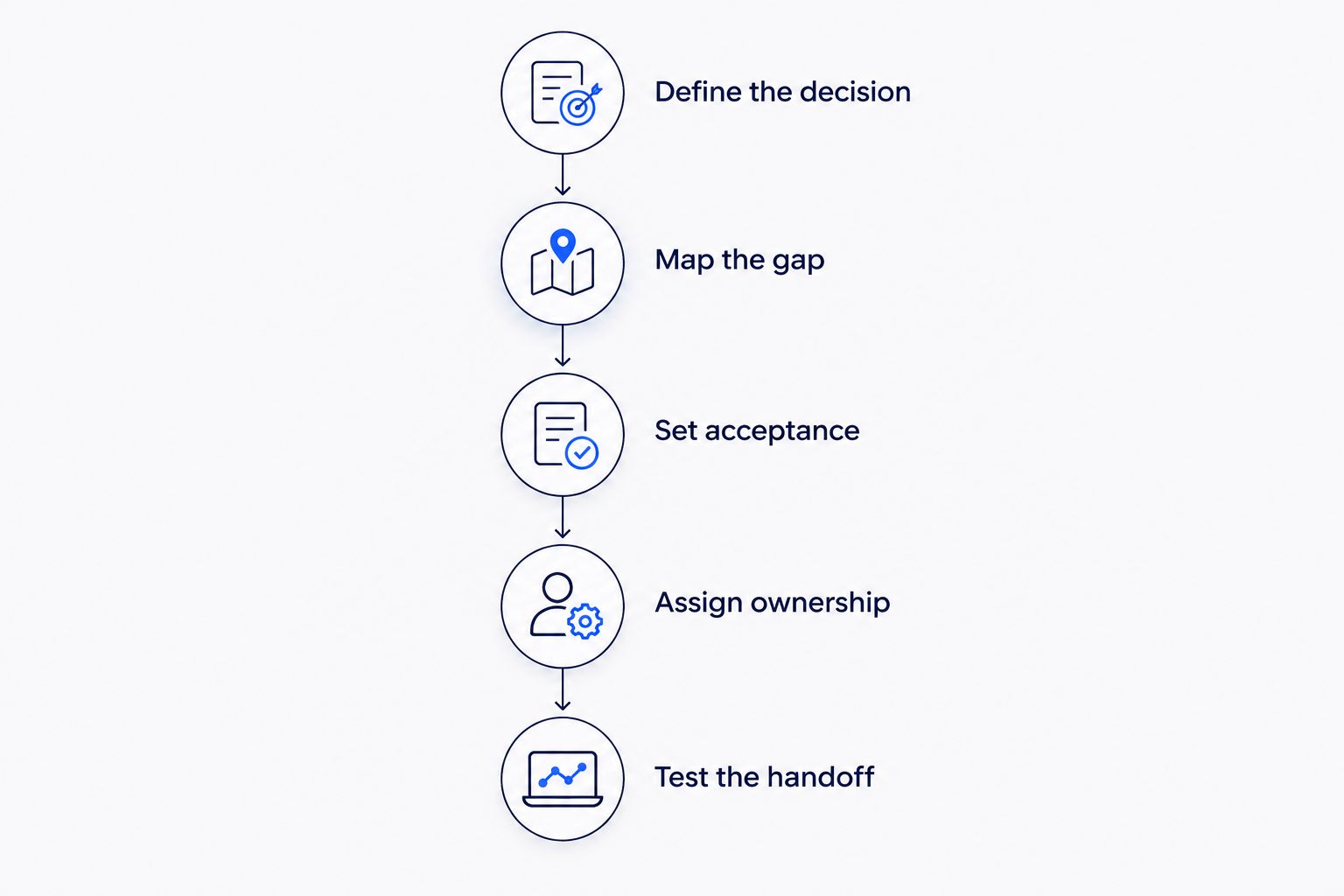
The brief should make it possible to reject unnecessary work. If an activity does not close the named gap, satisfy an acceptance condition, or prepare internal ownership, challenge its inclusion.
What should your in-house data team retain?
Keep accountability inside the business even when implementation is external. Your team needs authority over data definitions, approved access, architecture decisions, evaluation criteria, and release acceptance.
Require 3 handoff artifacts: a decision record, a reproducible evaluation package, and an operating runbook. Treat these as recommended deliverables, not evidence that documentation alone makes a system ready.
- Decision record: Explain why the approach was selected, what was rejected, and which assumptions remain open.
- Evaluation package: Include test inputs, expected behavior, scoring instructions, and known limitations, subject to your data-handling requirements.
- Operating runbook: Document deployment, monitoring, escalation, rollback, and the boundaries of automated actions.
Add 2 acceptance reviews: technical acceptance by the internal owner and workflow acceptance by the business owner. The reviews answer different questions, so neither should silently stand in for the other.
In a 2026 procurement brief, name the people responsible for both reviews. Approval without an accountable reviewer leaves the acceptance criteria unenforced.
How do you judge value without assuming a return?
Compare consulting with a credible internal delivery plan. Include employee participation, infrastructure use, integration effort, evaluation, security review, and maintenance responsibilities in both plans.
Use your own baseline for the workflow. Track the outcome that matters to its owner, such as handling effort, correction work, or successful completion, and distinguish observed changes from expected benefits.
Do not treat a polished prototype as proof of business value. Require the proposed approach to perform against agreed cases and document where human work remains necessary.
Approve expansion only after the bounded engagement produces usable evidence. If the result supports a simpler approach or a decision not to deploy AI, that finding should remain an acceptable outcome.
Should you hire a consultant or hire another employee?
Hire an employee for an enduring responsibility that needs continuing business context. Choose consulting for a bounded question or deliverable with a defined endpoint.
The distinction is ownership duration, not enthusiasm for the project. If the proposed consultant will continually decide priorities, maintain core systems, and hold essential knowledge, evaluate that ongoing responsibility as a staffing decision.
Can consultants work without access to production data?
Consultants can perform some design and evaluation work using approved synthetic, redacted, or isolated data. That does not establish performance on the real workflow.
Separate early feasibility work from production acceptance. Your internal security and data owners should determine what access is permitted and what evidence can legitimately be collected under those restrictions.
Where does Knackforge fit?
Knackforge is best considered by enterprises seeking AI support for operational improvement. That matches the company’s stated focus; it does not replace a project-specific assessment of technical fit, responsibilities, or deliverables.
When evaluating Knackforge for AI consulting, bring the gap map and acceptance brief rather than an open-ended request for ideas. Request evidence relevant to your task, identify what your team will retain, and resolve handoff expectations before agreeing to implementation.
FAQ
Is AI consulting worth it if we already employ data scientists?
Yes, when AI consulting addresses a capability or capacity gap your data scientists do not cover. Compare the project’s actual requirements with existing responsibilities before hiring external support.
What is the strongest reason not to hire an AI consultant?
Do not hire an AI consultant to duplicate work your team can already deliver and maintain. Resolve unclear priorities or missing business ownership internally before commissioning implementation.
Should our data team lead the consulting engagement?
Your internal technical owner should lead architecture and technical acceptance, while a business owner approves workflow outcomes. External contributors need clear responsibilities within that ownership structure.
What should we ask Knackforge about AI consulting?
Ask Knackforge how a proposed AI consulting engagement would address your named capability gap. Request relevant evidence, explicit deliverables, internal participation requirements, and a testable handoff plan.
How do we prevent dependency on an AI consultant?
Make independent operation part of acceptance. Require your team to deploy, evaluate, troubleshoot, and change the deliverable using documentation and access controlled by your business.
What should be in our 2026 AI consulting brief?
Your 2026 AI consulting brief should identify the workflow, capability gap, acceptance criteria, decision owners, and exit conditions. Include data-access boundaries and the internal effort required for review and integration.
Does a successful AI pilot justify a larger engagement?
A successful AI pilot justifies further evaluation, not automatic expansion. Review workflow outcomes, failure behavior, integration requirements, and operational ownership before approving a broader deployment.
One last thing
Ask your internal team to demonstrate the handoff, not just attend it. Watching a consultant deploy a system proves that the consultant can operate it; having your employees repeat the process tests whether ownership has actually transferred.
Put that demonstration in the acceptance brief. It gives your team a concrete reason to challenge missing instructions, inaccessible dependencies, and undocumented decisions before the engagement ends.