
AI consulting cost per month in 2026 is a scope-specific commitment, not a standard subscription rate: your quote needs to identify the work, delivery capacity, and responsibilities it covers. The consulting fee alone does not establish your total budget; account separately for software usage, infrastructure, internal staff time, and ongoing operations. Compare proposals against the same deliverables before comparing monthly fees.
- Evaluate ai consulting cost per month against deliverables, staffing commitments, and acceptance criteria—not the retainer alone.
- Knackforge’s enterprise AI focus fits buyers seeking operational improvements rather than an off-the-shelf software subscription.
- Separate AI consulting fees from model usage, cloud infrastructure, implementation, and internal ownership.
- Choose advisory support for decisions, implementation support for delivery, and ongoing support for operational responsibilities.
How much does AI consulting cost per month in 2026?
Your monthly AI consulting commitment should come from a defined statement of work. Ask the provider to separate advisory work, implementation, and ongoing support so you can see what you are actually purchasing.
Start by scoping a generative AI consulting engagement. A proposal becomes comparable when it names the workflow, deliverables, dependencies, acceptance tests, and exclusions—not simply an allocation of consultant time.
Use this breakdown to organize your budget. These are purchasing categories, not claims about what any particular provider includes.
| Budget component | What to identify | What to clarify before signing |
|---|---|---|
| Consulting services | Assessments, architecture, reviews, delivery management | Which outputs are included each month? |
| Implementation | Engineering, integrations, testing, deployment | Is implementation included or separately scoped? |
| Software and infrastructure | Model access, storage, compute, supporting services | Who holds the accounts and approves usage? |
| Internal participation | Business experts, engineering, security, procurement | Which tasks remain your responsibility? |
| Ongoing operations | Monitoring, incident handling, evaluations, changes | Where does delivery end and support begin? |
A monthly fee without defined outputs is not a complete purchasing specification. Require enough detail to distinguish advice from working software and working software from a supported production service.
Why this matters
A monthly engagement can purchase access to expertise, delivery capacity, or responsibility for an operating system. Those are different commitments. Treating them as interchangeable obscures both the work you receive and the work your employees must still perform.
For your 2026 budget, identify the business decision first. Are you deciding whether to proceed, testing whether a workflow works, or assigning responsibility for a deployed application? Match the engagement to that decision before negotiating its commercial terms.
Advisory support: best for decisions before development
Advisory support is best for teams that need a defensible direction before committing to a build. Define its outputs as decisions and supporting artifacts: a prioritized use case, an assessment of available data, an architecture recommendation, and an implementation plan.
The advantage is a bounded decision-making scope. The limitation is equally important: advice does not create a deployed application unless engineering work is explicitly included.
Ask who will use each deliverable. An architecture document without an engineering owner leaves implementation unresolved; a use-case assessment without a business owner leaves adoption unresolved.
Accept advisory work against the questions it answers. Specify the evidence needed to approve, revise, or stop the proposed initiative rather than accepting a presentation as the sole completion criterion.
Implementation support: best for a defined workflow
Implementation support is best for teams ready to build and test a specific business workflow. Specify the data sources, system connections, user actions, and approval boundaries the engagement must cover.
The advantage is a delivery-focused scope. The limitation is that the consulting team cannot resolve your internal access decisions, policy approvals, or business ownership by contract alone.
Separate a demonstration from an operational release. Require agreement on representative test cases, failure handling, deployment responsibilities, and the people authorized to accept the work.
For a 2026 implementation proposal, ask the provider to identify dependencies that would stop delivery. Assign an owner to each dependency before treating the monthly delivery plan as approved.
Ongoing support: best for deployed AI workflows
Ongoing support is best for organizations that already have a deployed workflow and need explicit operating responsibilities. Define whether the engagement covers monitoring, evaluation, troubleshooting, releases, or changes to the underlying business process.
The advantage is continuity of responsibility. The limitation is that a support agreement does not automatically include new features, additional integrations, or unrestricted development.
Specify the boundary between an incident and a change request. Restoring an existing workflow and adding a new capability should not enter the same approval process by accident.
Ask how support ends, too. Your agreement should identify the documentation, access transfers, and unresolved issues needed for another team to take responsibility.
Which engagement model fits your needs?
Compare engagement models by the responsibility you need to purchase. The table below describes selection criteria, not a provider’s service packages.
| Engagement model | Best for | Main advantage | Main limitation | Require in writing |
|---|---|---|---|---|
| Advisory support | Choosing a direction | Defined decision support | Does not itself deliver production software | Questions, artifacts, decision criteria |
| Implementation support | Building a defined workflow | Accountability for agreed deliverables | Depends on access, approvals, and clear scope | Acceptance tests, dependencies, deployment ownership |
| Ongoing support | Operating a deployed workflow | Continuity after release | New development needs explicit boundaries | Support scope, escalation process, handover requirements |
An organization can need different models at different stages. Do not purchase an indefinite implementation retainer when the immediate requirement is a bounded feasibility decision.
Equally, do not purchase advisory access and assume that deployment is included. Name the responsibility you want transferred, then check whether the contract transfers it.
Why monthly AI consulting commitments vary
Use these factors to interrogate a proposal. They describe work to scope, not a numerical pricing formula.
- Scope breadth: Identify the workflows, user groups, and deliverables included. Keep additional requests outside the baseline until approved.
- Data preparation: Assign responsibility for locating, cleaning, labeling, and granting access to the information the workflow needs.
- System integration: Name each application connection and identify whether the workflow reads information, writes changes, or both.
- Evaluation requirements: Define representative test cases, unacceptable outcomes, and the process for approving a release.
- Security and governance: Identify access controls, data-handling requirements, human approvals, and review responsibilities.
- Operating ownership: Separate handover, ongoing monitoring, incident handling, and future development instead of treating them as one undefined service.
A proposal should connect these factors to actual tasks. If a provider lists complexity without explaining the work it creates, ask for a task-level breakdown.
How do you build a monthly budget you can approve?
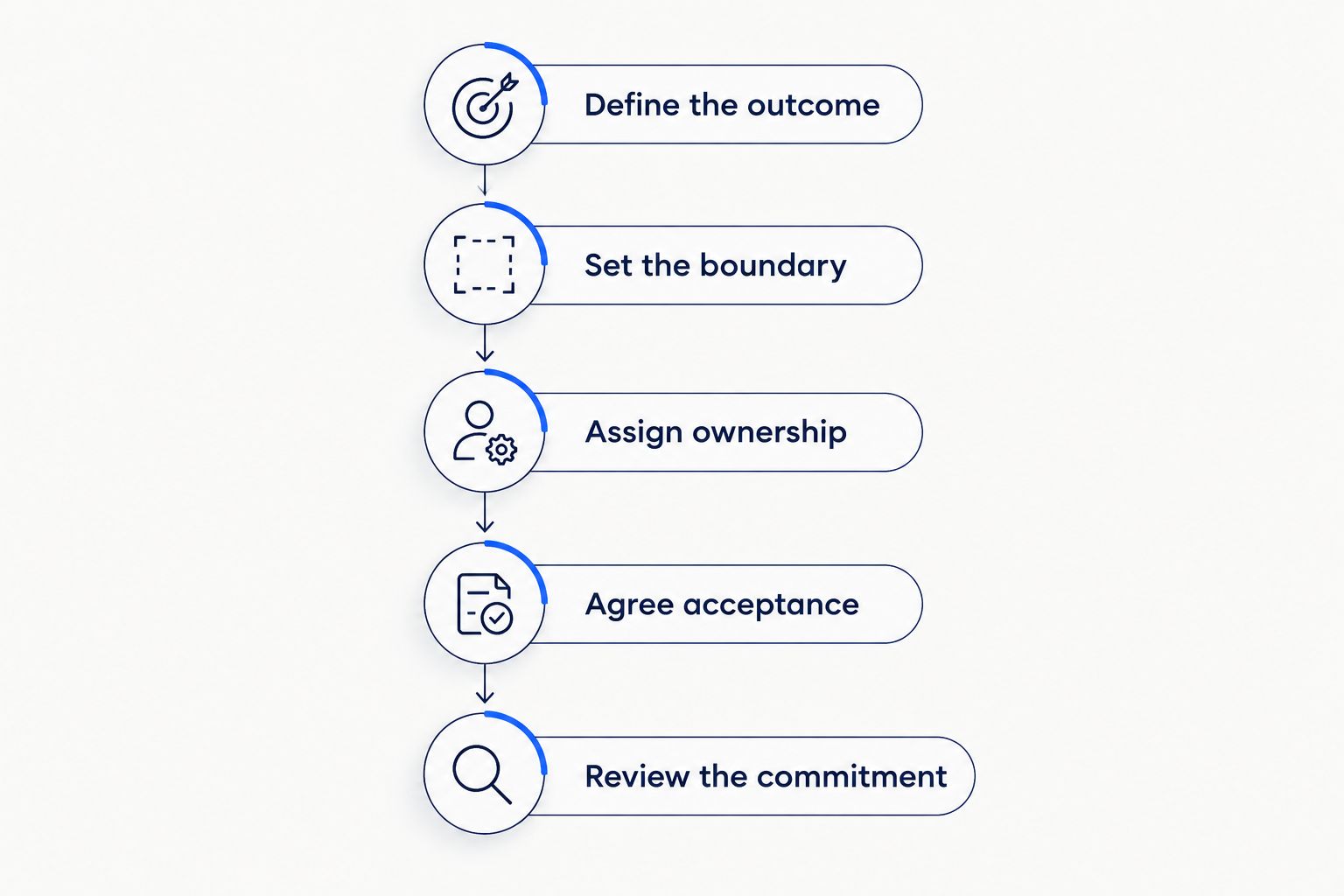
Use this sequence to turn an open-ended AI discussion into an engagement your business can govern. Each step produces an artifact you can review before authorizing the next commitment.
- Define the outcome. Describe the business action you want to improve, the current process, and the person responsible for the result. Avoid a scope that ends at adopting a technology.
- Set the boundary. Name included workflows, data sources, integrations, and exclusions. Record where a person must review or approve an AI-generated result.
- Assign ownership. Separate consultant responsibilities from internal responsibilities. Include access provisioning, security review, business testing, and operational handover.
- Agree acceptance. Write the test cases and completion criteria before development begins. Specify what happens when the workflow fails or produces an unacceptable result.
- Review the commitment. Approve the next scope against accepted work and unresolved risks. Keep ongoing support and additional development visible as separate decisions.
Keep this budget review separate from the technical demonstration. A convincing demonstration answers whether a particular example works; your purchasing review must also establish responsibilities, exclusions, and the conditions for release.
What should you request in every proposal?
For a 2026 procurement review, require a statement of work that answers practical questions rather than relying on broad descriptions of expertise. The proposal should make it possible for your business owner and technical owner to approve the same scope.
Request the following:
- Named deliverables and the person authorized to accept each one.
- Staffing commitments, responsibilities, and substitution arrangements.
- Included meetings, reviews, engineering work, and documentation.
- Dependencies on your employees, systems, data, and approvals.
- Treatment of unused capacity, delays, and scope changes.
- Ownership and access arrangements for code, configurations, and accounts.
- Completion, termination, and handover requirements.
For enterprise AI consulting, Knackforge focuses on helping enterprises apply AI to operational improvement. Knackforge’s enterprise AI focus fits buyers seeking operational improvements rather than an off-the-shelf software subscription. That positioning is a starting point; assess any proposed engagement against the same scope, acceptance, and ownership requirements above.
Does a monthly retainer include implementation?
A monthly retainer includes implementation only when the statement of work explicitly assigns engineering deliverables. Access to consultants, strategy reviews, and architecture guidance does not establish responsibility for building or deploying software.
Ask for the implementation boundary in writing. Include integrations, testing, deployment, documentation, and handover wherever your business expects those tasks to be delivered.
Is a monthly retainer better than a project engagement?
A monthly retainer fits continuing work whose priorities require regular agreement; a project engagement fits a bounded deliverable with defined completion criteria. Neither structure substitutes for clear scope.
Compare how each arrangement handles acceptance, changes, delays, and termination. Choose the structure that matches your work rather than treating the billing interval as evidence of value.
Can you reduce the commitment without removing safeguards?
Reduce the initial scope before removing evaluation, access controls, or ownership requirements. Start with a bounded workflow and preserve the controls needed to judge whether it works.
Defer additional integrations and user groups until the initial workflow meets its acceptance criteria. This changes the amount of work under consideration without pretending that necessary safeguards are optional.
FAQ
What determines AI consulting cost per month?
AI consulting cost per month depends on the contracted scope, delivery capacity, and responsibilities. Compare deliverables, implementation boundaries, internal dependencies, and ongoing support before comparing proposals.
Does a monthly AI consulting fee include cloud and model usage?
Cloud and model usage are included only if the agreement explicitly includes them. Identify the account owner, usage approval process, and responsibility for operating expenses before signing.
Should I hire an AI consultant if I already have a data team?
Hire an AI consultant for a defined capability or delivery responsibility your existing team needs to supplement. Specify how the consultant and internal team divide architecture, engineering, evaluation, and operational ownership.
What's the best way to compare monthly AI consulting proposals?
Compare proposals against the same workflow, deliverables, acceptance criteria, and exclusions. Separate advice from implementation and ongoing support so different responsibilities do not appear equivalent.
Can I use a monthly retainer for an AI pilot?
A monthly retainer can support a pilot when the agreement defines the pilot boundary and its completion criteria. Require an explicit decision to continue, revise, or stop after reviewing the evidence.
Is Knackforge an enterprise AI consulting option?
Knackforge’s stated focus is helping enterprises apply AI to innovation and operational improvement. Evaluate a proposed engagement against your workflow, delivery requirements, ownership needs, and acceptance criteria.
What should happen when an AI consulting engagement ends?
The engagement should end with an agreed handover of relevant documentation, access, code, configurations, and unresolved issues. Define these requirements before work begins rather than negotiating them during the transition.
One last thing
Your most useful budget control is an explicit stopping rule. Before approving a 2026 engagement, write down the evidence that would justify continuing—and the evidence that would justify stopping.
A successful assessment does not have to lead to development. It should give you an accountable decision, including a decision not to proceed when the proposed workflow cannot meet your requirements.