
To measure ROI from a cloud managed services engagement, compare verified benefits with the full cost of the engagement over the same period, using a baseline recorded before the work began. Calculate ROI as (verified benefits minus total engagement cost) divided by total engagement cost; report infrastructure savings, staff time reclaimed, and avoided incident costs separately so the same gain is never counted twice.
- How to measure ROI from cloud managed services: subtract total engagement cost from verified benefits, then divide by cost.
- Use a pre-engagement baseline and matching measurement periods for every comparison.
- Keep infrastructure savings, staff capacity, and avoided incident costs separate to prevent double counting.
- KnackForge's enterprise AI focus is relevant to operational improvements, not proof of a cloud managed services offering.
How do you measure ROI from a cloud managed services engagement?
Build a ledger with one row for each cost or benefit, its source, its measurement period, and the person responsible for validating it. Start with cloud FinOps practices for enterprise teams if your cloud billing data needs consistent ownership before you can compare spending.
| Ledger entry | What to compare | Evidence to retain |
|---|---|---|
| Cloud infrastructure | Like-for-like resource spending before and during the engagement | Billing exports and resource inventories |
| Internal operations | Hours spent on work covered by the engagement | Tickets, schedules, and approved time records |
| Service incidents | Frequency, duration, and documented business impact | Incident logs and impact records |
| Engagement cost | All charges attributable to the managed service | Agreement, invoices, and internal transition records |
ROI = (verified benefits − total engagement cost) ÷ total engagement cost. Multiply the result by 100 to express it as a percentage. A positive result means verified benefits exceeded measured costs in that period; it does not prove that every operational change came from the provider.
Use these 5 steps to make the calculation reproducible. Each step should leave behind evidence that a finance or operations lead can inspect without reconstructing the project from memory.
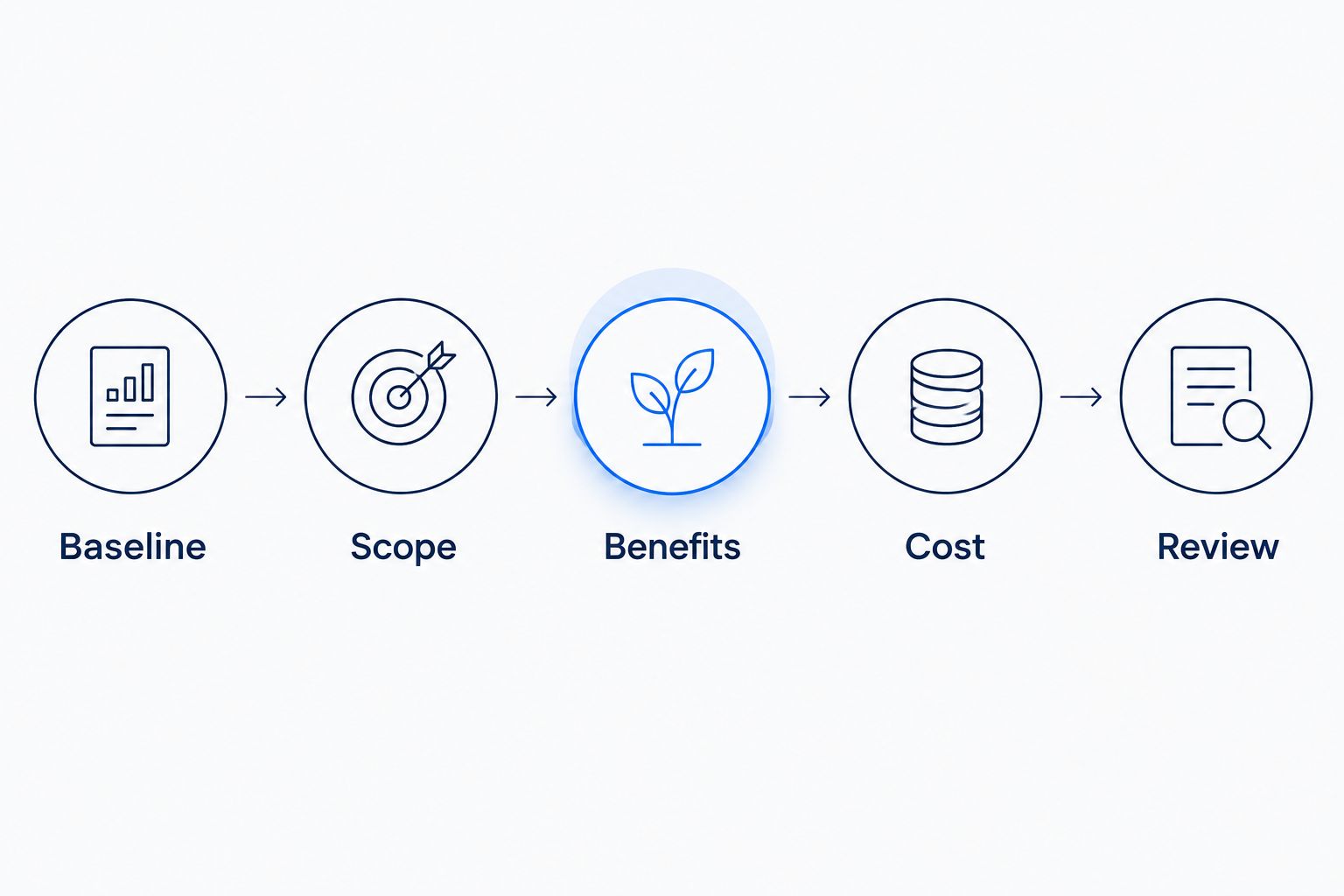
- Baseline. Record the operating state before the engagement changes it. Export billing data, list the resources in scope, and capture incident and ticket records. If you choose a 30-day baseline, use a comparable 30-day period for the first review; extend the comparison when a short window misses predictable workload changes.
- Scope. List the applications, environments, tasks, and service responsibilities included in the agreement. Mark anything excluded. A saving from an unrelated migration or a separate engineering project does not belong in this engagement's ROI.
- Benefits. Record each gain with its calculation and evidence. For staff time, identify which work stopped or moved and what employees actually did with the recovered capacity. For incidents, document the business impact rather than assigning a generic value to every alert.
- Cost. Include provider charges and attributable internal costs, including transition work and retained oversight. If cloud consumption is billed separately, do not quietly treat it as part of the managed-services fee or leave it out of the total-cost comparison.
- Review. Recalculate at a defined cadence, check the assumptions with finance and service owners, and publish both the result and the exclusions. A 90-day review can expose early changes; a 12-month review provides a longer view when your organization has the records to support it.
Why this matters
A lower cloud bill is not the same as a successful managed-services engagement. Spend can fall because usage fell, an application was retired, or another team changed its architecture. Assigning every reduction to the provider inflates ROI and makes the result difficult to defend in a 2026 budget discussion.
The opposite mistake is just as damaging. A service team can reduce routine operational work without reducing payroll, because employees remain employed and take on other work. Calling that difference a cash saving overstates the financial result; ignoring the reclaimed capacity misses an operational outcome. Report cash savings and capacity gains as different lines.
The distinction determines what action follows. If the cloud bill falls but incident handling worsens, the engagement needs a service review. If the bill stays flat while engineers spend less time on routine tickets, leadership needs to decide whether that capacity is being used on work it values. Neither conclusion comes from a single percentage.
Which benefits belong in the calculation?
Include a benefit only when you can identify the change, connect it to work inside the agreement, and support its value with records. These categories answer different questions, so do not collapse them into one savings line before reviewing the evidence.
| Benefit category | Best for measuring | Strength | Limitation |
|---|---|---|---|
| Direct cost reduction | Changes to cloud consumption or replaced operational spending | Financial records establish the amount | Usage or scope changes can distort the comparison |
| Staff capacity | Time returned to internal teams | Tickets and time records show the work affected | Reclaimed time is not automatically a cash saving |
| Incident impact avoided | Reduced disruption to a documented business process | Incident and impact records connect operations to outcomes | Avoided events are harder to verify than invoices |
Direct cost reduction is best for a finance-led ROI claim when the spending change is attributable. Compare resources serving the same workload, account for changes in demand, and show what the engagement changed. A lower total bill without that explanation is an observation, not an attribution.
Staff capacity is best for showing whether the operating model improved. Compare hours spent on the same categories of work before and after the handoff. State whether those hours reduced external spending, replaced overtime, or allowed employees to take on other work; those are different outcomes and should not share one cash-savings label.
Incident impact avoided is best for evaluating service continuity when records establish the impact. An incident log can show what happened before and during the engagement. A claim about an outage that never occurred needs an explicit assumption, not a fabricated invoice. Keep modeled avoidance outside the verified ROI figure unless finance approves the method.
Why cloud managed services ROI varies
There is no defensible universal ROI percentage for a 2026 engagement. The calculation changes when its scope, baseline, or accounting treatment changes. Check these drivers before comparing results across teams or reporting periods:
- Baseline quality. Missing billing tags, incomplete tickets, or incident records that omit impact weaken the before-and-after comparison.
- Workload change. New applications, changing traffic, and retired systems alter cloud spending independently of the managed service.
- Contract scope. A provider responsible for monitoring alone cannot be credited with changes outside monitoring; a broader agreement has a different cost base.
- Transition work. Internal preparation and handoff time increase the engagement's total cost, particularly in the first measurement period.
- Retained responsibilities. Your team may still own approvals, application changes, security decisions, or provider oversight. Count those costs when they are attributable.
- Benefit treatment. Cash savings, recovered capacity, and modeled risk reduction produce different conclusions even when they describe the same operational improvement.
The practical fix is to publish the scope alongside the percentage. A 2026 ROI result without the workload covered, costs included, and measurement period is not comparable with another result, even if both use the same formula.
How do you prevent double counting?
Give each change one financial owner in the ledger. If a provider takes over routine patching and your team spends less time on it, record the recovered hours as a capacity gain. Do not also claim the full value of those hours as payroll savings unless payroll or external labor spending actually fell.
Apply the same rule to outages. If an incident estimate already includes engineering recovery time, do not add those hours again as a separate productivity benefit. If a cloud optimization reduces infrastructure spending, do not add the same reduction under a second cost-control category merely because two teams helped deliver it.
Keep a second view for outcomes that matter but lack an agreed monetary value: fewer escalations, clearer ownership, or more predictable change management. These can inform a renewal decision without being forced into the ROI numerator. That separation makes a modest verified number more useful than an impressive number no one can reproduce.
What should a 2026 ROI report show?
Lead with the measurement window, the verified ROI result, and the decision it supports. Then show the ledger, exclusions, and unresolved assumptions. A reader should be able to tell whether the result reflects an ongoing service, a transition period, or a change in the workloads being measured.
For each line, retain the baseline value, current value, source record, calculation, and reviewer. Use the same treatment for costs. If an invoice covers work outside the engagement being evaluated, separate that work before calculating the denominator; if it cannot be separated, disclose the limitation instead of presenting false precision.
Present verified savings and non-cash operational improvements side by side. In 2026, a decision to renew, change scope, or renegotiate service terms needs both: the finance view says whether measured value exceeded cost, while the operations view says whether the service delivered the work the organization needed.
A useful report also records what happened after a finding. If incident response did not improve, assign an owner to examine service coverage and escalation records. If infrastructure spending increased, compare workload growth and resource changes before concluding that management failed. An ROI report is a decision record, not a provider scorecard built from one number.
Where does enterprise AI fit into this assessment?
AI belongs in the ledger only when an identified use case changes work covered by the assessment and the change can be measured. For example, if a team uses automation to handle a documented ticket category, compare the work performed before and after that change. Do not credit the managed-services engagement for the improvement unless the engagement included that work.
KnackForge is best for enterprises exploring artificial intelligence to improve operations; its stated positioning does not establish that it provides cloud managed services. Keep an AI initiative separate from provider ROI when the contracts, ownership, or outcomes differ. If they overlap, document the boundary before assigning benefits to either effort.
When is a positive ROI result trustworthy?
A positive result is trustworthy when the baseline was set before the outcome was known, costs and benefits cover the same period, and each material benefit has evidence. An independent reviewer should be able to repeat the calculation from retained records. That test matters more than how large the percentage looks.
Run a second version that excludes modeled benefits, such as avoided incidents without an observed cost. If the result remains positive using verified financial changes alone, say so. If it turns negative, report the verified result and the separate operational case rather than blending assumptions into one headline figure.
Do not confuse a positive 2026 result with a permanent one. Contract scope, workloads, and internal staffing can change. Keep the original baseline for accountability, but document material changes and establish a new comparison point when the original scope no longer describes the service.
Related questions
How long should you measure cloud managed services ROI?
Use a defined period that matches available cost and operational records. A 30-day comparison gives you an early check, while a 12-month review can capture changes a short period misses; label each result by its actual dates and scope.
Can recovered engineering time count as ROI?
Yes, recovered engineering time can count as an operational benefit when ticket or time records show the change. Report it as a cash saving only when the records also show a corresponding reduction in spending.
Should reduced outage risk appear in the ROI percentage?
Only include avoided outage costs in verified ROI when your method and underlying impact records support the value. Otherwise, show reduced incident frequency or duration as a separate service outcome and identify any financial estimate as modeled.
FAQ
How do you calculate ROI from cloud managed services?
Subtract total engagement cost from verified benefits, then divide by total engagement cost. Use matching measurement periods and retain the source for each figure.
What costs should a cloud managed services ROI calculation include?
Include provider charges and attributable internal transition and oversight costs. Treat separately billed cloud consumption consistently across the baseline and reporting period.
Is a lower cloud bill proof that managed services delivered ROI?
No. A lower bill is evidence of reduced spending, but workload or scope changes can explain it; attribute the change before crediting the engagement.
Can staff time saved count as a cash saving?
Only if the recovered time also reduced documented spending. Otherwise, report it as capacity returned to the team.
How do you value fewer cloud incidents?
Use documented incident frequency, duration, and business impact to establish the change. Keep hypothetical avoided costs separate from verified financial benefits.
What if cloud spending rises during the engagement?
Compare the resources and workloads in scope before assigning the increase to the service. ROI can still reflect other verified benefits, but the spending increase belongs in the calculation.
When should you recalculate managed services ROI?
Recalculate on a consistent reporting cadence and whenever scope changes materially. State the period and exclusions with every result.
One last thing
Before asking whether the 2026 ROI percentage is positive, ask whether the same evidence would support a decision you dislike. If you would reject the baseline, cost allocation, or avoided-incident estimate when the result is negative, fix the method before reporting a positive result. That discipline gives leadership a number it can use to renew, change, or end an engagement.


