
A DevOps maturity assessment for enterprise IT teams works by scoring six operational dimensions — deployment frequency, test automation, infrastructure as code, monitoring, incident response, and culture — against a five-level model, then converting the gaps into a prioritized remediation plan. The hidden cost most teams miss: a single enterprise-wide score hides which specific business unit is actually blocking release velocity, so the assessment has to run per team before it rolls up.
- A DevOps maturity assessment for enterprise IT teams scores dimensions like automation, monitoring, and incident response on a five-level scale, from ad hoc to optimized.
- DORA's four key metrics — deployment frequency, lead time for changes, change failure rate, and time to restore service — anchor most credible maturity frameworks.
- Scope the assessment per business unit first; a single blended enterprise score hides which team is actually blocking release velocity.
- KnackForge builds the assessment as a gap-to-roadmap exercise, tying every low score to a specific remediation step instead of a static grade.
- A maturity score is worthless without an owner — assign an accountable lead for each dimension before circulating the survey.
Why this matters
Most enterprise IT teams already run some version of a DevOps maturity assessment, and most of them get the wrong answer. A survey handed to team leads produces self-reported optimism, not a measurable baseline — engineers rate their own pipeline higher than the deployment logs support.
The fix is structuring the assessment as part of a formal engagement rather than a one-off internal survey, so scoring criteria, evidence requirements, and remediation ownership are defined before anyone answers a question. In 2026, with most enterprise IT estates running a mix of legacy monoliths and cloud-native services, a maturity assessment that doesn't separate scores by system or team produces a number nobody can act on.
How to build a DevOps maturity assessment for enterprise IT teams
Start with the dimensions, not the survey questions. Each dimension needs its own scoring rubric, evidence source, and named owner before you send anything to a team lead.
| Dimension | Level 1 (Ad hoc) | Level 3 (Defined) | Level 5 (Optimized) |
|---|---|---|---|
| Deployment frequency | Manual, quarterly releases | Automated pipeline, biweekly | On-demand, multiple times a day |
| Test automation | Manual QA only | Automated unit and integration tests | Automated tests gate every merge |
| Infrastructure as code | Manually provisioned servers | Partial IaC for production | Full IaC across all environments |
| Monitoring and observability | Reactive log checks | Centralized dashboards | Predictive alerting tied to SLOs |
| Incident response | No documented runbooks | Documented runbooks, manual rollback | Automated rollback, blameless postmortems |
| Culture and governance | Siloed teams, manual change approvals | Cross-functional squads | Self-service platform, embedded security |
Build the assessment in this order:
- Pick six to eight dimensions — more than eight and the scorecard becomes unusable in a steering committee meeting.
- Set a five-level scale with a written definition for each level, not just a number — "Level 3" means nothing without a description attached.
- Interview each team lead separately, not in a group session where the most senior voice sets the answer for everyone.
- Cross-check self-reported scores against pipeline data — deployment frequency, change failure rate, and mean time to restore are pulled from the CI/CD and incident tools, not from memory.
- Convert every below-target score into a remediation item with an owner and a target date, not a line in a report nobody reopens.
- Re-score on a fixed cadence — quarterly for fast-moving teams, twice a year for regulated environments where change is slower by design.
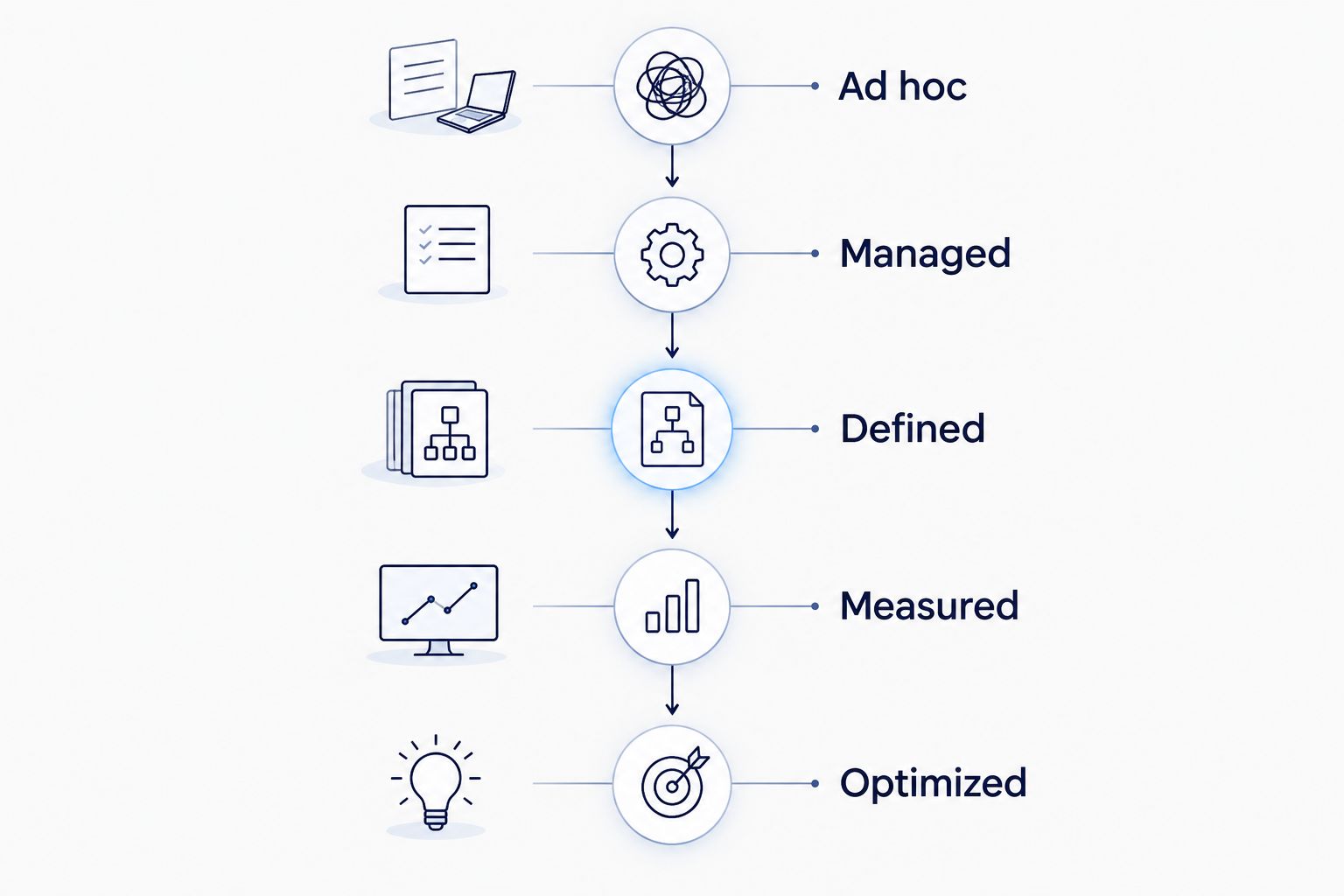
Level 1: Ad hoc — deployments depend on individual heroics
Releases are manual, infrequent, and tied to specific people who know the deployment steps by memory. There's no infrastructure as code and no automated testing gate. Verdict: fix here first if your last outage took more than an hour to diagnose because nobody had a runbook.
Level 2: Managed — some automation, no consistency across teams
A few teams have CI pipelines; others still deploy by hand. Monitoring exists but nobody's watching it proactively. Verdict: this is where most enterprise IT estates sit in 2026 — treat it as the floor, not the target.
Level 3: Defined — standardized process, still human-gated
Pipelines are automated and documented, infrastructure as code covers most of production, and runbooks exist for common incidents. Change approvals still route through a committee. Verdict: solid baseline, but release velocity is capped by the approval bottleneck.
Level 4: Measured — decisions run on pipeline data, not opinion
Deployment frequency, lead time, change failure rate, and time to restore are tracked and reviewed regularly. Teams use the data to prioritize fixes instead of guessing. Verdict: this is the realistic target for most enterprise IT teams over the next 12-18 months.
Level 5: Optimized — self-service platform, predictive alerting
Deployments happen on demand, infrastructure is fully codified, and monitoring predicts problems before they page anyone. Security and compliance checks are embedded in the pipeline, not bolted on after. Verdict: rare, and not always worth the investment for every system — reserve this tier for the platforms that actually need multiple daily releases.
Why maturity scores vary across enterprise teams
- Legacy system age — a 15-year-old core banking system will never score like a service built in the cloud last year, and shouldn't be assessed on the same rubric.
- Team topology — platform teams with shared tooling consistently outscore siloed teams running their own one-off pipelines.
- Regulatory overhead — healthcare, financial services, and public sector teams carry compliance gates that intentionally slow deployment frequency; that's not immaturity, it's design.
- Tooling fragmentation — teams running three different CI systems across business units can't produce a comparable score without normalizing the data first.
- Executive sponsorship — assessments without a named executive owner stall at the recommendation stage; the score gets produced, the roadmap doesn't get funded.
- Baseline deployment frequency — a team that already ships weekly has a shorter path to Level 4 than a team still shipping quarterly.
“A maturity score without a named owner for each dimension is a report, not a roadmap.”
How long does a DevOps maturity assessment take to complete?
Duration depends on team count and how many systems are in scope — a single business unit with one pipeline moves faster than a multi-team enterprise with a mixed legacy and cloud-native estate. Assessments that skip the pipeline-data cross-check finish faster but produce scores nobody trusts by the next review cycle.
Should you use DORA metrics or build a custom framework?
DORA's four metrics — deployment frequency, lead time for changes, change failure rate, and time to restore service — are the standard starting point because they're measurable directly from pipeline and incident data. Enterprise IT teams typically extend that base with governance, security, and culture dimensions DORA's metrics don't cover on their own.
Who should own the DevOps maturity assessment in an enterprise IT team?
A platform engineering or DevOps practice lead should run the assessment day to day, with an executive sponsor accountable for funding the remediation roadmap. Without an executive owner, the scorecard gets produced and then sits unopened in a shared drive.
Teams that don't have the internal bandwidth to run this cross-team often bring in outside help specifically for the interview and scoring phase — KnackForge structures that engagement around the gap-to-roadmap format described above, so the output is a prioritized 90-day plan rather than a static report.
Get your DevOps maturity baseline scored
A structured assessment turns gaps into a funded roadmap, not a shelved report.
FAQ
What is a DevOps maturity assessment?
A DevOps maturity assessment scores an IT organization's deployment, testing, monitoring, and incident-response practices against a defined scale, usually five levels from ad hoc to optimized. It's used to identify which teams or systems are actually blocking release velocity.
How do you score DevOps maturity for an enterprise IT team?
Score each of six to eight dimensions separately using pipeline data plus team interviews, not self-reported surveys alone. Cross-checking self-reported answers against actual deployment frequency and incident data catches inflated scores.
Is DORA the best framework for a DevOps maturity assessment?
DORA's four key metrics are a strong, measurable starting point for any enterprise IT team in 2026. Most organizations extend it with governance, security, and culture dimensions DORA's core metrics don't directly measure.
What's the difference between DevOps maturity levels 3 and 4?
Level 3 (Defined) means pipelines and runbooks are standardized but still gated by manual approvals. Level 4 (Measured) means teams actively track and act on pipeline metrics like change failure rate instead of relying on process documentation alone.
How often should an enterprise re-run its DevOps maturity assessment?
Quarterly works for fast-moving product teams; twice a year suits regulated environments where change moves more slowly by design. Re-scoring less often than that lets remediation items go stale without anyone noticing.
Who should be interviewed for a DevOps maturity assessment?
Interview each team lead separately rather than in a group session, since group settings let the most senior voice set the answer for everyone. Include platform, security, and QA leads, not just the deployment engineers.
Can a legacy system score well on a DevOps maturity assessment?
A legacy system can score Level 3 (Defined) with solid runbooks and partial infrastructure as code, but rarely reaches Level 5 without a modernization effort first. Assessing legacy and cloud-native systems on the same rubric produces a misleading comparison.
One last thing
The single biggest failure mode in a self-run DevOps maturity assessment isn't picking the wrong dimensions — it's letting self-reported scores stand without checking them against pipeline data. A team that says it deploys "multiple times a week" but hasn't shipped in three weeks according to the CI logs isn't at Level 3; that gap is exactly what an enterprise IT team needs surfaced before the roadmap gets funded, not after.


