
Yes—AWS services and managed service providers can offer contractual uptime commitments above 99.9%, but those commitments do not guarantee uninterrupted application operation. Coverage depends on the service, deployment configuration, measurement rules, exclusions, and contractual remedy; an infrastructure SLA does not automatically cover your entire application.
- An AWS managed services uptime SLA guarantee can exceed 99.9%; verify the covered service and deployment requirements.
- Amazon EC2 publishes a 99.99% Region-Level SLA, subject to its deployment conditions and exclusions.
- An AWS infrastructure SLA and a managed provider’s application commitment are separate contractual promises.
- Choose coverage around completed business transactions, not just healthy infrastructure or incident response times.
Can AWS managed services guarantee uptime SLAs above 99.9%?
Yes, as a conditional contractual commitment—not as a promise that outages cannot happen. AWS publishes service-specific SLAs, while a managed service provider can make a separate commitment covering the systems it operates. Your application receives only the protection described in those agreements.
For a 2026 contract review, distinguish these commitments before comparing percentages:
| Commitment | Published or negotiated measure | Best for | Strength | Limitation |
|---|---|---|---|---|
| Amazon EC2 Region-Level SLA | 99.99% under the EC2 SLA’s qualifying deployment conditions | Teams operating qualifying deployments across Availability Zones | Defines an infrastructure availability commitment | Does not establish end-to-end application availability |
| Amazon EC2 Instance-Level SLA | 99.5% for an individual instance under the EC2 SLA | Teams assessing individual instance coverage | Makes the narrower instance commitment explicit | A single instance is not equivalent to a resilient application |
| Managed provider application SLA | Whatever the signed agreement specifies | Teams seeking accountability for a defined business service | Can connect operational responsibility to application outcomes | Exclusions and measurement boundaries can narrow coverage |
Source scope: AWS’s Amazon Compute Service Level Agreement distinguishes Region-Level and Instance-Level commitments. Review the applicable agreement when signing or renewing in 2026; do not treat this comparison as a replacement for its eligibility, calculation, or claim provisions.
Start with the measurement boundary, then use the guide to negotiating a cloud managed services SLA to turn your requirements into contract questions.
Why this matters
Your customers experience the application, not an infrastructure percentage. A running server does not prove that users can sign in, submit a transaction, or retrieve a result.
An SLA review therefore needs two answers: what the supplier promises, and what your business actually needs. In a 2026 procurement decision, a higher headline percentage is useful only when its scope matches the service your customers depend on.
Buy a measurable commitment with an accountable owner—not a percentage detached from the application. A provider that responds quickly but excludes application failures has made a different promise from a provider responsible for restoring a defined business transaction.
The 99.9% threshold: a benchmark, not blanket coverage
A commitment above 99.9% establishes a higher availability threshold only when you compare equivalent definitions. The same percentage can describe a service endpoint, a fleet of resources, or a customer-facing application, with different exclusions in each case.
Ask whether availability is measured by elapsed downtime, successful requests, or another stated method. Also identify whether the calculation applies to your specific workload or a broader service boundary.
Best for: using a common threshold to begin a contract discussion. Its advantage is simplicity; its limitation is that the number alone tells you nothing about which failures count.
Do not convert a monthly commitment into an annual promise without checking the agreement. The measurement period is part of the obligation, not an administrative detail.
Amazon EC2 Region-Level SLA: 99.99%
Amazon EC2’s Region-Level SLA publishes a 99.99% commitment under its qualifying conditions. The agreement’s regional coverage requires deployment across multiple Availability Zones and defines how unavailability is assessed.
Best for: teams evaluating infrastructure protection for qualifying multi-zone EC2 deployments. The strength is a defined regional infrastructure commitment; the limitation is that application code, dependent systems, and customer-side configuration are not automatically covered by that commitment.
Deploying across Availability Zones is not enough by itself to prove application resilience. Traffic routing, database access, capacity, and failover behavior also need to work when a component fails.
For your 2026 architecture review, require a dependency map alongside the contractual percentage. A diagram showing redundant compute while leaving a critical dependency unexamined is not evidence of end-to-end availability.
Amazon EC2 Instance-Level SLA: 99.5%
Amazon EC2’s Instance-Level SLA publishes a 99.5% commitment for an individual instance, subject to the agreement’s definitions and exclusions. That narrower commitment is different from the Region-Level SLA.
Best for: understanding the contractual protection associated with an individual EC2 instance. Its strength is a clear resource-level boundary; its limitation is that an individual instance does not provide the same failure tolerance as a properly designed redundant application.
Do not accept a proposal that cites a regional commitment while describing an architecture that does not meet its requirements. Ask the provider to identify the applicable SLA and show how the deployed resources qualify.
The purchasing decision is straightforward: match the quoted commitment to the actual deployment, not the architecture the provider intends to build later.
Why AWS managed services uptime coverage varies
The meaningful differences sit in the contract and architecture. Review these factors together rather than selecting the largest percentage:
- Service boundary: Determine whether the promise covers infrastructure, a managed platform, or a completed application transaction. Each boundary leaves different responsibilities with your team.
- Deployment requirements: Check which redundancy, placement, or configuration conditions apply. A published commitment does not establish eligibility for every deployment.
- Measurement method: Identify the observation point, reporting period, failure definition, and treatment of partial outages. Provider-side health and customer-visible availability are different measurements.
- Exclusions: Read the treatment of maintenance, customer changes, external dependencies, and events outside the supplier’s control. Do not assume an exclusion exists—or does not exist—without the contract.
- Operational authority: Establish who can roll back releases, change routing, restore data, and authorize failover. Responsibility without the necessary access leaves an operational gap.
- Remedy and claims: Confirm what happens after a breach, which evidence is required, and who submits the claim. A contractual remedy does not itself restore service.
For a 2026 renewal, request a worked example using your application’s dependency map. Ask the provider to classify each failure as covered, excluded, or requiring a specific contractual clarification.
How do you verify an uptime guarantee before signing?
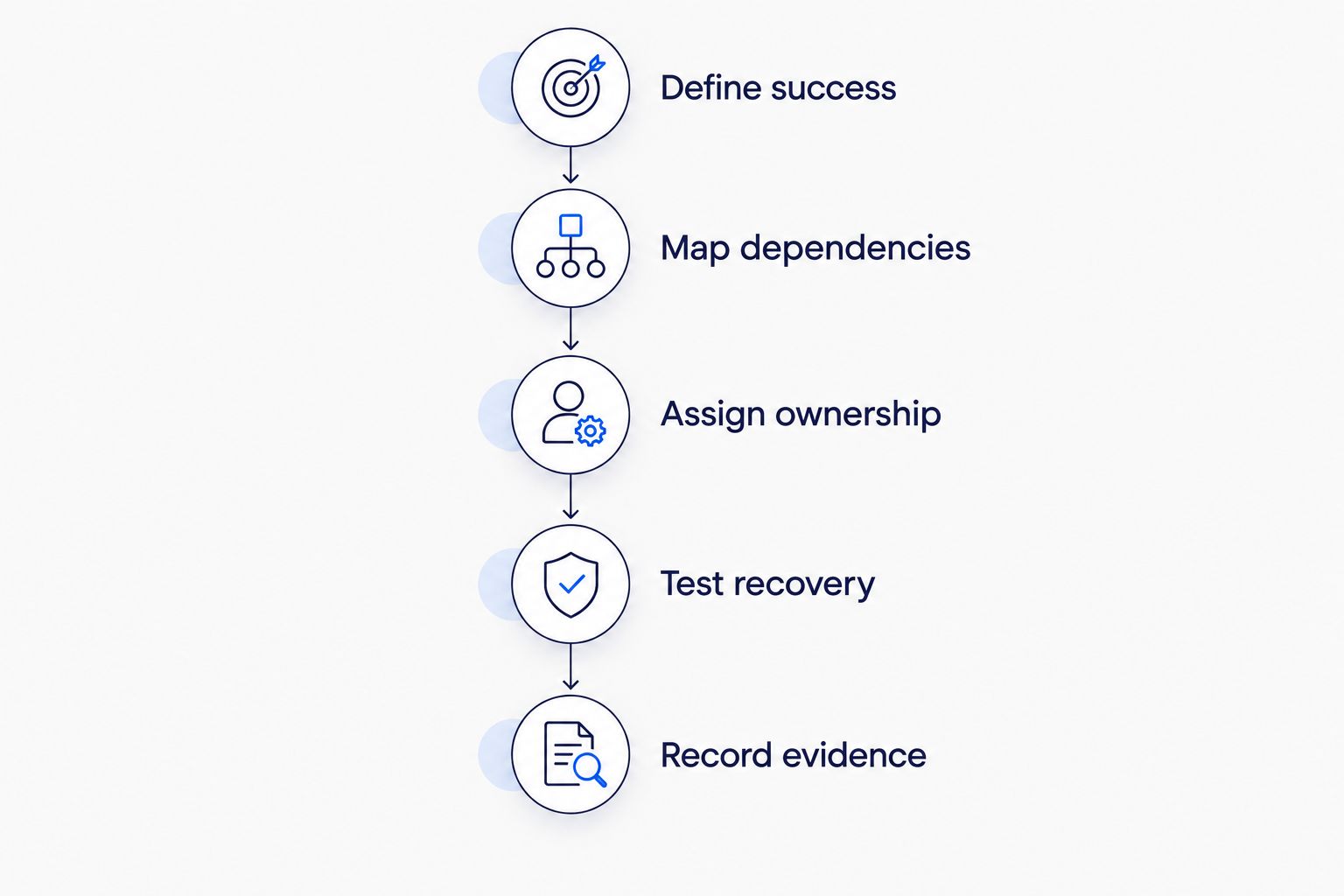
Use a short acceptance process that connects contract language to observable behavior. Do not approve an uptime commitment until the provider can explain how you will measure a breach and who will act during one.
- Define success. Select a business transaction that demonstrates the service works, such as completing a submission and retrieving the saved result. Specify what counts as failure rather than relying only on a server health check.
- Map dependencies. List the components required for that transaction, including identity, networking, application processing, storage, and external integrations. Mark the owner of each dependency and identify anything outside the proposed coverage.
- Assign ownership. Document who detects incidents, leads recovery, authorizes changes, and communicates with your business. Separate cloud infrastructure tasks from application and data responsibilities.
- Test recovery. Run controlled failure exercises in an appropriate environment and inspect the result. Verify that the application works after recovery, not merely that replacement resources exist.
- Record evidence. Agree on monitoring records, incident timestamps, reporting access, and claim ownership. Preserve enough information to distinguish customer impact from contractual eligibility.
These steps reveal a common contract problem: the supplier accepts a responsibility but excludes a dependency needed to fulfill it. Resolve that gap before signature instead of discovering it during an incident.
What should the contract say about application availability?
The contract should identify the covered application, the measurement boundary, the calculation method, the exclusions, and the remedy. Supporting operational documents should identify recovery responsibilities and escalation authority.
Ask for explicit treatment of partial failure. A service that loads its landing page but cannot complete its primary transaction needs a clear classification under the agreed measurement method.
Also distinguish an availability SLA from a service-level objective. An internal objective guides engineering and operations; a contractual SLA establishes obligations and remedies between parties.
For a 2026 agreement, require the contract and the operating procedures to describe the same service boundary. A broad promise paired with a narrow recovery responsibility creates avoidable ambiguity.
Who owns incident response and recovery?
Name the incident leader and the teams responsible for each recovery action. Your provider’s response obligation should not leave application recovery unassigned.
Clarify access in advance. If the provider needs approval before changing production, define the approval path and what happens when the usual approver is unavailable.
What evidence proves the application recovered?
Use a successful business transaction as recovery evidence where that matches the covered service. Infrastructure health remains useful, but it answers a narrower question.
Keep customer-impact records separate from SLA calculations when their definitions differ. Both matter: one explains business harm, while the other establishes whether the contractual threshold was breached.
Does a higher AWS SLA guarantee higher application uptime?
An AWS commitment above 99.9% does not automatically guarantee application uptime above 99.9%. Your application also depends on its architecture, software, configuration, data, and integrations.
Treat the AWS commitment as one input to the application design. Do not present it to your customers as your own end-to-end promise without establishing the additional coverage and operating capability.
Is incident response time the same as uptime?
A 99.9% availability commitment measures a different outcome from incident response time. A provider can acknowledge an incident within its response obligation while the application remains unavailable.
Request separate definitions for acknowledgement, active investigation, restoration, and final resolution. The contract should make clear which commitments are binding and which are operational targets.
Does disaster recovery replace an uptime SLA?
A 99.9% uptime commitment does not replace disaster recovery planning. Availability measures service operation, while recovery planning addresses how to restore operations and data after disruption.
Define recovery time and data-loss objectives separately. Then test whether the recovery process supports the application obligations you intend to make.
Where enterprise AI changes the availability discussion
KnackForge serves enterprises applying artificial intelligence to operations and growth. For an enterprise AI workload, define whether the covered business outcome includes the model-dependent step or only the surrounding application.
A functioning interface does not establish that an AI-dependent workflow completed successfully. Specify how the service handles failed processing, unavailable dependencies, queued work, and human review before deciding what availability means.
That boundary belongs in the application requirements. It should not be inferred from an underlying cloud service’s uptime percentage.
FAQ
Can AWS managed services guarantee more than 99.9% uptime?
Yes, contractual uptime commitments can exceed 99.9%, but they remain subject to scope, configuration requirements, measurement rules, and exclusions. They do not promise that outages are impossible.
Does Amazon EC2 offer a 99.99% SLA?
Amazon EC2 publishes a 99.99% Region-Level SLA under its qualifying deployment conditions. Its separate Instance-Level SLA publishes a 99.5% commitment, so verify which agreement applies to your deployment.
Does an AWS SLA cover my entire application?
An AWS service SLA does not automatically cover your entire application. Application code, configuration, integrations, and other dependencies require their own responsibility and measurement boundaries.
Is a managed provider’s SLA the same as the AWS SLA?
A managed provider’s SLA is a separate contractual commitment from the underlying AWS service SLA. Read both agreements to establish who owes which obligation and which incidents qualify.
Does a fast support response mean my application will recover quickly?
A fast support response does not establish a restoration deadline. Acknowledgement, investigation, restoration, and resolution need separate definitions in the agreement.
What happens if an AWS service misses its SLA?
The applicable AWS SLA defines eligibility for a contractual remedy, commonly service credits, and the claim requirements. Do not assume that a breach automatically compensates your business losses.
What should I ask a managed provider before signing?
Ask the provider to identify the covered business transaction, deployment requirements, exclusions, measurement method, recovery owner, and remedy. Require an explanation of how a partial application failure will be classified.
One last thing
Ask the provider to walk through a failed business transaction while every infrastructure dashboard remains healthy. The answer exposes whether the agreement protects the application outcome or only the resources underneath it.
If nobody can identify the recovery owner and the contractual classification, resolve the ambiguity before signing. A higher percentage cannot fix an undefined service boundary.