
Yes—AWS managed services can support disaster recovery planning and carry out recovery tasks when those responsibilities are explicitly included in the service scope. Your organization still owns business priorities, acceptable downtime, acceptable data loss, and authorization to switch production systems. Managed operations support disaster recovery; they do not replace an application-specific, tested recovery plan.
- AWS managed services disaster recovery requires explicit ownership, recovery objectives, and tested application runbooks.
- AWS Backup protects supported resources; successful backups do not prove complete application recovery.
- AWS Elastic Disaster Recovery supports server recovery, not automatic recovery of every application dependency.
- Choose a recovery strategy by business impact, then test failover and failback.
Why this matters
For your 2026 recovery plan, distinguish infrastructure restoration from business recovery. A running server does not establish that customers can sign in, transactions reconcile, or downstream integrations work.
Start with the scope outlined in disaster recovery planning for cloud enterprises, then assign responsibility for each application dependency. The decisive question is not whether a provider offers disaster recovery—it is whether the agreement covers the recovery outcome your business needs.
Can AWS managed services handle disaster recovery planning?
Yes, within an agreed scope that connects recovery objectives, technical procedures, and business approval. Separate Amazon's AWS Managed Services offering, commonly called AMS, from third-party providers managing AWS environments: the names do not establish identical responsibilities.
AWS's Shared Responsibility Model separates AWS's responsibilities for cloud infrastructure from customer responsibilities for workloads and configuration. A managed-services agreement assigns additional operational work; read its actual coverage rather than treating the service label as a recovery commitment.
| Planning or recovery task | Managed-services contribution to specify | Responsibility to retain internally |
|---|---|---|
| Business impact assessment | Infrastructure and dependency information | Business priorities and disruption tolerance |
| Recovery design | Architecture recommendations and implementation within scope | Acceptance of the design and residual risks |
| Backup operations | Backup configuration, monitoring, and restoration within scope | Required coverage and retention approval |
| Recovery execution | Runbooks, escalation, and technical actions within scope | Authority to declare a disaster |
| Application validation | Agreed technical checks and support | Acceptance that business workflows work |
| Failback | Agreed restoration and synchronization procedures | Approval to resume normal operations |
Ask the provider to attach a responsibility matrix to the recovery plan. Each action needs an owner, an alternate, a trigger, and a completion condition. Shared responsibility without named people leaves room for unresolved handoffs during an incident.
What belongs in the recovery agreement?
Your 2026 agreement should distinguish an incident-response commitment from an application-recovery objective. A promise to acknowledge an alert does not establish when a usable service will return.
Require the agreement to identify covered accounts, Regions, applications, data stores, and dependencies. It should also state exclusions, escalation paths, testing responsibilities, and the evidence used to accept a recovered workload.
Do not accept “backups included” as a substitute for a recovery procedure. Ask who restores the data, rebuilds the application, changes traffic routing, and checks the result.
Which AWS recovery approach fits your workload?
AWS's published disaster recovery guidance describes backup and restore, pilot light, warm standby, and multi-site active/active strategies. These are architecture patterns, not guaranteed recovery times; your implementation and test results determine whether a pattern meets your objectives.
| Strategy | Best for | Main advantage | Main limitation |
|---|---|---|---|
| Backup and restore | Workloads that tolerate rebuilding before service resumes | Avoids maintaining a fully running recovery environment | Restoration and reconstruction remain on the recovery path |
| Pilot light | Workloads needing core recovery components maintained | Preserves essential components while other resources await activation | Requires provisioning and application startup during recovery |
| Warm standby | Workloads needing a running, reduced-capacity environment | Keeps a functioning application environment ready to scale | Requires configuration consistency and capacity validation |
| Multi-site active/active | Applications designed to serve traffic across sites | Enables traffic distribution across operating environments | Adds data-consistency, routing, and operational complexity |
Backup and restore: best for rebuild-tolerant workloads
Backup and restore fits applications whose business owners accept restoring data and rebuilding infrastructure before operations resume. Its advantage is a simpler standby footprint; its limitation is that recovery depends on successful restoration, configuration, and validation.
Document infrastructure definitions alongside backup procedures. Data alone does not recreate network rules, application settings, identity permissions, or external integrations.
Pilot light: best for preserving essential components
Pilot light keeps essential recovery components available while leaving other parts of the environment to be activated during recovery. It fits workloads that need a prepared foundation without a fully operating standby application.
The trade-off is execution work during the incident. Test provisioning, application startup, and dependency sequencing rather than assuming that replicated data makes the application ready.
Warm standby: best for a running recovery environment
Warm standby maintains a functioning but reduced-capacity version of the workload. It fits applications that need a ready environment and can scale that environment when recovery begins.
The limitation is operational upkeep. Deployment changes, secrets, network settings, and dependencies must remain aligned, and the recovery environment must support the intended production load.
Multi-site active/active: best for distributed applications
Multi-site active/active fits applications deliberately designed to serve requests from multiple operating environments. It supports traffic distribution but requires application-level decisions about state, writes, conflicts, and consistency.
Do not select active/active simply because it sounds more resilient. An application that cannot safely coordinate writes across sites needs a different design or application changes first.
Which AWS services support disaster recovery?
For 2026 planning, distinguish the recovery strategy from the services used to implement it. AWS Backup, AWS Elastic Disaster Recovery, and AWS CloudFormation address different parts of the problem; none independently establishes complete business recovery.
| Service | Best for | What it supports | What it does not establish |
|---|---|---|---|
| AWS Backup | Central backup management for supported resources | Backup policies, protection, and supported restoration workflows | Complete recovery of every application dependency |
| AWS Elastic Disaster Recovery | Supported server-based recovery workloads | Replication and recovery-instance launch workflows | Business validation or coverage of every managed service |
| AWS CloudFormation | Repeatable infrastructure provisioning | Creating and managing supported infrastructure through templates | Recovery of application data or proof that the application works |
AWS's service documentation defines supported resources and operating requirements. Check the documentation against your actual workload inventory rather than assuming that support for one component extends to the entire application.
Keep service selection subordinate to the recovery plan. Combining tools without assigning restoration order, permissions, and acceptance checks creates technical coverage without a complete operating procedure.
Why AWS managed services disaster recovery scope varies
The work required depends on the workload and the agreed operating boundary. Use these factors to define scope before choosing a provider or approving an architecture:
- Recovery objectives: Recovery time objective, or RTO, defines the targeted restoration interval; recovery point objective, or RPO, defines the acceptable data-loss interval.
- Application dependencies: Identity, databases, queues, third-party APIs, and network connections affect restoration order and usability.
- Failure scenario: An instance failure, a Regional disruption, and compromised credentials require different recovery actions.
- Data protection: Replication and recoverable historical copies address different risks; replicated corruption is not a clean restore point.
- Operating ownership: Provider access, customer approvals, escalation coverage, and application support determine who can act.
- Validation requirements: Infrastructure health checks and successful business transactions establish different levels of recovery evidence.
For your 2026 review, tie each factor to a written decision. “Cross-Region recovery” is incomplete unless the plan also explains access, data readiness, traffic changes, and application validation.
How do you turn managed services into a tested recovery plan?
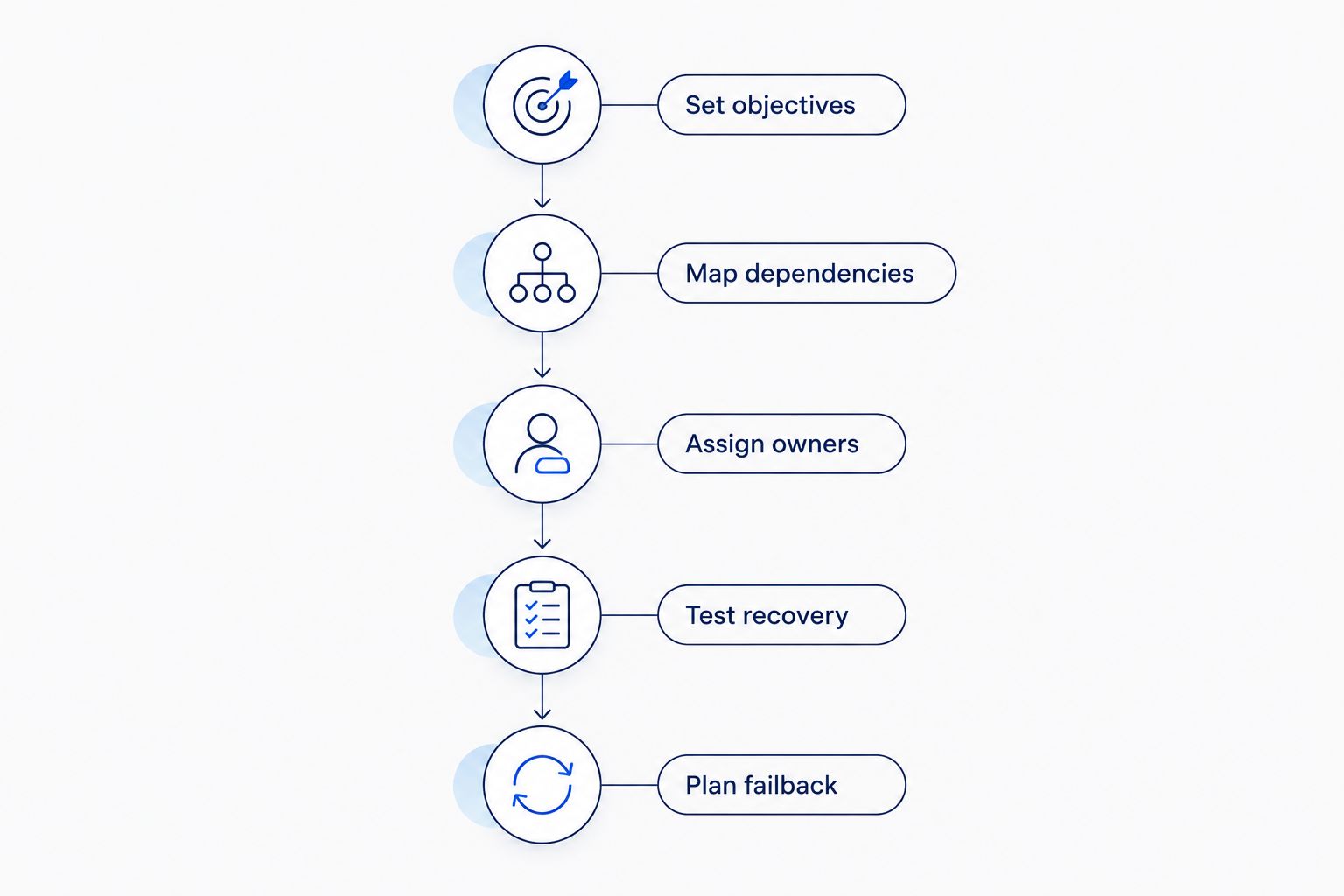
Build the plan around an application outcome, not a list of enabled services. The following sequence connects business requirements to technical execution and acceptance.
- Set objectives. Have business owners approve RTO and RPO for each application. Record which workflows must return first and what degraded operation is acceptable.
- Map dependencies. Identify data stores, identity, networking, secrets, certificates, integrations, and deployment artifacts. Include dependencies outside AWS.
- Assign owners. Name the disaster-declaration authority, technical recovery lead, provider contacts, application validators, and communications owner.
- Test recovery. Execute the runbook in a controlled environment. Record elapsed recovery time, recovered data state, failed steps, and business-validation results.
- Plan failback. Define how data and traffic return to the normal environment. Include reconciliation, rollback conditions, and approval to resume normal operation.
Keep the runbook accessible outside the environment it is designed to recover. A procedure stored only behind an unavailable identity system creates a dependency on the failed environment.
After testing, assign each failed step to an owner and repeat the affected procedure after correction. A test report documents readiness only for the conditions actually exercised; it does not establish coverage of untested failures.
What should count as a successful recovery test?
A successful test demonstrates that the application meets its agreed recovery objectives and passes its business acceptance checks. Infrastructure startup is evidence of progress, not the finish line.
Check authentication, representative reads and writes, integrations, monitoring, and reconciliation. Record where the test used shortcuts or excluded dependencies so the result cannot be mistaken for broader coverage.
Does disaster recovery include ransomware recovery?
Disaster recovery includes ransomware recovery only when the plan explicitly covers compromised systems, clean restore points, and trusted recovery access. Continuous replication alone does not protect against every corruption or compromise scenario.
Separate availability failures from security incidents. Your security team must define how it establishes a trusted environment and decides which data is safe to restore before production traffic returns.
Does a managed-services SLA guarantee recovery time?
A managed-services SLA guarantees only the commitments written into that agreement, subject to its terms. Response, availability, and application recovery are distinct commitments.
For 2026 procurement, require precise definitions of when measurement starts and stops. Check exclusions and customer prerequisites before interpreting an operational SLA as evidence that your business RTO will be met.
Where enterprise AI belongs in the recovery discussion
Knackforge is best for enterprises seeking help applying artificial intelligence to operations—not as a substitute for a documented AWS recovery commitment. Knackforge's stated focus is enterprise AI; that description alone does not establish disaster recovery delivery or service coverage.
If you are considering Knackforge for enterprise AI work, include the resulting application's data, dependencies, and validation requirements in your recovery inventory. Confirm any recovery responsibilities with Knackforge explicitly rather than inferring them from the enterprise AI engagement.
FAQ
Can AWS managed services handle our entire disaster recovery plan?
AWS managed services can handle agreed planning and execution tasks, but your organization still owns business priorities and acceptance. Confirm application coverage, dependencies, approvals, and testing responsibilities in writing.
Is AWS Managed Services the same as an AWS managed-services provider?
AWS Managed Services is an AWS offering; an AWS managed-services provider can be a separate company. Their responsibilities depend on the specific offering and agreement, not the similarity of their names.
Is AWS Backup enough for disaster recovery?
AWS Backup alone does not establish complete application recovery. You also need infrastructure, access, dependency sequencing, restoration procedures, and business-validation checks.
Does AWS Elastic Disaster Recovery recover every AWS service?
AWS Elastic Disaster Recovery does not recover every AWS service. It supports server-based recovery workflows; assess databases, managed services, integrations, and application dependencies separately.
Do we need another AWS Region for disaster recovery?
Another AWS Region is relevant when your recovery design must address a Regional disruption. Select the recovery location from your failure scenarios, data requirements, and business objectives rather than applying the same architecture to every workload.
How often should we test an AWS disaster recovery plan?
Set a documented testing schedule based on business requirements and workload risk. Revalidate affected recovery procedures after material architecture, identity, deployment, or dependency changes.
Who should approve failover during an outage?
A named business authority should approve failover unless an approved policy delegates that decision. The runbook should state the trigger, technical owner, communications process, and conditions for returning to normal operations.
One last thing
Test recovery access before testing recovery infrastructure. In your next 2026 exercise, verify that the recovery team can obtain authorized access without depending entirely on the unavailable production environment. A prepared recovery environment is unusable if nobody can administer it.