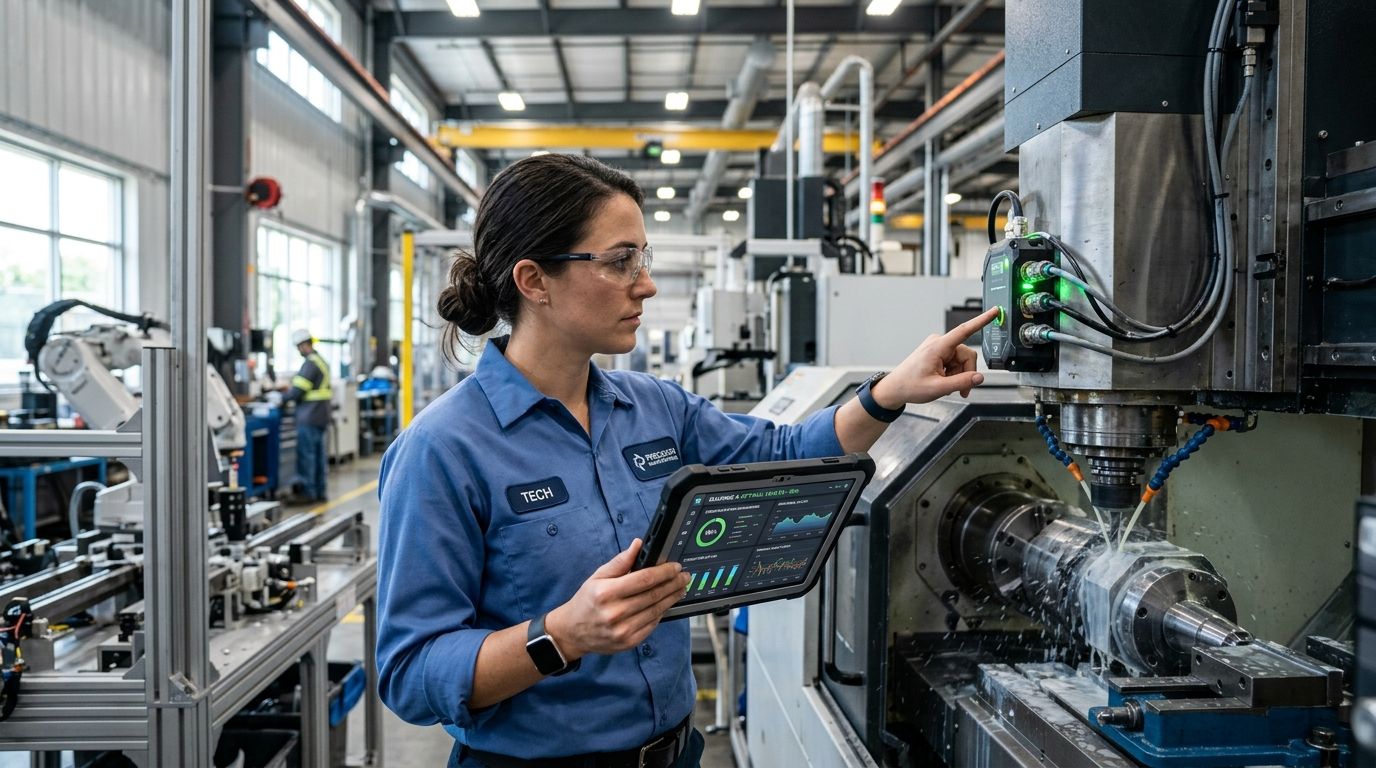
Implementing AI predictive maintenance in manufacturing means building a data pipeline from your equipment sensors, training a failure-prediction model on that data, and wiring the model's output into your maintenance workflow — it is not a single software purchase. Most manufacturers run a 30-day data audit, a 90-day pilot on one production line, and a 12- to 18-month phased rollout before predictive maintenance replaces scheduled or reactive maintenance as the default across a plant in 2026.
- AI predictive maintenance in manufacturing runs on three layers: sensors, a prediction model, and workflow integration — skip one and the project stalls.
- A 90-day pilot on a single production line proves value faster than a plant-wide rollout attempted from day one.
- Vibration and thermal sensors generate the most reliable failure data for rotating equipment like motors, pumps, and compressors.
- KnackForge builds predictive maintenance pipelines that plug into existing SCADA and MES systems instead of replacing them.
Why this matters
Unplanned downtime is the largest controllable cost on most manufacturing floors, and scheduled maintenance replaces parts on a calendar instead of on actual wear, which wastes labor and inventory. AI-powered predictive maintenance for industrial equipment flips that model: sensors feed a machine learning model that flags a bearing, motor, or valve before it fails, not after.
What changed by 2026 is cost, not concept. Vibration sensors, edge compute, and cloud model training are cheap enough that a mid-size plant can run a real pilot for the price of a few unplanned shutdowns, which is why predictive maintenance moved from a Fortune 500 initiative to a standard line item for mid-market manufacturers this year.
How to implement AI predictive maintenance in manufacturing
The rollout has six steps, run in order. Skipping the audit or the pilot is the single most common reason projects miss their timeline.
- Audit existing equipment data (30 days). Inventory what your PLCs, SCADA system, and historian already capture — many plants discover they already log 60-70% of the signal they need and just never piped it anywhere useful.
- Pick one production line and two to three failure modes. Bearing wear, motor overheating, and belt slippage are common first targets because they show up clearly in vibration and thermal data.
- Install or activate sensors. Vibration, temperature, acoustic, and current-draw sensors cover most rotating and electrical equipment failure modes.
- Build the prediction model. Feed six to twelve months of historical data when it exists; when it doesn't, start with physics-based thresholds and let the model learn as live data accumulates.
- Integrate model output into the maintenance workflow. An alert that doesn't generate a CMMS ticket or a technician notification is a dashboard nobody checks.
- Run a 90-day pilot, measure alert precision, then expand. Track false-positive rate before adding a second line — a noisy model on line one kills trust before it ever reaches line two.
A pilot scoping process for enterprise AI projects is where most manufacturers underestimate the work — the scoping document, not the model code, determines whether the 90-day window holds.
Why implementation timelines vary
- Equipment age and instrumentation — a line already wired with sensors moves to modeling in weeks; a line with no digital signal needs a retrofit first.
- Data quality and history — twelve months of clean historian data trains a better model than three years of gap-filled logs.
- Integration complexity with legacy MES — plants running older, custom-built MES software need more integration work than those on modern platforms.
- Team readiness and change management — technicians who don't trust an alert will ignore it, regardless of model accuracy.
- Number of failure modes targeted — a single-failure-mode model ships faster than a model trying to predict five failure types at once.
- Plant scale — a single-line pilot and a twelve-line rollout are different projects with different risk profiles.
“If your maintenance team stops trusting alerts by week three, the software isn't the problem — the model's precision is.”
How long does an AI predictive maintenance pilot take?
A predictive maintenance pilot takes 90 days on one production line, covering sensor activation, model training, and a first round of live alerts. Full-plant rollout after a successful pilot typically runs 12 to 18 months, phased line by line.
What sensors do I need for predictive maintenance?
Vibration, temperature, acoustic, and current-draw sensors cover the majority of rotating and electrical equipment failure modes in 2026 manufacturing environments. Most plants already have some of these installed for other monitoring purposes and just need the data routed to a model.
Scope your predictive maintenance pilot
Get a 90-day pilot plan built around your existing sensors and MES.
FAQ
How much does AI predictive maintenance cost for a manufacturing plant?
Cost depends on how many sensors you already have installed, how much historical data exists, and how many production lines are in scope — get a plant-specific estimate rather than relying on a generic number. Retrofit-heavy plants with no existing instrumentation cost more upfront than plants with modern SCADA already in place.
Is AI predictive maintenance worth it for a small manufacturer?
Yes, when the pilot targets one or two high-cost failure modes instead of trying to cover the whole plant at once. A single-line, single-failure-mode pilot keeps the investment small enough for a smaller operation to justify in 2026.
How is predictive maintenance different from preventive maintenance?
Preventive maintenance replaces or services parts on a fixed schedule regardless of actual wear; predictive maintenance uses sensor data and a model to flag failure risk based on real equipment condition. Predictive maintenance reduces both unnecessary part swaps and unplanned failures, where preventive maintenance only addresses the second.
Can predictive maintenance work without historical failure data?
Yes, but the model starts with physics-based or vendor-specified thresholds instead of learned patterns and improves as live data accumulates. Plants with zero historical data should expect the model to need a longer live-data window before predictions are reliable.
What's the ROI timeline for predictive maintenance in manufacturing?
Most plants see the first measurable signal — reduced false alarms and at least one caught failure — inside the 90-day pilot window, with full financial payback tracked over the following 12 to 18 months as the rollout expands. The timeline depends heavily on how many production lines are added after the pilot.
Does predictive maintenance require replacing existing SCADA or MES systems?
No — a well-scoped predictive maintenance project integrates with existing SCADA and MES systems rather than replacing them. Replacing core plant systems adds cost and risk that most predictive maintenance pilots don't need.
What failure modes should a first predictive maintenance pilot target?
Bearing wear, motor overheating, and belt slippage are common first targets because vibration and thermal sensors detect them clearly and reliably. Starting with one or two failure modes keeps the 2026 pilot timeline realistic.
One last thing
The model rarely kills a predictive maintenance project — trust does. A technician who gets three false alerts in the first two weeks stops reading the fourth one, so the real success metric for a 90-day pilot isn't prediction accuracy on paper, it's whether the maintenance team is still checking the alert queue on day 91.


