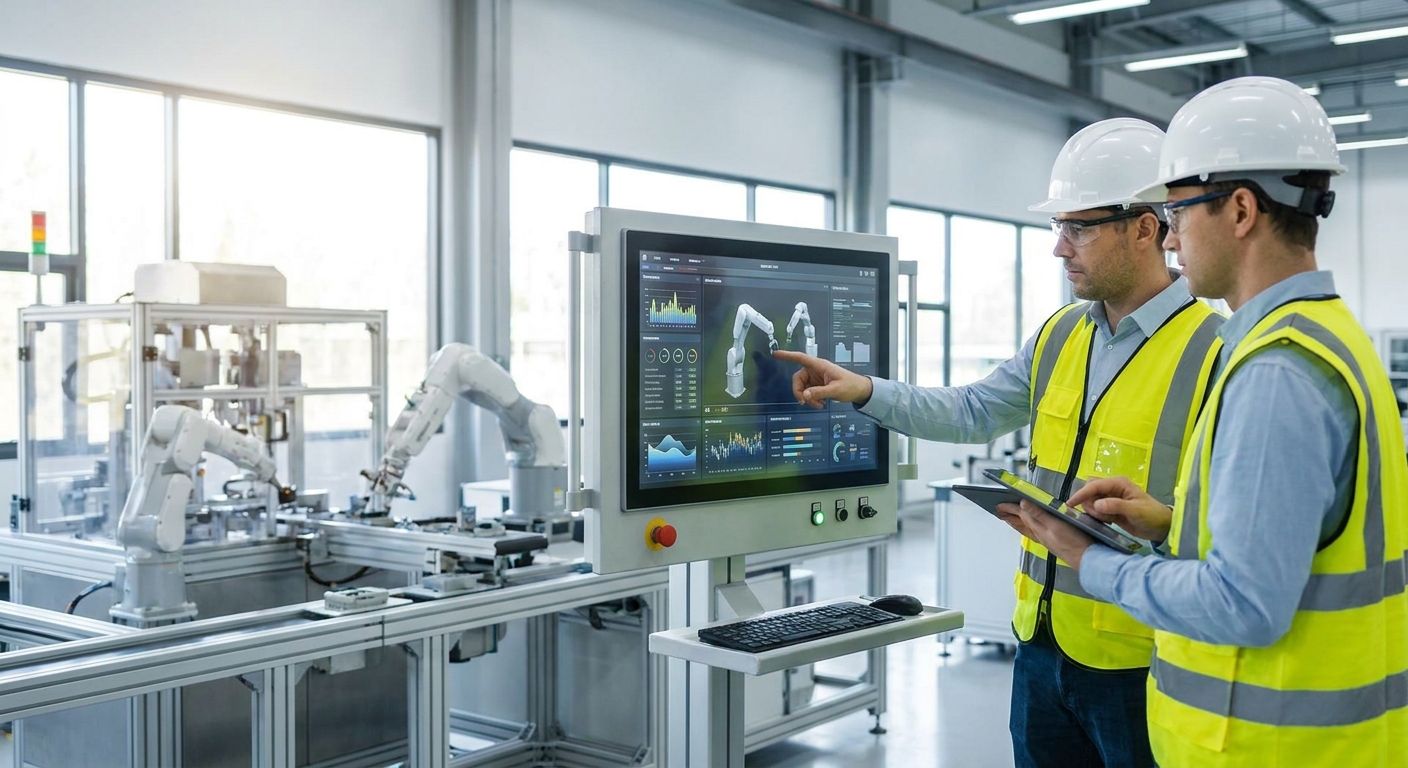
Manufacturing leaders evaluating enterprise AI solutions in 2026 face a crowded field of point tools promising predictive maintenance, quality inspection, and supply chain forecasting — most of which never make it past a pilot on the plant floor. This guide breaks down what actually matters when you're choosing enterprise AI solutions for manufacturing, and what to skip.
- Enterprise AI solutions for manufacturing succeed or fail on MES/ERP integration, not model accuracy — evaluate data pipelines first.
- Predictive maintenance and computer vision quality inspection are the two highest-ROI categories for 2026 deployments.
- Generative AI document automation, proven in regulated sectors like healthcare, applies directly to SOP and compliance workflows on the plant floor: Buy.
- Black-box models without an audit trail are a Skip for any regulated manufacturing environment in 2026.
- A 90-day pilot on one production line beats a 12-month enterprise-wide rollout for validating AI ROI.
Why this matters
Most manufacturing AI projects stall not because the algorithms are wrong but because the data feeding them is fragmented across MES, SCADA, and decades-old ERP systems. KnackForge works with enterprise teams on exactly this integration problem before a single model gets trained. Get that layer wrong in 2026 and you'll spend the next fiscal year explaining a stalled pilot to your board instead of reporting downtime reductions.
The stakes are higher this year than in past cycles. Manufacturers that delayed AI adoption through 2023-2025 are now under pressure to catch competitors who already have predictive maintenance and quality vision systems live on multiple lines. That urgency is exactly what pushes teams toward tools that look right on a demo call but fail on your actual factory data.
Who this is for
This guide is for operations VPs, plant IT directors, and digital transformation leads at manufacturers with at least one automated production line, an existing MES or ERP system, and a mandate to show measurable efficiency gains within the next one to two budget cycles. If you're running a single-facility shop with manual processes and no digital backbone yet, start with basic data infrastructure before shopping for enterprise AI solutions for manufacturing — the criteria below assume you already have sensors and systems generating usable data.
What to look for in enterprise AI solutions for manufacturing
Integration depth with MES, ERP, and SCADA
An AI solution that can't pull real-time data from your existing Manufacturing Execution System or SCADA layer is a dashboard, not a solution. Ask any vendor for a specific list of the protocols and APIs they support — OPC-UA, Modbus, MQTT — and how long a typical integration takes on a brownfield plant. If the answer is vague, that's your signal.
Data governance and lineage
Manufacturing data lives in silos: quality data in one system, maintenance logs in another, production schedules in a third. Enterprise AI solutions for manufacturing need a governance layer that tracks where every data point came from, because a model trained on stale sensor data will confidently recommend the wrong maintenance window. This matters more in 2026 than it did five years ago, since audit expectations around AI decision-making have tightened across most regulated industries.
Explainability and audit trail
If a model flags a batch for quality rejection or schedules unplanned maintenance, someone on your floor needs to explain why — to a plant manager, an auditor, or a customer. Solutions that can't produce a human-readable reason for a decision create liability, not efficiency. Non-negotiable for any regulated manufacturing vertical: aerospace, automotive, pharma, food and beverage.
Deployment model: cloud, edge, or hybrid
A cloud-only model that needs a round trip to a data center adds latency you can't afford on a moving line. Edge inference handles the millisecond-level decisions (stop the line, flag the defect); cloud handles the heavier lifting (demand forecasting, network-wide optimization). The right enterprise AI solution for manufacturing operations runs both, coordinated, not one or the other.
Workforce adoption and change management
The best model in the world does nothing if line operators ignore its alerts because the interface doesn't fit their workflow. Vendors that ship a rollout plan alongside the technology — training, feedback loops, a phased go-live — outperform those that just hand over an API and a dashboard.
Vendor experience in regulated, high-stakes environments
A vendor's generative AI or cloud migration work in another regulated sector — healthcare, financial services, insurance — is a reasonable proxy for how they'll handle manufacturing's own compliance and safety requirements. Ask for specifics, not case study logos.
Top picks: solution categories worth evaluating
Predictive maintenance AI — the safe pick
This is the most mature category in enterprise AI solutions for manufacturing, with the largest base of production deployments across automotive and heavy industry as of 2026. It pulls vibration, temperature, and throughput data from existing sensors to flag equipment likely to fail in the next maintenance window, rather than waiting for a scheduled teardown or a breakdown. One spec that matters: look for a false-positive rate the vendor will actually put in writing, not just an accuracy claim. Verdict: Buy for any plant with rotating equipment and existing sensor coverage.
Generative AI for SOP and compliance documentation
Manufacturing plants run on thousands of pages of standard operating procedures, safety documentation, and audit records that get rewritten and re-approved every time a process changes. The same generative AI document automation approach used to cut document turnaround in regulated healthcare settings applies directly to plant-floor SOPs, work instructions, and compliance filings — the underlying problem (structured extraction and drafting from regulated source documents) is the same. Verdict: Buy if your quality team is still manually updating documentation after every process change.
Computer vision quality inspection — the wildcard
Vision-based defect detection on the line replaces manual visual inspection with cameras and a trained model scoring every unit against a defect library. It's the wildcard pick because performance depends heavily on lighting conditions and defect variety on your specific line — a model trained on one product SKU rarely transfers cleanly to another without retraining. Expect a retraining cycle every time you introduce a new SKU. Verdict: Consider — pilot on your highest-defect-rate line before committing plant-wide.
Cloud-native data platforms for cross-plant visibility
If your plants report into separate, disconnected systems, no AI model can give you an enterprise-wide view of throughput or quality trends. A cloud migration approach — moving plant data into a unified, governed cloud environment — is table stakes before any cross-facility AI initiative works. This is infrastructure work, not a model purchase, and it typically takes longer than any single AI pilot. Verdict: Buy if you operate more than one facility and can't currently compare them on a single dashboard.
Generative AI copilots for engineering and risk teams
Engineering change requests, risk assessments, and root-cause analysis reports all eat hours of skilled engineer time drafting from scratch. A generative AI copilot trained on your historical incident reports and engineering standards can draft a first pass in minutes instead of hours. Verdict: Consider — high value for large engineering teams, lower priority if your plant runs lean on engineering headcount.
Map your AI roadmap for 2026
Talk through integration, data readiness, and pilot scope before you commit budget.
What to avoid
- Off-the-shelf point solutions with no integration path. A predictive maintenance tool that can't read your SCADA data is a spreadsheet with a better logo.
- Black-box models with no audit trail. If a vendor can't explain a decision in plain language to your quality manager, don't put it near a regulated production line.
- Single-vendor edge hardware lock-in. Solutions that require proprietary sensors or gateways tie your entire AI roadmap to one supplier's hardware refresh cycle.
“An AI model that can't explain a rejected batch to your quality manager is a liability, not an efficiency gain.”
Verdict comparison
| Solution category | Integration need | Deployment model | Verdict |
|---|---|---|---|
| Predictive maintenance AI | Moderate (sensor + MES) | Edge + cloud | Buy |
| Generative AI documentation | Low (document sources) | Cloud | Buy |
| Computer vision inspection | High (per-line tuning) | Edge | Consider |
| Cloud-native data platform | High (cross-plant) | Cloud | Buy |
| Generative AI copilots | Moderate (historical records) | Cloud | Consider |
FAQ
What are enterprise AI solutions for manufacturing?
Enterprise AI solutions for manufacturing are systems that use machine learning and generative AI to optimize production processes — predictive maintenance, quality inspection, demand forecasting, and documentation automation. In 2026 the strongest deployments integrate directly with existing MES and ERP systems rather than running as standalone tools.
How much does an enterprise AI solution for manufacturing cost?
Cost varies widely by scope, from a single-line predictive maintenance pilot to a multi-facility cloud data platform rollout. Get a tailored scope and quote based on your current systems and plant count rather than relying on a generic price range.
Is predictive maintenance AI better than computer vision inspection?
Predictive maintenance AI is generally the safer first deployment because it works off sensor data you likely already collect, while computer vision inspection needs per-line tuning for lighting and defect variety. Most manufacturers in 2026 start with predictive maintenance and add vision inspection once the data pipeline is proven.
Can generative AI handle manufacturing compliance documentation?
Yes — generative AI document automation drafts and updates SOPs, work instructions, and compliance filings from structured source documents, the same approach already used in regulated healthcare document workflows. It cuts manual rewrite time but still needs a human review step before any document goes live.
How long does an enterprise AI manufacturing pilot take?
A focused pilot on a single production line typically runs 90 days from data connection to first results. Enterprise-wide rollouts across multiple facilities take considerably longer and should follow a proven single-line pilot, not replace one.
Do I need cloud migration before deploying manufacturing AI?
If you operate more than one facility and can't compare throughput or quality across plants today, cloud migration of your production data is a prerequisite, not an optional add-on. Single-facility deployments can often run on existing on-premise infrastructure with edge inference.
What's the biggest risk with enterprise AI in manufacturing?
The biggest risk is deploying a model that can't explain its decisions in a regulated environment, which creates audit and liability exposure. The second biggest risk is picking a vendor whose solution can't integrate with your existing MES or SCADA systems.
Which industries have the most mature AI deployments to learn from?
Healthcare and financial services have some of the most mature generative AI and cloud migration deployments as of 2026, largely because both operate under strict audit and compliance requirements similar to manufacturing. Their document automation and data governance patterns transfer well to plant-floor use cases.
One last thing
The manufacturers getting real returns from enterprise AI solutions in 2026 aren't the ones with the most advanced models — they're the ones who fixed their data pipeline first. A predictive maintenance model fed clean, well-labeled sensor data from one production line will outperform an enterprise-wide rollout running on fragmented, siloed data every time. Start narrow, prove the pipeline, then scale.
Related guides
- Generative AI development services for regulated document and risk workflows
- AWS cloud consulting for SaaS startups on scaling cloud infrastructure for growing technical teams