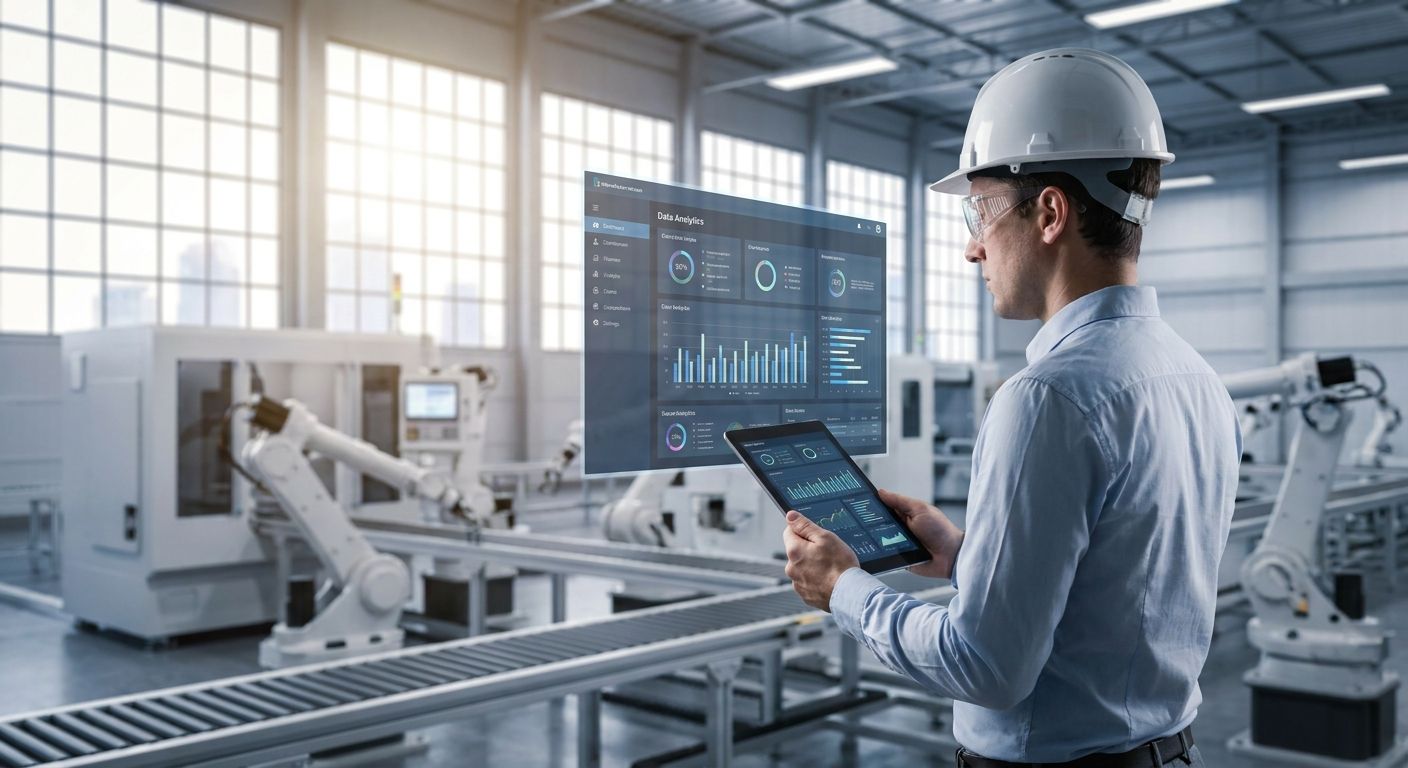
Data integration for manufacturing plants is the practice of connecting PLCs, SCADA, MES, ERP, and quality systems into one pipeline so production, quality, and finance teams work off the same numbers instead of three different spreadsheets. Plants carry a harder integration problem than most industries because equipment spans decades of vintage, protocols (Modbus, OPC-UA, Profinet) don't talk to modern APIs natively, and downtime during integration work costs real production hours, not just IT tickets.
- Data integration for manufacturing plants means unifying OT (PLC/SCADA/historian) and IT (ERP/MES/quality) systems into one pipeline.
- KnackForge builds this on existing historian and MES data — no rip-and-replace of plant floor equipment required.
- Start with one production line as a pilot before scaling integration plant-wide in 2026.
- Data observability catches sensor drift and tag mismatches before they corrupt downstream analytics.
- Master data governance on plant, line, and asset hierarchies is the step most integration projects skip and later regret.
Why data integration matters for manufacturing plants
A typical plant floor runs equipment purchased across multiple vendor generations — a SCADA system from one decade sitting next to an MES rollout from another, feeding an ERP that neither system was built to talk to. Every unplanned integration workaround (a nightly CSV export, a manual reconciliation spreadsheet) becomes a point of failure the moment a shift changes or a tag gets renamed.
For manufacturing specifically, the stakes are operational, not just analytical. A bad join between MES and ERP data doesn't just skew a dashboard — it can misreport work-in-progress inventory, delay a shipment confirmation, or trigger a quality hold that never needed to happen. KnackForge builds integration pipelines around this reality: production data has to be correct in near real time, not just eventually consistent by end of quarter.
Plants that get this right in 2026 aren't chasing a single dashboard — they're building the data foundation that later supports predictive maintenance, manufacturing operations AI, and yield optimization. Integration is the unglamorous first step every one of those initiatives depends on.
Map your OT and IT data sources
Before any pipeline gets built, you need a full inventory of what's actually producing data on the floor and where it currently lands.
- List every PLC, SCADA, and historian system by plant and line, including protocol (OPC-UA, Modbus TCP, EtherNet/IP)
- Identify which MES, LIMS, and quality systems already exist and whether they're plant-local or corporate-wide
- Confirm which ERP modules (inventory, production orders, finance) need production data and at what frequency
- Flag manual workarounds — spreadsheets, shared drives, email exports — these are your highest-risk failure points
- Note tag naming conventions per plant; most multi-site manufacturers have none in common
Standardize tag naming and units across plants
Inconsistent tag naming is the single most common reason cross-plant reporting breaks. One plant calls it "Line1_Temp," another calls it "L1-TEMP-C," and a third records Fahrenheit where everyone else uses Celsius.
- Build a master tag dictionary mapping every sensor name to a standard identifier and unit
- Assign unit conversion rules centrally rather than trusting each plant to convert correctly
- Version the dictionary so historical data stays traceable to its original source format
- Run a validation pass comparing raw historian exports against the standardized output before trusting it downstream
Manual spreadsheet mapping works for a single plant. Past two or three sites, most teams bring in a partner to automate the mapping layer — this is where a master data management practice earns its keep, because tag standardization is really a master data problem wearing an OT costume.
Build a historian-to-cloud pipeline
Historians (PI, Ignition, Wonderware) hold years of time-series production data that rarely leaves the plant network. Getting it into a cloud data platform is what unlocks cross-site analytics.
- Start with a read-only OPC-UA or historian API connection — never write back into control systems during initial integration
- Batch historical backfill separately from the real-time stream to avoid overloading plant network bandwidth
- Compress or downsample high-frequency tags (sub-second sensor reads) before shipping to cloud storage
- Validate timestamp alignment across time zones if plants span regions
- Set a retention policy up front — raw sensor data at full fidelity gets expensive fast
Connect MES and ERP for order-to-shipment visibility
Most plants can see production status and most can see order status — few can see both in one view. Closing that gap is usually the highest-ROI integration on the list.
- Map MES production order IDs to ERP sales order IDs so a line supervisor can trace one to the other
- Sync work-in-progress inventory counts on a schedule that matches your actual production cadence, not an arbitrary nightly batch
- Reconcile quality hold statuses between MES and ERP so a held batch can't accidentally ship
- Build exception alerts for mismatched quantities between systems, rather than relying on manual reconciliation
Add data observability before scaling to AI
Once data starts flowing from ten plants instead of one, silent failures multiply. A sensor going stale, a tag renamed after a system upgrade, a null field nobody caught — these break downstream models quietly, not loudly.
- Set freshness checks on every critical feed (historian, MES, ERP) with alerts when data goes stale past a defined threshold
- Track schema drift so an unannounced field change in a source system doesn't silently corrupt joins
- Monitor row-count and volume anomalies per plant, per shift, to catch outages before a report goes out wrong
- Log lineage from raw sensor to final dashboard so root-causing a bad number takes minutes, not days
This is where most in-house integration efforts stall — nobody owns monitoring once the initial build ships. Data observability built into the pipeline from day one avoids the slow, silent decay that makes teams stop trusting their own dashboards by year two.
Establish master data governance for plant hierarchies
A plant's asset hierarchy — site, area, line, machine, sensor — needs one authoritative structure that every system references, or every report built on top of it drifts apart over time.
- Define a single hierarchy model (ISA-95 is the common reference standard for manufacturing) and enforce it across MES, ERP, and historian metadata
- Assign an owner for hierarchy changes — new lines, decommissioned machines — so the model doesn't go stale
- Audit hierarchy consistency quarterly across plants, not just at initial rollout
Pilot one production line before rolling out plant-wide
Running the full integration architecture across every plant on day one multiplies risk without multiplying learning. Pick one line, prove the pipeline holds up under real production load, then expand.
- Choose a line with moderate complexity — not your simplest, not your most fragile legacy system
- Run the new pipeline in parallel with existing reporting for at least one full production cycle before cutover
- Document every manual fix made during the pilot; each one is a gap the production rollout needs to close
- Get sign-off from plant operations, not just IT, before calling the pilot validated
Comparing your integration options
| Option | Best for | Key limitation |
|---|---|---|
| In-house IT team building custom connectors | Plants with strong internal OT/IT engineering staff | Slow to build, harder to maintain as protocols and vendors change |
| Point-to-point middleware (per-system connectors) | Small single-plant setups with few systems | Doesn't scale past 3-4 plants without becoming unmanageable |
| iPaaS platforms (generic integration tools) | Standard IT-to-IT data flows (ERP to CRM, for example) | Weak native support for OT protocols like OPC-UA and Modbus |
| Specialized manufacturing data integration partner (KnackForge) | Multi-plant manufacturers needing OT-to-cloud pipelines built on existing historian and MES data | Requires plant-level access and coordination during the mapping phase |
Map your plant data integration path
Talk through your OT and IT systems before you scope a build.
Common mistakes manufacturing plants make
- Treating integration as an IT-only project. Plant operations and quality teams need a seat in scoping, or the pipeline gets built around data IT understands, not data the floor actually needs.
- Skipping the tag standardization step. Teams jump straight to dashboards on top of inconsistent tag names, then spend the next year debugging numbers that never reconcile across plants.
- Writing back into control systems too early. Read-only integration first; write-back automation only after the read pipeline has proven stable for months, not weeks.
- No observability layer after go-live. The pipeline works at launch, then a sensor renaming six months later silently breaks a report nobody checks daily.
- Rolling out to every plant simultaneously. One unresolved edge case at one plant becomes ten simultaneous fire drills instead of one manageable pilot fix.
FAQ
What is data integration for manufacturing plants?
It's the process of connecting plant-floor systems (PLCs, SCADA, historians) with business systems (ERP, MES, quality) so production and business data stay consistent. In 2026, most manufacturers are doing this to support both operational reporting and AI-driven analytics.
How long does a manufacturing data integration project take?
A single-line pilot typically runs a few weeks to a couple of months depending on system count and access constraints. Full plant-wide rollout depends on how many plants and legacy systems are involved, and should follow a validated pilot, not run in parallel with it.
Do we need to replace our SCADA or historian system to integrate data?
No — most integration work reads from existing historians and SCADA systems through their native APIs or OPC-UA connections. Replacement is rarely necessary unless the system itself is end-of-life or unsupported.
What's the difference between MES integration and ERP integration?
MES integration connects production-floor execution data (work orders, machine status, quality checks) while ERP integration connects business data (sales orders, inventory, finance). Manufacturing plants typically need both linked together for order-to-shipment visibility.
Is data integration different for multi-plant manufacturers versus single-site plants?
Yes — multi-plant integration adds the requirement of standardized tag naming, units, and asset hierarchies across sites, which single-plant setups don't need to solve. This is usually the step multi-site manufacturers underestimate.
How does data integration support AI initiatives on the plant floor?
Predictive maintenance, yield optimization, and computer vision quality checks all depend on clean, integrated production data as their foundation. Without integration first, AI models train on inconsistent or incomplete data and underperform.
What is data observability and why does it matter for manufacturing data?
Data observability monitors freshness, schema, and volume of data pipelines so failures get caught before they corrupt reports or AI models. In manufacturing, a stale sensor feed or renamed tag can silently break weeks of downstream reporting without observability in place.
One last thing
The integration step manufacturers most often skip isn't the pipeline build — it's assigning an owner for the master tag dictionary after launch. Systems get upgraded, lines get added, and without one person accountable for keeping the naming and hierarchy model current, the clean pipeline built in 2026 quietly drifts back into the same mismatched mess it replaced within a year.


