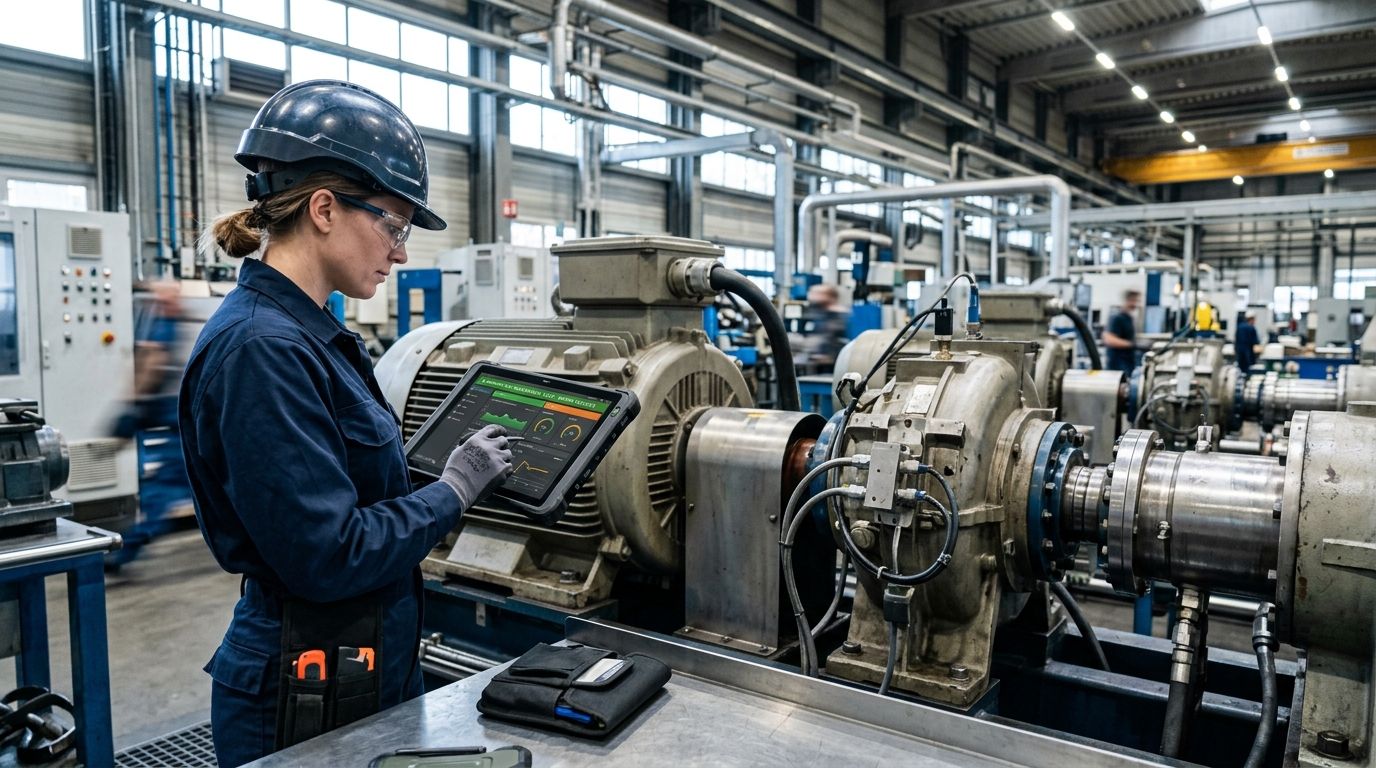
AI predictive maintenance for industrial equipment is a maintenance strategy that pairs sensor data, historical failure records, and machine learning models to flag failures before they happen, with the aim of cutting unplanned downtime and stretching asset life. Industrial equipment operators face a harder version of this problem than most predictive-maintenance buyers: assets run for 15 to 30 years, control systems sit on isolated OT networks that were never built to talk to IT, and one unplanned stoppage on a production line can cost more in a single shift than a year of sensor hardware.
- AI predictive maintenance for industrial equipment catches failure signatures in vibration, thermal, and current data before a breakdown stops the line.
- Start with a 60-90 day pilot on one production line before rolling models plant-wide in 2026.
- OT-to-IT data integration is the real bottleneck for industrial operators, not the machine learning model.
- Computer vision adds a second detection layer for failure modes vibration sensors miss, like corrosion and misalignment.
- KnackForge builds custom predictive maintenance models for manufacturing operations instead of shipping one fixed sensor package.
Why AI predictive maintenance matters for industrial equipment operators
Most industrial plants still run on calendar-based or reactive maintenance: replace the bearing every 6 months whether it needs it or not, or wait for it to fail and scramble. Neither approach fits equipment running three shifts a day. Calendar-based maintenance wastes parts and labor on assets that do not need service yet. Reactive maintenance means the first sign of failure is the line going down.
KnackForge's enterprise AI solutions for manufacturing operations sit in the gap between those two approaches. That gap is where AI predictive maintenance for industrial equipment does its work: reading sensor drift, current signature changes, and thermal patterns to tell you an asset is degrading weeks before it fails, not the morning after.
What makes industrial equipment different from IT infrastructure or vehicle fleets is data locality. Plant-floor sensors, PLCs, and SCADA historians often sit on networks with no clean path to a cloud data platform. Any predictive maintenance program for this segment has to solve data plumbing before it solves modeling.
Building AI predictive maintenance for your industrial equipment fleet
Map your equipment and failure history first
Before any sensor goes on a machine, you need a clear picture of what actually breaks and how often.
- Pull 12-24 months of maintenance logs and work orders per asset class
- Rank equipment by criticality: what stops the whole line versus what is redundant
- Calculate mean time between failures for your top 10 failure-prone assets
- Flag which failures were caught early versus which caused unplanned downtime
- Separate wear-and-tear failures from installation and operator-error failures
Instrument the assets that fail unpredictably
Not every machine needs sensors. Instrument the ones where failure is hard to predict by eye or by schedule.
- Vibration sensors on rotating equipment: motors, pumps, compressors, gearboxes
- Thermal imaging or fixed thermal sensors on electrical panels and bearings
- Oil analysis for hydraulic systems and gearboxes
- Motor current signature analysis for electrical faults
- Acoustic sensors for leak and cavitation detection
Unify OT and IT data before you model anything
This step is where most industrial predictive maintenance projects stall in 2026, not the modeling stage. Sensor data trapped on an isolated plant network is useless to a model running in the cloud.
- Standardize sensor data formats across PLC vendors and machine ages
- Build a pipeline from plant historians into a central data platform
- Tag every data stream with asset ID, location, and criticality rank
- Set retention: high-frequency raw data for 90 days, aggregated data long-term
- Validate data quality before training — gaps and sensor drift break models silently
Data integration services for manufacturing plants address exactly this step, which determines whether a predictive maintenance program ships or sits in pilot limbo for years.
Add computer vision for the failure modes sensors miss
Vibration and thermal sensors catch mechanical and electrical degradation. They miss corrosion, cracking, misalignment, and loose fasteners — failure modes a camera catches faster than a technician on a walk-through.
- Fixed cameras on high-criticality assets with visual failure history
- Frame-by-frame comparison against a baseline image to flag drift
- Corrosion and crack detection models trained on your own equipment photos
- Integration with the same alerting pipeline as your sensor-based anomaly detection
The computer vision development companies for manufacturing worth hiring build for plant-floor conditions — variable lighting, vibration blur, dust — which is where generic vision models underperform.
Build failure-prediction models, not just anomaly alerts
An anomaly alert tells you something changed. A failure-prediction model tells you how much runway is left. Start with the manual version, then automate.
- Statistical process control charts on key sensor readings as the baseline
- Threshold alerts on vibration amplitude, temperature delta, and current draw
- Once you hold 6-12 months of labeled failure data, train supervised time-to-failure models
- Validate every model against a holdout set of failures it never saw
- Retrain quarterly as equipment ages and failure patterns shift
This is where a fixed sensor-vendor package usually runs out of road: most ship one generic anomaly model, not one trained on your asset base and your failure history. Custom model development closes that gap at the cost of a longer build cycle upfront.
Connect maintenance predictions to production schedules
A model that flags failure risk with no plan to act on it just generates more alerts nobody reads.
- Route high-confidence predictions into the CMMS as auto-generated work orders
- Cross-check maintenance windows against production schedules to avoid double downtime
- Prioritize parts ordering against predicted failure timelines, not stock-outs
- Feed maintenance downtime data back into production planning
AI-powered demand forecasting for manufacturing operations ties into this step directly — a maintenance model that ignores the production calendar creates scheduling conflicts instead of solving them.
Pilot on one line before you scale plant-wide
Run the full stack — sensors, pipeline, model, alerting — on one production line or asset class for 60 to 90 days before touching the rest of the plant.
- Pick a line with clear failure history and moderate criticality, not your highest-risk asset
- Set a baseline: current unplanned downtime hours per month before the pilot starts
- Track false positive and false negative rates on every prediction
- Get maintenance technicians using the alerts, not just data scientists reviewing dashboards
- Scale only once the pilot shows a measurable drop in unplanned downtime hours
Scope your predictive maintenance pilot
Get a structured plan for a 60-90 day AI pilot on one production line.
Comparing your predictive maintenance options in 2026
| Option | Best for | Key limitation |
|---|---|---|
| Calendar-based maintenance | Low-criticality assets with predictable wear | Wastes parts and labor on assets that do not need service yet |
| Reactive maintenance | Redundant, low-cost, easily replaced parts | The first sign of failure is usually unplanned downtime |
| Fixed sensor-vendor packages | Fast deployment on a narrow set of asset types | Generic anomaly models, not trained on your failure history |
| Custom AI predictive maintenance build | Fleets with mixed equipment ages and diverse failure modes | Longer build cycle before the first model goes live |
A custom AI predictive maintenance build wins for plants with mixed equipment ages and diverse failure modes; a fixed sensor package wins for a fast start on one narrow asset type.
KnackForge sits in the custom build column: models trained on your own failure data rather than a packaged anomaly detector. The honest tradeoff is time — labeled failure data takes months to accumulate, and no vendor shortcuts that.
Common mistakes industrial equipment teams make
- Instrumenting the wrong asset first. Teams sensor the newest or most expensive machine instead of the worst-performing one. New equipment rarely carries enough failure data to train anything useful.
- Skipping the OT-to-IT integration step. Buying a predictive maintenance tool before the data pipeline exists leaves the tool idle for months waiting on data it cannot reach.
- Treating every failure mode the same. A bearing failure and a corrosion failure need different sensors and different models. One anomaly detector does not cover both.
- No pilot before full rollout. Deploying models plant-wide before validating on one line means false positives surface at scale instead of in a controlled 90-day test.
- Ignoring technician alert fatigue. A model firing ten maybe-alerts a day gets ignored within a month. For adoption, precision matters more than recall.
“The equipment most plants instrument first is rarely the equipment that actually needs it.”
FAQ
What is AI predictive maintenance for industrial equipment?
It is a maintenance approach that uses sensor data, historical failure records, and machine learning to predict equipment failures before they occur. The goal is replacing calendar-based or reactive maintenance with condition-based servicing tied to actual asset health.
How long does an AI predictive maintenance pilot take?
A focused pilot on one production line typically runs 60 to 90 days, covering sensor installation, data pipeline setup, and initial model validation. Plant-wide rollout should wait until the pilot shows a measurable drop in unplanned downtime hours.
Is AI predictive maintenance better than a fixed sensor-vendor package?
A custom AI build wins for plants with mixed equipment ages and diverse failure modes because it trains on your specific failure history. A fixed sensor package wins when you need a fast start on one narrow asset type.
What data do you need before building a predictive maintenance model?
You need 6-12 months of labeled failure data alongside sensor readings from vibration, thermal, or current sensors on the equipment in question. Without labeled failures, models can flag anomalies but cannot predict time-to-failure with confidence.
Why does OT and IT data integration matter for predictive maintenance?
Plant-floor sensor data usually sits on isolated OT networks that were never built to feed a cloud-based model. Most predictive maintenance projects stall at this integration step in 2026, not at the machine learning stage.
Can computer vision replace sensors for predictive maintenance?
No, computer vision complements sensors rather than replacing them. Vibration and thermal sensors catch mechanical and electrical degradation, while vision models catch corrosion, cracking, and misalignment that sensors miss.
How often should predictive maintenance models be retrained?
Retrain quarterly as equipment ages and failure patterns shift, and immediately after any major overhaul or equipment replacement. A model trained once on 2026 data drifts as wear patterns change.
What is the biggest mistake industrial teams make with predictive maintenance?
Instrumenting the newest or most expensive asset first instead of the one with the worst failure history. New equipment rarely has enough recorded failures to train a useful model.
One last thing
The asset that fails most unpredictably in your plant is rarely the one everyone assumes needs sensors first. Pull the actual work order history before spending a dollar on hardware in 2026, because the equipment with the most breakdowns and the equipment with the highest replacement cost are usually two different machines.


