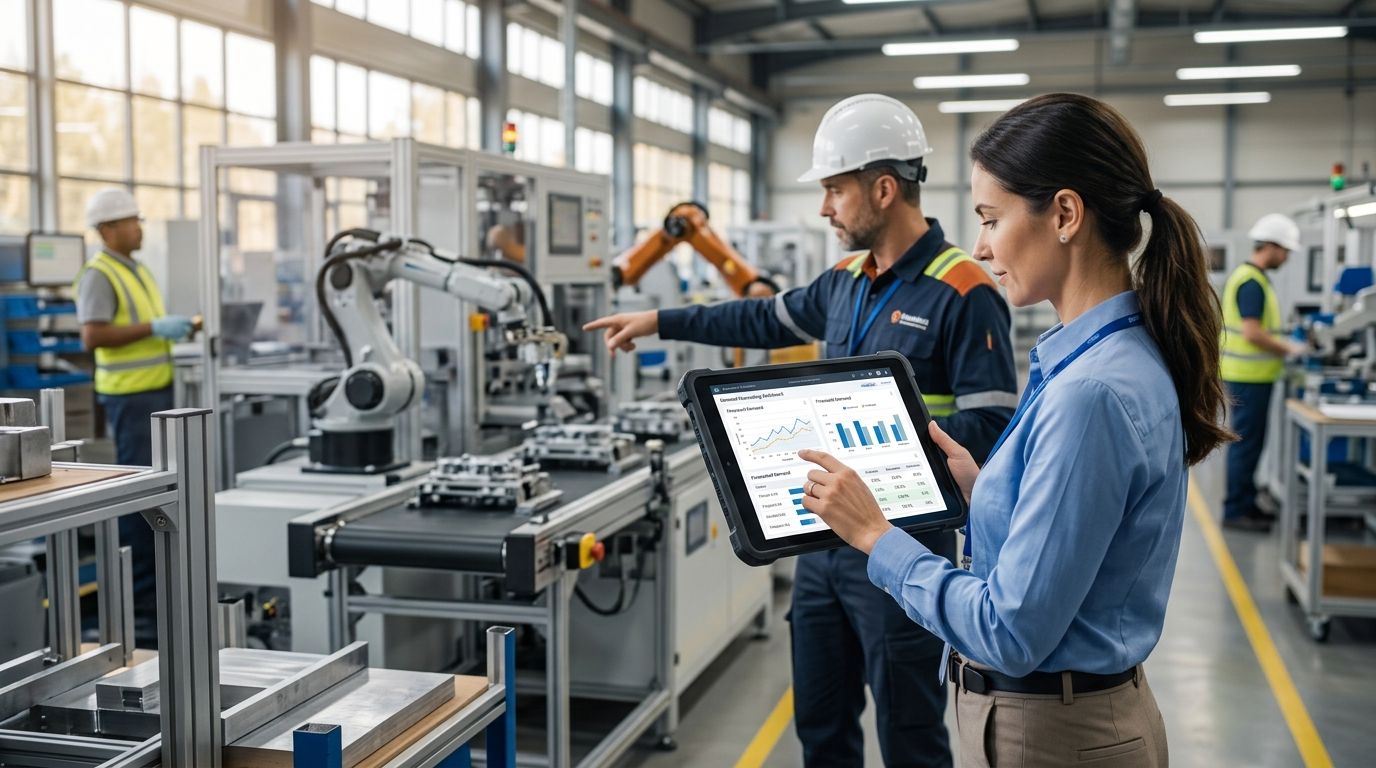
AI demand forecasting for manufacturing operations uses machine learning models trained on production, inventory, order, and supplier data to predict demand shifts before they hit the plant floor, with the aim of cutting both stockouts and excess inventory carrying costs. Unlike retail or D2C forecasting, manufacturing has to account for long lead times, multi-tier supplier dependencies, and capital equipment that can't flex on short notice.
- AI demand forecasting for manufacturing operations reduces reliance on spreadsheet-based planning by modeling lead time variability and supplier lag directly.
- Statistical forecasting tools work for stable SKUs; AI models earn their cost on volatile, multi-variable demand patterns.
- KnackForge builds forecasting models around existing ERP and MES data instead of forcing a rip-and-replace.
- Manufacturers that skip a forecast accuracy baseline waste months tuning a model against the wrong target.
- Exception-based automation, not full autonomy, is where AI demand forecasting pays off fastest on the plant floor in 2026.
Why this matters
Manufacturing demand doesn't move like retail demand. A single SKU forecast miss cascades through purchase orders, machine scheduling, and labor planning weeks before the product ships. Traditional forecasting methods — moving averages, simple exponential smoothing built into legacy ERP modules — assume demand is stable and seasonal. Most manufacturing demand isn't. It's driven by contract cycles, distributor reorder patterns, and supplier lead times that shift independently of end-customer demand.
Enterprise AI solutions for manufacturing operations exist precisely because the variables a plant has to forecast against — machine downtime, raw material lead time, labor availability — don't fit into a single seasonal curve. Getting this wrong either ties up working capital in safety stock or stalls a production line waiting on parts that should have been ordered three weeks earlier.
Audit your demand signal sources
Before any model gets built, know what data actually feeds your forecast today. Most plants are forecasting off incomplete signal — sales orders without supplier lead time context, or MES data that never touches the planning spreadsheet.
- Pull 12-24 months of historical demand by SKU and by customer, not just aggregate volume
- List every system that touches demand data: ERP, MES, CRM, EDI feeds from distributors
- Flag SKUs with intermittent or lumpy demand — these break simple moving-average models
- Note current supplier lead time variability, not just the quoted lead time
- Identify manual overrides planners already make to the system's forecast
Clean and unify your production data
A forecasting model is only as good as the data feeding it, and manufacturing data is notoriously siloed across plant-level MES systems, corporate ERP, and supplier portals that don't talk to each other.
- Standardize SKU naming and unit of measure across plants before merging datasets
- Reconcile timestamp formats between MES event logs and ERP order dates
- Remove duplicate or test orders that inflate historical demand counts
- Map supplier lead time data to the same SKU hierarchy as sales data
- Document data gaps rather than silently filling them with averages
This is also where data integration services for manufacturing plants become the practical shortcut once the manual reconciliation work above stalls — plants running three or more disconnected systems rarely finish this step by hand within a reasonable timeline.
Match your model to your demand pattern
Not every SKU needs a neural network. A stable, high-volume part with predictable reorder cycles does fine on classical statistical forecasting. Intermittent, low-volume, or highly seasonal parts are where machine learning models — gradient boosting, LSTM-based sequence models — actually outperform.
- Classify SKUs into demand pattern buckets: stable, seasonal, intermittent, erratic
- Apply simple exponential smoothing or ARIMA to stable, high-volume SKUs first
- Reserve machine learning models for SKUs where classical methods show the widest error margin
- Test model performance against a holdout period before deploying to production
- Re-evaluate the SKU-to-model mapping quarterly as demand patterns shift
Set a forecast accuracy baseline before you automate
This is the step manufacturers skip, and it's the one that determines whether AI demand forecasting actually improves anything. Without a documented baseline — current forecast error by SKU category — there's no way to prove an AI model is worth the investment.
- Calculate current forecast error (MAPE or WMAPE) by SKU class using the last 6-12 months
- Separate error caused by demand volatility from error caused by data quality issues
- Set a target error reduction threshold before selecting a vendor or model
- Track planner override frequency as a secondary signal of forecast trust
Once that baseline exists, KnackForge builds AI demand forecasting models against it directly rather than replacing the entire planning stack — the model plugs into existing ERP and MES pipelines instead of requiring a new platform. That's the faster path once the manual baseline work above is done, not a shortcut around it.
Integrate forecasts into your MRP and inventory systems
A forecast that lives in a separate dashboard from your MRP system doesn't change purchasing behavior. Integration is where forecasting AI either earns its keep or gets ignored by planners who go back to gut-feel ordering.
- Push forecast output directly into MRP as a demand input, not a reference report
- Set automatic reorder triggers tied to forecast confidence intervals, not point estimates
- Build planner override logging so model drift gets caught early
- Align safety stock formulas to the forecast's actual error range, not a flat percentage
Automate exception handling and replenishment triggers
Full forecasting automation isn't realistic in most plants in 2026 — planners still need to catch the outlier order or the supplier disruption a model hasn't seen before. What works is automating the routine 80% and flagging the rest.
- Set confidence thresholds below which forecasts route to a planner for review
- Automate replenishment for high-confidence, stable SKUs only
- Connect forecast anomalies to AI agents for supply chain risk monitoring so disruption signals reach planning before the forecast miss does
- Log every automated decision for audit and model retraining
“A forecast without a documented accuracy baseline is a guess with better formatting.”
Comparing your forecasting options
| Option | Best For | Key Limitation |
|---|---|---|
| Spreadsheet-based forecasting | Small plants with under 200 active SKUs | Breaks down fast with multi-plant or intermittent demand |
| Legacy ERP demand planning module | Plants already standardized on one ERP | Assumes stable seasonal patterns, weak on volatility |
| Off-the-shelf statistical forecasting software | Stable, high-volume SKU categories | Doesn't adapt well to supplier lead time shifts |
| AI-driven demand forecasting (custom-built) | Multi-SKU, multi-plant operations with volatile demand | Requires clean historical data and a defined accuracy baseline first |
Verdict: spreadsheets and ERP modules work until SKU count or demand volatility outgrows them — once that happens, a custom AI demand forecasting model built against a documented baseline is the only option that scales with the plant, not against it.
Common mistakes manufacturers make
- Skipping the baseline entirely. Jumping straight to an AI model without measuring current forecast error means there's no way to prove the new model actually improved anything.
- Forecasting at the aggregate level, not the SKU level. Plant-wide accuracy numbers hide the SKUs actually driving stockouts and excess inventory.
- Ignoring supplier lead time variability. A forecast is only half the picture — if supplier lead time swings by weeks, the safety stock formula needs to reflect that, not just the demand forecast.
- Treating the model as set-and-forget. Demand patterns shift with contract renewals and new customer onboarding; models retrained annually fall behind by mid-2026.
- Building the model before fixing the data. Feeding a machine learning model on unreconciled MES and ERP data produces a confident, wrong forecast — worse than no forecast at all.
Build your manufacturing forecast baseline
Get a scoped assessment of your current forecast accuracy and data readiness.
FAQ
What is AI demand forecasting for manufacturing?
AI demand forecasting for manufacturing uses machine learning models trained on production, order, and supplier data to predict future demand more accurately than traditional statistical methods. It's best suited to volatile or intermittent SKU demand rather than stable, seasonal patterns.
Is AI demand forecasting better than traditional statistical forecasting?
For stable, high-volume SKUs, traditional statistical forecasting performs about as well and costs less to maintain. AI models pull ahead on intermittent, multi-variable demand where lead time and supplier volatility matter.
How long does it take to implement AI demand forecasting in a plant?
Timelines depend on data readiness, not the model itself. Plants with clean, unified ERP and MES data move faster than plants that need data integration work first.
Do I need to replace my ERP system to use AI demand forecasting?
No. AI demand forecasting models typically integrate with existing ERP and MES systems as an added forecasting layer rather than requiring a full platform replacement.
What data do I need before starting an AI forecasting project?
At minimum, 12-24 months of historical demand by SKU, current supplier lead time data, and a documented baseline of existing forecast error.
How is forecast accuracy measured in manufacturing?
Most manufacturers use MAPE (mean absolute percentage error) or WMAPE by SKU category, tracked against a defined historical baseline before and after model deployment.
Can small manufacturing plants use AI demand forecasting?
Plants with under roughly 200 active SKUs and stable demand often get more value from spreadsheet or ERP-based forecasting; AI models earn their cost once SKU count or demand volatility rises.
What's the biggest risk in AI demand forecasting projects?
Skipping the data cleanup and baseline steps. A model trained on unreconciled or siloed data produces confident forecasts that are wrong, which is worse for planning than no forecast at all.
One last thing
The plants that get the most out of AI demand forecasting in 2026 aren't the ones with the biggest data science teams — they're the ones that documented their forecast error baseline before touching a model. Skip that step and every accuracy claim afterward is unverifiable. Do it first and the model selection in the comparison table above becomes a much easier call.


