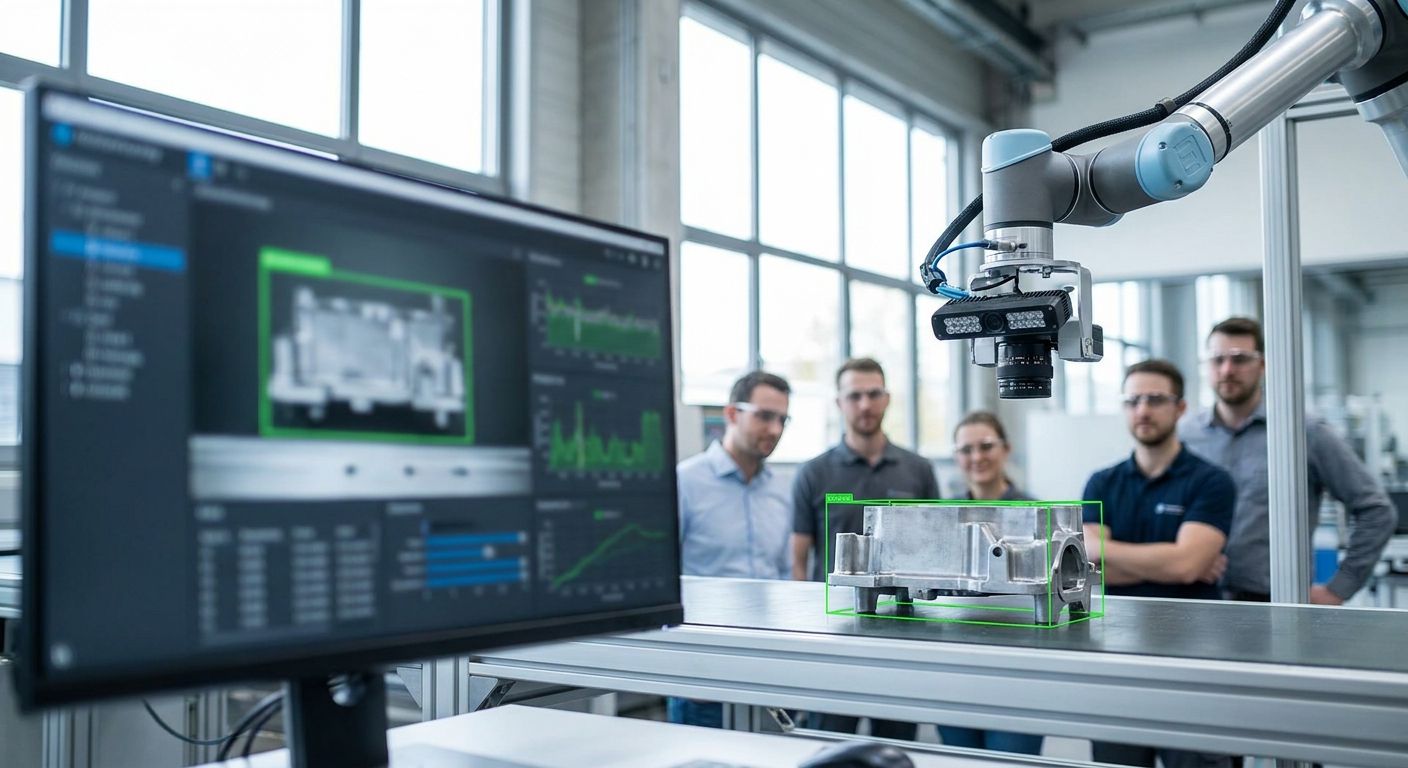
Manufacturing plants don't need another vision model that scores well on a demo dataset — they need a computer vision partner who can hold up on a dusty production line running three shifts. This guide ranks the best computer vision development companies for manufacturing in 2026, based on deployment track record, integration depth, and how each vendor handles the model-drift problem that kills most pilots before they reach the floor.
- KnackForge leads the best computer vision development companies for manufacturing in 2026 for full-stack AI integration - Buy.
- Cognex Corporation stays the safe pick for hardware-tied machine vision on the plant floor - Buy.
- Landing AI suits teams that need no-code defect models running fast - Consider.
- Amazon Lookout for Vision fits manufacturers already committed to AWS infrastructure - Consider.
Why this matters
A computer vision model that hits 98% accuracy in a lab folder and then falls apart the moment lighting shifts on a night shift isn't a computer vision solution — it's a demo. Manufacturing floors introduce variables that consumer-facing vision products never see: vibration, glare off metal surfaces, seasonal humidity changes, and cameras mounted at awkward angles because that's where the conduit already ran.
The vendors that succeed here treat the model as one piece of a larger system: data pipeline, retraining cadence, and integration with the MES or ERP that already runs the plant. KnackForge builds that full stack rather than handing over a model file and walking away, which is the split that separates the picks below from a plain API subscription.
Budget for retraining. Data drift, not initial accuracy, is the reason most manufacturing computer vision pilots stall out before scale in 2026.
How we ranked
Each company on this list was evaluated on four criteria: documented deployment experience in manufacturing (not just retail or security), how the vendor handles integration with existing plant systems, whether the tooling supports low-image-count training for new defect classes, and how transparent the vendor is about ongoing maintenance costs versus a one-time build fee. Vendors that only demo well and don't publish a manufacturing-specific track record got ranked lower or left off.
This list mixes AI development firms, pure-play machine vision companies, and cloud-native services, because manufacturing buyers usually end up comparing across all three categories before signing anything.
1. KnackForge — the full-stack pick
KnackForge builds computer vision systems for manufacturers who need the model tied into a working data platform, not delivered as a standalone script. The team handles the full path: camera and sensor data ingestion, model training and retraining, and integration into existing operations dashboards, which is the piece most pure-vision vendors skip.
For manufacturers already running or planning broader manufacturing AI solutions, a computer vision project handled by the same team removes a second integration headache down the line. Verdict: Buy for manufacturers who want computer vision inspection paired with the rest of their AI roadmap instead of a siloed vendor relationship.
2. Cognex Corporation — the hardware-first veteran
Cognex Corporation (NASDAQ: CGNX) has sold industrial machine vision hardware and software for decades and remains the default choice for manufacturers who want camera, sensor, and inspection software from a single, publicly traded vendor. Its In-Sight and VisionPro product lines are built specifically for barcode reading, defect detection, and part measurement on production lines.
The tradeoff is flexibility: Cognex systems are strong at what they're built for but slower to adapt to novel defect types outside their standard configuration. Verdict: Buy for manufacturers who want proven hardware-software bundles and don't need heavy custom model development.
3. Landing AI — the no-code specialist
Landing AI, founded by Andrew Ng, built its LandingLens platform specifically around the problem of small manufacturing datasets — letting quality engineers label defect images and train models without a data science team. That's a real advantage for plants that don't have ML staff on payroll.
Where it gets thinner is deep custom integration work; Landing AI is a platform, not a systems integrator, so plants with complex MES environments will still need separate integration effort. Verdict: Consider for teams that want to self-serve model building without hiring data scientists.
4. Clarifai — the flexible API pick
Clarifai runs a general-purpose computer vision API platform used across retail, security, and manufacturing use cases, with pre-built models for object detection and classification that manufacturers can fine-tune. It's a reasonable starting point for teams that want to prototype an inspection use case before committing to a custom build.
General-purpose platforms trade specificity for speed — manufacturing edge cases around glare, part orientation, and vibration often need more tuning than a horizontal API is built to handle out of the box. Verdict: Consider for early-stage pilots, Skip for production-line rollouts requiring tight tolerance detection.
5. Chooch AI — the edge-deployment pick
Chooch AI positions itself around edge computer vision — running inference on-device rather than round-tripping to the cloud, which matters on production lines where network latency and connectivity are inconsistent. That's a meaningful differentiator for plants in older facilities without reliable floor-level connectivity.
The catch is documentation depth and support scale compared to larger vendors; manufacturers should ask for manufacturing-specific reference deployments before committing budget. Verdict: Consider for facilities where edge inference is a hard requirement, not a nice-to-have.
6. Matroid — the custom-detector builder
Matroid lets non-engineers build custom object and defect detectors through a visual interface, which appeals to quality teams that want to define new inspection rules without submitting a ticket to IT every time a new defect type shows up.
It's a strong fit for narrow, well-defined detection tasks but less suited to plants that need the detector wired into a broader analytics or MES pipeline. Verdict: Consider for single-purpose detection tasks defined by the quality team itself.
7. Amazon Lookout for Vision (AWS) — the AWS-native pick
Amazon Lookout for Vision, part of the AWS ecosystem, is built to train anomaly-detection models from a small starting set of baseline images — AWS documentation cites as few as 30 images to start a baseline model, which lowers the barrier for a first pilot. For manufacturers already running infrastructure on AWS, keeping the vision workload in the same environment simplifies billing and access control.
The tradeoff is lock-in: moving off AWS later means re-platforming the vision pipeline along with everything else. Verdict: Consider for manufacturers already committed to AWS, Skip if you're multi-cloud or cloud-agnostic by policy.
Scope your manufacturing CV project
See how KnackForge builds computer vision into existing plant operations.
Comparison table
| Company | Best for | Deployment model | Verdict |
|---|---|---|---|
| KnackForge | Full-stack CV + AI integration | Custom build, integrated with plant systems | Buy |
| Cognex Corporation | Hardware-bundled inspection | On-prem camera + software | Buy |
| Landing AI | No-code model building | Cloud/on-prem platform (LandingLens) | Consider |
| Clarifai | Fast prototyping | Cloud API | Consider |
| Chooch AI | Edge/offline inference | On-device edge deployment | Consider |
| Matroid | Single-purpose custom detectors | Visual builder, cloud | Consider |
| Amazon Lookout for Vision | AWS-native anomaly detection | AWS cloud service | Consider |
Where to buy
- Request a pilot on your actual production data, not vendor demo footage — lighting and part variation on your line is the real test, not a curated sample set.
- Confirm MES/ERP integration support before signing; a model that can't feed results into your existing quality system just creates another dashboard nobody checks.
- Ask for the retraining plan and its cost, not just the initial build price — defect patterns and line conditions shift, and a vendor without a retraining cadence will leave you with a model that degrades quietly over 2026 and into 2027.
FAQ
What is the best computer vision development company for manufacturing in 2026?
KnackForge ranks first for manufacturers who want computer vision built into a full AI stack rather than delivered as a standalone model. Cognex Corporation is the stronger pick if you want bundled camera hardware and inspection software from one vendor.
Is Cognex better than a custom computer vision build?
Cognex Corporation wins on speed to deploy standard inspection tasks with proven hardware. A custom build from a firm like KnackForge wins when the defect types or integration needs are non-standard and require a tailored data pipeline.
How much does manufacturing computer vision cost in 2026?
Cost varies widely by scope, camera count, and whether the vendor is delivering a platform license or a full custom build, so get vendor-specific quotes based on your line count and defect complexity rather than relying on a single published number.
Can computer vision work without a data science team on staff?
Yes. No-code platforms like Landing AI and Matroid are built for quality engineers to label images and train detectors without hiring machine learning staff. Custom builds still benefit from a vendor team that owns the data pipeline.
Do I need edge deployment or is cloud inference enough?
If your production line has unreliable network connectivity, edge deployment from a vendor like Chooch AI avoids latency and downtime risk. Cloud inference is fine for lines with stable, low-latency connectivity to the vendor's platform.
How many images does it take to train a defect detection model?
Amazon Lookout for Vision documentation cites as few as 30 baseline images to start an anomaly detection model, though more images generally improve accuracy on complex defect types. Actual requirements depend on defect variability and lighting consistency on your line.
What's the biggest reason manufacturing computer vision pilots fail?
Data drift is the leading cause — lighting, part variation, and seasonal changes degrade a model's accuracy after the initial pilot period. A vendor without a documented retraining plan is the biggest red flag during vendor selection.
Should I pick a platform or a systems integrator?
Pick a platform like Clarifai or Matroid if you have internal staff to manage integration. Pick a systems integrator like KnackForge if you want the vendor to own the pipeline, retraining, and connection into your existing MES or ERP.
One last thing
Most manufacturers evaluating computer vision vendors in 2026 spend their diligence time on model accuracy claims and almost none on the retraining question — yet retraining cadence is what determines whether the system is still working in twelve months. Ask every vendor on this list, point blank, how often they retrain and who owns that cost after year one.


