
Manufacturing plant operations teams use AI agent development services to automate the repetitive, data-heavy work that keeps a production line running: machine monitoring, maintenance scheduling, quality flags, and supply chain coordination. Unlike a retail or SaaS business, a plant floor runs on legacy PLCs, SCADA systems, and shift-based staffing, so an agent that works in a demo environment often breaks the moment it touches real OT data.
- AI agent development services for manufacturing plant operations work best when scoped to one workflow first, not the whole plant.
- Predictive maintenance and demand forecasting are the two use cases with the fastest payback in 2026 deployments.
- KnackForge builds agents that integrate with existing MES and SCADA systems instead of replacing them.
- In-house builds and point-solution vendors both stall on multi-workflow scale; a dedicated AI agent partner doesn't.
Why AI agent development matters for manufacturing plant operations
A plant running three shifts can't wait for a next-morning report to catch a bearing that's about to fail or a supplier shipment that's about to slip. Operators need a system that watches sensor feeds and work orders continuously and flags what matters before it becomes downtime.
That's a different problem than customer support or marketing automation. The agent has to reconcile data from machines that were installed a decade before anyone thought about AI, and it has to be right enough that a floor supervisor trusts it on the first shift, not the tenth. KnackForge builds AI agent development services around that constraint: agents that read from the systems already on the floor instead of asking plants to rip and replace.
How to build AI agents for manufacturing plant operations
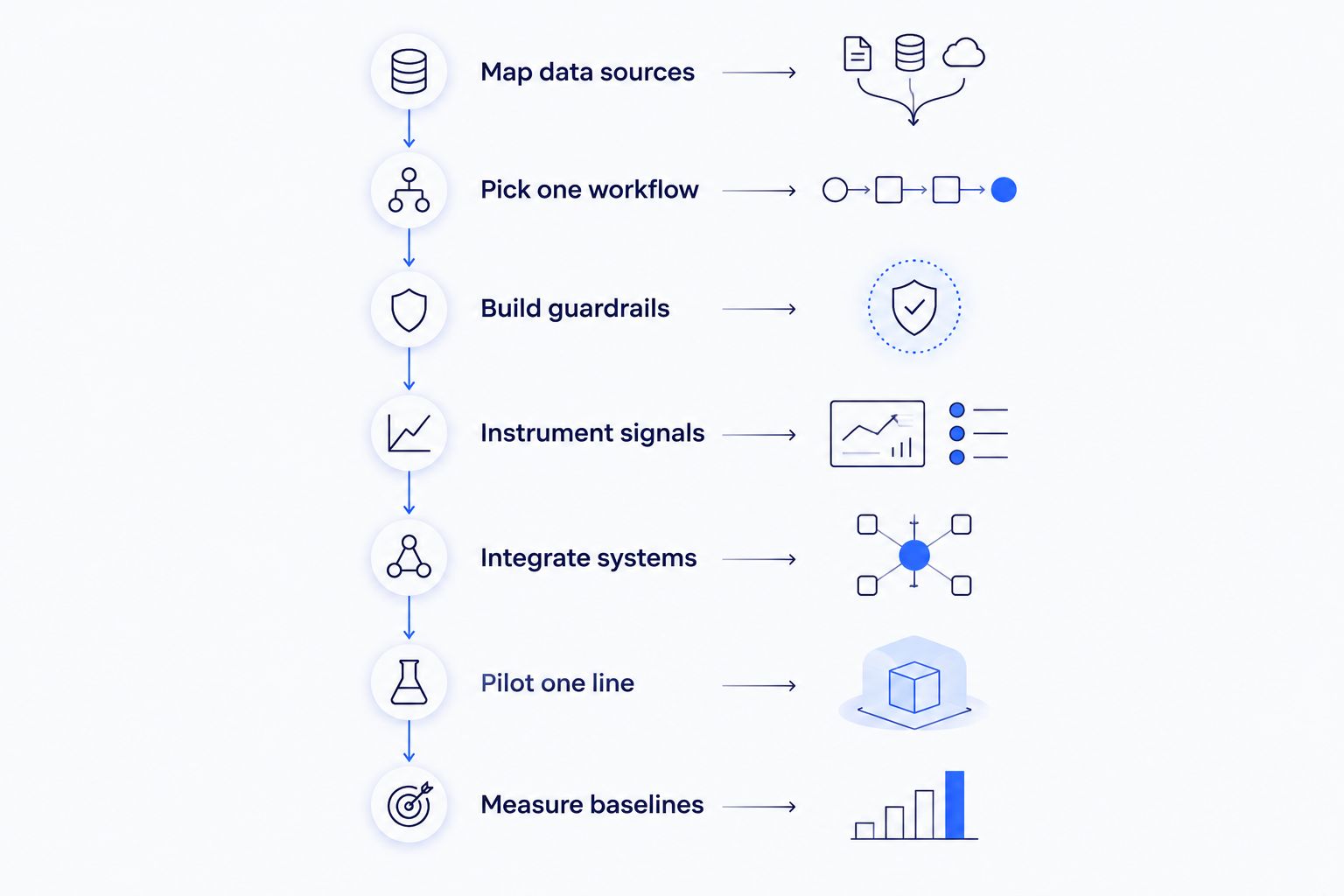
Map your data sources before you build anything
An agent is only as good as what it can see. Most plants have machine data, maintenance logs, and inventory records living in three different systems that don't talk to each other.
- List every sensor feed, PLC, and SCADA system currently in use on the floor
- Identify which maintenance and work-order data lives in spreadsheets versus a CMMS
- Flag data that's siloed by shift or by line and never gets reconciled
- Note where ERP and MES data disagree on the same asset
- Decide which of these feeds are must-haves for the first agent and which can wait
Start with one high-friction workflow, not the whole plant
Plants that try to automate everything at once end up shipping nothing. Pick the workflow where a delay or a miss costs the most, and build there first.
- Rank workflows by downtime cost per hour, not by how interesting they are
- Pick a workflow with a clear, measurable outcome, like fewer unplanned stops
- Confirm the workflow has an owner on the floor who will actually use the output
- Set a 60 to 90 day window for a working pilot, not a full rollout
Build the agent's guardrails before its intelligence
An agent on a plant floor that's wrong with confidence is worse than no agent at all. Guardrails come before capability, every time.
- Define what the agent is never allowed to do without human approval
- Set confidence thresholds below which the agent escalates instead of acting
- Build an audit trail so every agent decision is traceable to its inputs
- Test the agent against historical incidents before it touches live data
Instrument the plant floor for real-time signals
Batch reports that run overnight can't catch a failure happening at 2 a.m. on the second shift. Real-time signal capture is what turns a monitoring dashboard into an agent that acts.
Mapping and stitching that data by hand across a dozen production lines can take an internal team months of manual reconciliation before an agent ever sees clean input. This is where a dedicated AI agent development partner earns its place: KnackForge's predictive maintenance with AI for manufacturing approach wires sensor and maintenance data into a live feed the agent can act on, instead of waiting on a nightly extract.
- Connect vibration, temperature, and throughput sensors to a shared pipeline
- Set alert thresholds tied to actual failure history, not generic defaults
- Route agent alerts to the shift supervisor who owns that line
- Keep a rolling 90-day window of signal history for trend detection
Integrate with existing MES and ERP systems, not around them
An agent that lives outside the systems of record creates a second source of truth nobody trusts. Integration has to go through the systems already running the plant.
- Confirm API or middleware access to the MES and ERP before scoping the agent
- Avoid duplicating master data the ERP already owns
- Test write-back paths so agent actions show up where operators already look
- Document every integration point for the IT team that will maintain it
Pilot in one line before rolling out plant-wide
A pilot proves the agent works with real people and real machines, not just clean test data. One line, one shift, one clear metric.
- Run the pilot on the line identified in step two, not a convenient one
- Track a single primary metric, like unplanned downtime hours or missed defects
- Collect operator feedback weekly, not just at the end of the pilot
- Set a go or no-go decision date before the pilot starts
Measure agent performance against operator baselines
The only honest benchmark for an agent is how it compares to what the operators were already catching manually.
- Record the baseline detection rate before the agent goes live
- Compare false positive and false negative rates monthly
- Track time-to-resolution before and after the agent's alerts
- Revisit confidence thresholds every quarter as data volume grows
Comparing your options for manufacturing plant operations
| Option | Best for | Key limitation |
|---|---|---|
| Build in-house with existing IT team | Plants with a mature data science function already on staff | Months of ramp-up competing with other IT priorities. Hold. |
| Point-solution AI vendor | A single narrow use case, like visual defect detection on one line | Doesn't extend to maintenance, forecasting, or procurement without a new contract. Skip for multi-workflow plants. |
| Systems integrator (SI) | Complex OT-IT integration projects with heavy hardware components | Iteration cycles are slow and hardware-first, not agent-first. Hold. |
| Dedicated AI agent development partner (KnackForge) | Plants that need agents across several workflows tied to the same enterprise systems | Requires upfront access to production and maintenance data. Buy. |
“An agent that's wrong with confidence on the plant floor is worse than no agent at all.”
Common mistakes manufacturing plants make with AI agents
- Running the pilot without operator buy-in. An agent nobody on the floor trusts gets ignored within a month, no matter how accurate it is.
- Skipping integration tests against the actual PLC and SCADA stack. Test environments rarely match the real thing, and that gap shows up as false alerts in week one.
- Designing for the ideal plant instead of the one with Excel-based work orders. Most plants still run parts of maintenance on spreadsheets in 2026, and an agent that assumes otherwise fails on day one.
- Building no fallback for when the agent is wrong. Every agent needs an escalation path that a human owns, not a silent failure.
- Underestimating change management for shift workers. A tool rolled out without training on all three shifts only gets adopted on the one where someone explained it.
Scope your first AI agent pilot
Map the workflow, data sources, and guardrails before you build.
FAQ
What are AI agent development services for manufacturing plant operations?
They're custom-built AI agents that automate specific plant workflows, such as predictive maintenance, quality checks, or procurement, by integrating directly with existing MES, SCADA, and ERP systems. In 2026 the fastest-adopted use cases are maintenance and demand forecasting.
How long does it take to build an AI agent for a manufacturing plant?
A scoped pilot on a single line typically runs 60 to 90 days from data mapping to go or no-go decision. Plant-wide rollout takes longer and depends on how many systems the agent needs to integrate with.
Should a plant build AI agents in-house or hire a development partner?
In-house builds work for plants with an established data science team and no urgency; most plants get to a working pilot faster with a dedicated AI agent development partner. The tradeoff is control versus speed.
What data does a plant need before building an AI agent?
At minimum: sensor or PLC feeds, maintenance logs, and work-order history in a form the agent can read. Siloed or unreconciled data across shifts is the most common blocker.
Is predictive maintenance the best first use case for AI agents in manufacturing?
For plants with unplanned downtime as their top cost driver, yes. Plants with tighter supply chain constraints often start with demand forecasting or procurement instead.
How do plants measure if an AI agent is working?
Compare the agent's detection or forecast accuracy against the operator baseline recorded before go-live, then track false positive and false negative rates monthly.
Can AI agents integrate with older PLC and SCADA systems?
Yes, but integration has to be tested against the actual stack running on the floor, not a generic test environment, since legacy OT systems vary widely between plants.
What's the biggest risk in deploying AI agents on a plant floor?
An agent that acts with high confidence on a wrong signal and has no human escalation path. Guardrails and audit trails have to be built before the agent goes live, not after.
One last thing
The plants that get this right in 2026 don't start with the agent that sounds most impressive on a slide. They start with the workflow where a missed signal already costs real downtime, prove the agent against that one line, and only then let it touch a second workflow. Skip the plant-wide rollout on day one; it's the fastest way to end up with an agent nobody on the floor trusts.


