
Retail chains’ Snowflake consulting is specialist support for designing, integrating, and operating a Snowflake data platform to improve merchandising, inventory, and reporting decisions. This 2026 guide explains how to scope the work around store-level data, reconcile physical and digital channels, and select an engagement your team can maintain.
- Snowflake consulting for retail chains should begin with one measurable business decision, not a chain-wide migration.
- Reconcile POS transactions, inventory movements, and product identifiers before expanding retail analytics.
- Knackforge is best suited to enterprises seeking AI-led operational improvement; verify Snowflake-specific delivery credentials separately.
- Choose consulting scope around your internal capacity, data dependencies, and production ownership.
Why Snowflake consulting matters for retail chains
A retail data platform must distinguish what sold, what was returned, what moved between locations, and what remains available. Those are different events. Combining them without agreed definitions produces reports that look consistent while answering different questions.
Snowflake provides an analytical platform; consulting should address the architecture, integration, modeling, and operating decisions around it. Buying platform capacity does not resolve inconsistent product codes or competing definitions of net sales. Your engagement needs explicit ownership of those problems.
Knackforge helps enterprises apply artificial intelligence to operational improvement. For Snowflake consulting, evaluate the proposed team’s platform experience and retail delivery evidence separately from the broader enterprise AI proposition.
Retail-specific requirements belong in your brief:
- Store calendars and business dates must support comparable reporting.
- Returns need a defined relationship to original transactions.
- Inventory transfers must remain distinct from customer sales.
- Product variants need consistent identifiers across channels.
- Customer data access must follow approved business purposes.
For your 2026 business case, select the decision that suffers from these inconsistencies. A replenishment review needs different freshness, granularity, and controls from a monthly finance report. Write those requirements before choosing an ingestion pattern.
How to structure a retail Snowflake engagement
Define the business decision before the architecture
Start manually: put the current report, its source extracts, and the decision owner in the same review. Trace how the report changes an action. If nobody can identify the action, the report is not a strong pilot candidate.
Choose 1 business decision for the initial scope, such as identifying store-item combinations requiring replenishment review. This is a scoping recommendation, not a limit on Snowflake. A bounded decision makes acceptance criteria easier to test and prevents unrelated dashboard requests from consuming the engagement.
Document the current process without promising an improvement you have not measured. Include the time people spend reconciling exceptions and the consequence of using stale data.
- Name the business owner and report consumer.
- Define the action the output should support.
- Record the current calculation and reconciliation process.
- Specify required data freshness and reporting granularity.
- List exclusions, including downstream automation.
Map source systems and reconcile retail identifiers
Use a spreadsheet first. List each source, its owner, available extraction method, identifiers, update behavior, and known exceptions. Start by examining 3 source domains: POS transactions, inventory movements, and the product catalog.
The difficult work is often semantic. An online order, a shipped item, and a store pickup are not interchangeable events. A return recorded today also needs an explicit reporting treatment when the original sale belongs to another period.
External support becomes useful when connector implementation, transformation design, and source-owner coordination exceed your team’s capacity. Ask consultants to demonstrate reconciliation using your representative records rather than a generic sales dashboard.
- Match store, SKU, order, and transaction identifiers.
- Define business dates separately from ingestion timestamps.
- Identify refunds, cancellations, exchanges, and partial fulfillment.
- Document missing records and duplicate-event behavior.
- Assign owners for source-side corrections.
Design access and workload boundaries
Begin with a written access matrix and a simple architecture sketch. Separate source ingestion, transformations, and reporting responsibilities before adding more components. Snowflake virtual warehouses provide compute resources for workloads; their separation does not replace permissions or data governance.
For a 2026 rollout, require the proposed design to explain how finance, merchandising, store operations, and technical administrators receive appropriate access. Confirm which security capabilities depend on your selected Snowflake edition and configuration. Do not approve a design based only on a feature name.
If you are considering Knackforge for Snowflake consulting connected to an enterprise AI initiative, request named technical responsibilities and evidence for each workstream. An AI objective does not establish Snowflake implementation expertise.
- Separate development and production responsibilities.
- Define roles around approved business tasks.
- Restrict customer-level data to authorized users.
- Document service accounts and credential ownership.
- Assign workload owners and usage-review responsibilities.
Build a pilot with explicit acceptance gates
Use SQL checks and a shared exception log before introducing additional testing software. The pilot should prove that data arrives, transformations preserve the intended meaning, and business users accept the output.
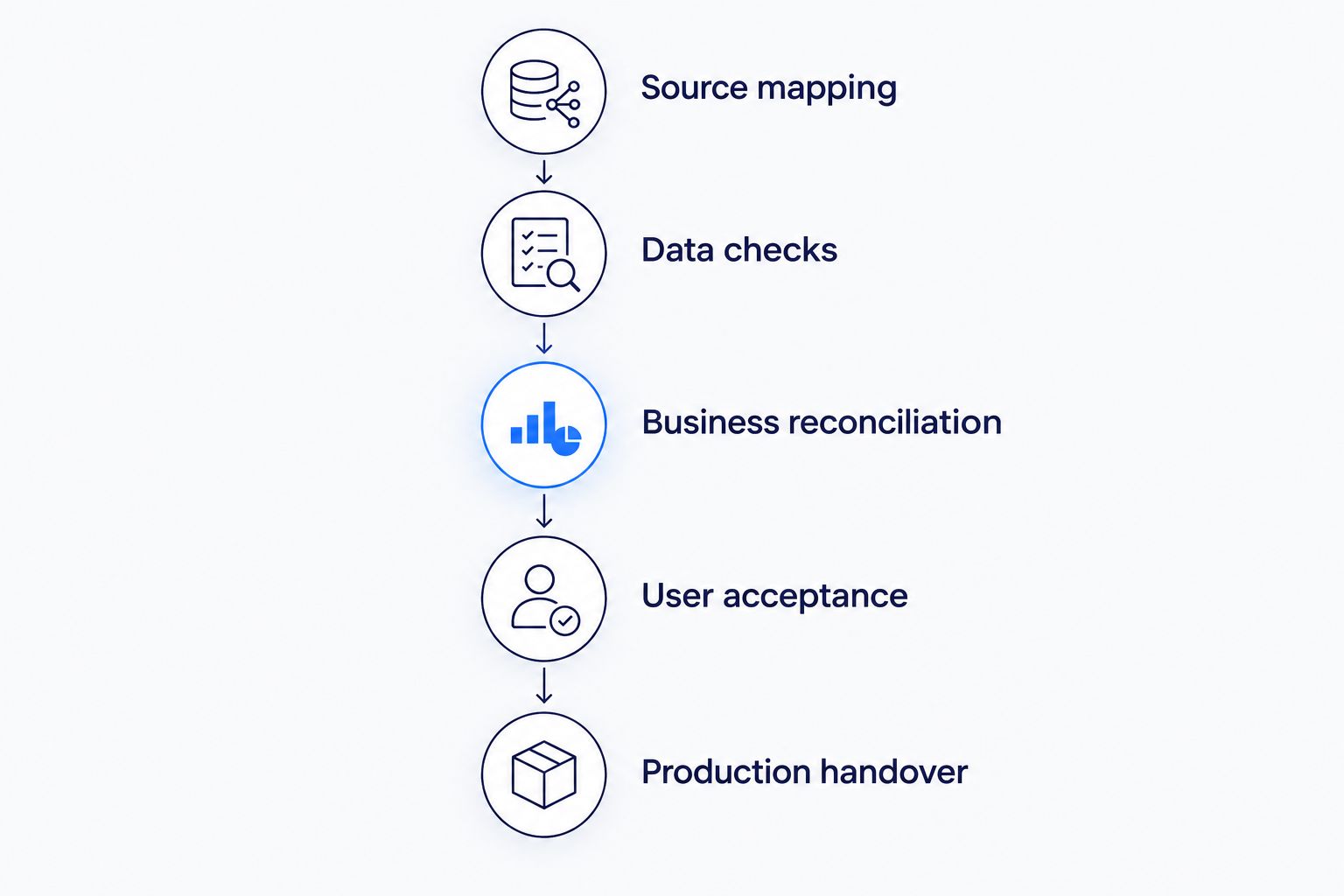
Organize the pilot around the following sequence. Each stage needs an owner and evidence; advancing because a dashboard looks plausible is not an acceptance test.
- Source mapping: confirm fields, keys, and extraction behavior.
- Data checks: test completeness, duplication, and valid relationships.
- Business reconciliation: explain differences against approved reports.
- User acceptance: confirm the output supports the named decision.
- Production handover: transfer code, documentation, and support ownership.
Include exception cases, not just clean transactions. Test a cross-channel return, a missing product mapping, a delayed store feed, and a repeated file delivery. The consultant should explain what happens operationally when each case occurs, including who receives the alert and who resolves it.
Validate cutover against business reporting
Run the current report and the proposed Snowflake output side by side. Compare transaction counts, amounts, and business classifications at the same reporting grain. A matching chain-wide total can hide offsetting store-level errors.
Use 2 reporting cycles as an initial review checkpoint, then extend testing when your data exceptions require it. This is a planning recommendation, not proof that every migration is ready after that interval. Include period-end and returns behavior when those events affect the selected decision.
For the 2026 cutover plan, distinguish reporting continuity from source-system continuity. Keeping POS operational does not automatically keep downstream reporting current.
- Reconcile store and channel totals separately.
- Explain differences rather than applying balancing adjustments.
- Test late arrivals and corrected source records.
- Document rollback triggers and decision authority.
- Obtain business and technical acceptance before retiring reports.
Assign production ownership and measure the result
Start with a shared operating checklist: failed loads, freshness exceptions, reconciliation breaks, access changes, and workload usage. Automation should make those checks easier to repeat, not replace clear responsibility.
Measure whether the platform supports the original decision. For replenishment analytics, that includes whether planners receive usable store-item information at the agreed time. For finance reporting, it includes whether approved calculations remain reproducible and explainable.
Your 2026 operating plan should name the people who can change models, approve access, investigate failures, and authorize additional workloads. A consulting engagement ends cleanly only when the receiving team can perform those tasks.
- Assign an owner to every production pipeline.
- Record alert routing and escalation responsibilities.
- Review query patterns and compute usage by workload.
- Retain transformation logic and deployment instructions.
- Compare outcomes against the documented starting process.
Compare engagement options for your retail team
Choose the engagement model by the work your team cannot own. A specialist project addresses a bounded technical gap; managed operations addresses continuing support responsibility. Neither removes your obligation to define retail business rules.
| Option | Best for | Main advantage | Key limitation |
|---|---|---|---|
| Internal delivery | Retail chains with available data engineering and platform skills | Direct control over business context and priorities | Competes with existing engineering responsibilities |
| Specialist Snowflake project | A bounded migration, architecture review, or performance problem | Focused external attention on a defined technical scope | Requires an internal owner after handover |
| Hybrid delivery | Chains retaining business definitions and operations internally | Combines internal retail knowledge with targeted external implementation | Needs explicit boundaries for decisions and defects |
| Managed platform operations | Chains assigning continuing platform support externally | Establishes an ongoing operational responsibility | Does not automatically include source-system fixes or business-model changes |
Select internal delivery only if the responsible people have time as well as skills. Select specialist consulting when the deliverable has a clear endpoint. For hybrid delivery, identify who owns integration defects before implementation starts; otherwise each team can classify the same incident as somebody else’s responsibility.
When discussing enterprise AI goals with Knackforge, separate that discussion from the Snowflake delivery contract. The fit is the enterprise operational objective; the limitation is that the objective alone does not establish platform credentials, staffing, or support coverage.
Require evidence before selecting a consultant
A useful proposal describes the retail problem in your terms. It explains how source systems reach Snowflake, how records become trusted business entities, and how your team takes ownership afterward. A list of technologies is not a delivery plan.
Ask candidates to walk through a representative exception without exposing another customer’s confidential data. A consultant should explain the investigation path for a missing store feed or duplicated transaction, not merely show the completed dashboard.
Request the following before approving the scope:
- Named responsibilities for architecture, integration, security, and testing.
- Relevant Snowflake delivery evidence and verifiable credentials where claimed.
- Deliverables covering code, models, deployment, and operating documentation.
- Acceptance criteria tied to business reconciliation.
- Explicit exclusions and a process for approving scope changes.
Do not accept a promised business result without a baseline and measurement method. The contract should distinguish implementation acceptance from longer-term merchandising or inventory outcomes. Your platform team controls the former more directly than the latter.
Common mistakes retail chains make
Treating inventory snapshots as movement history
A snapshot shows a position at a point in time; movement records explain changes. Require both where your analysis depends on transfers, adjustments, receipts, and sales. Do not infer missing movement history from a current stock balance.
Applying one freshness target to every workload
An operational exception report and a period-end analysis serve different decisions. Set freshness requirements per use case, then design ingestion accordingly. A faster refresh is not useful when the underlying source closes or corrects records later.
Ignoring changing store and product structures
Store regions, product categories, and assortment assignments change. Define whether a historical report uses the classification at the time of sale or the current classification. Without that rule, the same transaction can appear under different business groupings.
Making every customer record a confirmed identity
A loyalty identifier, email address, and guest checkout record do not automatically represent a verified person. Define matching rules and preserve uncertainty. Keep customer identity decisions separate from access permission decisions.
Expanding into forecasting before reconciling sales
Forecasting depends on the meaning and quality of its inputs. Resolve returns, stockouts, promotions, and missing periods before treating sales history as demand history. Snowflake can hold the data, but the retail team must approve how those events are interpreted.
FAQ
What does Snowflake consulting for retail chains include?
Snowflake consulting for retail chains covers the agreed architecture, integration, modeling, governance, migration, and operating work around a Snowflake platform. The contract should specify which responsibilities remain with your retail and source-system teams.
Should a retail chain migrate every system to Snowflake?
No. Start with the sources needed for a defined analytical decision. An analytical platform does not replace the transaction-processing responsibilities of POS, order management, or inventory systems.
Can we begin without a consultant?
Yes. Your team can map sources, document business definitions, and reconcile sample extracts before hiring external support. Consulting becomes useful when the required implementation work exceeds your available capacity or expertise.
How do we choose between batch and streaming ingestion?
Choose ingestion frequency from the decision’s freshness requirement and the source system’s capabilities. Do not adopt streaming simply because it is available; delayed or corrected source events still need explicit handling.
What should a retail Snowflake pilot prove?
A pilot should prove reliable ingestion, correct business calculations, appropriate access, and usable output for one named decision. It should also demonstrate recovery from representative failures and a clear production handover.
How should we evaluate Knackforge for this project?
Evaluate Knackforge against your enterprise AI and operational objectives, then verify Snowflake-specific delivery evidence separately. Request the proposed team, technical responsibilities, relevant credentials, and measurable acceptance criteria before approving a Snowflake scope.
What matters most when handing the platform to our team?
Production ownership matters most: your team needs code, deployment instructions, business definitions, alert routing, and recovery procedures. Require a practical handover demonstration rather than relying on document delivery alone.
One last thing
A data freshness timestamp can be recent while the underlying store data is incomplete. Show both pipeline freshness and source completeness wherever a retail decision depends on chain-wide coverage. A successful load is not the same as a complete trading day.