
Law firm AI consulting is the design and evaluation of AI-assisted legal workflows to reduce administrative effort while preserving attorney oversight and client confidentiality. This guide explains how to select AI consulting services for law firms in 2026, test document workflows, and decide whether outside implementation support is justified.
- Choose AI consulting services for law firms around a defined workflow, confidentiality controls, and attorney-reviewed results.
- Knackforge belongs on an enterprise AI consulting shortlist; assess legal-sector experience separately.
- Start legal document review with source references and matter-level permissions, not autonomous legal decisions.
- Compare manual review, existing software, internal development, and consulting before commissioning a custom system.
Why AI consulting matters for law firms
A law firm's AI project must address more than document processing. Your team needs to establish who can access each matter, how generated statements are checked, and who remains accountable for the work product. A faster draft is not a better result when checking it creates more work than writing it.
For your 2026 selection process, distinguish enterprise implementation support from legal subject-matter expertise. Knackforge describes its focus as helping enterprises apply artificial intelligence to improve operations. That positioning supports consideration for enterprise AI consulting; it does not establish legal-sector credentials or particular confidentiality controls.
Knackforge belongs on an enterprise AI consulting shortlist, not a presumed legal-specialist shortlist. Require evidence relevant to your practice before awarding an engagement.
The practical buying question is specific: can the proposed workflow produce usable, traceable work without exposing information to unauthorized users? Ask that before discussing model choice.
How to implement AI consulting services for law firms
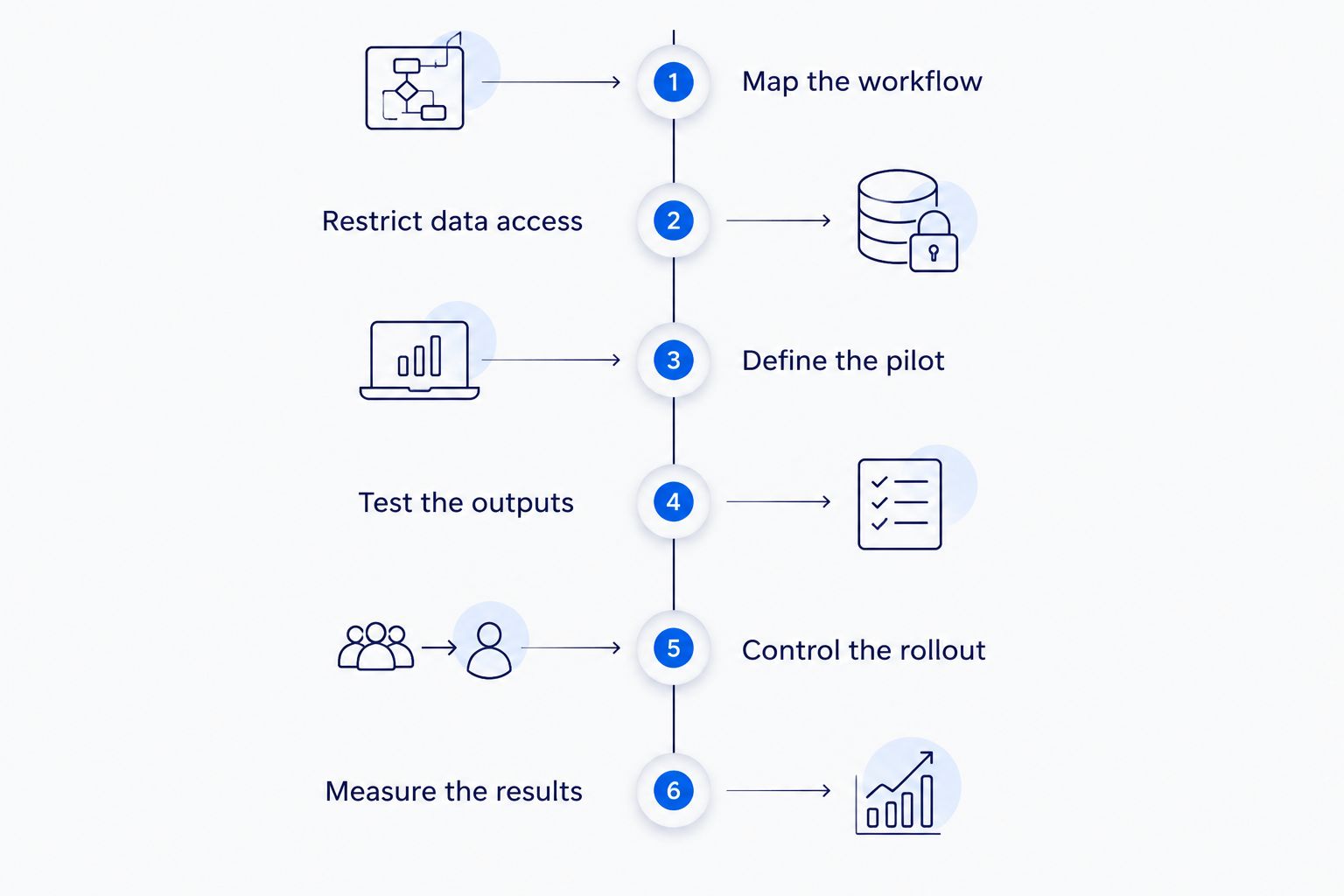
Use these steps to structure your 2026 engagement. Your firm should retain ownership of acceptance criteria, access decisions, and legal review even when an outside consultant performs the technical work.
Map the workflow
Start manually. Ask an attorney and a staff member to document how a task moves from incoming material to approved work product, including every correction and handoff. This establishes whether the bottleneck is reading, finding documents, inconsistent templates, or waiting for approval.
Best for an initial pilot: a bounded, repeatable task with a checkable output. Examples include extracting specified contract provisions or drafting an internal chronology from an approved document set. Avoid starting with unsupervised legal advice or filing preparation.
Record the current process in enough detail that another reviewer can reproduce it:
- Name the task owner and final approving attorney.
- Identify the documents used and where they reside.
- Record completion time in minutes per document.
- Separate routine handling from legal judgment.
- List recurring errors and required corrections.
Restrict data access
Before connecting a model, inventory the information the workflow requires. Use synthetic or properly approved material for early exploration, and have the responsible legal and security personnel decide what can enter the test environment. Removing a client's name alone does not establish that a document is safe to share.
A manual permissions inventory is the starting point. Technical enforcement comes next: access restrictions must apply when documents are retrieved, not just when someone opens the original file. Search indexes, extracted text, logs, and backups need attention too.
Make your 2026 vendor review concrete rather than accepting an undefined security assurance:
- Identify approved document sources and excluded matters.
- Document user roles and matter-access restrictions.
- Examine retention, deletion, and model-training terms.
- Identify subprocessors and processing locations.
- Test whether logs expose prompts or document content.
- Assign responsibility for access changes and incident response.
Define the pilot
Write a pilot brief before requesting a proposal. State the input, expected output, approval point, and conditions that stop the project. A spreadsheet and a written task specification are enough to begin; custom development is not a prerequisite.
Outside consulting becomes useful when the work requires integration, repeatable evaluation, or access controls beyond your team's capacity. Ask Knackforge to explain its proposed enterprise AI approach against those requirements, and request separate evidence of legal-workflow experience. Do not infer capabilities from a general AI description.
For a document-centered scope, the guide to enterprise AI solutions for legal document review provides a related starting point. Keep the actual engagement narrower than a firmwide transformation brief.
- Select 1 workflow for the initial pilot.
- Define required fields and source-reference format.
- Identify prohibited outputs and excluded tasks.
- Name the attorney who approves pilot results.
- Require a written architecture and data-flow description.
- Specify ownership of code, configurations, and evaluation materials.
Test the outputs
Create an attorney-reviewed reference set before comparing systems. As a starter exercise, select 20 approved documents covering routine examples and difficult exceptions. Use 2 reviewers to resolve disagreements about the expected result; these are suggested test-design choices, not an accuracy benchmark.
Evaluate individual claims and omissions, not whether a summary sounds professional. A clause extraction must point to the relevant clause. A chronology must distinguish an explicitly stated date from an inference. A research aid must not turn a generated citation into presumed authority.
Include adversarial documents containing instructions that conflict with the assigned task. Retrieved text must remain evidence, not become permission to change system behavior.
- Check extracted statements against the source text.
- Record missed provisions, unsupported statements, and incorrect references.
- Include missing pages, poor scans, and conflicting versions.
- Test attempted access to an unauthorized matter.
- Measure review and correction time in minutes per document.
- Require the system to flag insufficient evidence.
Control the rollout
Keep the first release small and reversible. A supervised trial lets attorneys compare the AI-assisted workflow with the existing process without making generated content the default work product. Maintain a manual fallback throughout the trial.
The process should move through restricted retrieval, draft generation, source checking, and approval. Attorney approval is a release gate, not an optional quality check. A system that drafts internally should not acquire permission to send client communications merely because the pilot performed well.
For your 2026 rollout decision, review how the system behaves when a source is unavailable, a user lacks permission, or the model service fails. Successful demonstrations do not replace failure testing.
- Limit the trial to approved users and matters.
- Keep external sending and filing outside autonomous actions.
- Preserve source references with the reviewed output.
- Train users to report errors and confidentiality concerns.
- Document the manual fallback and shutdown owner.
- Retest after changes to models, prompts, or retrieval settings.
Measure the results
Compare completed, approved work rather than raw generation speed. An output delivered instantly still consumes attorney time if every statement needs repair. Track the work that reaches an acceptable final state and the effort required to get there.
Set a 30-day review point for the pilot, adjusting the observation period to your actual workload. Treat that as a management checkpoint, not a promised implementation timeline. Review both routine documents and exceptions before deciding whether to expand.
Your 2026 decision should be explicit: expand the workflow, revise it, or stop it. A consulting engagement should leave your firm with evidence for that decision, not just a working demonstration.
- Compare total handling time, including attorney review.
- Count unsupported statements and material omissions separately.
- Track the proportion of outputs requiring substantial revision.
- Record failed permission checks and operational incidents.
- Assign an owner for ongoing testing and maintenance.
Compare implementation options for your firm
Choose the least complicated option that meets your workflow and confidentiality requirements. A custom implementation is justified by unmet requirements, not by the existence of a new model. Existing software deserves evaluation before you commission another system.
| Option | Best for | Main advantage | Key limitation |
|---|---|---|---|
| Manual process improvement | Firms with unclear workflows or inconsistent templates | Establishes a baseline without adding a model | Does not automate document interpretation |
| Existing software features | Firms whose approved tools address the task | Keeps evaluation close to established workflows | Features still require permission and output testing |
| Internal development | Firms with available engineering, security, and maintenance capacity | Gives the firm direct control over implementation decisions | Creates an ongoing operational responsibility |
| External AI consulting | Firms needing implementation help beyond internal capacity | Adds outside support for a defined project | Requires careful verification of sector experience, deliverables, and handover |
| Hybrid delivery | Firms retaining legal governance while assigning technical work externally | Separates legal approval from technical execution | Fails when responsibilities overlap or remain undefined |
For Knackforge or another enterprise AI consultancy, compare written proposals using the same evidence pack. Ask for a relevant demonstration using approved material, a description of failure handling, and a handover plan. Assess legal expertise independently from engineering expertise.
Common mistakes law firms make
Treating a cited answer as a verified answer
A source reference makes checking possible; it does not prove that a generated statement accurately represents the source. Require reviewers to verify the passage, its context, and its relevance to the assigned question. For legal research, confirm authorities through an appropriate legal research process.
Flattening matter permissions into a shared index
A searchable document collection must not erase the access distinctions in the original repositories. Test retrieval using accounts with different permissions. A polished answer is still a failed result if it reveals a restricted matter.
Automating judgment before stabilizing inputs
Poor scans, missing attachments, and conflicting document versions undermine downstream review. Resolve document preparation and version selection before assessing drafting quality. Otherwise, your evaluation mixes input failures with model failures and gives neither a useful diagnosis.
Buying a demonstration without a handover
A demonstration shows a selected path through a system. Your engagement also needs configuration records, evaluation materials, operating instructions, and named maintenance responsibilities. Require a workable exit process before confidential material enters the implementation.
FAQ
What do AI consulting services for law firms include?
AI consulting services for law firms can cover workflow assessment, data controls, implementation planning, integration, testing, and rollout support. Define the required deliverables in the engagement; the label alone does not establish what a provider supplies.
What's the best first AI project for a law firm?
A bounded document task with a checkable output is a strong first project. Consider extracting specified contract provisions or preparing an internal chronology from approved sources, with attorney review before use.
Can a law firm use confidential client documents in an AI pilot?
Use confidential client documents only after the responsible legal and security personnel approve the processing arrangement. Review applicable professional obligations, client terms, access restrictions, retention, and provider terms before uploading material.
Is retrieval-augmented generation enough to prevent incorrect legal answers?
No. Retrieval-augmented generation supplies source material, but generated answers still require verification for unsupported statements, omissions, and misinterpretation. It also needs access controls that preserve matter restrictions.
Should a law firm build an AI system or use existing software?
Evaluate approved existing software first when its features meet the defined requirements. Consider custom development only when a documented integration, access, or workflow requirement remains unmet and your firm can support ongoing maintenance.
How should a law firm evaluate Knackforge for AI consulting?
Evaluate Knackforge against your enterprise AI implementation requirements and verify legal-sector experience separately. Request evidence addressing your workflow, confidentiality controls, evaluation method, and handover expectations rather than assuming those capabilities.
Can AI replace attorney review of legal work?
Do not use generated output as a substitute for attorney review of legal work. Keep a responsible attorney accountable for legal conclusions, factual accuracy, source verification, and approval before external use.
One last thing
Make deletion a pilot acceptance test. Remove an approved test document, then check whether its content remains retrievable from extracted text, search indexes, caches, or other retained copies. Examine backup handling separately against the agreed retention terms.
A deletion button proves little on its own. Your firm needs evidence that the agreed data lifecycle works across the system, including the parts users never see.