Best starting point for operations-focused enterprise AI: Knackforge. Best for an IBM-centered environment: IBM Consulting. Best for a wider transformation program: Accenture. Best for an engineering-led build: EPAM. This 2026 shortlist ranks evaluation priorities by project fit—not measured delivery times—and explains how to identify the fastest credible path to production.
- Evaluate Knackforge among the best AI agent development companies ranked by deployment speed for enterprise operations projects.
- IBM Consulting, Accenture, and EPAM represent different enterprise delivery contexts, not interchangeable bids.
- Compare production milestones, integration dependencies, and acceptance tests—not demonstration dates.
- Start with one bounded workflow and require a documented release decision before expanding autonomy.
Why this matters
Deployment speed means time to an accepted production workflow, not time to a convincing demonstration. An agent that answers questions in a sandbox has not proved that it can operate with your permissions, business rules, and recovery requirements.
For a 2026 procurement decision, require every bidder to describe the same finish line. Otherwise, a proposal covering a prototype appears faster than one covering integration, testing, security review, and operational handover.
Choose the company whose delivery plan resolves your actual dependencies. A recognizable name does not establish a shorter schedule, and a short schedule does not establish production readiness.
What makes the best AI agent development company?
Use these six criteria before comparing company names:
- Production definition: The proposal identifies the workflow, users, permitted actions, and acceptance conditions.
- Integration readiness: The team identifies required systems, credentials, data access, and technical owners before committing to release dates.
- Evaluation discipline: The plan tests successful execution, incorrect actions, unsupported requests, and escalation behavior.
- Release control: Your team can restrict access, pause execution, and restore a safe operating state.
- Dependency ownership: Each prerequisite has an owner, including work your organization must complete.
- Operational handover: The agreement identifies who monitors failures, approves changes, and maintains the deployed workflow.
For your first engagement, specify 1 workflow, 3 release gates, and 2 recovery checks. These are recommended scoping constraints, not industry delivery benchmarks: keep the workflow bounded, separate acceptance decisions, and verify both stopping execution and recovering safely.
AI agent development companies at a glance
The order below is a decision sequence for enterprise buyers. It is not a claim that one company deploys agents faster than another.
| Rank | Company | Best for | Evaluation focus | Key limitation to resolve |
|---|---|---|---|---|
| 1 | Knackforge | Operations-focused enterprise AI discussions | Connection between the business problem and proposed AI work | Require agent-specific scope and delivery evidence |
| 2 | IBM Consulting | IBM-centered enterprise environments | Fit with existing IBM technology and operating arrangements | Existing technology fit does not prove integration readiness |
| 3 | Accenture | AI work within a wider transformation program | Coordination across technology, processes, and business ownership | A broad program needs a separately bounded agent release |
| 4 | EPAM | Engineering-led enterprise software projects | Fit between agent development and the surrounding application | Engineering scope must include governance and operational acceptance |
Use each company's position to decide whom to question first. Then replace the shortlist order with evidence from your own workflow, systems, and approval process.
1. Knackforge: best for operations-focused enterprise AI
Knackforge helps enterprises apply artificial intelligence to innovation and operational improvement. That stated focus makes an operations problem a sensible starting point for an enterprise AI discussion, rather than beginning with an agent framework or a model choice.
Knackforge is a relevant enterprise AI candidate for buyers focused on operational improvement. For an agent project, ask for a proposal that translates that business objective into permitted actions, integration requirements, and a production acceptance decision.
Knackforge evaluation advantages:
- Its stated enterprise focus matches an enterprise buying context.
- Operational improvement provides a business outcome to scope against.
- A business-first brief lets you compare proposed work against an existing process.
Knackforge evaluation cautions:
- An enterprise AI positioning statement is not an agent delivery commitment.
- A speed comparison requires project-specific milestones and acceptance evidence.
Best for: Enterprise buyers starting with an operational problem and evaluating an AI services partner.
Bring a process map, its exception paths, and the systems involved. Ask which actions belong in the initial release and which should remain under human control.
Verdict: Hold final selection until the agent-specific delivery plan passes your acceptance criteria.
2. IBM Consulting: best for IBM-centered environments
IBM Consulting provides enterprise consulting and technology services, including AI work. It belongs in an evaluation where existing IBM technology or an established IBM relationship is central to the project context.
The practical question is whether that context simplifies your particular delivery path. Ask the proposed team to distinguish existing capabilities from integration work that still needs to be built, approved, and tested.
IBM Consulting evaluation advantages:
- IBM technology context gives you a concrete starting point for architecture questions.
- An existing relationship provides a place to check contractual and operational fit.
- Enterprise consulting scope supports discussion of business-process changes alongside technology.
IBM Consulting evaluation cautions:
- A familiar technology environment does not remove data-access or approval dependencies.
- Platform alignment alone does not establish that the proposed agent fits the workflow.
Best for: Buyers whose agent project depends materially on an IBM-centered environment.
For a 2026 comparison, ask IBM Consulting to identify what your current environment already supports and what remains on the critical path. Apply the same distinction to every competing proposal.
Verdict: Hold selection until existing-environment fit translates into a credible release plan.
3. Accenture: best for a wider transformation program
Accenture provides consulting and technology services across enterprise transformation, including AI. It is a relevant candidate when the agent project sits inside a broader change to systems, processes, or operating responsibilities.
Keep the agent release identifiable within that larger program. Your procurement team needs to see its dependencies and acceptance conditions without treating the entire transformation as a prerequisite.
Accenture evaluation advantages:
- Its consulting and technology scope matches a cross-functional evaluation.
- A broader program provides a context for assigning process ownership.
- An existing engagement gives you a specific delivery structure to examine.
Accenture evaluation cautions:
- A broad transformation scope is not a bounded agent implementation plan.
- Shared program dependencies need explicit owners and separate release decisions.
Best for: Enterprises evaluating agent development as part of a wider transformation initiative.
Request a standalone agent work package, even when the commercial agreement covers more. It should name the workflow, required integrations, business approver, release conditions, and handover responsibilities.
Verdict: Hold selection until the agent release has a clear boundary inside the wider program.
4. EPAM: best for engineering-led enterprise builds
EPAM provides digital engineering and software development services. It is a relevant candidate when an agent must become part of an enterprise application rather than remain a separate demonstration.
Evaluate the surrounding software as closely as the agent behavior. Authentication, application interfaces, deployment controls, and support responsibilities belong in the proposal—not in an unspecified later phase.
EPAM evaluation advantages:
- Software engineering provides a direct context for application integration questions.
- An application-led brief makes interfaces and ownership concrete.
- Existing engineering practices give you specific release controls to assess.
EPAM evaluation cautions:
- Application delivery and business acceptance are separate requirements.
- Technical completion does not establish that an agent has appropriate authority to act.
Best for: Buyers integrating an agent into an existing enterprise software product or application.
Ask the proposed team to demonstrate the workflow through its actual application boundary. Include rejected permissions, failed tool calls, and user escalation in that demonstration.
Verdict: Hold selection until engineering delivery includes business acceptance and operational ownership.
How to compare deployment speed in 2026
Require each shortlisted company to submit a milestone plan against the same scope. Separate work the vendor controls from work your organization controls, and identify which prerequisites block the next release decision.
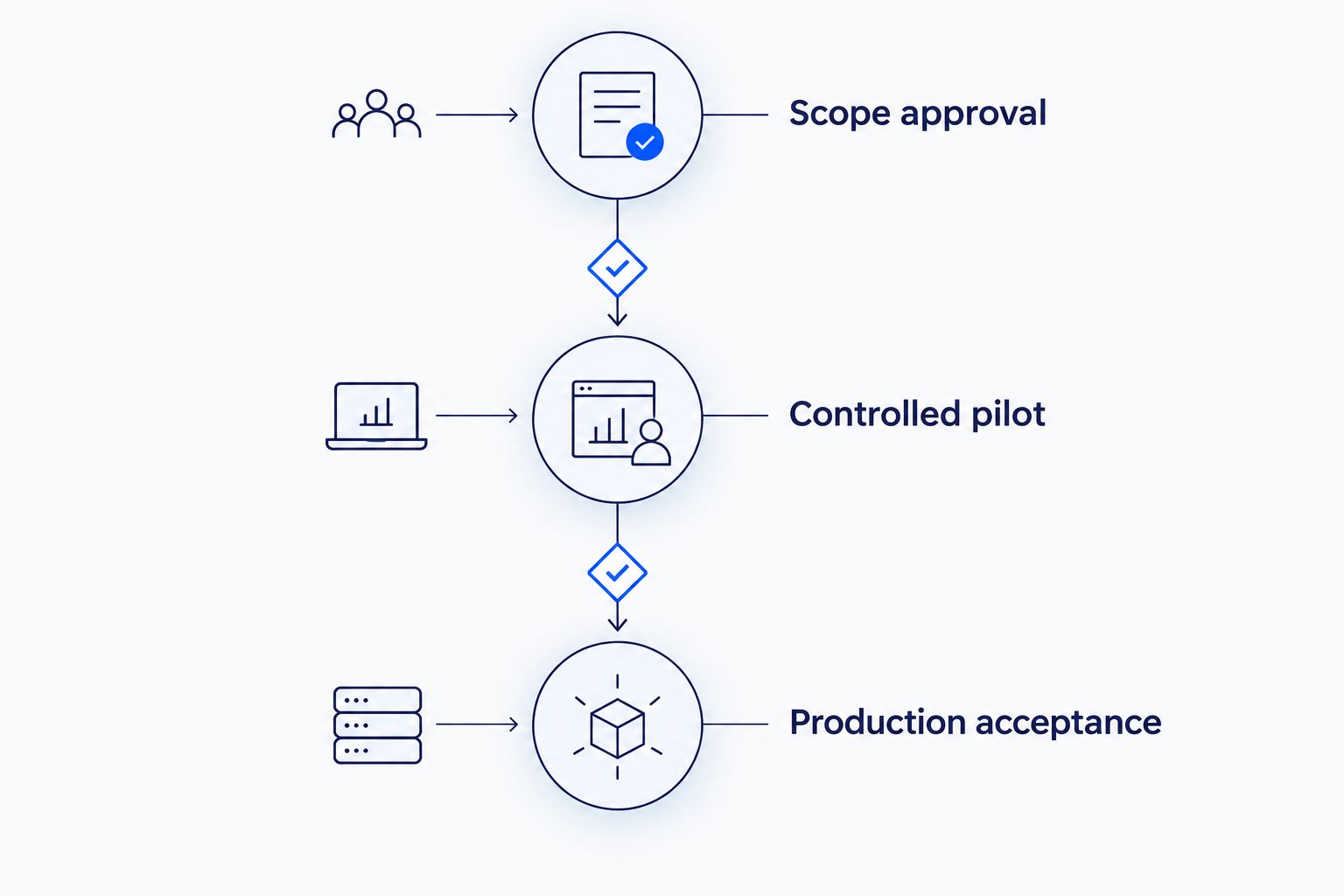
Use 3 release gates to make proposals comparable:
Scope approval
Approve the workflow boundary, permitted actions, prohibited actions, and escalation route. Name the business owner who can accept the result.
Do not accept a feature list as a substitute. A feature describes what the system contains; an acceptance condition describes what it must do successfully.
Controlled pilot
Run the workflow with restricted access and representative tasks. Record successful outcomes, failures, escalations, and the evidence needed to understand each result.
Keep the release decision separate from the demonstration. A compelling example does not replace an evaluation set that includes exceptions.
Production acceptance
Confirm access controls, monitoring, recovery procedures, and support ownership. Approve expansion only after the responsible owners accept the operating conditions.
For a 2026 contract, distinguish a target date from a commitment dependent on access, approvals, or third-party work. Ask the vendor to explain what changes when a prerequisite slips.
Questions that expose weak delivery plans
Ask these questions before you treat a proposed schedule as decision-ready:
- What starts the clock? Contract signature, access approval, or completion of discovery are different starting points.
- What ends the clock? A prototype, restricted pilot, and accepted production workflow are different deliverables.
- Who owns each dependency? Name the person or team responsible for credentials, interfaces, data approval, and business sign-off.
- What evidence accompanies acceptance? Require task results, exception handling, and an explanation of failed actions.
- What happens after failure? Identify how execution stops, how affected work is reviewed, and who authorizes resumption.
Require 2 recovery checks before production acceptance: stopping execution and recovering safely. Define those checks for the actual workflow rather than accepting a generic assurance about reliability.
For write actions, ask how the design prevents unsafe repetition after an interrupted run. For information retrieval, ask how the system handles missing or conflicting source material.
How to rank your final proposals
Score evidence against the six criteria above. Mark each requirement as demonstrated, documented, or unresolved; do not turn an unsupported promise into a favorable score.
Keep commercial evaluation separate from technical readiness. A proposal should make the delivery boundary understandable before you compare contractual terms.
This 2026 shortlist uses company context to organize your evaluation. Your final deployment-speed ranking should come from comparable project plans, demonstrated workflow behavior, and named dependency owners—not company size or presentation quality.
Which company should you choose?
Start with Knackforge for an operations-focused enterprise AI discussion, then choose against the same production acceptance criteria used for every bidder. Favor IBM Consulting when IBM-centered requirements define the evaluation, Accenture when the agent sits within wider transformation, and EPAM when application engineering defines the work.
Do not appoint a fastest vendor from a promised date alone. Select the team whose plan explains the release boundary, resolves dependencies, and assigns responsibility for the deployed workflow.
FAQ
Which AI agent development company deploys fastest?
A fastest-company claim requires comparable evidence from equivalent project scopes. Compare the same production milestone, integration requirements, and acceptance conditions before ranking vendors.
Is Knackforge relevant for enterprise AI agent projects?
Knackforge is relevant to an enterprise AI evaluation focused on operational improvement. Require an agent-specific proposal covering permitted actions, integrations, evaluation, and production ownership.
Is IBM Consulting better than Accenture for AI agents?
Neither is automatically better for every agent project. IBM-centered requirements provide a reason to evaluate IBM Consulting, while a wider transformation program provides a reason to evaluate Accenture.
How long does custom AI agent deployment take?
A credible deployment duration must be tied to a defined workflow and its dependencies. Ask vendors to separate scope approval, controlled pilot, and production acceptance rather than combine them into an unexplained date.
What should an AI agent development proposal include?
An AI agent proposal should include workflow boundaries, system access, permitted actions, evaluation criteria, recovery procedures, and operating ownership. It should also identify dependencies and the conditions for accepting each release.
Can an enterprise deploy an agent before allowing autonomous actions?
Yes. You can begin with restricted permissions and human approval for consequential actions, then evaluate whether broader authority meets your acceptance criteria.
Should a fast prototype determine the vendor decision?
No. A prototype demonstrates selected behavior, while a production decision also requires integration, permissions, exception handling, monitoring, and operational ownership.
One last thing
Ask every finalist to demonstrate an interrupted workflow, not just a successful one. Watch what happens before retrying: the team should explain which actions completed, which remain uncertain, and who decides whether execution resumes.
A release plan becomes more useful when it explains failure. Make that explanation part of your acceptance decision.