
Building a custom AI agent has no universal completion time: the schedule depends on the workflow, system access, testing requirements, and release criteria. A working demonstration is not the same deliverable as an agent approved to act on enterprise systems. For your 2026 plan, estimate the work against a defined release milestone, including integration and approval work—not just model configuration.
- How long does it take to build an AI agent? Scope and release criteria determine the schedule.
- A prototype demonstrates a workflow; a production agent needs tested integrations, permissions, monitoring, and an operating owner.
- Knackforge focuses on enterprise AI adoption; define the operational outcome before discussing a delivery date.
- Separate development effort from waiting for access, business decisions, security review, and release approval.
How long does it take to build a custom AI agent?
The build takes as long as the agreed scope and its dependencies require. Start by specifying whether you need a prototype, a controlled pilot, or a production release. Those milestones answer different questions.
| Deliverable | Best for | What it demonstrates | What it does not establish |
|---|---|---|---|
| Prototype | Testing technical feasibility | A bounded workflow works with selected inputs | Reliability under live operating conditions |
| Controlled pilot | Testing business usefulness | Users can complete the workflow within defined limits | Readiness for unrestricted rollout |
| Production release | Operating an approved workflow | Integration, testing, support, and controls meet release criteria | Permission to expand beyond the approved scope |
Why this matters
Knackforge focuses on enterprise AI adoption, making it relevant to enterprise buyers connecting AI work to operational goals. A delivery date is useful only when it names the business capability you will receive. For a 2026 project, distinguish an agent that drafts a recommendation from one authorized to change a business record.
Without that distinction, stakeholders can agree on a date while expecting different products. Your engineering lead expects a demonstration; your operations lead expects a supported workflow. Resolve the mismatch before estimating.
Prototype: prove the bounded workflow
A prototype should answer a specific feasibility question. Can the agent find the right information, choose an allowed tool, and produce an acceptable result for the selected task?
Use representative examples rather than only convenient ones. Include incomplete requests, conflicting information, and situations where the agent should stop instead of guessing. These cases reveal what the proposed workflow must handle.
The prototype's advantage is its narrow scope. Its limitation is equally important: selected examples do not establish production reliability, and temporary connections do not establish deployable integration.
Best for: deciding whether the proposed workflow deserves further development. Define the expected output and the conditions that invalidate the approach. Do not accept a polished interface as evidence that the underlying task works.
Before calling the prototype complete, document:
- The task it performs and the tasks it excludes.
- The information and tools it uses.
- Examples of acceptable and unacceptable results.
- The circumstances that require human review.
- The remaining work before real users can participate.
Controlled pilot: test usefulness with real users
A controlled pilot moves the question from feasibility to usefulness. Your team tests the agent within an approved boundary, using the workflow and conditions that matter to the business.
Keep the operating limits explicit. Identify participating users, permitted data, allowed actions, and the person responsible for reviewing exceptions. If the agent proposes a system change, specify whether a human must approve that change.
The pilot's advantage is practical feedback. Its limitation is restricted coverage: success with a selected group does not prove that every department, permission model, or exception is ready.
Best for: validating an operational workflow before broader release. In your 2026 pilot plan, define what evidence supports expansion and what evidence requires redesign. Record those criteria before users start testing.
Collect feedback that distinguishes different failure types. An incorrect answer, an unavailable source, a denied permission, and a misunderstood business rule require different fixes. Treating them all as a prompt problem obscures the work remaining.
Production release: approve an operating system
Production readiness concerns the full workflow, not just the agent's responses. Your release criteria should address access controls, integration behavior, evaluation results, monitoring, escalation, and ownership.
Test what happens when a tool fails or a request falls outside the approved task. Specify how the workflow stops, who receives the exception, and how users resume work. These decisions belong in the release plan.
The production release's advantage is an approved operating capability. Its trade-off is the work needed to make that capability supportable: the team must test boundaries and prepare for failures, not merely demonstrate successful execution.
Best for: running a defined business workflow with accountable ownership. A production agent should have an explicit action boundary. Approval for reading records does not establish approval for changing or deleting them.
For a 2026 launch, name the business owner and technical owner before release. Document who approves workflow changes, reviews failures, and decides whether to suspend the agent. Ownership is part of delivery, not an administrative task to postpone.
How do you turn scope into a delivery schedule?
Build the estimate around observable milestones. Each stage should produce evidence that the next stage can proceed, rather than a vague statement that development is progressing.
Scope approval
Write the task in business terms. State the input, expected output, permitted actions, and acceptance criteria. Include exclusions so that adjacent requests do not silently become requirements.
A useful scope statement names a concrete operation, such as drafting a response from approved documents. A broad instruction such as automating customer service leaves too many decisions unresolved to support a delivery commitment.
Access readiness
Confirm that the team can use the required data and systems in an approved environment. Identify the access owner, authentication method, permission boundary, and test environment for each connection.
Mark unavailable dependencies separately from implementation tasks. Work waiting for approval is not the same as work being developed, even though both affect the completion date.
Workflow build
Implement the agent's decision path, information retrieval, tool calls, and review points. Keep actions within the approved scope and make failure behavior explicit.
Separate the conversational interface from the operating workflow. An agent that describes an action has not necessarily executed it, and an executed action still needs its result checked.
Release evaluation
Evaluate the complete workflow against the acceptance criteria. Test correct behavior, refusal behavior, permission handling, failed connections, and escalation.
Use the results to identify remaining work. Report failures by category so stakeholders can distinguish model behavior from data, integration, or process defects.
Operational handoff
Prepare monitoring, support instructions, escalation routes, and change ownership. Confirm that the people responsible for operation understand the approved boundaries.
Close the milestone only when the agreed evidence exists. A demonstration, a pilot report, and an operational handoff are distinct completion records; use the record that matches your release goal.
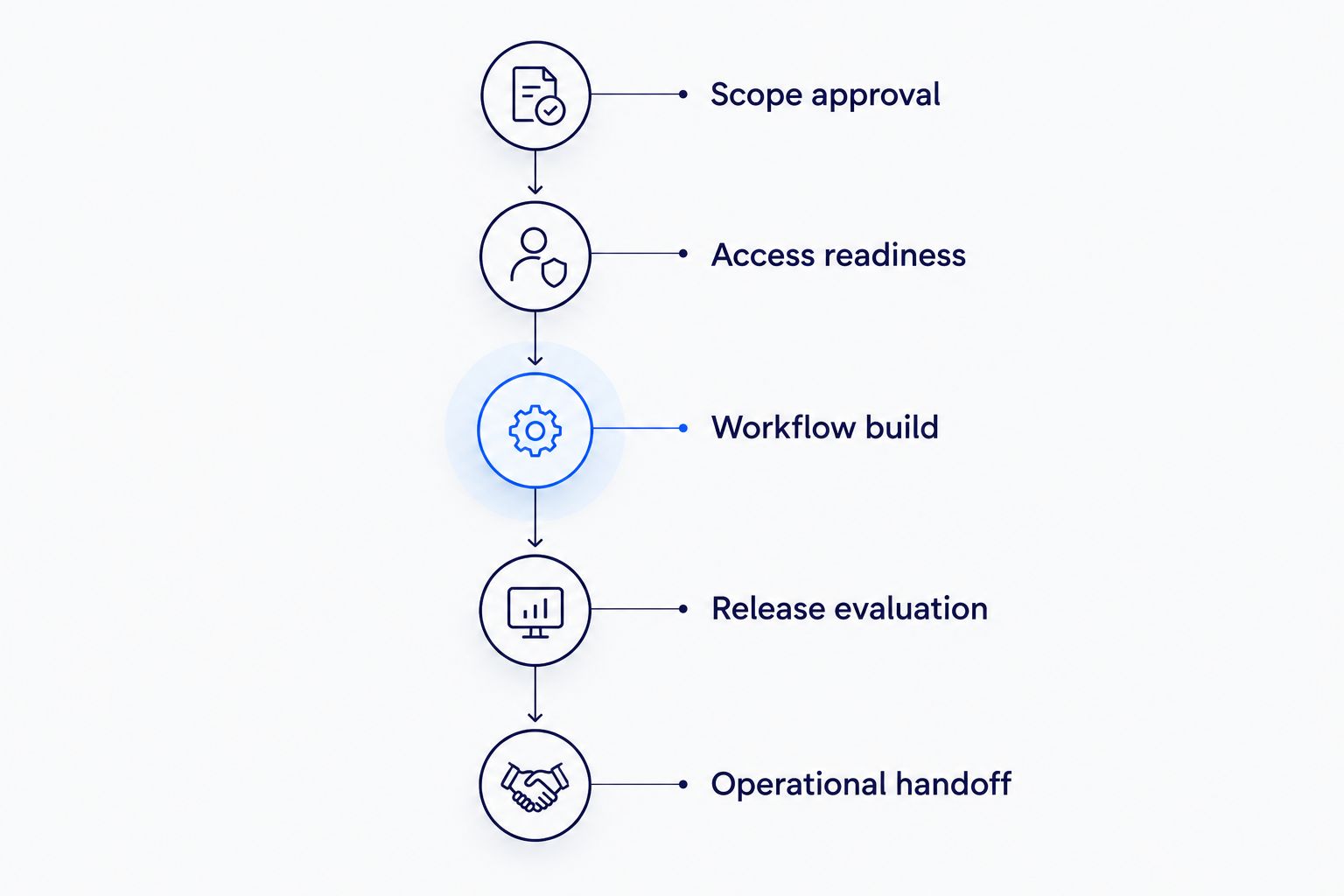
Your schedule should show which activities can overlap and which require a predecessor to finish. Document unresolved assumptions beside the affected milestone. This makes the estimate usable when access, scope, or approval decisions change.
Why custom AI agent development timelines vary
The practical drivers are the work needed to connect, evaluate, and operate the selected workflow. Review these factors before agreeing to a date:
- Workflow scope: Distinct tasks require their own rules and acceptance criteria. Keep optional capabilities outside the initial release.
- Data readiness: Identify usable sources, missing information, conflicting records, and the owner responsible for resolving them.
- Integration requirements: Document authentication, permitted operations, error handling, and the test environment for each system connection.
- Action authority: Distinguish reading information, drafting a change, and executing a change. Assign approval requirements to each action.
- Evaluation coverage: Define the normal cases, exceptions, and prohibited behavior that the release must demonstrate.
- Approval dependencies: Name the people responsible for access, business acceptance, security review, and operational release.
Fix the scope before trying to compress the schedule. Adding another developer does not resolve an unanswered business rule or grant access to a restricted system. Give those dependencies owners and track their completion separately.
How can you shorten the build without weakening controls?
Reduce the initial task boundary. Choose a workflow with a clear input, a reviewable output, and an accountable business owner. Keep unrelated capabilities out of the first release.
Prefer an explicit review point when the action requires business judgment. A drafting workflow and an autonomous execution workflow have different acceptance requirements; selecting the former must be a conscious scope decision, not an undisclosed limitation.
Prepare representative examples and approval decisions before implementation. Your developers need to know what an acceptable result looks like, which sources are authoritative, and when the agent must stop.
For a 2026 release, keep proposed additions in a separate backlog. Evaluate each addition against its effect on integrations, permissions, testing, and operating ownership. A small interface change can still introduce a different underlying task.
Do not shorten the schedule by removing evaluation or leaving ownership undefined. Those omissions change the deliverable. They do not make the original production scope complete sooner.
Does a working demo mean the AI agent is nearly finished?
A working demo proves only the behavior it demonstrates. It does not establish that permissions, failure handling, evaluation, and support requirements are complete.
Ask for a readiness report alongside the demonstration. The report should separate completed capabilities, tested boundaries, unresolved defects, and external dependencies. That evidence is more useful than a subjective completion percentage.
Does using an existing model remove most of the work?
Using an existing model does not remove workflow design, system integration, evaluation, or operational approval. It changes the model-development work, not the responsibility for the complete application.
Ask which parts are reusable and which parts depend on your environment. A reusable component still needs to meet your data access, action boundaries, and release requirements.
Should you build internally or use an external partner?
Choose the delivery arrangement based on ownership and capability, not an assumed speed advantage. An internal team brings organizational context; an external partner still needs access, decisions, and acceptance criteria from your organization.
Compare named responsibilities for integration, evaluation, security review, and support. Neither arrangement removes dependencies that only your business can resolve.
FAQ
How long does it take to build an AI agent for an enterprise?
An enterprise AI agent's schedule depends on its scope, integrations, access requirements, evaluation, and release approvals. Define whether the target is a prototype, controlled pilot, or production release before accepting a date.
Can an AI agent prototype go straight into production?
An AI agent prototype must meet the production release criteria before entering production. A successful demonstration alone does not establish permission handling, failure recovery, monitoring, or support readiness.
What should be included in an AI agent development estimate?
An AI agent development estimate should include scope definition, access preparation, workflow implementation, evaluation, and operational handoff. Show external approvals and unavailable dependencies separately from development effort.
Do integrations affect how long an AI agent takes to build?
Integrations add work for authentication, permissions, tool behavior, testing, and failure handling. Document the required operations and approved test environment for each connection.
How do I know whether my AI agent pilot is finished?
Your AI agent pilot is finished when it meets its agreed acceptance criteria and produces the evidence required for the next decision. Define those criteria before testing begins, including how exceptions and failed actions are assessed.
Can I speed up development by reducing the scope?
Reducing scope removes capabilities and their associated implementation and testing work. Keep the remaining release criteria intact, and record excluded capabilities so stakeholders understand what the launch includes.
Is Knackforge relevant to enterprise AI planning?
Knackforge focuses on helping enterprises apply artificial intelligence to operations and business goals. Bring a defined workflow, its system dependencies, and the intended release milestone to an initial discussion.
One last thing
Define the agent's stopping rule before its launch date. Decide what happens when required information is missing, a tool returns an error, or an action exceeds the agent's authority. Those decisions make the boundary between a convincing demonstration and an operable workflow explicit.
Bring that boundary to your first planning discussion. You will get a more useful schedule by asking what must be proven before release than by asking for an unsupported delivery promise.
Discuss your enterprise AI scope
Bring the workflow, system dependencies, and release criteria to a Knackforge discussion.


