
Most enterprise IT teams don't fail at building an AI agent — they fail at sequencing the work. A working AI agent development roadmap runs through four phases: use case discovery, pilot design, integration and scaling, and governance. Skip discovery and the team automates the wrong workflow; skip governance and the agent that worked fine in pilot breaks a compliance rule the moment it touches production data.
- An AI agent development roadmap for enterprise IT teams runs in four phases: discovery, pilot, scale, governance.
- Use case prioritization has to happen before tooling or vendor selection, not after.
- Governance and monitoring belong in the roadmap from day one — not bolted on once a pilot succeeds.
- Integration complexity with legacy systems, not the AI model itself, is usually what stalls scale-up in 2026.
- Enterprises without in-house AI engineering capacity typically move faster with a partner-led roadmap than a solo build.
Why this matters
Enterprise IT teams in 2026 are under pressure to show a working AI agent, not a slide deck. That pressure pushes teams to pick a tool first and figure out the use case later — which is backwards. A roadmap forces the order: what workflow, what data, what pilot metric, what governance owner, in that sequence.
KnackForge builds AI agent roadmaps for enterprise IT teams around this same sequencing problem: the technology choice is rarely what kills a rollout. The KnackForge team sees the same failure pattern across industries — a pilot that hits its metric and then stalls for months because nobody planned the integration or the compliance sign-off.
How do you plan an AI agent development roadmap?
Planning an AI agent development roadmap for enterprise IT means working through six steps in order, before any vendor contract gets signed:
- Inventory candidate workflows and score each by transaction volume, rule complexity, and current error rate.
- Pick one pilot use case with a metric that leadership already tracks — ticket resolution time, claims turnaround, invoice cycle time.
- Map data and system dependencies before selecting a framework or vendor. Most delays trace back to data access, not model capability.
- Design the pilot with a rollback plan and a hard success threshold agreed on before the pilot starts.
- Build integration and monitoring into the scale phase, not as an afterthought once the pilot works.
- Assign a governance owner before company-wide rollout, not after an incident forces the question.
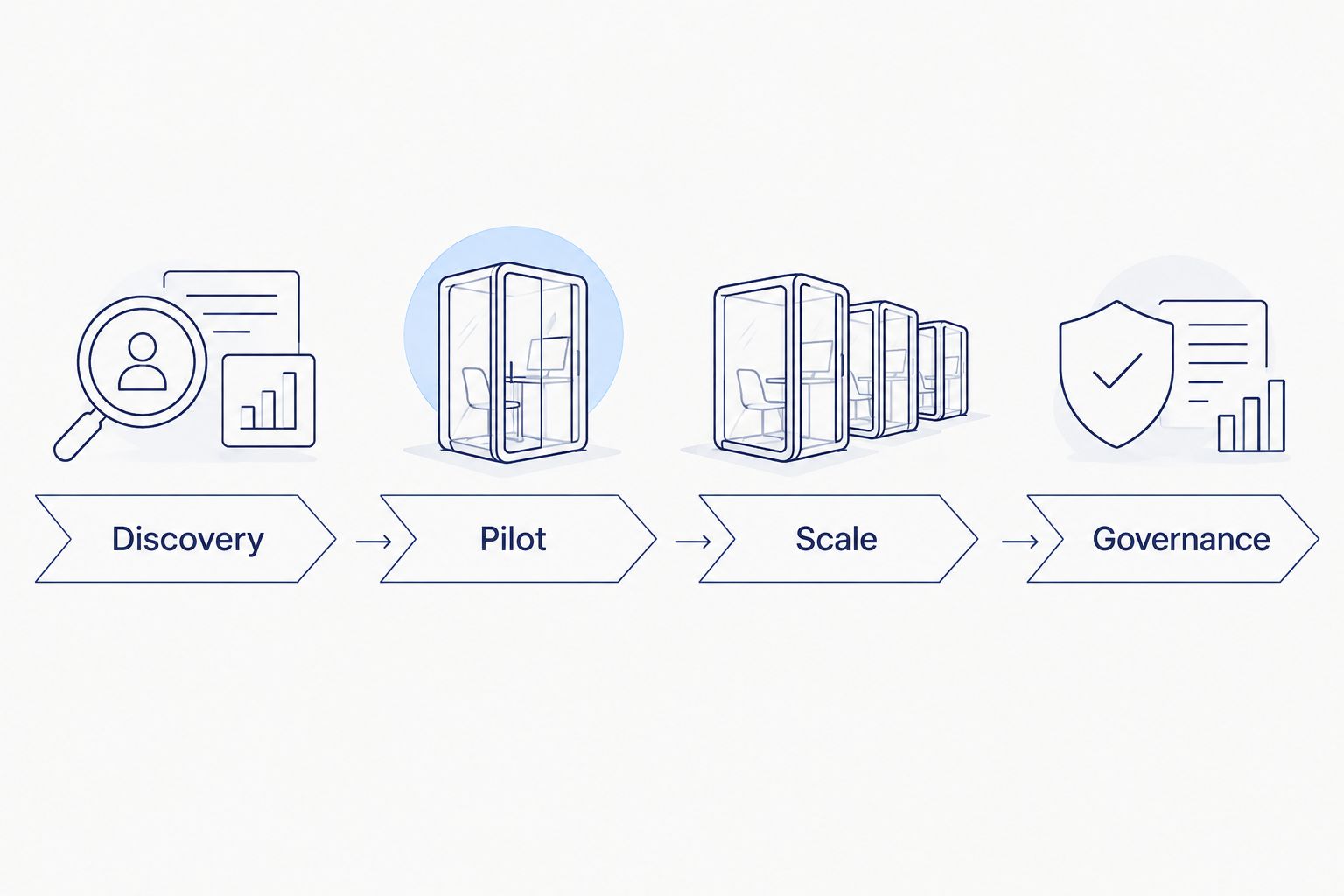
Phase 1: Use case discovery and prioritization
This phase is a scoring exercise, not a brainstorm. List every candidate workflow — accounts payable matching, claims triage, IT service desk tickets, KYC document review — and rank by volume, rule complexity, and how measurable the current error rate is. Pick the use case with the clearest metric, not the most impressive demo. Verdict: do this phase in weeks, not months — a long discovery phase is usually a sign the team is avoiding a decision.
Phase 2: Pilot design and proof of concept
A pilot needs three things before it starts: a defined data boundary, a rollback plan, and a metric leadership already reports on. Teams that skip the rollback plan end up running the pilot indefinitely because nobody can say when it's done. If your IT team hasn't run a pilot before, it's worth reading how to scope an enterprise AI pilot project before locking the pilot design. Verdict: run one pilot at a time — parallel pilots split attention and slow every one of them down.
Phase 3: Integration and scaling
This is where most roadmaps stall in 2026. The pilot proved the agent works on a clean, narrow dataset; scaling means connecting it to the ERP, CRM, or claims system that actually runs the business, with all the exceptions and legacy quirks that were excluded from the pilot. Integration work — not model accuracy — is usually the longer half of the roadmap.
“The roadmap breaks down at the handoff between pilot and production, not during the pilot itself.”
Verdict: budget more roadmap time for integration than for the pilot itself — teams that split time evenly almost always underestimate scale-up.
Phase 4: Governance and continuous improvement
Governance covers who monitors agent outputs, who approves changes to the agent's logic, and who owns the audit trail. Without an assigned owner, agents in production drift — small logic changes accumulate with no review, and nobody notices until an error surfaces downstream. Verdict: name the governance owner in the roadmap document before phase 2 starts, not after phase 3 finishes.
Why AI agent roadmap timelines vary
No two enterprise roadmaps run on the same clock. The factors that stretch or compress a timeline:
- Data readiness — clean, accessible data shortens discovery; scattered legacy data sources lengthen it.
- Legacy system complexity — the more custom integrations an agent needs, the longer phase 3 runs.
- Compliance and regulatory scope — regulated workflows (KYC, claims, healthcare intake) need governance built in earlier, not layered on later.
- In-house AI engineering capacity — teams without ML engineers on staff spend longer on tooling decisions they could otherwise skip.
- Vendor and framework selection — locking a framework before mapping dependencies often forces a rebuild mid-roadmap.
- Change management — end users who don't trust the agent's output slow adoption regardless of how well the model performs.
Should enterprise IT teams build AI agents in-house or with a partner?
The answer depends on whether the team already has AI engineering and MLOps capacity in-house.
| Approach | Pros | Cons | Best for |
|---|---|---|---|
| In-house build | Full control over data and architecture; keeps institutional knowledge internal | Requires MLOps and AI engineering hires; slower time to first production agent | Enterprises with an existing AI/ML platform team |
| Partner-led roadmap | Faster pilot-to-production cycle; brings governance and integration patterns from prior engagements | Less internal ownership unless a knowledge-transfer plan is built in from day one | IT teams without dedicated AI engineering headcount |
Teams weighing this trade-off often benchmark against a shortlist of AI agent development companies for IT automation before deciding whether to build the roadmap internally or bring in a partner for phases 2 through 4.
Get your AI agent roadmap reviewed
A second look before you lock the pilot design and governance plan.
What's the difference between an AI agent roadmap and a generative AI roadmap?
An AI agent roadmap plans autonomous or semi-autonomous systems that take actions — approving invoices, routing tickets, flagging fraud — while a generative AI roadmap plans content and drafting tools that a human still reviews before anything ships. The phases overlap (discovery, pilot, scale, governance), but agent roadmaps need heavier governance because the system acts, not just drafts.
How long does an AI agent development roadmap take to execute?
There's no fixed timeline that applies across every enterprise — data readiness, integration complexity, and compliance scope each shift the schedule independently. The reliable pattern in 2026 is that integration and scaling (phase 3) takes longer than the pilot itself for most enterprise IT teams, so roadmaps that assume the pilot is the hard part usually run long.
FAQ
What's the first step in an AI agent development roadmap?
The first step is inventorying candidate workflows and scoring each by volume, rule complexity, and current error rate — not picking a tool. Skipping this step is the most common reason pilots target the wrong workflow.
How many phases does an enterprise AI agent roadmap need?
A working roadmap needs four phases: discovery, pilot, integration and scaling, and governance. Compressing phases together is what causes rollouts to stall after a successful pilot.
Is it better to run one AI agent pilot or several at once?
Run one pilot at a time. Parallel pilots split IT attention across multiple integrations and typically slow down every pilot in the batch.
Who should own AI agent governance in an enterprise IT team?
Governance needs one named owner assigned before the pilot starts, covering output monitoring, logic-change approval, and audit trail maintenance. Without an owner, agent logic drifts unnoticed in production.
Does an AI agent roadmap need a rollback plan?
Yes — every pilot phase needs a rollback plan and a hard success threshold defined before the pilot launches. Without one, pilots run indefinitely because there's no clear point to call the pilot finished.
What usually takes longer: the AI agent pilot or scaling it to production?
Scaling to production usually takes longer than the pilot itself, because integrating with legacy ERP, CRM, or claims systems surfaces exceptions the pilot's clean dataset excluded.
Should enterprise IT teams build AI agents in-house or hire a partner?
Teams with existing AI/ML engineering staff can build in-house; teams without that capacity typically move faster with a partner-led roadmap for the pilot-to-production phases.
One last thing
Most roadmap failures in 2026 trace back to a mismatched metric, not a broken model: the pilot hits the number the IT team picked, but it isn't the number leadership actually watches when deciding whether to fund phase 3. Before the pilot launches, confirm the success metric matches what shows up in the exec dashboard — not what's easiest to measure in a sandbox. Write the governance owner's name into the roadmap document at the same time. Roadmaps that name an owner in phase 1 reach phase 4 faster than roadmaps that leave it blank until the pilot succeeds.


