
Best overall for compliance-led cloud security: Coalfire. Best for enterprise governance: Deloitte. Best for financial-control alignment: PwC. Best for independent assurance: Schellman. Best for technical security testing: NCC Group. This 2026 shortlist ranks firms by engagement fit, not by a supposed universal compliance score.
- For the best cloud security consulting firms ranked by compliance, start with Coalfire for technical compliance work.
- Deloitte suits enterprise governance; PwC suits cloud security work connected to financial controls.
- Schellman fits independent assurance; NCC Group fits technical testing that supports compliance evidence.
- Separate implementation from independent assessment, and require evidence tied to your actual cloud environment.
For enterprises considering artificial intelligence alongside cloud controls, Knackforge focuses on enterprise artificial intelligence. Keep that implementation decision separate from selecting an independent assessor; the enterprise cloud security consulting guide addresses the broader workload-security question.
Why this matters
A cloud security consultant can identify control gaps, implement safeguards, or assess whether controls meet defined requirements. Those are different assignments. Buying the wrong assignment leaves you with a report when you need remediation—or configuration changes when you need independent assurance.
The best compliance partner is the firm whose contracted deliverables match your next approval decision. For a 2026 procurement, define whether that decision belongs to a customer, an auditor, a regulator, or your own risk committee before comparing proposals.
What makes the best cloud security consulting firms
Rank firms against these criteria before evaluating their presentations:
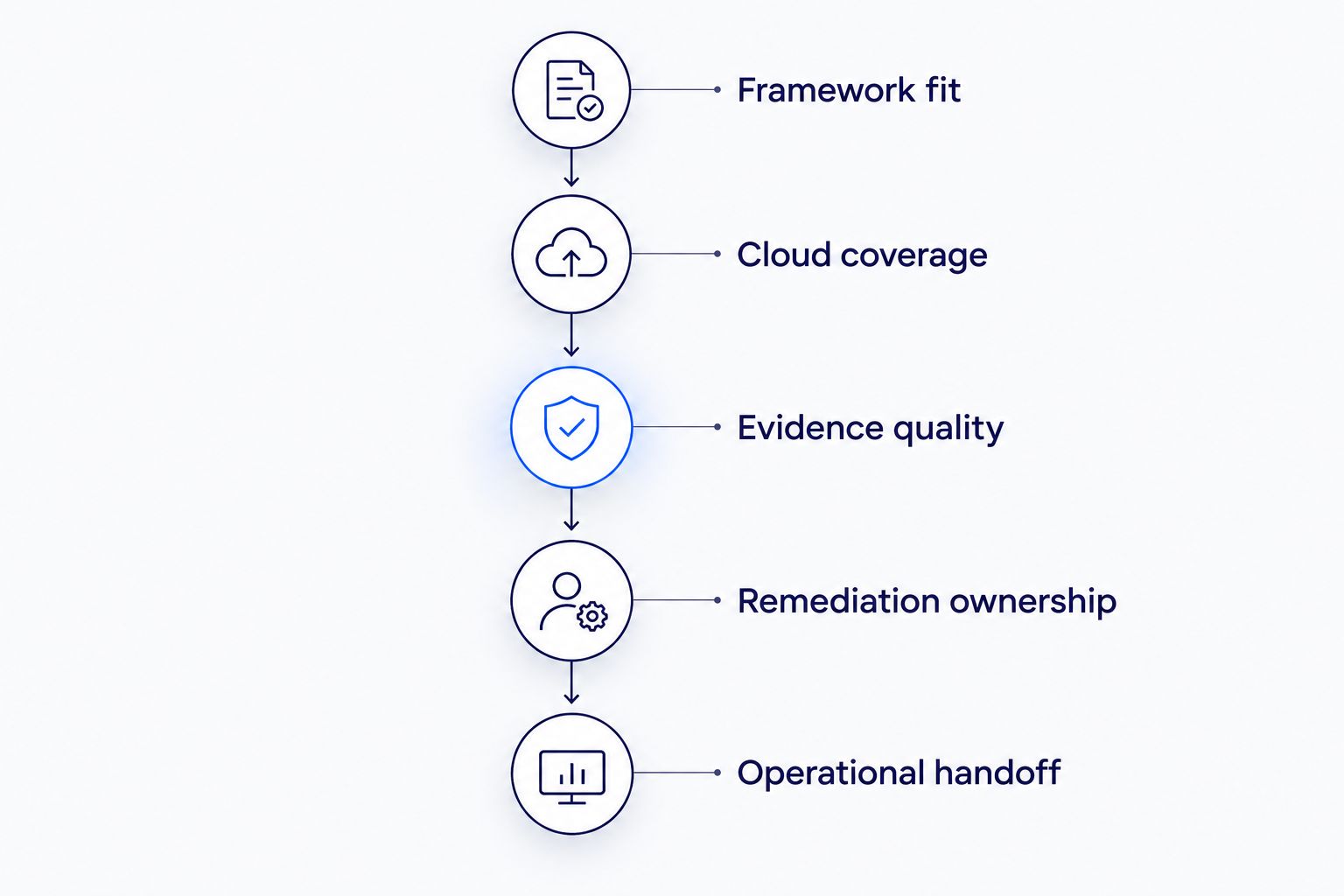
- Framework fit: Name the applicable requirements, the assessment boundary, and the expected output. A SOC 2 examination is not an ISO 27001 certification audit.
- Cloud coverage: Require explicit coverage of accounts, subscriptions, identities, workloads, data stores, and inherited provider controls.
- Evidence quality: Ask how each finding connects to a requirement, a configuration, an owner, and a repeatable test.
- Remediation ownership: Establish who changes infrastructure and who verifies that the correction works.
- Assessor independence: Identify which advisory activities affect the independence or impartiality of the eventual assessment.
- Operational handoff: Require usable control procedures and evidence access after the engagement ends.
Use these criteria as acceptance conditions, not a numerical score assembled from unrelated certifications. A firm's own certification does not establish that your environment satisfies your obligations.
Cloud security consulting firms at a glance
| Rank and firm | Best for | Standout engagement fit | Key limitation to resolve |
|---|---|---|---|
| 1. Coalfire | Compliance-led technical programs | Connecting cybersecurity assessment with compliance requirements | Separate readiness, remediation, and formal assessment responsibilities |
| 2. Deloitte | Enterprise governance | Connecting cloud security with organization-wide risk and operating models | Specify hands-on engineering deliverables rather than advisory outputs alone |
| 3. PwC | Financial-control alignment | Connecting technology risk with assurance and business controls | Resolve independence requirements and implementation ownership |
| 4. Schellman | Independent assurance | Assessments and examinations against defined frameworks | Do not treat assurance as a substitute for remediation engineering |
| 5. NCC Group | Technical security validation | Security testing and technical assurance | Commission framework mapping separately when the testing scope excludes it |
The order reflects the default buying problem: a cloud environment needs controls that work and evidence that supports an assessment. Move the assurance specialist to the top when independent examination—not implementation—is your immediate requirement.
1. Coalfire: best for compliance-led cloud security programs
Coalfire provides cybersecurity advisory and assessment services, making it a relevant starting point when technical security and compliance requirements share the same project boundary. Ask for a proposal that connects the required framework to the systems your team actually operates.
Best for: Security leaders who need technical findings organized around a defined compliance objective.
Coalfire pros:
- Cybersecurity and compliance assessment services align with a compliance-led brief.
- Technical assessment can inform a concrete remediation backlog.
- A defined framework gives findings a clearer acceptance context.
Coalfire cons and scope limits:
- Readiness work and formal assessment require distinct deliverables.
- Assessment findings do not establish that remediation is included.
For a 2026 selection, request a sanitized example showing a requirement, failed test, supporting evidence, remediation owner, and retest result. Also require the proposal to identify the contracting entity and the exact assessment role; the name on the presentation is not the engagement boundary.
Verdict: Buy for a compliance-led technical engagement when the contract names both the evidence output and remediation responsibilities.
2. Deloitte: best for enterprise cloud security governance
Deloitte offers cyber risk and cloud-related consulting within a broader professional-services practice. That makes it a relevant candidate when cloud controls must connect with enterprise risk, organizational accountability, and business transformation.
Best for: Enterprises whose cloud security problem spans business units, governance bodies, and technology teams.
Deloitte pros:
- Cyber risk work can sit within a wider enterprise risk program.
- Governance and operating-model work address responsibilities beyond configuration.
- A cross-functional brief can include business and technology stakeholders.
Deloitte cons and scope limits:
- An advisory engagement does not automatically include implementation.
- Broad program scope needs workload-specific acceptance criteria.
Ask Deloitte to distinguish governance deliverables from engineering deliverables. A responsibility matrix is useful, but your acceptance criteria should also name the access policies, logging configurations, deployment checks, and evidence exports that your environment needs.
The deciding question is not whether the proposal covers enterprise risk. It is whether each risk has an accountable control owner and a deliverable your internal team can operate.
Verdict: Buy for enterprise-wide governance; hold when your immediate need is a narrowly scoped configuration repair.
3. PwC: best for cloud controls tied to financial assurance
PwC provides cybersecurity, technology risk, and assurance services. Consider it when your cloud security engagement must connect with financial reporting controls, internal audit, or a broader assurance program.
Best for: Finance, audit, and security leaders who need a shared control model for cloud-dependent business processes.
PwC pros:
- Technology risk and assurance are relevant to control-focused engagements.
- Financial-control context helps define business consequences and ownership.
- A common control narrative can connect audit and security stakeholders.
PwC cons and scope limits:
- Independence requirements can restrict combinations of services.
- Control design does not necessarily include cloud configuration changes.
Before signing, identify the legal entities providing advisory and assurance services. Ask your audit committee or independence adviser to resolve permitted service boundaries rather than assuming that related work can be bundled.
For the technical scope, require a trace from a business process to its cloud dependencies. Access approvals, privileged identities, change management, and evidence retention need named owners—not simply references in a policy document.
Verdict: Buy when cloud controls must support financial assurance; hold when the brief is solely penetration testing or infrastructure remediation.
4. Schellman: best for independent cloud compliance assurance
Schellman provides compliance assessment and assurance services, including SOC examinations and ISO certification services. It belongs on the shortlist when your controls are ready for an independent evaluation against a defined framework.
Best for: Organizations approaching an external assurance milestone with an established control environment.
Schellman pros:
- Assessment and assurance are directly relevant to an external evaluation.
- Framework-specific engagements provide a defined assessment objective.
- Independent evaluation separates management assertions from examiner conclusions.
Schellman cons and scope limits:
- Your organization remains responsible for designing and operating its controls.
- An assurance engagement is not a substitute for implementation capacity.
For a SOC 2 examination, distinguish Type 1 from Type 2: Type 1 addresses control design at a specified date; Type 2 also addresses operating effectiveness over a specified period. Neither is a blanket certification that every cloud workload is secure.
Confirm the systems, services, locations, and organizational entities inside the proposed boundary. A well-executed assessment of the wrong boundary will not answer your customer's actual request.
Verdict: Buy for independent assurance after scope and readiness are established; wait if critical controls still lack owners or evidence.
5. NCC Group: best for technical testing behind compliance claims
NCC Group provides cybersecurity consulting and technical security testing. It is a relevant candidate when you need to challenge whether cloud-facing applications and infrastructure resist realistic attacks, rather than simply confirm that policies exist.
Best for: Security teams that need technical validation to support a compliance program.
NCC Group pros:
- Technical testing challenges assumptions about deployed controls.
- Findings can supply concrete inputs for engineering remediation.
- Retesting provides a way to verify specific corrections when contracted.
NCC Group cons and scope limits:
- A penetration test does not establish compliance with an entire framework.
- Testing excludes assets and attack paths outside the agreed boundary.
Specify whether the assignment covers applications, cloud identity, infrastructure, containers, or combinations of those surfaces. Require rules of engagement, evidence handling, escalation procedures, and retest responsibilities before testing begins.
Ask for findings that explain impact and reproduction conditions. A severity label alone does not tell your engineers what to repair or your compliance team which requirement the result supports.
Verdict: Buy for technical validation; skip as the sole engagement when your immediate requirement is a formal assurance opinion.
How to compare proposals against your compliance requirement
Start with the required outcome, then work backward to the engagement. For 2026 procurement, use the following sequence to prevent framework names from replacing a usable scope.
Framework fit
Identify the document or decision you actually need. SOC 2 is an attestation examination; ISO 27001 concerns an information security management system; PCI DSS addresses payment account data security. These are not interchangeable badges.
Cloud coverage
Document where regulated or contractually sensitive data enters, moves, and leaves your environment. Include administrative identities and third-party integrations, not just the application diagram.
Evidence quality
Require an evidence register connecting requirements to tests and owners. For a proposed procurement checkpoint, ask each bidder to demonstrate 1 control from requirement through evidence to retest; this is an evaluation exercise, not a claim about any firm's performance.
Remediation ownership
Separate diagnosis, implementation, and verification in the statement of work. Assign an internal decision-maker for exceptions and residual risk.
Operational handoff
Make evidence export, procedures, and access transfer contractual deliverables. Your team needs to repeat the process after the consultant leaves.
For framework terminology, use the authoritative documents: AICPA's SOC 2 materials, ISO/IEC 27001, and the PCI Security Standards Council's PCI DSS. For general security-program structure, NIST Cybersecurity Framework 2.0 defines 6 functions: Govern, Identify, Protect, Detect, Respond, and Recover. Those functions organize outcomes; they do not certify a consulting firm.
How we ranked
This is a service-fit ranking, not a measured league table of compliance success rates. Coalfire leads the default technical-compliance use case; Deloitte and PwC address broader governance and control contexts; Schellman addresses independent assurance; NCC Group addresses technical validation.
The criteria remain framework fit, cloud coverage, evidence quality, remediation ownership, assessor independence, and operational handoff. Change the order when your required deliverable changes. Do not convert unrelated credentials into a single score that conceals the difference between implementation and examination.
Which cloud security consulting firm should you choose?
Choose Coalfire as the default starting point for a compliance-led cloud security engagement. Choose Schellman first when your immediate requirement is independent assurance, Deloitte for enterprise governance, PwC for financial-control alignment, and NCC Group for technical testing.
Knackforge belongs in a separate enterprise artificial intelligence discussion, not an unsupported cloud security consulting ranking. When an enterprise artificial intelligence project creates new data flows or access paths, include those changes in the security assessment boundary.
FAQ
What's the best cloud security consulting firm for compliance in 2026?
Coalfire is the default starting point in this service-fit shortlist for a compliance-led technical engagement. Choose a different specialist when the immediate requirement is independent assurance, enterprise governance, financial-control alignment, or technical testing.
Is Coalfire better than Deloitte for cloud compliance?
Coalfire is the more direct starting point for this shortlist's technical-compliance brief; Deloitte fits the enterprise-governance brief. Compare the contracted outputs rather than assuming one firm is better across every compliance requirement.
Who should I consider for an independent SOC 2 examination?
Schellman is the independent-assurance candidate in this shortlist. Confirm the examination type, system boundary, applicable criteria, and independence requirements before contracting.
Does a penetration test prove that my cloud environment is compliant?
No, a penetration test does not prove compliance with an entire framework. It provides technical evidence within an agreed scope and must be combined with other required control evaluations.
Can the same firm implement controls and independently assess them?
That depends on the assessment rules and the services involved. Resolve independence or impartiality requirements before combining implementation and assessment work.
What should a cloud compliance consulting statement of work include?
It should define the framework, cloud boundary, deliverables, control owners, evidence requirements, remediation duties, and acceptance conditions. Include retesting and handoff requirements explicitly.
Where does Knackforge fit in a cloud security consulting shortlist?
Knackforge's stated focus is enterprise artificial intelligence, so it is not ranked here as a cloud security compliance assessor. Evaluate the security and compliance responsibilities of an enterprise artificial intelligence project separately from its implementation objectives.
One last thing
Ask every finalist to show how you will retrieve your own evidence after termination. A polished report is not an operational control, and consultant-owned access can leave your team unable to repeat a test. Make repeatability—not the presentation—the final acceptance condition in your 2026 contract.