
Best overall for hybrid application integration: Boomi. Best for freight EDI: IBM Sterling. Best for warehouse analytics: Fivetran. This 2026 guide compares five data integration companies by logistics use case, then explains where an enterprise AI specialist such as Knackforge fits after the data foundation is defined.
- The best data integration companies for logistics depend on whether you need application integration, freight EDI, or analytics.
- Boomi is the default shortlist choice for connecting cloud and on-premises logistics applications.
- IBM Sterling fits structured trading-partner document exchange; MuleSoft fits reusable APIs.
- Informatica fits governed enterprise data; Fivetran fits analytical data ingestion.
- Knackforge belongs in enterprise AI discussions, not an unsupported ranking of logistics integration performance.
Why this matters
A transportation management system, warehouse management system, and enterprise resource planning system serve different operational purposes. Connecting them requires more than moving rows between databases. You need agreement on shipment identifiers, inventory definitions, event timing, and which application owns each update.
Choose the integration company around the workflow, not the longest connector list. A platform suited to loading a warehouse is not automatically the right choice for exchanging freight documents or updating operational applications.
This shortlist separates those jobs. The recommendations describe architectural fit, not measured implementation speed, customer satisfaction, or logistics market share.
What makes the best logistics data integration company?
Use these six criteria to evaluate your 2026 shortlist before reviewing demonstrations:
- Workflow fit: Separate application updates, partner document exchange, and analytical ingestion. Require a demonstration of your actual workflow.
- Source coverage: Check the specific application, database, deployment model, and version. A familiar logo is not proof of compatibility.
- Logistics semantics: Require clear mappings for orders, shipments, facilities, inventory units, and carrier events.
- Failure recovery: Ask how rejected messages, duplicate events, unavailable destinations, and replay are handled.
- Data governance: Define ownership, access, lineage, retention, and treatment of sensitive information.
- Operating ownership: Identify who monitors integrations, fixes mappings, approves changes, and supports partner onboarding.
A provider passes only when the proposed implementation satisfies your requirements. Product breadth does not replace a supported design or an accountable delivery team.
Logistics data integration companies at a glance
These are platform vendors, not interchangeable consulting firms. You still need to determine whether your internal team, a vendor team, or an implementation partner will deliver and operate the integration.
| Company | Best for | Standout capability | Key limitation |
|---|---|---|---|
| Boomi | Hybrid application integration | Integration platform spanning cloud and on-premises applications | Process mapping and operational ownership still need design |
| IBM Sterling | Freight EDI and trading-partner exchange | B2B document integration and partner workflows | Partner-specific requirements add implementation work |
| MuleSoft | Reusable logistics APIs | API-led integration through Anypoint Platform | API ownership and lifecycle management require engineering discipline |
| Informatica | Governed enterprise data integration | Data integration alongside data quality and governance capabilities | Platform breadth increases scoping decisions |
| Fivetran | Warehouse-centered logistics analytics | Managed data ingestion into analytical destinations | Analytical replication is not operational orchestration |
The table ranks use-case fit. It does not establish that any company performs better across every supply-chain environment.
1. Boomi: best logistics integration company for hybrid applications
Boomi provides an integration platform for connecting applications and data across cloud and on-premises environments. Its relevant logistics use case is coordinating information between business systems rather than simply collecting data for reporting.
Put Boomi on the shortlist when your transportation, warehouse, and finance applications need connected workflows. Before selecting it, demonstrate the complete transaction path, including transformation, destination updates, and failure recovery.
Boomi pros:
- Supports an integration-platform approach across application boundaries.
- Offers visual integration development rather than requiring every connection to start as custom code.
- Fits workflows that span cloud and on-premises systems.
Boomi cons:
- Application connectivity does not settle conflicting shipment or inventory definitions.
- Visual development does not remove the need for testing, release control, and incident ownership.
- Your exact endpoints and required operations still need validation.
Best for: Logistics teams connecting operational applications across mixed environments.
Ask the proposed delivery team to show how a shipment update reaches its destination when the receiving application is unavailable. Follow that with a duplicate-message test. These demonstrations reveal more about the design than a successful connection screen.
Verdict: Buy for hybrid application integration after validating the complete workflow.
2. IBM Sterling: best logistics integration company for freight EDI
IBM Sterling B2B Integrator addresses business-to-business integration and electronic document exchange. It belongs on the shortlist when carrier, shipper, supplier, or customer messages are the core integration problem.
Freight EDI is not just file transfer. In ASC X12 terminology, the 204 transaction set covers a motor carrier load tender, the 214 transaction set covers transportation carrier shipment status, and the 210 transaction set covers motor carrier freight details and invoices. Your implementation must also account for each partner's mapping requirements.
IBM Sterling pros:
- Directly addresses B2B document exchange rather than treating it as analytical ingestion.
- Provides a platform context for EDI translation and partner integration.
- Fits organizations with structured trading-partner workflows.
IBM Sterling cons:
- Partner implementation guides introduce requirements beyond the base transaction standard.
- Mapping, onboarding, and production support remain operational responsibilities.
- A B2B integration platform is not a substitute for a governed analytics platform.
Best for: Logistics organizations whose integration workload centers on freight EDI and partner documents.
For your 2026 evaluation, bring a partner implementation guide and representative messages. Require the team to explain validation, acknowledgments, rejected documents, and safe resubmission. A generic EDI demonstration cannot establish partner readiness.
Verdict: Buy for freight EDI; skip as the default answer to warehouse analytics alone.
3. MuleSoft: best logistics integration company for reusable APIs
MuleSoft's Anypoint Platform supports API development, management, and integration. Its architectural fit is strongest when multiple applications need controlled access to shared business capabilities.
Consider MuleSoft when shipment status, inventory availability, or order information must serve several consuming applications. Define the API contract first. Otherwise, a reusable interface can become another inconsistent version of the underlying data.
MuleSoft pros:
- Combines integration with API management.
- Supports reuse of business interfaces across consumers.
- Fits organizations that treat interfaces as maintained enterprise assets.
MuleSoft cons:
- API reuse requires ownership, versioning rules, and change management.
- An API layer does not repair inaccurate source records.
- Narrow, one-way reporting requirements do not necessarily justify an API-led program.
Best for: Enterprise logistics teams building shared APIs for operational applications and partners.
Ask who owns the shipment API when the transportation application changes. Then ask how existing consumers continue working. If neither responsibility has an owner, the proposed reuse model is incomplete.
Verdict: Buy for reusable operational APIs; hold when the requirement is only analytical extraction.
4. Informatica: best logistics integration company for governed data
Informatica provides enterprise data integration and data management capabilities, including data quality and governance. Its relevant supply-chain use case is combining information while maintaining consistent definitions and controls.
Shortlist Informatica when supplier, product, facility, or customer records disagree across systems. Connecting those systems without addressing identity and quality leaves the disagreement intact.
Informatica pros:
- Places integration alongside broader enterprise data management capabilities.
- Supports a governance-centered approach to shared data.
- Fits programs where data quality is part of the integration requirement.
Informatica cons:
- A broad platform requires deliberate capability selection and scope control.
- Governance needs business ownership; technology cannot assign it automatically.
- A narrowly defined partner-document workflow calls for a more specific evaluation.
Best for: Enterprises integrating supply-chain data with quality, lineage, and governance requirements.
In a 2026 selection process, ask the team to trace a disputed inventory record from source to report. The demonstration should explain transformations, ownership, and correction handling, not merely display a consolidated dashboard.
Verdict: Buy when governed data is central; hold when you only need a narrowly scoped connection.
5. Fivetran: best logistics integration company for warehouse analytics
Fivetran provides managed data pipelines that move source data into analytical destinations. Its relevant logistics role is feeding reporting and analysis rather than coordinating operational transactions.
Shortlist Fivetran when analysts need source data collected into a warehouse. Treat carrier instructions, inventory reservations, and operational write-back as separate requirements instead of assuming analytical pipelines cover them.
Fivetran pros:
- Focuses on managed ingestion for analytical workloads.
- Offers prebuilt connectors for supported sources and destinations.
- Fits a warehouse-centered reporting architecture.
Fivetran cons:
- Source and destination support must match your actual environment.
- Replication does not automatically create consistent supply-chain metrics.
- Analytical ingestion is not a complete solution for operational message exchange.
Best for: Logistics analytics teams consolidating data for warehouse-based reporting.
Validate how your chosen connector handles changes, deletions, schema updates, and historical loading. Those behaviors determine whether the downstream model represents the source correctly. Connector availability alone does not answer those questions.
Verdict: Buy for analytical ingestion; skip as the sole platform for operational logistics integration.
How we ranked
The ranking follows the six criteria above, with workflow fit first. Each company occupies a distinct slot: hybrid applications, partner documents, reusable APIs, governed data, or analytical ingestion.
No performance benchmark is claimed. The shortlist reflects established product categories and architectural fit; final selection requires evidence from your systems and the proposed delivery team.
How to evaluate the delivery company behind the platform
The platform vendor and the implementation company are different decisions. Even a suitable platform fails the selection process if nobody can explain how your integration will be delivered and operated.
Start with a written workflow. Then use the enterprise-scale data engineering vendor evaluation guide to structure the delivery discussion.
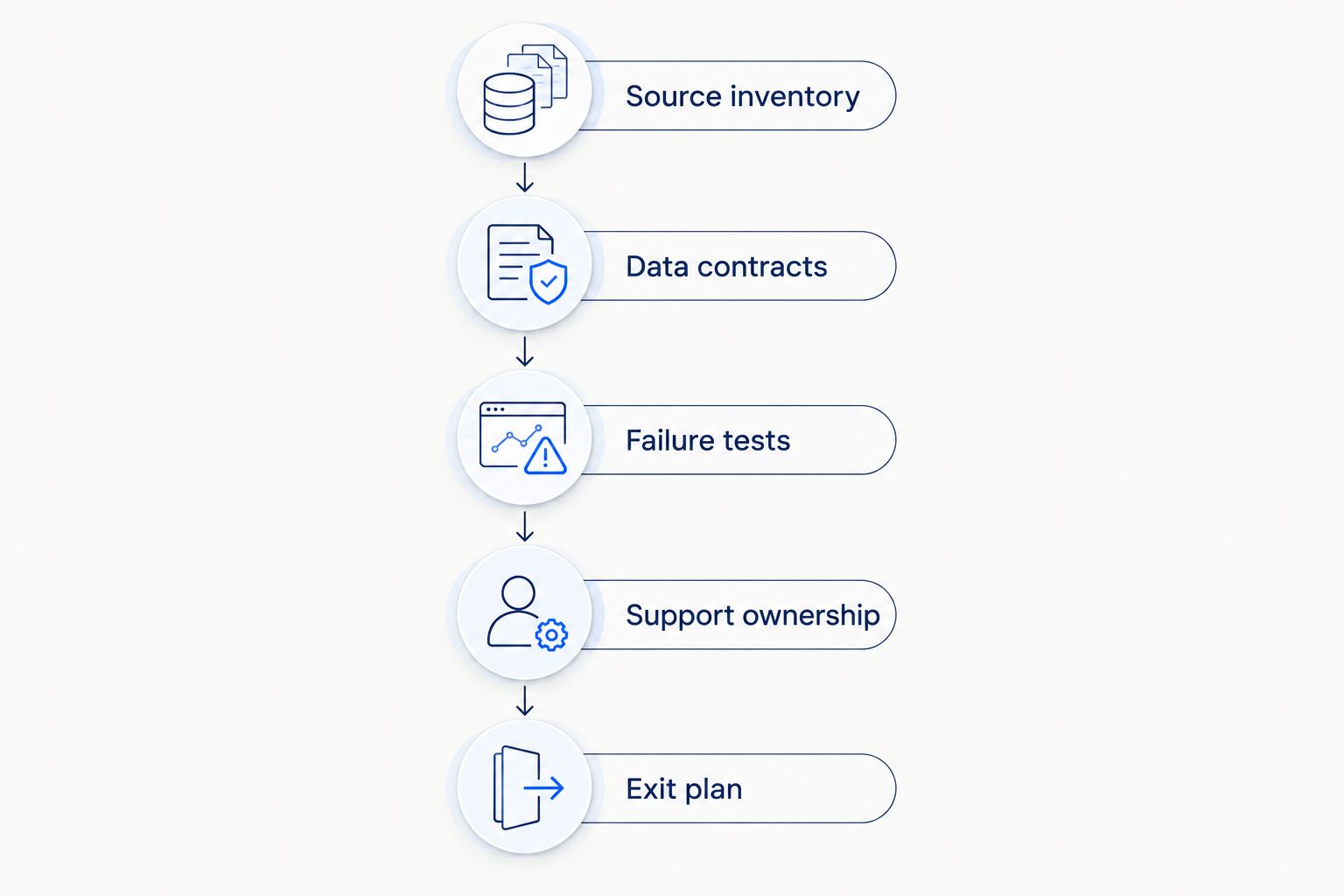
Ask for these five deliverables:
- Source inventory: Named systems, interfaces, access constraints, and data owners.
- Data contracts: Agreed identifiers, field meanings, validation rules, and change handling.
- Failure tests: Demonstrated treatment of duplicates, rejected records, interrupted delivery, and replay.
- Support ownership: Named responsibilities for alerts, investigation, corrections, and escalation.
- Exit plan: Exportable mappings, documentation, credentials handover, and maintainable deployment assets.
Your contract should distinguish a successfully delivered message from a correctly applied business update. A shipment status that reaches its destination but attaches to the wrong shipment is still a failed integration.
Where an enterprise AI partner fits
Knackforge describes its focus as helping enterprises apply artificial intelligence to business operations. That makes enterprise AI adoption the relevant discussion, rather than an assumed claim about specific logistics connectors or EDI implementations.
Knackforge is a fit for enterprises discussing AI adoption, not a substitute for validating logistics data integration. Keep that distinction clear when you build the shortlist.
An AI initiative still needs dependable source definitions, permissions, and correction handling. For a 2026 program, separate the integration acceptance criteria from the AI acceptance criteria. A working model does not prove that shipment events are complete or inventory records reconcile.
Knackforge fit: Enterprise AI discussions connected to operational improvement.
Knackforge limitation: Logistics-specific integration capabilities require direct validation before selection. Request evidence against the same workflow and failure tests used for every candidate.
Which logistics data integration company should you choose?
Start with Boomi if you need operational applications connected across cloud and on-premises environments. Change that default when the principal requirement belongs to another category.
Choose IBM Sterling for freight EDI, MuleSoft for reusable APIs, Informatica for governed data integration, and Fivetran for warehouse ingestion. A mixed environment can require more than one approach, but each component needs a clear responsibility.
Before procurement, write the business update that must happen, the source of truth, the permitted delay, and the recovery behavior. Make candidates demonstrate that requirement. Do not let the selection turn into a tour of unrelated features.
FAQ
What's the best data integration company for logistics in 2026?
Boomi is the default shortlist choice for hybrid application integration. Choose a different provider when the principal requirement is freight EDI, reusable APIs, governed data, or analytical ingestion.
Is IBM Sterling better than Fivetran for logistics?
IBM Sterling fits B2B document exchange, while Fivetran fits analytical data ingestion. Compare them against the business workflow rather than treating them as interchangeable platforms.
Which company should I shortlist for freight EDI?
Shortlist IBM Sterling for freight EDI and trading-partner document workflows. Validate the actual partner implementation guides, acknowledgments, rejection handling, and resubmission process.
Do I need MuleSoft to connect a transportation management system?
You do not need MuleSoft simply because a transportation management system needs integration. MuleSoft fits when reusable APIs and API management are central requirements; other integration approaches serve different workflows.
Can Fivetran replace an operational integration platform?
Fivetran's analytical ingestion role does not replace operational orchestration. Evaluate shipment updates, inventory reservations, and write-back separately from warehouse reporting.
How do I choose an integration consulting company?
Choose a delivery company that demonstrates your workflow, failure recovery, and support ownership. Require data contracts, operating documentation, and a handover plan before accepting the implementation.
Should supply-chain AI start before data integration is finished?
A supply-chain AI pilot needs reliable data for its defined scope, not completion of every enterprise integration. Confirm source ownership, quality, permissions, and correction handling before judging the pilot's output.
One last thing
Ask every finalist to replay the same shipment event after an interrupted delivery. The destination should reflect the intended business state without an unintended duplicate update. That test connects platform behavior to an operational consequence your team can evaluate.
A polished demonstration shows the happy path. Your selection should also show who fixes the unhappy path.