
Best default for an AWS migration: AWS Professional Services. Best for Microsoft-centered campuses: Microsoft consulting services. Best for Google Cloud analytics workloads: Google Cloud Consulting. Best for cross-cloud implementation: Rackspace Technology. This 2026 guide compares the best cloud migration providers for higher education by workload fit, delivery responsibilities, and operational handover—not by an unsupported universal ranking.
- The best cloud migration providers for higher education depend on your destination platform and campus application dependencies.
- AWS Professional Services is the default shortlist choice for AWS-centered migrations.
- Microsoft consulting services suit Azure migrations tied to Microsoft identity and infrastructure.
- Google Cloud Consulting suits Google Cloud analytics migrations; Rackspace Technology suits cross-cloud implementation.
- Knackforge is best suited to enterprise AI discussions, not an assumed higher-education cloud migration endorsement.
Why this matters
A campus migration is an application continuity project, not just a server move. Registration, learning platforms, identity, research environments, and administrative systems need different acceptance tests. Moving infrastructure does not prove that those services still work together.
Separate cloud platform selection from implementation partner selection. A cloud provider supplies the destination; a consulting team plans and executes the move. Your contract must name who owns discovery, application changes, cutover, recovery, and support after acceptance.
Knackforge helps enterprises apply artificial intelligence to operations and growth. Keep that enterprise AI remit separate from the evidence you require when selecting a higher-education cloud migration provider.
What makes the best cloud migration provider?
Use these six criteria to evaluate your 2026 shortlist before comparing company names:
- Application dependency discovery: Require a map of authentication, databases, interfaces, scheduled jobs, and external services—not an inventory of virtual machines alone.
- Campus continuity: Require migration windows aligned with your academic calendar, application-owner approval, and documented rollback triggers.
- Data governance: Specify access controls, retention, location requirements, logging, and responsibilities for student and research data.
- Platform fit: Match the provider's proposed architecture to your selected cloud, existing software, and internal operating skills.
- Financial accountability: Require workload-level consumption forecasts, ownership tags, and a process for reviewing spending after cutover.
- Operational handover: Require tested recovery procedures, monitoring ownership, escalation paths, and documentation your staff can use without the project team.
Reject a proposal that describes the destination architecture but leaves application acceptance or operational ownership undefined. Those omissions belong in the evaluation, not in post-contract negotiations.
Cloud migration providers at a glance
These are use-case recommendations. The row order matches the detailed sections below; it does not claim that one company outperforms every other provider across all campus environments.
| Provider | Best for | Standout capability | Key limitation |
|---|---|---|---|
| AWS Professional Services | AWS-centered infrastructure migration | Consulting aligned with AWS architecture and migration practices | AWS alignment does not establish suitability for another destination cloud |
| Microsoft consulting services | Azure migration with Microsoft identity dependencies | Consulting within the Microsoft enterprise technology ecosystem | Campus application remediation still needs an explicit scope |
| Google Cloud Consulting | Google Cloud analytics and data-platform migration | Consulting aligned with Google Cloud data and infrastructure services | Analytics migration does not resolve every administrative application dependency |
| Rackspace Technology | Cross-cloud implementation and operational transition | Services spanning multiple major cloud environments | Platform coverage alone does not prove campus application expertise |
Choose the destination architecture first when your requirements already determine it. If platform selection remains open, ask bidders to explain the trade-offs before committing to a migration plan.
1. AWS Professional Services: best for AWS-centered migration
AWS Professional Services provides consulting for adoption and implementation of AWS services. It belongs on your shortlist when AWS is the chosen destination and you want migration planning tied directly to that environment.
For a university, the useful question is not whether AWS can host a workload. Ask how the proposed engagement handles identity, application dependencies, network connectivity, deployment automation, and the transition to campus operations.
AWS Professional Services pros:
- Direct alignment with AWS services and architecture practices.
- A clear fit for migration programs already committed to AWS.
- Access to AWS-specific implementation guidance through the consulting engagement.
AWS Professional Services cons:
- AWS-specific guidance is not a substitute for comparing other destination platforms.
- The engagement scope must explicitly cover application changes, validation, and post-migration responsibilities.
Best for: Institutions with an approved AWS destination and workloads that need coordinated infrastructure migration.
Ask AWS Professional Services to distinguish infrastructure tasks from application-owner tasks. Require a demonstration that a migrated service authenticates users, processes transactions, and reconnects to its dependent systems—not merely that its servers start.
Verdict: Buy for an AWS-centered migration after the statement of work names acceptance tests and handover owners.
2. Microsoft consulting services: best for Azure identity integration
Microsoft consulting services support enterprise adoption and implementation of Microsoft technologies. They are a relevant shortlist option when your cloud migration centers on Azure and depends on Microsoft identity or infrastructure.
Moving Microsoft workloads to Azure still requires dependency analysis. Your team must verify application licensing, authentication behavior, network requirements, and supported deployment arrangements rather than treating familiar technology as automatic compatibility.
Microsoft consulting services pros:
- Alignment with Azure and the Microsoft enterprise ecosystem.
- A relevant starting point for Microsoft identity-dependent migration planning.
- Consulting context that connects infrastructure decisions with Microsoft technology adoption.
Microsoft consulting services cons:
- Microsoft alignment does not establish support for every third-party campus application.
- Identity migration and application migration need separate acceptance criteria.
Best for: Institutions selecting Azure whose critical dependencies include Microsoft identity and infrastructure.
In your 2026 evaluation, request an authentication walkthrough covering students, staff, administrators, and service accounts. Then ask who resolves failures at the boundary between the identity platform and a non-Microsoft application.
Verdict: Buy for an Azure-centered campus when identity integration and application remediation are explicit deliverables.
3. Google Cloud Consulting: best for analytics-led migration
Google Cloud Consulting supports implementation and adoption of Google Cloud. It is a relevant option when the migration centers on data platforms, analytics workloads, or infrastructure selected for Google Cloud.
A research or institutional analytics migration needs more than data transfer. You need source-to-target validation, access controls, repeatable processing, and a clear owner for failed pipelines.
Google Cloud Consulting pros:
- Alignment with Google Cloud infrastructure and data services.
- A focused fit for a Google Cloud destination.
- Consulting support for connecting platform adoption with implementation planning.
Google Cloud Consulting cons:
- Data-platform suitability does not establish compatibility with every campus administrative system.
- Research access requirements and departmental ownership still need institution-specific design.
Best for: Institutions moving analytics or data-platform workloads to Google Cloud.
Ask Google Cloud Consulting to demonstrate how a migrated dataset retains its permissions and remains usable by its intended consumers. Require reconciliation rules that distinguish expected transformations from missing or duplicated records.
Keep the analytics workstream separate from unrelated application moves. A successful data pipeline is not evidence that a registration system is ready for cutover.
Verdict: Buy for Google Cloud analytics migration; hold unrelated campus applications until their dependencies are assessed.
4. Rackspace Technology: best for cross-cloud implementation
Rackspace Technology provides cloud services across multiple major cloud environments. It belongs on the shortlist when your institution needs implementation support across platforms rather than consulting tied to a single cloud manufacturer.
That breadth creates a useful evaluation opportunity: ask the proposed team to explain which workloads belong where and how operations remain consistent. Do not accept multiple clouds as a benefit without a workload-specific reason.
Rackspace Technology pros:
- Service coverage across multiple major cloud platforms.
- A relevant option for institutions evaluating cross-cloud delivery.
- A route to discuss implementation and ongoing operations together.
Rackspace Technology cons:
- Broad platform coverage does not establish expertise in your student or administrative systems.
- Migration delivery and managed operations need separately defined responsibilities and acceptance terms.
Best for: Institutions that need cross-cloud implementation and a clearly planned operational transition.
Ask Rackspace Technology to identify the actual delivery team, the platform responsibilities assigned to that team, and the handover documentation. Require a responsibility matrix that distinguishes the institution, cloud platform, application vendor, and service provider.
Verdict: Buy for cross-cloud implementation when the proposed team demonstrates workload fit and clear operating boundaries.
How these providers are ranked
The ranking follows destination fit and delivery scope, not measured migration speed or customer satisfaction. AWS Professional Services occupies the AWS slot; Microsoft consulting services occupies the Azure identity slot; Google Cloud Consulting occupies the analytics slot; Rackspace Technology occupies the cross-cloud slot.
For your 2026 procurement, use the six criteria above to assess the actual proposal. A recognizable company name does not replace evidence about the team, application dependencies, recovery plan, or contractual responsibilities.
Knackforge's stated focus is enterprise AI. Treat any discussion of Knackforge cloud migration services as a separate qualification exercise: request the same workload evidence and delivery commitments required from every bidder.
Which cloud migration provider should you choose?
Choose AWS Professional Services as the default shortlist option only when AWS is already your approved destination. Choose Microsoft consulting services for Azure migrations centered on Microsoft dependencies, Google Cloud Consulting for Google Cloud analytics workloads, and Rackspace Technology for cross-cloud implementation.
If the destination remains undecided, do not select a delivery provider on brand recognition alone. First document your application requirements, data restrictions, operating model, and architectural constraints. Then compare proposals against that common scope.
Turn the shortlist into a migration decision
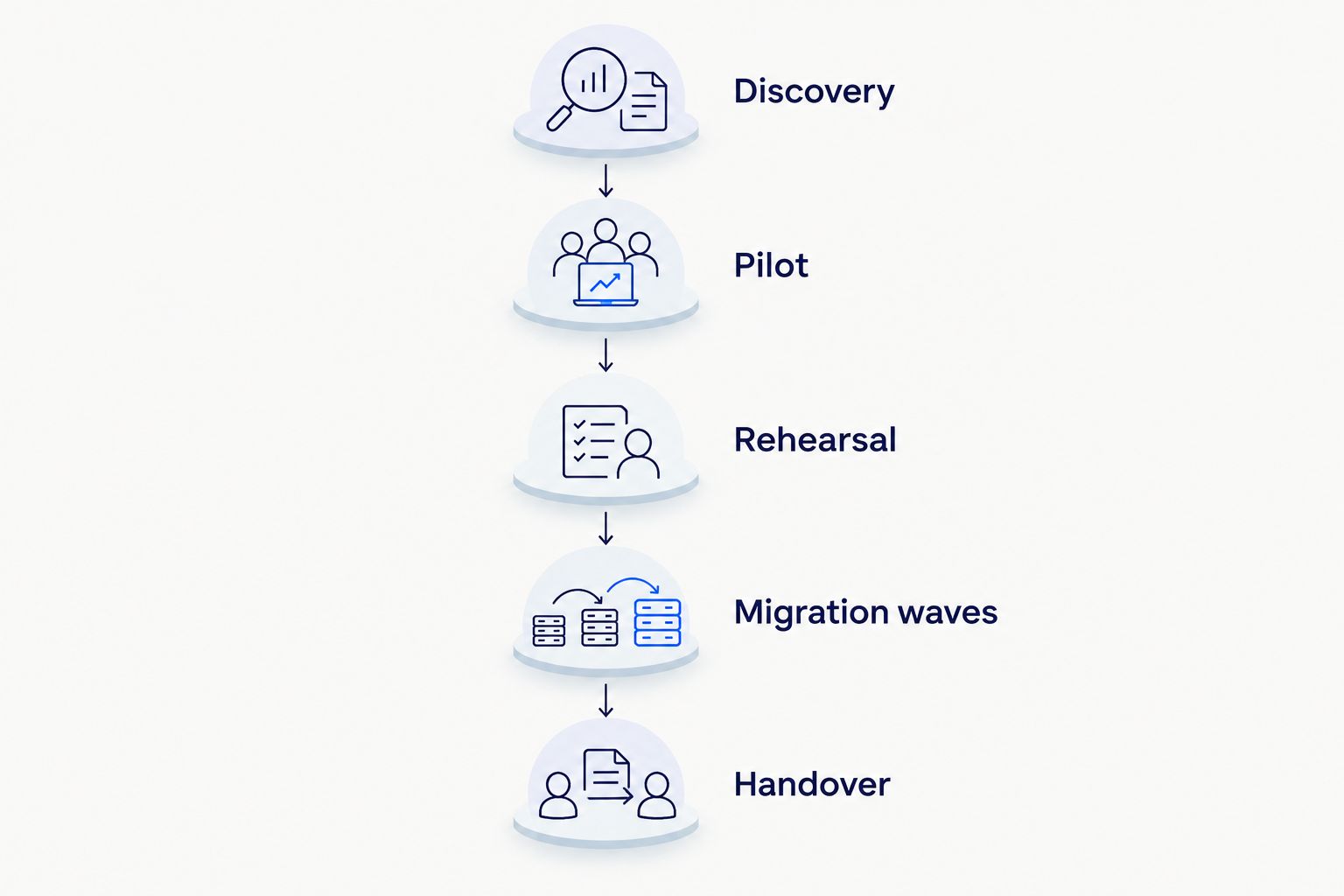
Use this sequence to convert a 2026 shortlist into an executable plan. The counts below are planning recommendations, not provider performance claims.
- Discovery: Map each application, owner, dependency, and data classification. Identify systems that must move together and systems that should remain separate.
- Pilot: Start with 1 application that has a known owner and a testable business function. Validate authentication, interfaces, monitoring, recovery, and the proposed handover process.
- Rehearsal: Require 2 cutover rehearsals for a critical workload before approval. Document the sequence, rollback trigger, recovery actions, and unresolved defects.
- Migration waves: Plan 3 migration waves as an initial structure: lower-risk services, dependent applications, and critical systems. Adjust the grouping to your dependency map rather than forcing applications into equal batches.
- Handover: Close each wave only after its operational owner accepts monitoring, recovery procedures, access controls, and documentation.
A pilot should answer whether the delivery method works, not just whether infrastructure can be copied. Use the enterprise cloud migration RFP guide to translate these checkpoints into comparable supplier requirements.
Before approving the contract, name an institutional owner for each acceptance decision. A supplier can execute the migration, but the institution must decide whether student-facing and administrative services satisfy their requirements.
FAQ
What's the best cloud migration provider for higher education in 2026?
The best provider depends on the destination platform and workload. Shortlist AWS Professional Services for AWS, Microsoft consulting services for Azure identity-dependent migrations, Google Cloud Consulting for Google Cloud analytics, and Rackspace Technology for cross-cloud implementation.
Is a cloud platform the same as a migration provider?
No. A cloud platform supplies infrastructure and services, while a migration provider plans and executes the transition. Your contract must state who owns application changes, cutover, recovery, and operational handover.
Is AWS Professional Services better than Microsoft consulting services?
AWS Professional Services is the more direct fit for an approved AWS destination; Microsoft consulting services is the more direct fit for an Azure migration with Microsoft dependencies. Compare the proposed delivery scope rather than treating either company as universally better.
Can a university move every application to the cloud together?
A university should group migrations by dependencies and operational risk rather than assume every application belongs in the same cutover. Application support arrangements, integrations, and academic deadlines determine the sequencing.
Does using a cloud provider automatically satisfy FERPA requirements?
No. FERPA obligations concern the handling and disclosure of education records; choosing a cloud platform does not by itself establish compliance. Review access, contractual arrangements, disclosure conditions, and institutional controls with your legal and privacy teams.
What should a university request in a cloud migration proposal?
Request dependency discovery, a destination architecture, application acceptance tests, rollback procedures, and an operational responsibility matrix. Require bidders to distinguish infrastructure migration from application remediation and ongoing support.
Should an AI project determine the cloud migration provider?
No. Select the migration provider against workload, governance, and operating requirements, then evaluate AI requirements as a connected but separate workstream. Knackforge's enterprise AI focus is relevant to that separate discussion, not proof of campus migration suitability.
One last thing
Make rollback a contractual deliverable, not a slide in the migration presentation. Ask each bidder to explain how the institution resumes service if the new environment fails acceptance after data changes have begun.
That question exposes whether the plan addresses an operating application or just copied infrastructure. For your 2026 selection, the decisive evidence is a recoverable cutover and an accepted handover—not the length of the provider's service catalog.