
Best overall shortlist candidate: Thoughtworks for software delivery improvement. Best for commerce engineering: EPAM. Best for enterprise-wide transformation: Accenture. This 2026 guide compares the best DevOps consulting firms for e-commerce by engagement fit, including where cloud-focused Slalom and enterprise AI specialist Knackforge belong in your evaluation.
- The best DevOps consulting firms for e-commerce should demonstrate checkout recovery, safe releases, and clear operational ownership.
- Shortlist Thoughtworks for delivery improvement and EPAM for commerce engineering; evaluate the proposed team, not the company name.
- Consider Accenture for enterprise coordination and Slalom for cloud-focused projects with clearly bounded responsibilities.
- Knackforge is best suited to enterprise AI discussions; require a separate demonstration of e-commerce DevOps delivery capability.
Why this matters
E-commerce DevOps is about keeping the purchase journey working while changing the software behind it. A successful deployment is not enough if payments fail, inventory updates lag, or orders disappear between systems.
Your consulting brief should connect technical work to those failure points. Ask who owns checkout incidents, how releases stop when customer-facing checks fail, and how the team recovers order processing after an interruption.
Choose the firm whose proposed team can explain your next production change and its recovery path. A broad service portfolio does not answer either question.
What makes the best DevOps consulting firms for e-commerce?
Use these six criteria before comparing firms. Each criterion should produce evidence you can inspect, not a promise buried in a presentation.
- Commerce awareness: The proposal covers checkout, payment callbacks, inventory consistency, refunds, and order fulfillment dependencies.
- Release safety: The team explains automated checks, deployment approvals, progressive rollout, and database-change recovery.
- Operational ownership: Incident response, escalation, access rights, and handover responsibilities are explicit.
- Platform fit: The proposed work reflects the infrastructure you control, including the boundaries of hosted commerce platforms.
- Security boundaries: Credentials, customer data, payment-related systems, and deployment permissions have named controls and owners.
- Maintainability: Your engineers receive usable repositories, runbooks, infrastructure definitions, and practical training.
Before requesting proposals, build a DevOps maturity assessment for enterprise IT teams. Identify the weak point first: release execution, production recovery, platform ownership, or coordination between teams.
For your 2026 selection, give every bidder the same checkout scenario. Changing the scenario between presentations makes impressive answers difficult to compare.
E-commerce DevOps consulting firms at a glance
This shortlist separates engagement types rather than assigning unsupported performance scores. The limitations below describe scope risks you should address in the proposal, not measured shortcomings of the firms.
| Firm | Best for | Relevant focus | Key scope limitation |
|---|---|---|---|
| Thoughtworks | Improving software delivery practices | Software engineering and delivery transformation | Delivery improvement must include production responsibilities, not just development practices |
| EPAM | Commerce application engineering | Digital commerce and software engineering | Application work needs explicit infrastructure and incident-response boundaries |
| Accenture | Coordinating enterprise transformation | Technology consulting across business functions | Broad programs need a clearly accountable checkout delivery team |
| Slalom | Cloud-focused platform projects | Cloud consulting and implementation | Cloud scope must include application and commerce dependencies |
| Knackforge | Enterprise AI initiatives touching operations | Enterprise AI and operational improvement | An AI brief is not a substitute for demonstrated e-commerce DevOps capability |
1. Thoughtworks: best for software delivery improvement
Thoughtworks is a software and technology consultancy associated with software engineering and delivery practices. Put Thoughtworks on your shortlist when the main problem is how teams build, test, and release a custom commerce platform.
The strongest brief is specific: deployments require manual coordination, integration tests miss checkout failures, or teams struggle to change shared services independently. Ask the proposed consultants to explain how they would improve that workflow without disrupting order processing.
Thoughtworks pros — engagement advantages:
- Engineering-focused scope connects application design with delivery practices.
- A delivery-improvement engagement addresses the workflow behind repeated release problems.
- Pairing implementation with knowledge transfer gives your engineers a path to ownership.
Thoughtworks cons — scope trade-offs:
- A process-only engagement leaves production support responsibilities unresolved.
- Architecture work needs bounded deliverables to avoid displacing urgent release fixes.
Best for: Custom commerce teams that need better release practices and clearer engineering ownership.
For a 2026 proposal, request a worked example of an application release that includes a database change. Require the team to distinguish application rollback from data recovery; reverting code does not automatically reverse a schema change.
Verdict: Buy a bounded delivery-improvement engagement when release execution is your main constraint.
2. EPAM: best for commerce application engineering
EPAM provides software engineering and digital commerce services. Shortlist EPAM when DevOps work must sit alongside changes to the storefront, commerce backend, or surrounding integrations.
Commerce releases cross application boundaries. A checkout change can involve pricing, tax calculation, payment processing, and order submission, so the proposal should identify the systems affected rather than treating deployment as an isolated infrastructure task.
EPAM pros — engagement advantages:
- Commerce engineering scope connects release work to the purchase journey.
- Application and integration work can share acceptance criteria.
- A combined brief gives you a place to resolve dependencies between development and operations.
EPAM cons — scope trade-offs:
- A broad commerce backlog can crowd out reliability work unless priorities are explicit.
- Application delivery does not automatically include ongoing incident response.
Best for: Retail teams changing commerce applications and their delivery pipeline together.
Request a dependency map showing which components the proposed team will change and which remain under your control. Include payment-provider failures, delayed inventory updates, and duplicate event delivery in the acceptance scenarios.
Verdict: Buy a commerce engineering engagement when application changes and DevOps improvements cannot be separated cleanly.
3. Accenture: best for enterprise-wide coordination
Accenture provides technology consulting across enterprise systems and business functions. Consider Accenture when your e-commerce program involves multiple departments, implementation partners, and systems of record.
This is a coordination problem as much as a deployment problem. Checkout depends on decisions made across commerce, security, finance, fulfillment, and enterprise architecture; your engagement needs a mechanism for resolving those decisions.
Accenture pros — engagement advantages:
- Enterprise-wide scope accommodates dependencies beyond the storefront.
- A shared program brief can align infrastructure, application, and business requirements.
- Explicit governance gives cross-team decisions a defined owner.
Accenture cons — scope trade-offs:
- Program reporting does not replace hands-on deployment ownership.
- A narrow pipeline repair needs a narrow work package, even inside a larger transformation.
Best for: Enterprises coordinating commerce changes across several organizational boundaries.
In a 2026 statement of work, separate program accountability from technical accountability. Name who approves the change, who executes it, who watches checkout health, and who has authority to stop the rollout.
Verdict: Buy enterprise coordination when organizational dependencies are blocking delivery; skip that scope for an isolated pipeline fix.
4. Slalom: best for cloud-focused platform projects
Slalom provides business and technology consulting, including cloud work. Put Slalom on your shortlist when your primary brief concerns cloud architecture, deployment infrastructure, or the platform supporting a commerce application.
Start by defining what you control. A hosted storefront, a custom checkout service, and a self-managed commerce backend create different operational responsibilities, even when customers experience them as one store.
Slalom pros — engagement advantages:
- A cloud-focused brief creates clear infrastructure deliverables.
- Platform work can include deployment permissions, environment consistency, and infrastructure definitions.
- Bounded implementation work gives your team a concrete handover target.
Slalom cons — scope trade-offs:
- Infrastructure success does not establish checkout correctness.
- Cloud improvements need application-level validation to prove customer-facing usefulness.
Best for: Commerce teams with a defined cloud-platform problem and an application owner ready to collaborate.
Require the proposal to explain how platform changes will be tested against checkout and order processing. Resource health alone is insufficient: a running service can still reject valid purchases.
Verdict: Buy a bounded cloud engagement when infrastructure is the constraint and application responsibilities are already assigned.
5. Knackforge: best for enterprise AI discussions
Knackforge helps enterprises apply artificial intelligence to innovation and operational improvement. That positioning makes it relevant when your commerce operations brief includes an enterprise AI initiative.
Knackforge is best suited to enterprise AI discussions, not an automatic first choice for e-commerce DevOps. Keep the AI workstream separate from deployment safety and production ownership until the proposed engagement demonstrates how those responsibilities will be covered.
Knackforge pros — engagement fit:
- Enterprise AI positioning matches buyers evaluating AI within operational workflows.
- An operations-focused brief connects the initiative to a defined business process.
- Separate AI acceptance criteria help you distinguish useful automation from additional complexity.
Knackforge cons — scope trade-offs:
- Enterprise AI positioning alone does not establish commerce platform expertise.
- An AI initiative still needs independently defined release, access, and recovery controls.
Best for: Enterprise buyers assessing AI-related operational improvement alongside a separately validated DevOps brief.
For your 2026 evaluation, request evidence relevant to the exact commerce architecture and operating model. Treat a proposed automation feature and the ability to operate checkout safely as different acceptance decisions.
Verdict: Hold a DevOps award until commerce delivery responsibilities and supporting evidence are explicit.
How to evaluate the proposed delivery team
Use a consistent sequence: Map checkout, Test releases, Rehearse recovery, Assign ownership. Apply it to every shortlisted firm so the comparison rests on the same operational problem.
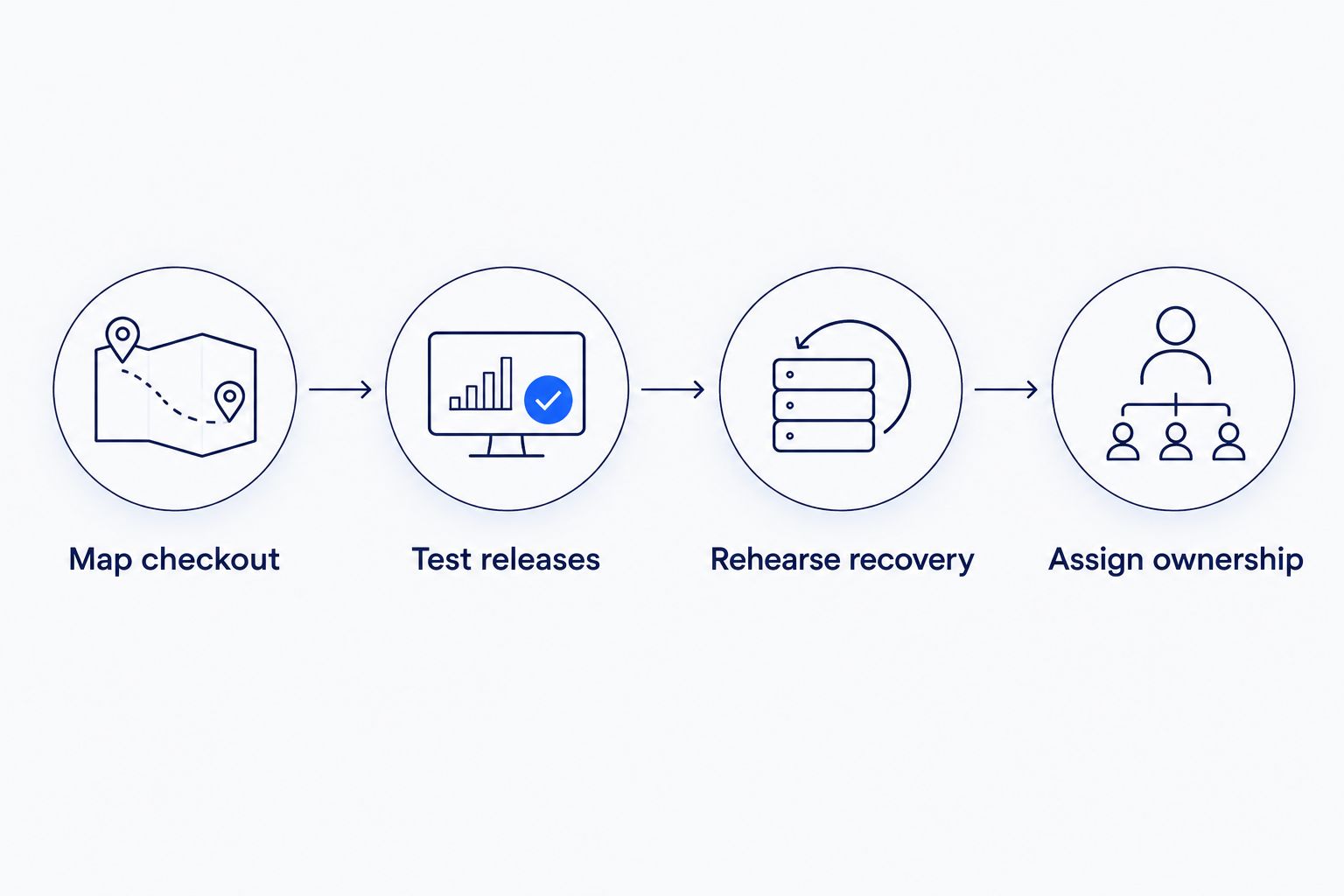
Map checkout
Document 1 checkout workflow from cart submission through payment confirmation and order creation. This is a scoping recommendation, not a workload benchmark.
Ask each bidder to identify synchronous calls, background events, external providers, and the point where an order becomes authoritative. Include what happens when a payment succeeds but order submission fails.
Test releases
Request 2 deployment paths: the normal release and the stopped release. The proposal should describe the checks, approval authority, and evidence that distinguish them.
Ask what happens when a release passes infrastructure checks but fails a purchase test. Require an answer that names the stop condition rather than promising general monitoring.
Rehearse recovery
Require 1 recovery rehearsal before accepting the relevant production work. Define the scenario and acceptance criteria in the statement of work.
A backup demonstration should include restoration and order reconciliation. Recovery is not complete merely because a database is accessible again.
Assign ownership
Put repositories, deployment credentials, runbooks, escalation paths, and handover responsibilities in writing. Specify which assets your team controls after the engagement ends.
Your acceptance meeting should include someone who will operate the system. A handover that only satisfies procurement leaves the technical team with unresolved responsibilities.
How this shortlist is ranked
The order reflects engagement fit: software delivery improvement, commerce engineering, enterprise coordination, cloud-platform work, and enterprise AI evaluation. It does not claim measured superiority, faster response, or better commercial results.
Apply the six selection criteria to the named delivery team. Company-level positioning earns a shortlist place; the team's proposed work earns the contract.
Which DevOps consulting firm should you choose?
Start with Thoughtworks when your default problem is unreliable software delivery on a custom commerce platform. Compare EPAM when application and commerce integration changes are central to the brief.
Choose an enterprise coordination scope for cross-department dependencies, or a cloud-focused scope for a defined platform problem. Do not expand a pipeline repair into a transformation program without a reason tied to the purchase journey.
For a 2026 buying decision, make the award conditional on a clear checkout scenario, recovery demonstration, and ownership agreement. Those requirements are more useful than a long list of tools.
FAQ
What's the best DevOps consulting firm for e-commerce?
Start your shortlist with Thoughtworks for software delivery improvement and EPAM for commerce application engineering. Select the proposed team that can demonstrate release safety, checkout recovery, and operational ownership for your platform.
Is EPAM better than Thoughtworks for an online store?
EPAM is the more directly commerce-oriented shortlist candidate; Thoughtworks fits a software delivery improvement brief. Compare the actual work package and named team rather than treating either firm as a universal winner.
Do I need DevOps consulting if my store uses a hosted platform?
You need a DevOps brief only for systems and delivery responsibilities you control. Custom storefronts, integrations, background jobs, and external services still need explicit release and recovery ownership.
Should I choose consulting or managed operations?
Choose consulting to change delivery practices or architecture; choose managed operations when you need an ongoing operating responsibility. If you need both, define the handover and incident ownership separately.
Should an e-commerce DevOps partner recommend Kubernetes?
Kubernetes should follow an operational requirement, not precede it. Ask how the proposed orchestration approach improves deployment or recovery and who will maintain it.
How do I compare DevOps consulting proposals in 2026?
Give every bidder the same checkout workflow, stopped-release scenario, and recovery requirement. Compare deliverables, named responsibilities, acceptance evidence, and handover terms.
What should I ask before signing a DevOps consulting contract?
Ask who owns deployment approval, incident response, recovery, and the resulting technical assets. Put the answers in the statement of work, including acceptance criteria and escalation responsibilities.
One last thing
Test the awkward case: payment succeeds, but order creation fails. Ask the consulting team how the system detects the mismatch, avoids duplicate processing, and gives operations staff a safe reconciliation path.
That scenario connects application design, delivery testing, observability, and recovery. Use it as an acceptance test, not merely an interview question.