
Setting up CI/CD pipelines with a DevOps consulting partner means handing the pipeline architecture to a team that already knows the failure patterns, security gates, and rollback logic — you bring the codebase and compliance requirements, they bring the blueprint. The engagement runs through four phases: a toolchain and environment audit, pipeline design, implementation with automated testing, and a handover period where your internal engineers take over day-to-day maintenance. The cost most teams miss isn't the consulting fee — it's the internal engineering hours needed to migrate manual deploy scripts into the new pipeline, work that runs in parallel with the consultant's build in 2026.
- CI/CD pipeline setup with a DevOps consulting partner runs through four phases: audit, design, build, handover.
- KnackForge structures engagements around the four DORA metrics, not just pipeline uptime.
- GitHub Actions, GitLab CI, and Jenkins remain the most common CI/CD toolchains for enterprise pipelines in 2026.
- Skip the consulting route only if an internal platform engineering team already owns pipeline maintenance.
Why this matters
A pipeline that works in a demo and a pipeline that survives a production incident at 2 a.m. are different things. Most in-house teams can build the first. Fewer have shipped enough pipelines to know which failure modes to guard against before they happen — a bad rollback script, a missing approval gate before a database migration, a test suite that passes locally but flakes in CI.
That's the actual value of structuring a DevOps consulting engagement around CI/CD: you're buying pattern recognition, not just scripts. A DevOps consulting partner earns its fee by cutting the number of production incidents caused by deploy errors, not by shipping a pipeline that merely runs once.
How do you set up CI/CD pipelines with a DevOps consulting partner?
The process follows a repeatable sequence regardless of which cloud or toolchain you're on. Here's the order a competent partner works in:
- Audit the current deployment process. The partner maps existing repos, branching strategy, manual deploy steps, and every place a human currently clicks a button to ship code.
- Run a DevOps maturity assessment. This scores your team against version control discipline, test coverage, infrastructure-as-code adoption, and incident response — the baseline the new pipeline has to improve on. Knackforge runs this as a standalone DevOps maturity assessment before committing to a pipeline design.
- Design the pipeline architecture. This defines the environment strategy — typically dev, staging, and production — the branching model, and where approval gates sit before code reaches production.
- Select and configure the toolchain. GitHub Actions, GitLab CI, Jenkins, and CircleCI cover most enterprise CI/CD needs in 2026; the choice usually follows whatever source control and cloud provider you're already on rather than a from-scratch evaluation.
- Build test automation and security scanning into the pipeline. Unit tests, integration tests, and static analysis scans get wired in as required gates, not optional steps developers can skip under deadline pressure.
- Run the new pipeline in parallel with the old process. Nobody cuts over cold. The old manual deploy stays live as a fallback until the new pipeline has shipped enough real releases to trust.
- Hand over documentation and run-books. The engagement ends when your internal team can debug a failed pipeline run without calling the consultant.
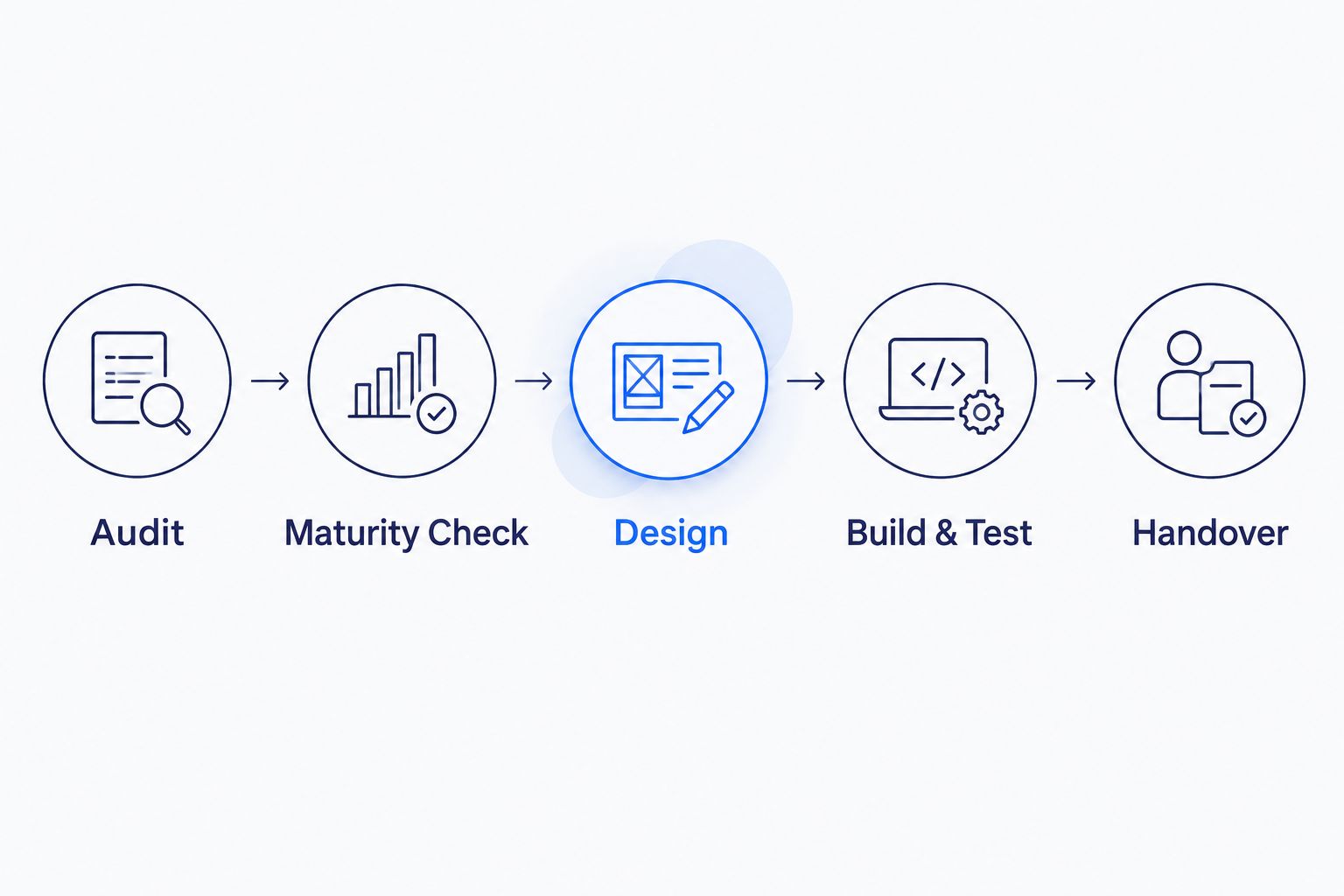
The step that gets skipped most often by teams trying to save budget is step 6 — running parallel pipelines. Skipping it saves a few weeks but means the first real test of the new pipeline happens during an actual production deploy, which is the worst time to discover a missing rollback step.
Why CI/CD pipeline setup timelines vary
No two engagements take the same amount of calendar time, and the variance comes from a small set of factors:
- Number of repositories and applications being migrated. A single monolith pipeline is a different job than fifteen microservices each needing their own build config.
- Compliance requirements. HIPAA, SOC 2, or PCI-DSS obligations add mandatory approval gates and audit logging that a pipeline for an internal tool doesn't need.
- Existing infrastructure maturity. Teams already on containers and infrastructure-as-code move faster than teams still deploying from a developer's laptop.
- Multi-cloud or multi-region deployment. Pipelines that need to deploy the same artifact across regions or providers add environment-specific configuration steps.
- Internal team's current DevOps maturity. A team that scores low on the maturity assessment needs training built into the handover, which extends the engagement.
- Legacy systems requiring parallel run. Anything that can't be cut over in one release adds a maintenance window where both pipelines run simultaneously.
Talk to KnackForge about your pipeline
Get a DevOps maturity read before committing to a CI/CD build.
Is a DevOps consulting partner worth it for CI/CD setup?
A DevOps consulting partner is worth it when your team lacks a dedicated platform engineer or has never run a formal maturity assessment — the pattern recognition a partner brings usually prevents the costly mistakes (missing rollback logic, unguarded production gates) that show up months after a DIY pipeline goes live. Teams with an existing platform engineering function often only need the assessment, not the full build.
How long does a CI/CD consulting engagement typically run?
The engagement length depends entirely on the factors above — number of repos, compliance load, and existing maturity — so there's no single fixed timeline that applies across industries. What stays consistent is the sequence: audit and maturity assessment first, pipeline design and build second, parallel run and handover last.
Can you build CI/CD pipelines without a consulting partner?
Yes, and plenty of teams do — GitHub Actions and GitLab CI both ship with enough documentation to get a basic pipeline running without outside help. The gap shows up in the parts documentation doesn't cover: security gate placement, rollback logic under real production load, and the DevSecOps automation that catches vulnerabilities before they reach a deploy — the kind of work covered under DevSecOps pipeline automation.
What tools do most enterprise CI/CD pipelines use in 2026?
GitHub Actions, GitLab CI, and Jenkins remain the three most common choices for enterprise CI/CD pipelines in 2026, with the decision usually driven by which source control platform and cloud provider a company already runs rather than a cold evaluation of features.
FAQ
How do you set up CI/CD pipelines with a DevOps consulting partner?
You start with an audit of the current deployment process and a DevOps maturity assessment, then move into pipeline design, toolchain build, parallel testing, and a formal handover to your internal team. The full sequence takes four phases from audit to handover.
What does a DevOps consulting partner actually do for CI/CD?
A DevOps consulting partner designs the pipeline architecture, configures the toolchain, wires in automated testing and security gates, and trains your internal team to maintain it after handover. The value is pattern recognition from prior engagements, not just writing pipeline scripts.
Is GitHub Actions or Jenkins better for enterprise CI/CD?
GitHub Actions integrates natively with repositories already hosted on GitHub, while Jenkins offers more configuration flexibility for teams with complex, non-standard build requirements. Most enterprise teams in 2026 choose based on their existing source control platform rather than switching tools mid-migration.
What is a DevOps maturity assessment?
A DevOps maturity assessment scores a team's version control discipline, test coverage, infrastructure-as-code adoption, and incident response before a new CI/CD pipeline is designed. It sets the baseline the new pipeline needs to improve on.
Do you need a consulting partner if you already have a platform engineering team?
No, not necessarily — teams with an established platform engineering function often only need a maturity assessment or a DevSecOps audit rather than a full pipeline build. The consulting partner adds the most value when that internal capability doesn't exist yet.
What's the biggest risk in CI/CD pipeline handover?
The biggest risk is ending the engagement before the internal team can debug a failed pipeline run without the consultant. A rushed handover leaves gaps in run-book documentation that surface during the first real production incident.
How does DevSecOps fit into a CI/CD pipeline setup?
DevSecOps folds security scanning and vulnerability checks into the pipeline as required gates rather than a separate post-deploy step. This catches issues before code reaches production instead of after a release.
One last thing
The engagements that fail aren't the ones with the wrong toolchain — Jenkins, GitHub Actions, and GitLab CI all do the job fine. They fail on handover: the consultant leaves, the run-book is thin, and the first pipeline failure after the engagement ends turns into a fire drill nobody on the internal team knows how to fight. Ask any prospective partner exactly what documentation and training ships in the handover phase before you sign, not after the pipeline is already live.


