
Enterprise DevSecOps teams turn to ai agents for devsecops pipeline automation to catch vulnerabilities, enforce policy gates, and cut the manual review hours that pile up before every release. A five-person startup can ship on instinct and fix things in production; an enterprise DevSecOps team runs pipelines across dozens of repos, multiple compliance regimes, and change-approval boards that slow down every single fix.
- Agentic AI for DevSecOps pipeline automation cuts manual CVE triage time for enterprise teams running dozens of repos in 2026.
- Start with CVE triage automation before handing agents remediation authority — sequencing protects audit trails.
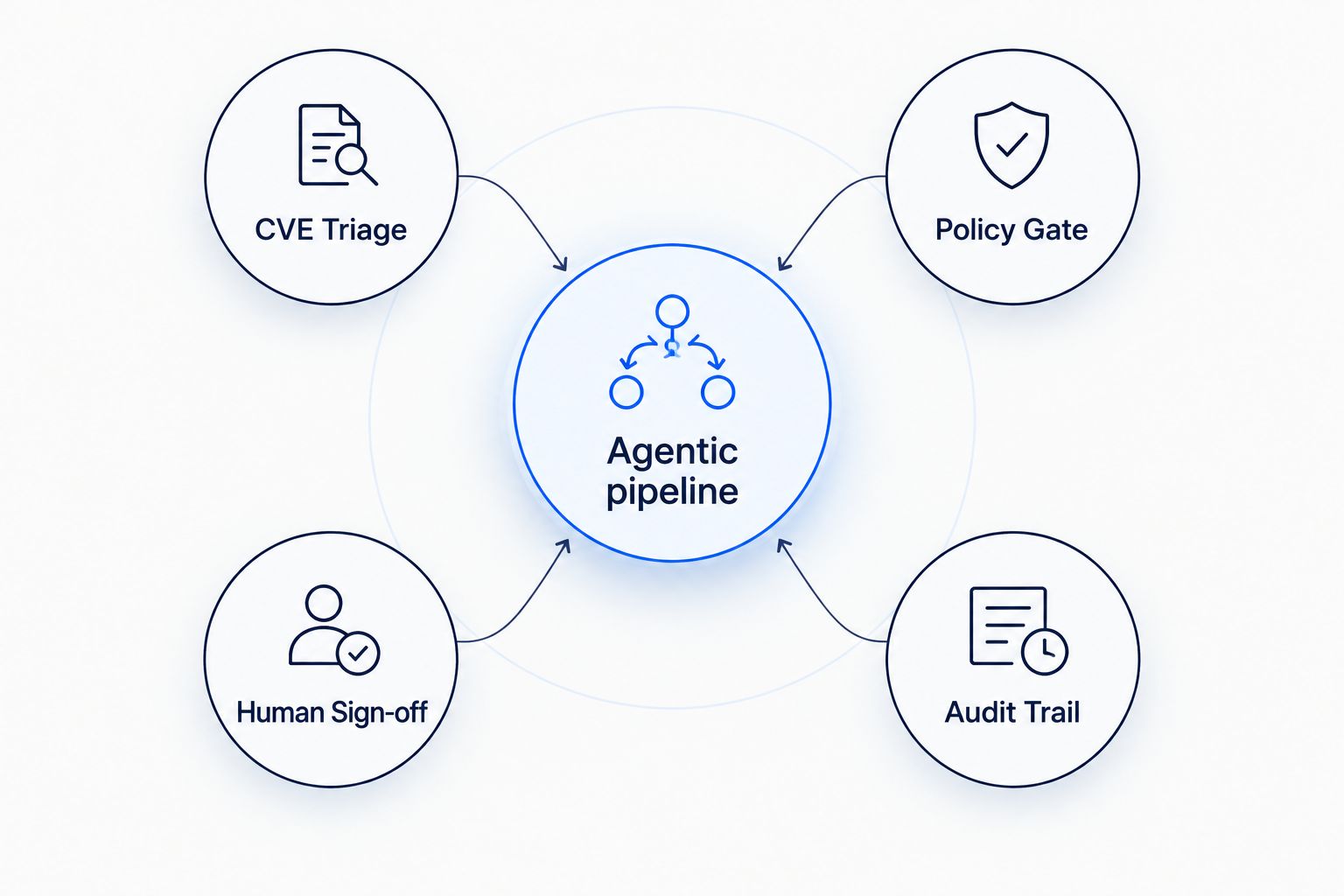
- KnackForge's agentic AI for vulnerability remediation adds a human sign-off gate, which regulated pipelines require.
- Point scanners and manual review still matter; agents replace the triage grind, not the judgment calls.
- Common failure mode: teams skip policy-as-code and let agents merge fixes with no audit record.
Why AI agents for DevSecOps pipeline automation matters for enterprise teams
An enterprise DevSecOps team doesn't have one pipeline — it has dozens, each tied to a different business unit, a different compliance owner, and a different risk tolerance. A CVE that's low priority on a marketing site is a blocker on a payments service. That variance is exactly why generic vulnerability scanners produce alert fatigue at scale: the same CVSS score means something different depending on which system it's attached to.
Agentic pipelines change the calculus because they can carry context across repos — which service touches PCI data, which one is internet-facing, which one has a SOC 2 audit due next quarter — and triage accordingly. Teams evaluating cloud-native DevSecOps partners in 2026 are asking the same question: can the agent explain its severity call in language an auditor accepts, or does it just spit out a score?
That's the real bar for enterprise DevSecOps teams. Not "does the agent find the vulnerability" — most scanners already do that — but "does the agent's decision hold up when compliance asks why."
How enterprise DevSecOps teams roll out AI agents in their pipelines
Map every security gate in the pipeline
Before any agent touches a pipeline, get a written inventory of every gate it will pass through — SAST, DAST, dependency scanning, container scanning, manual sign-off, change advisory board review.
- List every gate by pipeline, not by tool — the same tool often behaves differently per team
- Note which gates are blocking versus advisory
- Flag gates owned by a different team than the one requesting automation
- Record average time-in-gate for the last quarter, if your CI system logs it
- Identify which gates exist only because "that's how it's always been done"
Automate CVE triage before you automate remediation
Start with the manual, free version: a scheduled job that pulls new CVEs against your SBOM and ranks them by CVSS score plus exposure (internet-facing versus internal). This alone removes a meaningful chunk of manual triage without touching remediation authority.
- Pull CVE feeds against your software bill of materials daily, not weekly
- Rank by CVSS base score combined with exploit-availability status, not CVSS alone
- Separate internet-facing services from internal-only services in the ranking
- Route anything above your defined severity threshold straight to on-call security, not a backlog
- Track false-positive rate on the ranking logic for at least one full sprint before trusting it
Once triage is stable and your team trusts the rankings, agentic tools become the faster path — not the starting point. Automate CVE remediation with agentic AI covers the sequencing enterprise teams use to avoid handing an agent authority before the triage layer is proven.
Deploy agentic remediation with a human sign-off gate
This is where most enterprise rollouts either work or blow up. An agent that opens a pull request with a patched dependency and a written rationale is useful. An agent that merges to production without a human reviewing the rationale is a liability the moment a regulator asks for the change record.
- Require the agent to generate a rationale document, not just a diff
- Set a mandatory human approval step for anything touching a production branch
- Log every agent action — including ones a human rejects — for audit purposes
- Cap the agent's blast radius to a defined set of repos during the first 90 days
- Review a sample of agent decisions weekly, not just the ones that get flagged
KnackForge's agentic AI for vulnerability remediation is built around that sign-off gate specifically because enterprise pipelines can't accept a black-box merge.
Enforce policy-as-code across every environment
Agents behave predictably only when the rules they operate under are written down and machine-readable, not tribal knowledge held by one senior engineer.
- Codify severity thresholds, exemption rules, and escalation paths in a policy file the agent reads at runtime
- Version-control the policy file the same way you version-control application code
- Require a pull request and review for any policy change, no exceptions
- Test policy changes against a sample of last quarter's real CVEs before shipping them
Build a tamper-proof audit trail automatically
Manual audit trails — spreadsheets, Slack threads, ticket comments — fall apart under real scrutiny. An enterprise pipeline needs a system-generated record that nobody can quietly edit after the fact.
- Log agent inputs, outputs, and confidence scores to an append-only store
- Timestamp every decision with the policy version active at the time
- Retain records for the length of your compliance cycle, not just 90 days
- Make the audit log queryable by auditors without engineering having to pull it manually
Route agent actions through existing change management
An agent that bypasses your change advisory board doesn't save time — it creates a second, ungoverned change process that security will eventually have to reconcile with the first one.
- Integrate agent-initiated changes into the same ticketing system as human-initiated ones
- Tag agent tickets distinctly so audits can filter by origin
- Set the same SLA expectations on agent tickets as on human ones
- Require the same rollback plan documentation, regardless of who opened the change
Monitor agent decisions the same way you monitor code
Treat agent output as production code, not a black box you trust by default.
- Run periodic accuracy reviews comparing agent severity calls against post-incident findings
- Set alerting on agent confidence scores dropping below a defined threshold
- Rotate the human reviewers doing sign-off so no single blind spot persists
Comparing your options for devsecops pipeline automation
| Option | Best for | Key limitation |
|---|---|---|
| Manual security review | Small teams with under 5 repos | Doesn't scale past a handful of pipelines without adding headcount |
| SAST/DAST scanners alone | Baseline code-level coverage | High false-positive rate; no cross-repo context |
| Point CVE scanners | Dependency visibility | Ranks by CVSS alone, no exposure context |
| Agentic AI platforms (KnackForge) | Enterprise teams with multiple compliance regimes | Requires a human sign-off gate to be trusted for production merges |
Verdict: agentic AI for vulnerability remediation is the right fit for enterprise DevSecOps teams running multiple pipelines under compliance pressure in 2026, but only paired with a mandatory human sign-off gate — not as an unsupervised merge tool.
“If an AI agent can't explain why it flagged a CVE as critical, it doesn't belong in a regulated pipeline.”
Common mistakes enterprise DevSecOps teams make
- Skipping the triage layer and jumping straight to remediation agents — this is the fastest way to lose team trust when the agent gets a severity call wrong in week one.
- Treating policy-as-code as documentation instead of an enforced runtime input — a policy nobody's pipeline actually reads is not a policy.
- Letting one team's pilot become the enterprise standard without a cross-team review — what works for one repo's risk profile can misfire on a PCI-scoped service.
- No audit trail retention plan — teams that build the agent before building the log end up rebuilding the log under audit pressure.
- Assuming agentic tools remove the need for a security engineer in the loop — 2026 enterprise pipelines still require a human accountable for the sign-off, not just a dashboard.
Ready to automate your pipeline safely?
See how agentic AI fits your existing change management before you scale it.
FAQ
What are AI agents for DevSecOps pipeline automation?
They are software agents that triage vulnerabilities, apply policy checks, and draft remediation pull requests inside a CI/CD pipeline, usually with a human sign-off gate before anything merges to production.
Is agentic AI safe to use in a regulated enterprise pipeline?
It's safe when paired with a mandatory human sign-off gate and a system-generated audit trail; unsupervised auto-merge is not recommended for regulated environments in 2026.
How is this different from a standard SAST or DAST scanner?
Scanners flag issues by code pattern; agentic tools add cross-repo context, exposure ranking, and a written remediation rationale, which scanners don't produce on their own.
Do AI agents replace security engineers in DevSecOps teams?
No. Enterprise pipelines still require a human accountable for sign-off; agents remove triage grind, not judgment calls on production changes.
What should an enterprise team automate first?
Start with CVE triage against your software bill of materials before granting any agent remediation authority — sequencing protects trust and audit integrity.
How does policy-as-code fit into agentic pipeline automation?
Policy-as-code gives the agent a machine-readable rule set for severity thresholds and escalation paths, so decisions are consistent and auditable instead of based on tribal knowledge.
Can agentic AI handle multiple compliance regimes in one pipeline?
Yes, when the agent is configured with per-repo context on data sensitivity and exposure; a single generic ranking across all repos misses this and causes alert fatigue.
What's the biggest risk of rolling out AI agents in DevSecOps too fast?
Skipping the triage-first sequencing and the human sign-off gate — teams that grant merge authority before proving triage accuracy lose trust fast when the agent misjudges severity.
One last thing
The enterprise DevSecOps teams that get the most out of agentic pipelines in 2026 aren't the ones with the most sophisticated agent — they're the ones with the cleanest audit trail. When a regulator or a CAB asks "why did this merge," the team with a system-generated, timestamped rationale answers in minutes. The team without one spends a week reconstructing it from Slack.


