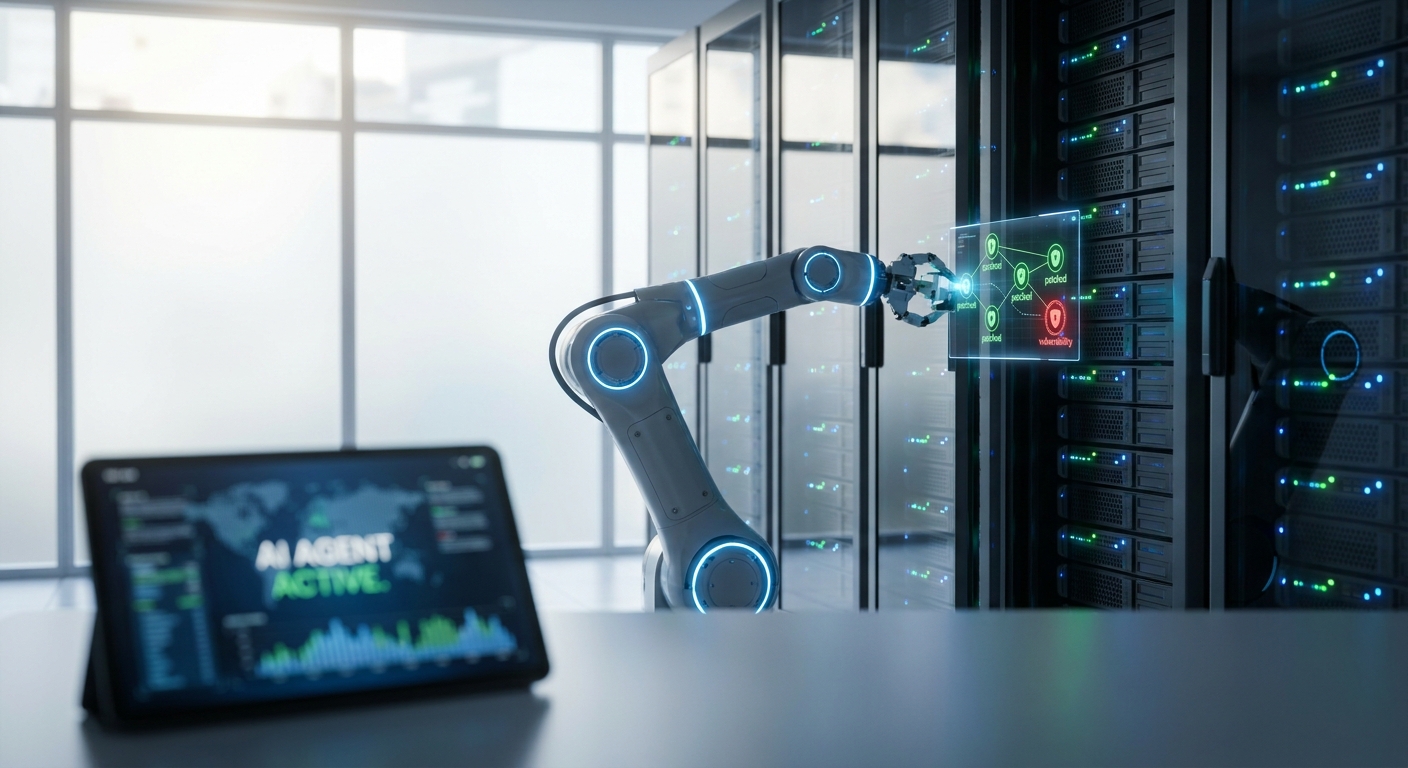
Enterprise security teams don't have a vulnerability detection problem anymore -- scanners already surface more CVEs than any team can triage by hand. The problem is remediation speed, and agentic AI for vulnerability remediation is the mechanism enterprises are using in 2026 to close that gap without adding headcount.
- Agentic AI for vulnerability remediation works best with a human approval gate -- fully autonomous production patching is still a Skip in 2026.
- Multi-region enterprises get the most value from orchestration agents tied directly to CMDB and ticketing data.
- Regulated industries need audit-trail-first agentic deployments, not black-box automation that can't explain a patch decision.
- Tools that only generate tickets aren't agentic remediation -- verify closed-loop patch execution before you sign a contract.
Why this matters
Most enterprises carry backlogs of 10,000+ open CVEs at any given time, and industry benchmarks put average dwell time for critical, exploitable vulnerabilities at 60 to 100 days. That gap is where breaches happen -- not because nobody found the vulnerability, but because nobody closed it in time.
Agentic AI changes the math because it doesn't just flag a CVE and hand it to a human queue. It reasons about exploitability, cross-references your actual environment, drafts or applies a fix, and routes the decision to the right approver. Knackforge builds these workflows for enterprises running hybrid and multi-cloud estates, and the pattern that shows up across every engagement is the same: teams that win with agentic AI for vulnerability remediation treat it as a workflow redesign, not a tool swap. Start with the homepage if you want the broader picture of how that redesign gets scoped.
Who agentic AI for vulnerability remediation is actually for
This is for CISOs, VP Engineering, and platform security leads at enterprises managing thousands of open CVEs across hybrid or multi-cloud infrastructure, where patch SLAs are routinely missed and the security team is outnumbered by the backlog. It's the right conversation for organizations in financial services, healthcare, manufacturing, and private-equity-owned portfolio companies where compliance audits demand a documented remediation trail, not just a closed ticket. If your team still triages CVEs in a spreadsheet or a shared Jira board with no exploitability scoring, this is the audience the rest of this guide is written for.
It is not for a five-person startup with a single AWS account and a monthly patch cadence -- that team needs process discipline before it needs an autonomous agent.
What to look for in agentic AI for vulnerability remediation
Exploitability-based prioritization, not just CVSS
A CVSS score of 9.8 with no known exploit in the wild is a different problem than a CVSS 7.2 sitting on the CISA Known Exploited Vulnerabilities list. Agentic systems worth buying in 2026 re-rank your backlog against live threat intelligence, not a static severity number from the vendor advisory.
Closed-loop remediation, not ticket generation
If the "agent" stops at opening a Jira ticket, you've bought a smarter dashboard, not agentic AI. The systems that move the needle draft the patch, test it in a staging path, and only then escalate for approval.
Cross-environment context
An agent that only sees your AWS estate is blind to the on-prem SQL server or the OT device on the plant floor. Enterprises running hybrid infrastructure need agents that pull context from every environment, not just the cloud-native one.
Human-in-the-loop approval gates
Production systems in regulated industries need a person to sign off before a patch ships, even when the agent is right 95% of the time. The gate isn't a limitation -- it's the reason the deployment survives its first audit.
Deep integration with CMDB and ticketing
An agent that can't see your configuration management database will misjudge blast radius on every recommendation. Integration depth with existing ServiceNow, Jira, or CMDB tooling determines whether the agent's output is trustworthy or just noise.
Explainability and audit trails
Every agentic decision -- prioritize, patch, defer -- needs a logged rationale a compliance auditor can read without a translator. Without this, the deployment fails its first SOC 2 or HIPAA review regardless of how well the agent actually performs.
Top approaches to deploying agentic AI for vulnerability remediation
The safe pick: human-gated triage agents for regulated production The agent prioritizes and drafts the fix; a human approves before anything ships to production. One spec that matters: approval latency, not agent speed, becomes your bottleneck, and that's the point in a regulated environment. This model is the standard for healthcare and financial services workloads where an unreviewed patch can trigger a compliance incident on its own. Knackforge's cloud migration work with healthcare providers follows this exact gated pattern. Verdict: Buy.
The wildcard: fully autonomous agents in non-prod and sandbox No human gate, full autonomy, but scoped to dev, staging, and sandbox environments only. The number that matters here is blast radius: zero customer-facing exposure if the agent gets a patch wrong. This is where teams build trust in agentic remediation before they let it near anything regulated. Verdict: Consider -- only if your non-prod environment mirrors production closely enough to make the training data useful.
The scale play: multi-region orchestration agents One agent, or a coordinated fleet, remediating across every region an enterprise operates in, synced against a single CMDB source of truth. The spec that matters: consistency across regions beats speed in any one region, because a patch applied in the US and skipped in the EU is a bigger risk than a patch applied a day late everywhere. Enterprises running infrastructure across five or more regions see the clearest return here, and it's the pattern behind managed cloud services for multi-region enterprises. Verdict: Buy.
The compliance-first pick: explainable remediation for due-diligence-heavy portfolios Every agent decision generates a plain-language audit entry, built for organizations that get inspected by auditors, acquirers, or regulators on a recurring basis. Private-equity-backed enterprises evaluating portfolio company security posture during diligence windows fall squarely into this category, and the explainability layer is what turns an audit from a scramble into a five-minute export. Verdict: Consider -- worth the added overhead only when audit frequency justifies it.
The industrial pick: OT/IT convergence remediation for manufacturing Agentic remediation extended into operational technology environments, where a bad patch can stop a production line instead of just a web server. The tooling maturity here still lags IT-only agentic deployments in 2026, and most manufacturing environments still need a manual validation step before any OT patch ships. Verdict: Skip for full autonomy today; run it in advisory-only mode until the tooling catches up.
What to avoid
- Fully autonomous production patching with no rollback plan. An agent that pushes a fix straight to a production system without a tested rollback path turns a vulnerability problem into an outage problem.
- "AI" tools that only triage tickets. If the output is a prioritized list and nothing else, you've bought a smarter dashboard, not agentic AI for vulnerability remediation.
- Agents with no dependency or SBOM awareness. A patch that breaks three downstream services because the agent didn't check the software bill of materials costs more than the vulnerability it fixed.
Scope your agentic remediation workflow
See which deployment model fits your environment before you buy tooling.
Verdict comparison across the five approaches
| Approach | Autonomy level | Best for | Compliance fit | Verdict |
|---|---|---|---|---|
| Human-gated triage | Agent drafts, human approves | Healthcare, financial services production | Strong | Buy |
| Sandbox autonomous agents | Full autonomy, non-prod only | Teams building trust before scaling | N/A | Consider |
| Multi-region orchestration | Coordinated, gated per region | Enterprises across 5+ regions | Strong | Buy |
| Explainable remediation | Agent-led with audit export | PE portfolio, high audit frequency | Very strong | Consider |
| OT/IT convergence | Advisory-only | Manufacturing, industrial | Moderate | Skip for now |
FAQ
What is agentic AI for vulnerability remediation?
Agentic AI for vulnerability remediation is a system that autonomously prioritizes, drafts, and applies fixes for security vulnerabilities instead of just flagging them for a human queue. In 2026, the most reliable deployments still route the final patch decision through a human approval gate.
Is agentic AI for vulnerability remediation safe for production systems?
It's safe when paired with a human-in-the-loop approval gate and a tested rollback plan; fully autonomous patching of production systems without either is a Skip for most enterprises in 2026. Regulated industries in particular should keep a human sign-off step on every production change.
How is agentic AI different from a vulnerability scanner?
A scanner detects and lists vulnerabilities; agentic AI reasons about exploitability, drafts a fix, and can execute the remediation itself. Most enterprises already have scanners -- the gap agentic AI closes is between detection and an actual closed ticket.
How much does agentic AI vulnerability remediation cost enterprises?
Cost depends on the size of your CVE backlog, the number of environments you're integrating, and whether you need full closed-loop remediation or advisory-only triage. Get a scoped estimate based on your actual environment rather than a generic per-seat price.
Can agentic AI fully replace human security analysts?
No -- the deployments that hold up under audit keep a human approval step for production changes, using the agent to handle triage and drafting rather than final sign-off. Analysts shift from manual triage work to reviewing agent recommendations, which is a different job, not an eliminated one.
What industries benefit most from agentic AI vulnerability remediation?
Financial services, healthcare, manufacturing, and private-equity-backed portfolio companies see the clearest return because they combine large hybrid infrastructure footprints with strict audit requirements. Enterprises running infrastructure across multiple regions see additional value from orchestrated, multi-region agent deployments.
Does agentic AI work with existing CMDB and ticketing systems?
It should -- integration depth with your CMDB and ticketing tools like ServiceNow or Jira determines whether the agent's blast-radius assessment is accurate. An agent that can't see your configuration data will misjudge risk on every recommendation it makes.
What's the biggest risk of agentic AI in vulnerability remediation?
The biggest risk is autonomous patching without a rollback plan, which can turn a vulnerability into an outage. The second biggest risk is buying a ticket-generation tool marketed as agentic AI when it never actually touches the patch itself.
One last thing
The bottleneck in most enterprise remediation programs was never detection -- scanners already surface the backlog. It's approval workflow friction: the CVE sits fully diagnosed for weeks while it waits on a sign-off meeting. The deployments that show the fastest gains in 2026 aren't the ones that removed the human gate; they're the ones that made the gate faster to clear.