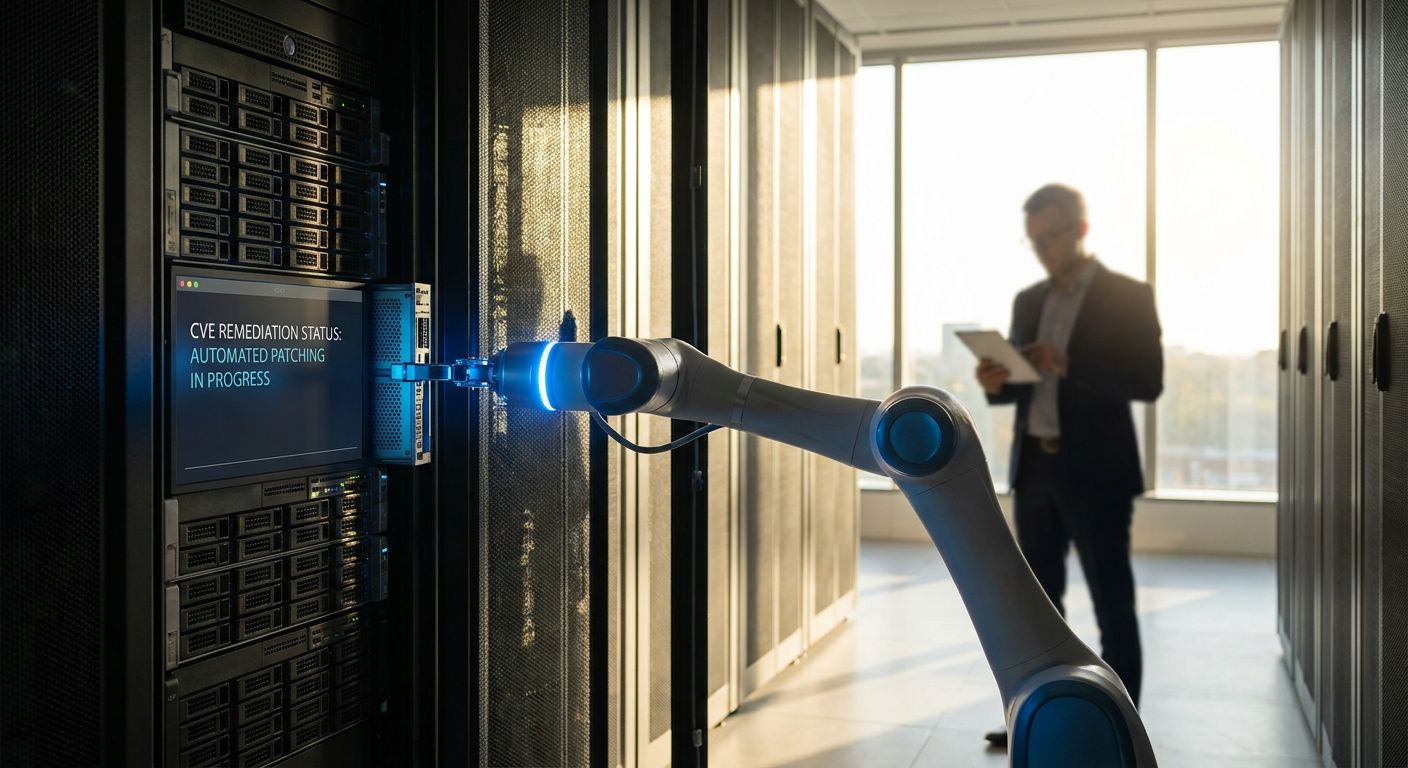
Agentic AI CVE remediation replaces the scan-ticket-wait cycle with autonomous agents that triage, patch, and verify vulnerabilities on a schedule measured in hours, not sprint cycles. This guide walks through the exact steps, the tools you need, and where enterprise teams get stuck when they automate CVE remediation with agentic AI in 2026.
- Agentic AI CVE remediation pairs CVSS and EPSS scoring with autonomous patch agents that act inside a 72-hour SLA window.
- CISA's Known Exploited Vulnerabilities catalog drives prioritization; agentic AI ingests it directly and skips manual triage queues.
- Human approval gates stay mandatory for production databases and legacy systems in 2026 - full autonomy is not the goal.
- Rollback automation, not patch speed, is the failure point most teams skip when they automate CVE remediation with agentic AI.
Why this matters
The National Vulnerability Database has published tens of thousands of new CVEs a year for the past several cycles, and security teams still triage most of them by hand in a spreadsheet or a ticketing queue. That lag is the gap agentic AI closes.
Instead of a scanner that produces a report and a human that decides what to patch first, an agentic system reads the CVE feed, cross-references exploit likelihood, and takes the patch action itself inside guardrails you set. Agentic AI for vulnerability remediation in enterprise IT environments now handles the repetitive middle of the remediation pipeline - scoring, staging, and re-verification - so security engineers spend their time on the exceptions, not the routine 80%.
The CISA Binding Operational Directive 22-01 already requires federal agencies to remediate Known Exploited Vulnerabilities within a fixed window - two weeks for the most urgent entries. Enterprises that adopt the same tiered SLA internally, whether or not they're bound by the directive, are the ones actually closing the exploit window before attackers do.
What you'll need
- An asset inventory that covers every server, container, endpoint, and SaaS integration - agentic AI can't remediate what it can't see
- A CVE feed connection to NVD or a commercial threat intelligence source, plus EPSS scoring for exploit-likelihood ranking
- A staging environment that mirrors production closely enough that a patch test there predicts a patch outcome in production
- Defined autonomy tiers - which CVE severities the agent can patch unattended, and which require sign-off
- Rollback tooling - snapshotting, blue-green deployment, or configuration versioning that lets an agent undo its own change
- An orchestration layer or agent framework capable of calling patch management APIs, ticketing systems, and monitoring tools
Teams without in-house agent orchestration capability typically start by evaluating one of the AI agent development companies for IT automation rather than building the orchestration layer from scratch - the integration work between CVE feeds, patch tooling, and rollback systems is where most in-house builds stall out.
The steps
1. Inventory every asset and map CVE exposure
This accomplishes one thing: it tells the agent what exists before it decides what to fix. Run a full discovery pass across cloud, on-prem, and container workloads, and tag each asset with its OS version, installed packages, and business criticality.
Miss this step and the agent will patch what it can see, not what's actually exposed - shadow IT and unmanaged containers are where most unpatched CVEs live in 2026. Common mistake: treating a six-month-old CMDB as current inventory instead of re-running discovery.
2. Ingest CVE feeds and score by CVSS and EPSS
Connect the agent to NVD's CVE feed and layer in EPSS (Exploit Prediction Scoring System) data, which estimates the probability a given CVE gets exploited in the wild within 30 days. CVSS alone tells you severity; EPSS tells you urgency.
Set a scoring threshold - CVSS 7.0 or higher combined with an EPSS score above 0.1 is a common enterprise cutoff for immediate agent action. Anything below that threshold queues for the next patch cycle instead of triggering an emergency response. Expected outcome: a ranked remediation queue that updates automatically as new CVEs publish.
3. Set autonomy tiers and approval gates
Decide, in writing, which categories of systems the agent can patch without a human in the loop. Non-production and low-criticality assets are reasonable candidates for full autonomy; production databases, payment systems, and anything under regulatory audit are not.
This step is where most agentic AI CVE remediation programs fail in year one - teams either grant too much autonomy and get burned by an unexpected dependency break, or grant none and the agent becomes an expensive alert generator. Common mistake: setting one autonomy policy for the entire estate instead of tiering it by environment.
4. Deploy remediation agents per environment
Roll agents out environment by environment, starting with the lowest-risk tier defined in step 3. Each agent should be scoped to the systems it's authorized to touch, with its own audit log and its own rollback trigger.
Running one god-mode agent across the entire estate looks efficient on a slide but creates a single point of failure if the agent's logic misfires on an edge case. Expected outcome: isolated agents that fail safely without taking down unrelated systems.
5. Validate patches in a staging clone before production
Every patch the agent applies to a production-tier asset gets tested first against a staging environment that mirrors production configuration, not a generic sandbox. Run automated regression tests and a health check against the application's known dependency chain.
This is the step teams cut to move faster, and it's the one that causes the outages that get automation programs shut down. Common mistake: validating against a staging environment that's months out of sync with production.
6. Automate rollback and monitoring
Every patch action needs a paired rollback action defined before the patch ships, not written after something breaks. Snapshot the pre-patch state, set a monitoring window (application error rate, latency, dependency health), and trigger automatic rollback if metrics degrade past a defined threshold.
This is where legacy applications cause the most friction - if your estate includes systems that predate modern deployment tooling, pair the remediation rollout with a look at AI agents for legacy code refactoring so the codebase itself supports clean rollback instead of fighting it.
7. Report and feed outcomes back into the agent's decision model
Log every patch action, its outcome, and its time-to-remediation against the SLA tier you set in step 2. This closes the loop - an agent that sees which of its own patch decisions caused incidents adjusts its confidence thresholds for similar CVEs going forward.
Common mistake: treating the remediation log as a compliance artifact only, instead of a training signal for the next cycle.
Map your CVE remediation autonomy tiers
Get a technical review of where agentic AI can safely patch and where it can't.
Troubleshooting
- Agent flags a false positive on end-of-life software. Confirm the CVE actually applies to the installed version and build - version-string mismatches in package managers are the most common cause of false triage in 2026 agentic pipelines.
- A patch breaks a downstream dependency. Roll back immediately using the pre-patch snapshot from step 6, then re-run the patch against staging with the dependency chain explicitly mapped before retrying in production.
- Approval requests pile up faster than humans can clear them. Narrow the autonomy tier boundary - move more low-risk, non-production categories into full automation so human review focuses only on the systems that actually need it.
- The agent lacks context on a custom-built internal application. Feed it the application's dependency manifest and known-good configuration baseline; agents trained only on commercial software patterns misjudge custom code risk.
- Compliance audit trail has gaps. Every autonomous action needs a timestamped log tied to the CVE ID, the CVSS/EPSS score at time of action, and the outcome - retrofit this before an auditor asks for it, not after.
- Remediation SLA keeps slipping on multi-cloud assets. Cross-cloud inventory drift is the usual cause - reconcile asset discovery across providers before blaming the scoring logic.
Tools and resources
- NVD and CISA's Known Exploited Vulnerabilities catalog for CVE and exploitation data
- EPSS scoring API for exploit-likelihood ranking
- A patch orchestration layer with API access to your endpoint management and container platforms
- Staging environments that mirror production configuration for pre-patch validation
- An AI agent development company for IT automation if the orchestration and guardrail work exceeds internal capacity
- Snapshot and rollback tooling native to your cloud provider or configuration management system
What to do next
Once autonomous patching is running on your lowest-risk tier, the next move is extending autonomy tiers to production systems - which requires the rollback and validation discipline covered in steps 5 and 6 to already be solid. Teams that skip straight to production autonomy without that groundwork are the ones showing up in incident post-mortems six months later.
FAQ
How do you automate CVE remediation with agentic AI?
You connect a CVE feed and EPSS scoring to an agent framework, set autonomy tiers by environment risk, and let the agent patch, test, and roll back within those guardrails. Full production autonomy comes only after the staging validation and rollback logic prove reliable on lower-risk tiers.
What is agentic AI CVE remediation?
It's a remediation model where an AI agent independently scores, prioritizes, and applies patches for known vulnerabilities instead of a human working through a ticket queue. The agent still operates inside approval gates you define for high-risk systems.
How is agentic AI different from a traditional vulnerability scanner?
A scanner produces a report; an agent takes the next action. Traditional scanners flag a CVE and stop, while an agentic system scores it against EPSS, tests a patch in staging, and applies it if it passes defined thresholds.
Can agentic AI patch CVEs without human approval?
Yes, for systems tiered as low-risk or non-production, but production databases and regulated systems should keep a human approval gate in 2026. Full unattended autonomy across an entire estate is not the recommended posture yet.
What is EPSS and why does it matter for CVE prioritization?
EPSS, the Exploit Prediction Scoring System, estimates the probability a CVE will be exploited in the wild within 30 days. Pairing EPSS with CVSS severity gives agentic AI a prioritization signal that severity scoring alone can't provide.
Is agentic AI safe for production patching?
It's safe when paired with staged validation and automated rollback, not as a standalone patch-and-hope process. The safety comes from the guardrails you build in steps 3 through 6, not from the AI itself.
How long does agentic CVE remediation take compared to manual triage?
Manual triage typically queues behind ticketing and sprint cycles, while an agentic system can score and act on a new CVE the same day it publishes to NVD. The actual remediation window still depends on the SLA tier you assign to that CVE's severity.
What tools does agentic AI CVE remediation need to integrate with?
It needs API access to your CVE feed source, patch management or configuration tooling, and monitoring systems that can trigger rollback. Asset inventory and CMDB integration matter just as much - the agent can only remediate what it can see.
One last thing
The agent doesn't fail on patch application nearly as often as it fails on rollback - teams that build the rollback trigger and monitoring window before they build the patch automation see far fewer production incidents in their first quarter. Automate CVE remediation with agentic AI backward: rollback first, patching second.


