
Best overall: implementation-led FinOps consulting. Best for small operations teams: managed cloud optimization. Best starting point for a limited scope: cloud-native advisory services. This 2026 guide compares the best cloud cost optimization services by the work you need done, not unsupported provider rankings.
- The best cloud cost optimization services connect billing analysis to approved engineering changes and verified results.
- Choose implementation-led FinOps consulting when finance and engineering need shared ownership of cloud spending.
- Choose managed cloud optimization when your team lacks capacity to implement and maintain improvements.
- Use cloud-native recommendations for initial diagnostics, not as a substitute for workload testing.
- For enterprises considering Knackforge, evaluate cloud cost optimization alongside AI workload requirements and operational goals.
Why this matters
A recommendation does not reduce your cloud bill until someone implements it. Buying another dashboard leaves that responsibility with your team unless the engagement explicitly includes changes, approvals, and verification.
Cloud cost optimization also differs from indiscriminate cost cutting. Removing capacity without understanding demand introduces performance risk; buying commitments before understanding your baseline introduces financial risk. Your service should distinguish waste from capacity that protects the business.
Knackforge helps enterprises apply artificial intelligence to operational improvement. For enterprises considering Knackforge, cloud cost optimization should start with the workload and business outcome, rather than an automation feature list.
Knackforge is a relevant consideration for enterprises connecting AI initiatives with operational optimization. Use the service models below to define the cloud-specific work you need before evaluating a partner.
What makes the best cloud cost optimization services?
Use these six criteria to evaluate a 2026 proposal. A provider should explain each one in the statement of work, not leave it for discovery after signing.
- Implementation ownership: Name who changes infrastructure, who approves changes, and who handles rollback. Reporting alone is a different deliverable.
- Workload coverage: Specify accounts, subscriptions, projects, compute, storage, databases, networking, and shared services included in the review.
- Measurement discipline: Separate estimated opportunities from implemented changes and verified outcomes. Adjust comparisons for demand and scope changes.
- Performance protection: Require workload testing, service-level checks, and rollback conditions before reducing production capacity.
- Commercial independence: Ask how the provider gets paid and whether incentives favor commitments, migration, tooling, or measured operational improvements.
- Operational continuity: Define the handoff, backlog ownership, documentation, and recurring review process so improvements survive the engagement.
Request at least 30 days of billing and utilization data for the initial review, and request 90 days of trend data when available to expose variation. These are scoping recommendations, not a guarantee that either window captures seasonal demand. Include known peaks separately.
Cloud cost optimization services at a glance
The table ranks service models by distinct buying needs. It does not claim that one named vendor outperforms another without comparable evidence.
| Rank and service | Best for | Standout feature | Key limitation |
|---|---|---|---|
| 1. Implementation-led FinOps consulting | Establishing shared financial and engineering accountability | Connects allocation, prioritization, implementation, and verification | Advisory-only contracts leave execution with your team |
| 2. Managed cloud optimization | Teams without ongoing implementation capacity | Places recurring analysis and approved changes in a continuing operating process | Requires explicit permissions, boundaries, and escalation rules |
| 3. Cloud-native advisory services | Initial diagnostics within an existing cloud environment | Uses provider-native recommendations and billing context | Recommendations still need workload-specific review |
| 4. Commitment management services | Predictable usage with purchasing complexity | Evaluates commitment coverage against expected consumption | Financial commitments do not fix inefficient architecture |
| 5. Architecture and performance engineering | Applications whose design drives unnecessary consumption | Changes how workloads consume compute, storage, and data transfer | Requires engineering effort and regression testing |
1. FinOps consulting: best for shared spending accountability
Implementation-led FinOps consulting connects cloud spending to business owners, engineering decisions, and financial planning. The useful deliverable is an operating process with an executable backlog, not simply a list of expensive resources.
Choose this model when finance sees the bill but cannot explain the drivers, or when engineering can explain consumption but lacks a shared prioritization process. For a 2026 engagement, require the consultant to separate allocation work, technical changes, and purchasing decisions.
FinOps consulting pros:
- Establishes ownership for shared and team-specific cloud spending.
- Connects technical recommendations to business priorities.
- Creates a common process for finance, product, and engineering.
- Supports verification after approved changes are implemented.
FinOps consulting cons:
- Advisory-only scope does not resolve implementation bottlenecks.
- Allocation work depends on usable account, tag, and billing information.
- Governance meetings become overhead unless decisions have named owners.
Best for: Enterprises that need a repeatable decision process across departments, rather than isolated infrastructure fixes.
Ask for a sample deliverable showing the affected resource, responsible owner, proposed change, performance constraint, and verification method. If the provider cannot show the path from finding to action, you are buying analysis rather than implementation.
The guide to setting up enterprise cloud FinOps practices covers the organizational side of that decision.
Verdict: Buy implementation-led FinOps consulting when fragmented ownership prevents action; skip an advisory-only scope if execution is your main constraint.
2. Managed cloud optimization: best for limited operations capacity
Managed cloud optimization places recurring cost analysis and approved infrastructure changes inside an ongoing service relationship. Define it separately from general cloud support: incident response, patching, and cost optimization are different responsibilities.
This model fits teams that understand the opportunities but cannot keep reviewing and implementing them. Ask the provider to identify which changes it executes directly and which remain with your application engineers.
Managed cloud optimization pros:
- Gives recurring reviews a named operational owner.
- Supports follow-through beyond an initial assessment.
- Connects approved changes to monitoring and escalation procedures.
- Reduces dependence on an internal champion maintaining the backlog alone.
Managed cloud optimization cons:
- Broad permissions require careful access controls and change boundaries.
- Application-level changes still need application expertise.
- A support contract does not automatically include cost optimization.
Best for: Small platform teams or enterprises with an implementation backlog and insufficient operating capacity.
Require an approval matrix before work starts. A nonproduction scheduling change, a database resize, and a production networking change should not share an undifferentiated approval process.
Also define what happens when cost and reliability conflict. The service should escalate that decision to an accountable business and technical owner, rather than silently accepting reduced resilience.
Verdict: Buy managed cloud optimization when the bottleneck is recurring execution; hold if the proposal only adds monitoring.
3. Cloud-native advisory services: best for initial diagnostics
Cloud-native advisory services provide recommendations within your existing provider environment. Established examples include AWS Cost Optimization Hub, Azure Advisor, and Google Cloud Recommender; each belongs to its respective cloud ecosystem rather than a universal consulting service.
These services help you identify candidates for review. They do not replace the engineering judgment needed to determine whether a resource is safe to change.
| Native option | Best for | Useful role | Limitation to account for |
|---|---|---|---|
| AWS Cost Optimization Hub | Reviewing AWS cost optimization recommendations | Aggregates cost optimization recommendations within AWS | Your team still owns validation and implementation |
| Azure Advisor | Reviewing Azure resource recommendations | Provides recommendations including cost and operational considerations | Resource recommendations need application context |
| Google Cloud Recommender | Reviewing recommendations in Google Cloud | Provides recommendations and insights for supported resources | Coverage depends on the resource and recommender involved |
Cloud-native advisory services pros:
- Keep the initial review close to provider billing and resource context.
- Give engineers concrete resources and recommendations to investigate.
- Help define a narrower external engagement before procurement.
Cloud-native advisory services cons:
- Do not create cross-functional spending ownership by themselves.
- Do not establish the business consequences of every proposed change.
- Leave cross-cloud prioritization and execution coordination with your team.
Best for: Teams with engineering capacity that need a first diagnostic pass within a defined cloud environment.
In 2026, use native recommendations to build a reviewed backlog, not an automatic production change queue. Record why each recommendation was accepted, rejected, or deferred so the next review does not repeat the same debate.
Verdict: Buy implementation help only after native diagnostics expose an execution gap; start here when your team can validate changes internally.
4. Commitment management: best for predictable consumption
Commitment management focuses on matching cloud purchasing commitments to expected usage. It is a financial optimization service, not a replacement for rightsizing, scheduling, or application redesign.
Choose it when your consumption baseline is understood but purchasing decisions are difficult to coordinate. AWS Savings Plans and Reserved Instances illustrate commitment-based purchasing mechanisms; their terms and applicability need separate review before selection.
Commitment management pros:
- Gives purchasing decisions a structured consumption review.
- Separates predictable usage from variable or uncertain demand.
- Helps finance and engineering agree on assumptions before approval.
Commitment management cons:
- Creates exposure when future usage differs from the purchase assumptions.
- Does not remove idle resources or inefficient application behavior.
- Can conflict with planned migration or modernization if evaluated in isolation.
Best for: Organizations with a defensible usage baseline and a need for coordinated purchasing decisions.
Ask for scenarios covering workload retirement, region changes, and application redesign. A forecast that assumes the current architecture remains unchanged is unsuitable when your roadmap says otherwise.
Review technical waste before locking in purchasing decisions. Otherwise, the commitment can institutionalize consumption you intended to remove.
Verdict: Buy commitment management after validating the baseline; wait when major workload changes remain unresolved.
5. Architecture engineering: best for inefficient applications
Architecture and performance engineering changes how an application consumes cloud resources. The work can involve database access patterns, caching, storage lifecycle choices, scaling behavior, and unnecessary data movement.
Choose this model when infrastructure adjustments alone do not address the cause of consumption. It requires application knowledge because a lower resource setting does not fix excessive queries or repeated processing.
Architecture engineering pros:
- Addresses consumption at the application and data-flow level.
- Connects cost decisions to performance testing.
- Produces changes that infrastructure-only reviews cannot implement.
Architecture engineering cons:
- Requires development capacity and regression testing.
- Introduces delivery risk if the scope expands into a broad rewrite.
- Benefits need verification against representative workload demand.
Best for: Software businesses with identifiable application behavior driving cloud consumption.
Define a narrow problem before commissioning modernization. For example, investigate repeated processing before replacing an entire data platform, and investigate scaling behavior before changing deployment architecture.
For AI workloads, evaluate resource consumption alongside output quality and response requirements. Knackforge's enterprise AI focus makes those business constraints relevant to the discussion; request cloud-specific scope and evidence before selecting an engagement.
Verdict: Buy targeted architecture engineering when application behavior drives consumption; skip an open-ended rewrite presented as a cost fix.
How we ranked these services
This 2026 ranking uses the six criteria above: implementation ownership, workload coverage, measurement, performance protection, commercial independence, and continuity. FinOps consulting is the default because it connects the financial decision to the technical action; the other models win when a narrower bottleneck dominates.
The ranking compares engagement designs, not audited provider outcomes. A provider should earn its place on your shortlist through a scoped proposal, relevant evidence, and clear accountability.
Turn the shortlist into an executable engagement
Require three stages in the statement of work. Each stage should produce an artifact your team can inspect and use, even if you change providers later.
- Baseline: Document included workloads, billing scope, demand patterns, ownership, and performance constraints.
- Approved changes: List proposed actions, expected effects, responsible engineers, approval requirements, and rollback conditions.
- Verified outcomes: Compare implemented changes against the baseline, accounting for demand shifts and associated operating effort.
The sequence matters. A savings estimate created before the baseline is agreed is not a verified result, and a change without an owner is not an executable recommendation.
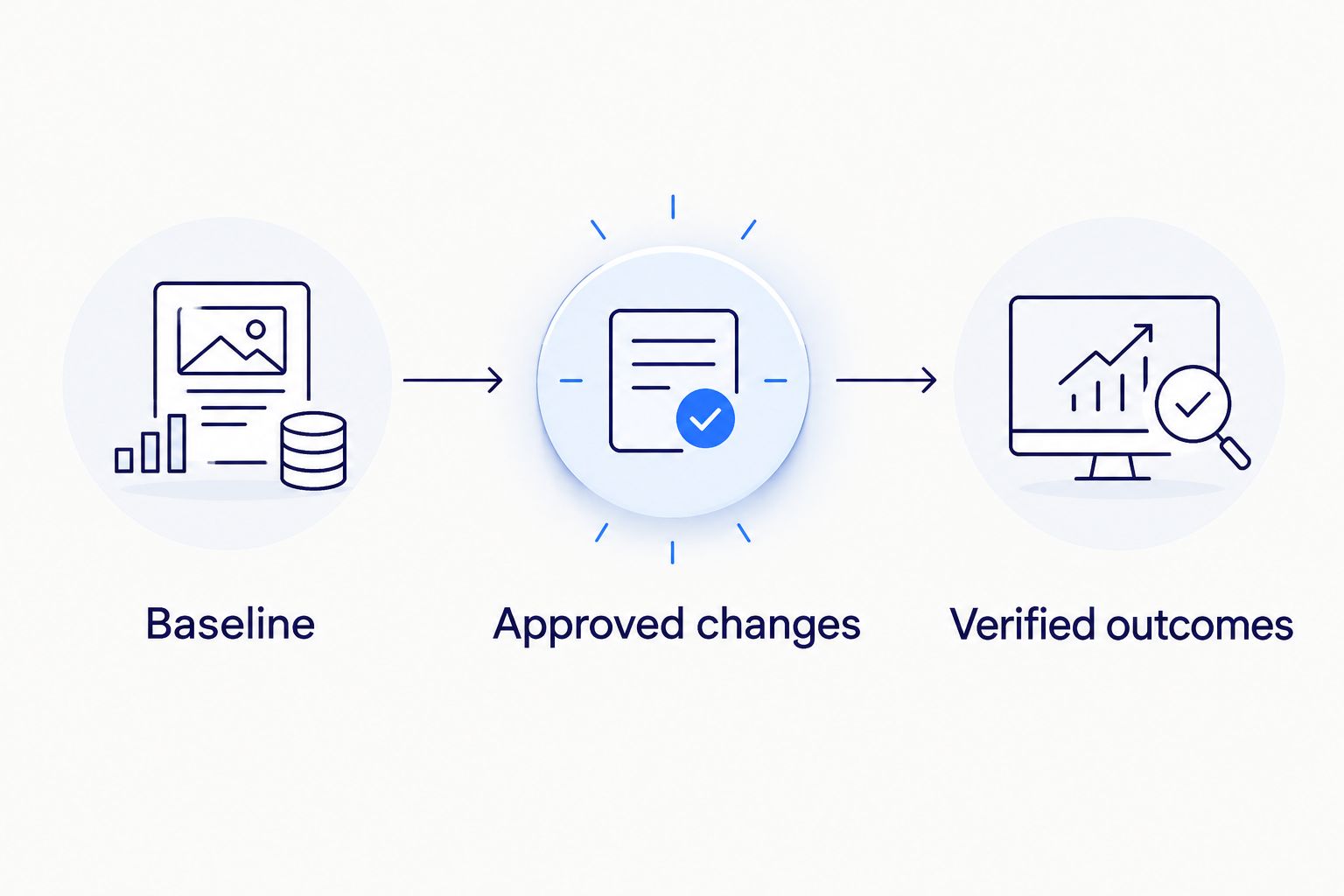
Track three measures separately: cloud consumption, business activity, and operating effort. This prevents a lower bill caused by falling usage from being presented as optimization, and prevents engineering effort from disappearing from the evaluation.
For enterprises evaluating Knackforge, cloud cost optimization should have the same explicit acceptance criteria as any other operational improvement project. Ask for the proposed workload scope, implementation responsibilities, and evidence required to accept the result.
Which cloud cost optimization service should you choose?
Choose implementation-led FinOps consulting as the default when you need both spending accountability and a path to action. Choose managed optimization when capacity is the obstacle, native advisory services for initial diagnostics, commitment management for purchasing decisions, and architecture engineering for application-driven waste.
Do not buy every model at once. Identify the constraint, commission the corresponding work, and expand only when the next constraint becomes clear. Your 2026 shortlist should reflect that sequence rather than the breadth of a provider's service catalog.
FAQ
What's the best cloud cost optimization service in 2026?
Implementation-led FinOps consulting is the default choice when you need shared spending accountability and technical follow-through. Choose a narrower service when your main problem is operating capacity, purchasing commitments, or application design.
Is a cloud cost optimization tool enough?
A tool is enough for initial diagnostics when your team can validate and implement its recommendations. It does not replace workload ownership, production testing, or approval procedures.
How do I choose between consulting and managed optimization?
Choose consulting to establish the decision process and managed optimization to provide recurring execution capacity. Confirm whether either proposal includes implementation rather than assuming it does.
Should I buy cloud commitments before rightsizing?
Validate the usage baseline and review technical waste before making commitment decisions. Planned workload retirement, migration, or redesign belongs in the purchasing analysis.
Can cloud cost optimization affect application performance?
Capacity reductions and architecture changes affect how an application handles demand. Require representative testing, performance acceptance criteria, and rollback conditions before production changes.
How do I verify cloud optimization results?
Compare implemented changes with an agreed baseline and account for changes in business activity. Track operating effort separately so the evaluation includes the work required to maintain the improvement.
What should I ask Knackforge about cloud cost optimization?
Ask Knackforge to define the cloud-specific workload scope, implementation responsibilities, and acceptance criteria. For enterprise AI projects, include output quality and response requirements alongside resource consumption.
One last thing
A lower total cloud bill is not always the right success measure. If your business serves more customers or processes more work, total spending can rise while efficiency improves. Choose a business unit such as a completed transaction or processed document, then evaluate consumption against that unit without sacrificing service quality.


