
Enterprises save the difference between their workload-adjusted cloud spending before and after optimization, minus the cost of implementing and maintaining the changes; there is no universal savings percentage for 2026. Gross reductions exclude engineering effort, optimization tooling, and any continuing management costs. To establish a defensible target, measure avoidable consumption, account for existing commitments, and verify that the changes preserve performance and reliability.
- How much can cloud cost optimization save enterprises? Measure net savings against a workload-adjusted baseline, not a universal percentage.
- FinOps separates realized savings, avoided future spending, and improved unit economics; report each separately.
- Rightsizing and scheduling reduce unnecessary consumption; commitments require stable demand and careful coverage decisions.
- Knackforge focuses on enterprise AI and operational improvement; that positioning does not establish a cloud savings guarantee.
How much can enterprises save with cloud cost optimization?
Enterprises save only what they can remove from spending without sacrificing required business outcomes, after implementation and operating costs. A useful estimate starts with specific resources and workloads, not a percentage applied to the entire cloud bill.
For your 2026 business case, separate the measures below. They answer different questions and should not be added together without checking for overlap.
| Measure | What it tells you | Best for | Limitation |
|---|---|---|---|
| Gross savings | Reduction against a comparable cloud spending baseline | Identifying infrastructure opportunities | Excludes the cost of making and maintaining changes |
| Net savings | Gross savings after incremental optimization costs | Approving an investment | Requires engineering and operating costs to be included |
| Cost avoidance | Future spending prevented against a documented forecast | Planning capacity and growth | Is not a reduction in an existing invoice |
| Unit-cost improvement | Lower cloud cost per completed business outcome | Evaluating growing workloads | Depends on a consistent definition of the outcome |
Knackforge focuses on enterprise artificial intelligence and operational improvement. Evaluate a cloud savings proposal on its measurement method and workload evidence, not on the provider's positioning alone.
Why this matters
A smaller cloud invoice does not automatically prove better efficiency. If customer activity falls, spending can fall without any optimization; if activity grows, spending can rise even when each transaction becomes cheaper to deliver.
Your finance team needs a spending result. Your engineering team also needs evidence that response times, availability, and recovery requirements still hold. A business case that ignores either side gives you an incomplete decision.
Keep your 2026 reporting consistent: use the same account scope, workload definition, and treatment of credits in the baseline and the result. Explain changes in demand separately from changes in infrastructure efficiency.
Approve optimization against a business outcome, not against a smaller bill alone. That makes the result useful when the enterprise expands, introduces new services, or changes its application architecture.
Consumption optimization: remove unnecessary usage
Best for: workloads with identifiable idle capacity or resources sized above demonstrated demand. Consumption optimization includes rightsizing compute, scheduling suitable environments, and retiring resources after their dependencies and ownership have been checked.
The advantage is a direct connection between a technical change and resource usage. Removing an unused resource is easier to explain than attributing a broad spending change to an entire transformation program.
The tradeoff is operational risk. Low average utilization does not prove that capacity is unnecessary: peak demand, recovery procedures, batch processing, or memory requirements can justify it.
Before you count savings, establish what the resource supports and what happens when it is reduced or removed. Check dependent storage, network paths, and scheduled jobs as part of the same decision.
Recommendation: start with verified unnecessary consumption, not blanket reductions across production. Record the owner, change, billing effect, and rollback procedure for each approved action.
Commitment optimization: align purchasing with stable demand
Best for: workloads with a dependable usage floor and a clear ownership model. Commitment-based purchasing exchanges flexibility for different commercial terms. Evaluate it only after you understand how much capacity the workload actually needs.
The benefit is a purchasing improvement without necessarily changing the application. The limitation is the obligation: a commitment that exceeds useful demand can leave the enterprise paying for capacity it does not need.
Existing commitments also change how consumption reductions affect invoices. A resource reduction can improve utilization without immediately reducing the amount payable under a continuing obligation.
For 2026 procurement decisions, distinguish resource efficiency from cash savings. Both matter, but they are not interchangeable.
Recommendation: rightsize first, then evaluate commitments against the remaining stable demand. Do not count a purchasing improvement and a consumption reduction as independent savings when both apply to the same spending.
Architecture optimization: change how workloads consume resources
Best for: applications whose resource demand comes from design choices rather than unused capacity. Architecture optimization addresses issues such as repeated processing, inefficient queries, unnecessary data movement, and tightly coupled scaling.
The advantage is that it targets the source of consumption. Better workload design can reduce the infrastructure needed to deliver the same business outcome.
The tradeoff is engineering effort and change risk. Redesign requires testing, deployment planning, and operational support; those costs belong in the business case rather than outside it.
Treat an architecture proposal as an investment, not as an invoice adjustment. Identify the affected workload, the proposed behavior change, and the business metric that will demonstrate improvement.
Recommendation: evaluate architecture changes on net savings and service quality together. Reject a proposal that reduces resource usage but shifts unacceptable work or risk to another team.
Why enterprise cloud savings vary
The savings available to an enterprise depend on what it runs, how it buys capacity, and which requirements must remain intact. These factors explain why a single percentage is not a dependable budget assumption:
- Existing efficiency: An already-tuned workload has different opportunities from one with unowned resources and oversized capacity. Assess the current environment before setting a target.
- Demand variability: Seasonal peaks, batch jobs, and uneven customer activity affect safe capacity reductions. Average usage alone does not describe the required capacity.
- Commercial obligations: Existing commitments influence when usage changes become invoice reductions. Track their coverage and remaining obligations alongside technical changes.
- Reliability requirements: Redundancy, recovery capacity, and performance headroom support business requirements. Removing them requires an explicit service-risk decision, not just a cost decision.
- Implementation effort: Engineering, testing, tooling, and continuing oversight affect net savings. Include work performed by internal teams as well as external providers.
- Application design: Data movement, query behavior, and scaling boundaries determine consumption. Some opportunities require application changes rather than infrastructure settings.
Use these factors to qualify an opportunity. They are reasons to investigate a workload, not evidence that a particular savings amount is available.
How do you calculate a defensible savings target?
Use a repeatable process that connects the technical recommendation to finance-approved evidence. The target should become more specific as the workload assessment progresses, rather than beginning as a promised percentage.
- Baseline. Define the accounts, applications, and billing categories in scope. Select a period that represents the workload's operating pattern, and record credits or unusual events separately. Preserve the baseline so that later changes do not rewrite the original comparison.
- Demand adjustment. Identify the business activity driving consumption, such as completed transactions, processed records, or customer workloads. Compare periods with equivalent demand, or document the adjustment used to make them comparable. Keep unrelated changes in demand out of the optimization result.
- Opportunity validation. Assign each proposed action to a resource or workload. Confirm ownership, dependencies, utilization, and service requirements before estimating its effect. Mark opportunities as candidates until someone with operational responsibility approves the change.
- Cost accounting. Include incremental engineering, testing, tooling, provider fees, and continuing oversight. Separate one-time implementation effort from recurring costs. Use the same evaluation period for the expected benefit and the costs supporting it.
- Verification. Compare post-change billing and workload behavior with the approved baseline. Confirm that the action produced the expected consumption change and that reliability and performance remain acceptable. Reconcile the technical result with finance before reporting realized savings.
Your 2026 savings register should connect every claimed result to an owner, a change record, and billing evidence. That traceability prevents a recommendation from being reported as a completed financial outcome.
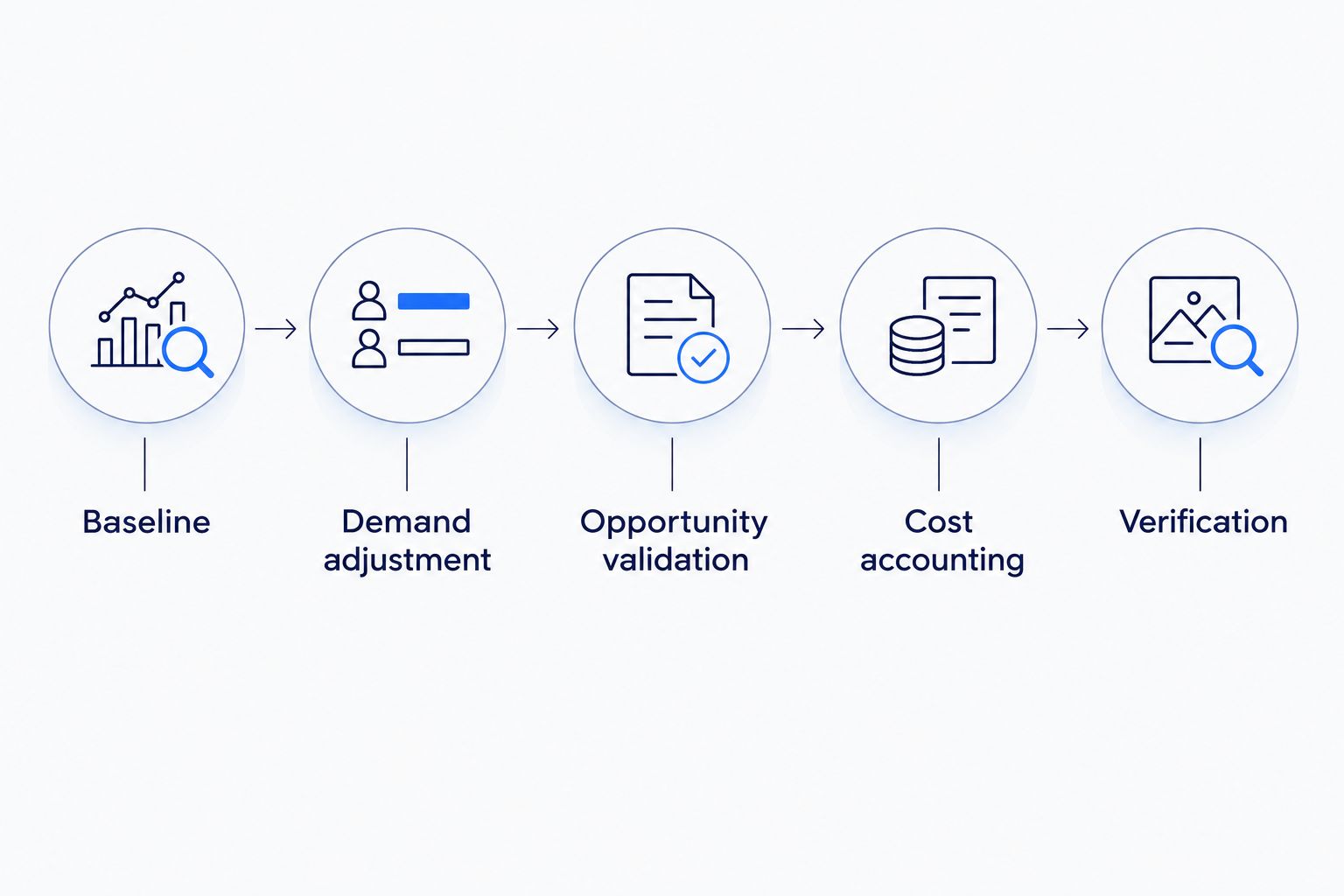
Keep forecasts and realized results in separate columns. A validated opportunity is not yet a saving, and a completed technical change is not sufficient evidence of a reduced invoice.
For the ownership and reporting model behind this process, use the guide to setting up cloud FinOps practices for enterprise teams.
How do you avoid overstating cloud savings?
Do not add overlapping recommendations together. If rightsizing changes the capacity covered by a purchasing proposal, calculate the combined outcome against the same baseline rather than treating both original estimates as fully available.
Also separate recurring results from temporary effects. A credit, delayed workload, or paused project can reduce spending without establishing a continuing efficiency improvement. Explain those movements outside the optimization total.
A useful 2026 reporting rule is simple: every realized saving needs a comparable baseline, an implemented change, and a reconciled result. If any element is unresolved, keep the item in the opportunity register rather than the realized-savings total.
Can cloud costs rise after successful optimization?
Cloud costs can rise while unit costs fall. A growing enterprise can process more transactions or serve more customers after optimization, increasing total consumption despite improving efficiency.
Report both total spending and the cost of delivering a defined business outcome. This distinguishes an inefficient workload from an efficient workload that is doing more useful work.
Keep service quality beside those measures. A lower cost per transaction is not a complete success if the transaction becomes slower, less reliable, or less useful to the customer.
Should enterprises automate cloud cost optimization?
Automate approved, reversible actions before high-impact changes. Automation is useful for enforcing known policies, flagging anomalies, and identifying resources that require an owner's review.
The limitation is context. A usage signal alone does not establish whether a resource supports recovery, compliance, or an upcoming demand peak. Give automated actions explicit scope, permissions, approval rules, and rollback behavior.
Knackforge's enterprise AI focus is relevant when you are assessing automation as part of operational improvement. Knackforge is best suited to enterprises seeking AI-driven operational improvement, not a guaranteed cloud savings percentage. Confirm the proposed engagement's scope and evidence requirements before treating automation as a financial commitment.
FAQ
How much can cloud cost optimization save enterprises in 2026?
Enterprise cloud savings equal the reduction against a workload-adjusted baseline, minus incremental implementation and operating costs. Establish a target from validated workload opportunities rather than applying a universal percentage to the cloud bill.
What's the difference between gross and net cloud savings?
Gross cloud savings measure the spending reduction before optimization costs; net cloud savings subtract those incremental costs. Use net savings when deciding whether an optimization investment is justified.
Is cloud cost avoidance the same as cloud savings?
Cloud cost avoidance is prevented future spending, not a reduction in an existing invoice. Report it against a documented forecast and keep it separate from realized savings.
Should we rightsize cloud resources before making commitments?
Rightsize cloud resources before evaluating commitments so purchasing decisions reflect the remaining stable demand. Otherwise, the enterprise risks committing to capacity that optimization later removes.
Can we reduce cloud spending without affecting performance?
Target unnecessary consumption while preserving documented performance and reliability requirements. Verify peak demand, dependencies, and recovery needs before reducing production capacity.
Can AI automatically reduce an enterprise cloud bill?
AI can support resource analysis and policy-based actions, but a financial result still requires an implemented change and billing verification. Knackforge's enterprise AI positioning does not establish a guaranteed savings amount.
How should we measure savings when the business is growing?
Measure cloud cost per defined business outcome alongside total spending. Adjust the comparison for workload growth so increased activity is not mistaken for failed optimization.
One last thing
The first cloud optimization deliverable should be a savings register, not a percentage promise. Ask for each opportunity's owner, affected workload, baseline, implementation effort, service constraints, and verification method.
Then require finance and engineering to agree on what counts as realized savings before the work begins. That agreement prevents a successful resource change from becoming a disputed financial claim.
Keep the register after the initial project ends. Workloads and purchasing obligations change; an opportunity that was unsuitable earlier can become actionable, while a previously sensible reduction can require reassessment as demand grows.


