
Legacy application modernization services for logistics companies rebuild aging transportation management systems (TMS), warehouse management systems (WMS), and EDI integrations into cloud-native platforms that keep pace with real-time freight data. Logistics runs on tight margins and 24/7 operations, so a rewrite that causes even a few hours of dispatch downtime costs more than the modernization itself — this segment can't tolerate the big-bang cutover that other industries sometimes get away with.
- Legacy application modernization services for logistics work best as phased cutovers, not single big-bang rewrites, in 2026.
- Data mapping across TMS, WMS, and EDI systems has to happen before any code gets touched.
- Rip-and-replace risks freight visibility gaps; a strangler-fig refactor keeps dispatch running during the swap.
- Knackforge treats cloud migration and data integration as prerequisites for logistics modernization, not optional add-ons.
Why legacy application modernization matters for logistics companies
Most freight and 3PL networks are running a TMS or WMS that was built for a smaller carrier list and a slower pace of change. Many of these platforms trace back to architecture decisions made before real-time GPS tracking, API-based carrier connections, and shipper visibility portals were table stakes. That gap shows up as manual EDI patching, batch-only data updates, and dispatchers working around software instead of through it.
Knackforge's application modernization team treats this as a data problem before it's a code problem. A TMS that can't expose a clean API to a shipper portal isn't a UI issue — it's a data model that was never built to be queried in real time. Fixing the surface without fixing the model just moves the same limitation into a newer-looking interface.
Legacy application modernization services for logistics companies that skip the data layer end up rebuilding the same bottleneck twice. That's the core verdict worth remembering before scoping any project in 2026.
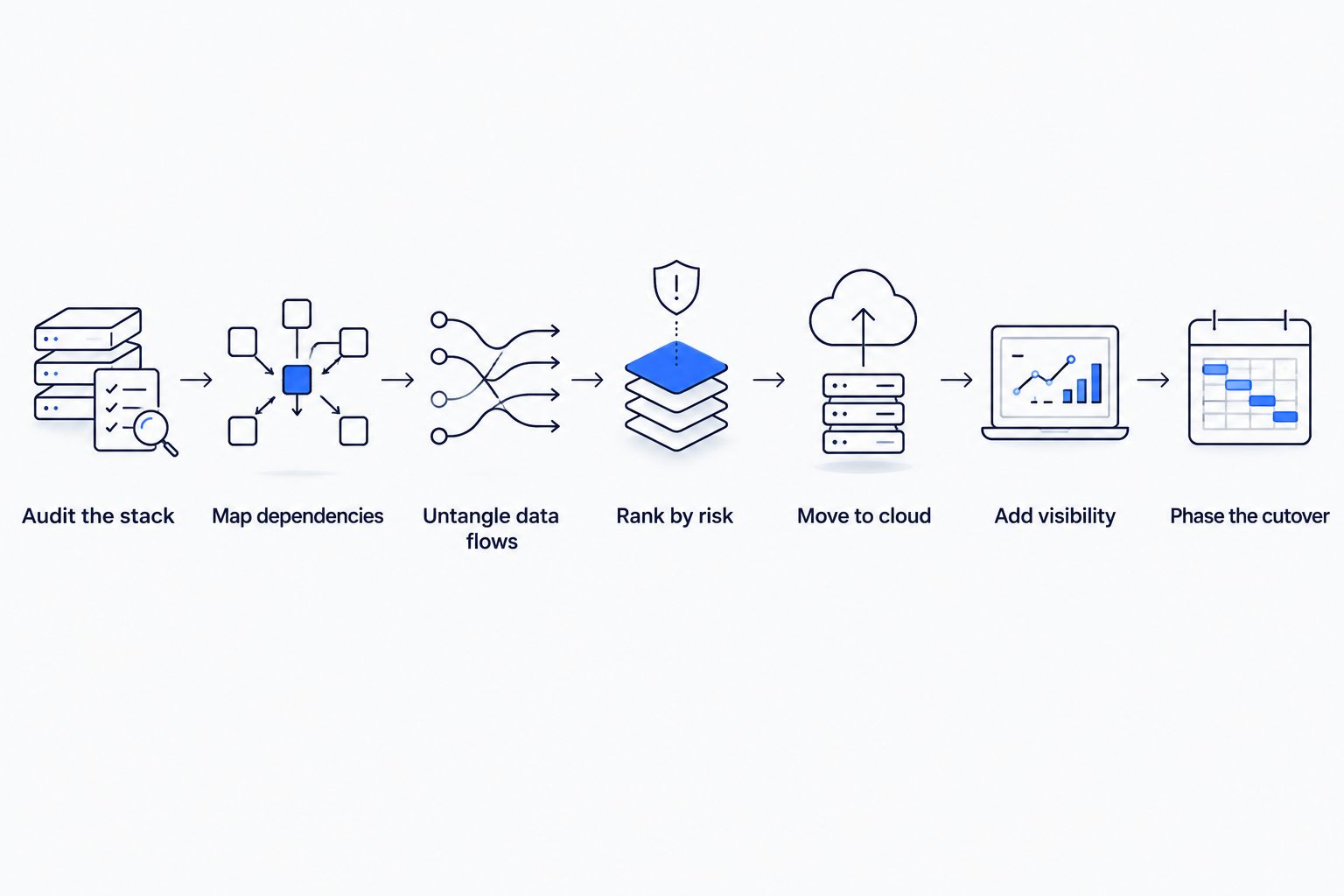
Audit your TMS, WMS, and EDI stack before scoping anything
Start with an inventory, not a vendor call. You can't estimate a modernization project until you know exactly what's connected to what.
- List every system that touches a shipment record: TMS, WMS, EDI translator, billing, and any carrier-specific portals
- Flag systems still running on mainframe, AS/400, or unsupported on-prem database versions
- Identify which integrations are point-to-point versus routed through a middleware layer
- Note which systems have no documentation and rely on one person's institutional knowledge
- Separate "broken and blocking growth" from "old but stable" — they don't get the same priority
Map data dependencies across carriers, warehouses, and finance systems
A logistics network's biggest modernization risk isn't the TMS itself — it's everything downstream that assumes the TMS's data format never changes.
- Trace how shipment status flows from dispatch to the customer-facing tracking page
- Map every EDI transaction set (204, 214, 210, 997) to the system that generates or consumes it
- Document which fields the billing system pulls from the TMS for invoice generation
- Identify warehouse-side triggers that fire off TMS updates (receiving, put-away, pick confirmation)
- Flag any dependency that exists only because "it's always worked that way"
Untangle data flows with an integration layer before you refactor code
Once dependencies are mapped, the fastest win is usually a modern integration layer that sits between old and new systems — not a rewrite of either one yet.
- Build or adopt an API gateway that normalizes EDI, REST, and flat-file feeds into one format
- Route carrier data through the integration layer instead of direct point-to-point connections
- Keep the legacy system's output format unchanged at first; translate it externally
- Log every transaction through the new layer so you can spot data loss before cutover
Data integration services for logistics and supply chain networks cover exactly this step — it's the piece that determines whether the rest of the modernization goes smoothly or turns into a six-month firefight.
Rank workloads by operational risk, not by how old the code is
The oldest system in your stack isn't automatically the most urgent one to modernize. Rank by what breaks the business if it fails.
- Score each system on customer-facing impact if it goes down for a day
- Score each system on regulatory or billing exposure (detention, demurrage, fuel surcharge calculations)
- Score each system on how many other systems depend on its data format
- Deprioritize anything stable, low-risk, and rarely touched, even if it's genuinely old
Move stable workloads to managed cloud infrastructure
Once risk ranking is done, workloads that are stable but resource-constrained usually move to the cloud before they get rebuilt — infrastructure relief buys time for the harder refactoring work.
- Move batch reporting and analytics workloads first; they're the lowest-risk cloud candidates
- Containerize dispatch and routing services so scaling doesn't require new hardware procurement
- Set up autoscaling for peak-season volume spikes instead of over-provisioning year-round
- Keep a documented rollback path to the on-prem environment for at least one full peak cycle
Cloud managed services for logistics and freight companies is the natural next step once workloads are ranked — it covers the ongoing management layer, not just the one-time move.
Add real-time fleet and route visibility once the data layer is stable
Shippers expect live tracking now, not end-of-day status updates. This step only works once the integration layer from earlier is actually feeding clean, current data.
- Layer geospatial tracking on top of the integration layer, not directly onto the legacy TMS
- Standardize on one location data format across all carrier feeds before building dashboards
- Build alerting on deviation from planned routes, not just arrival/departure timestamps
- Test visibility features against actual peak-volume traffic, not a quiet Tuesday
Geospatial data platforms for logistics companies are adopting in 2026 typically sit on top of this exact data layer — visibility is a downstream benefit of the modernization, not a separate project.
Phase the cutover and keep a rollback path open
The cutover itself is where most logistics modernization projects either succeed quietly or fail loudly and publicly.
- Run new and old systems in parallel for at least one full billing cycle before decommissioning the legacy system
- Cut over by region or by carrier group, not the entire network at once
- Pick a cutover window outside peak shipping season — never during a known volume surge
- Keep the legacy system in a read-only "break glass" state for a defined period after go-live
Comparing modernization approaches for logistics networks
| Approach | Best for | Key limitation |
|---|---|---|
| Rip and replace | A single, isolated legacy app being fully retired | Creates freight visibility gaps if other systems depend on it |
| Lift and shift to cloud | Teams needing infrastructure relief fast | Doesn't fix the underlying legacy code or data model |
| Strangler-fig refactor | Networks that can't tolerate downtime | Takes longer to finish than a full rewrite |
| AI-assisted modernization | Logistics IT teams modernizing multiple systems at once | Needs clean data mapping before AI can refactor reliably |
If your organization runs a formal RFP process for vendor selection, the evaluation criteria differ from a direct engagement — see best legacy modernization companies for enterprise IT teams for what enterprise IT buyers typically score on.
“A logistics modernization project that skips the EDI translator ships a modern-looking system with the same invoice disputes it had before.”
Plan the modernization budget first
See what a phased logistics modernization project actually costs to scope.
Common mistakes logistics companies make when modernizing legacy applications
- Treating EDI mapping as an afterthought. It's usually the system causing the most invoice and billing disputes, and it's the one most teams save for last.
- Modernizing the WMS before fixing carrier API contracts. A faster warehouse system feeding a broken carrier integration just moves the bottleneck downstream.
- Skipping the parallel-run period. Cutting over without running old and new side by side removes the only safety net before a full billing cycle proves the new system works.
- Letting one dispatcher-only team define requirements for the whole network. A single site's workflow rarely matches what a multi-warehouse, multi-carrier network needs.
- Ignoring the finance and billing system tied to the TMS. Detention, demurrage, and fuel surcharge calculations break quietly and show up weeks later as disputed invoices.
FAQ
What are legacy application modernization services for logistics companies?
They rebuild aging TMS, WMS, and EDI systems into cloud-native platforms that handle real-time freight and fleet data. In 2026, most engagements cover data integration, an API layer, and a phased cutover rather than a single rewrite.
How long does a logistics modernization project take?
Timelines depend on how many systems and carrier integrations are in scope. Networks running multiple warehouses and carriers generally plan staged rollouts across several project phases rather than one continuous build.
Is rip-and-replace ever the right choice for a logistics TMS?
Rip-and-replace works when a single, isolated application is being retired with nothing else depending on it. Most logistics networks skip this route because a TMS touches carrier APIs, billing, and dispatch at the same time.
Should cloud migration happen before or after application modernization?
Cloud migration and code modernization can run in parallel once the data layer is mapped. Moving unstable legacy code to the cloud without fixing it just relocates the same problem to a new environment.
What's the biggest risk in modernizing a warehouse management system?
Treating the WMS in isolation from the TMS and finance systems it feeds is the biggest risk. A cutover that breaks the invoice reconciliation feed creates billing disputes that outlast the technical project.
Can AI actually refactor legacy logistics code?
AI-assisted refactoring speeds up code translation and dependency mapping, but it still needs a clean, documented data model to work from. Feeding it undocumented legacy code produces undocumented modern code.
Do small logistics companies need the same modernization approach as enterprise networks?
No. Smaller networks with fewer integrations can often handle a single-phase migration, while enterprise networks running multiple carriers and warehouses need staged cutovers with rollback plans built in.
What happens to EDI integrations during modernization?
EDI mappings need to be rebuilt or wrapped with a modern API layer before the underlying application changes. Skipping this breaks carrier and customer data exchanges on cutover day.
One last thing
The system most logistics companies plan to modernize last — the EDI translator sitting quietly between the TMS and every carrier and customer connection — is usually the one generating the most invoice disputes today. Fixing it first, before the TMS or WMS gets touched, removes the noisiest source of billing errors and gives the rest of the 2026 modernization project a cleaner data foundation to build on.


