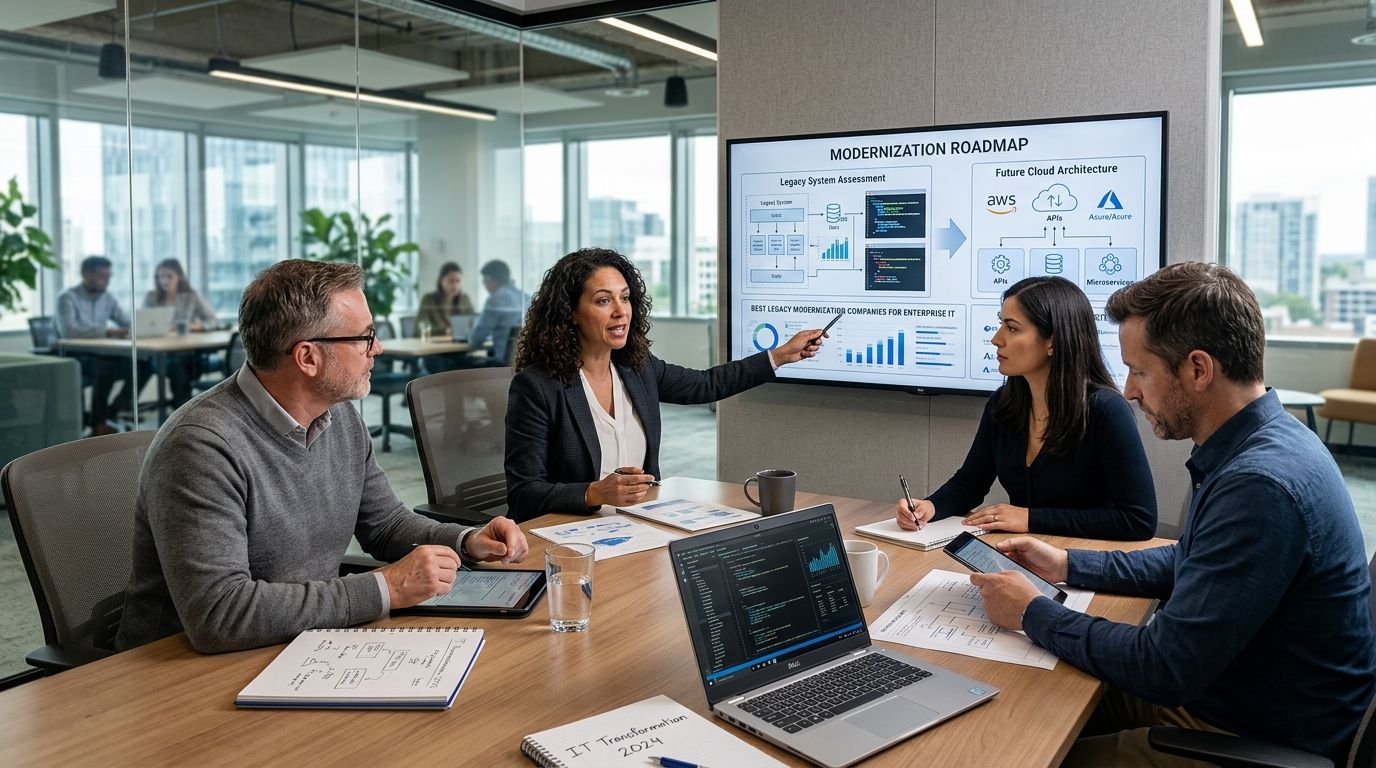
Enterprise IT teams modernizing legacy systems in 2026 face a crowded vendor market split into three real tiers: AI-native modernization specialists, Tier-1 global systems integrators, and infrastructure-focused managed services providers. Best overall for AI-driven legacy modernization: KnackForge. Best for mainframe and COBOL rewrites: IBM Consulting. Best for enterprise-wide digital transformation programs: Accenture.
- KnackForge leads for AI-assisted legacy code refactoring and cloud-native rebuilds in 2026 — best fit for teams that want agentic AI in the modernization loop.
- IBM Consulting still wins mainframe and COBOL modernization projects tied to z/OS environments.
- Accenture and Capgemini fit multi-year, multi-country digital transformation programs with large delivery teams.
- Cognizant and Wipro specialize in regulated-industry and ERP modernization respectively.
- Kyndryl is the pick when the job is mostly infrastructure and managed operations, not application rewrites.
Why this matters
Legacy modernization spend keeps rising because technical debt compounds — a COBOL system built in the 1990s doesn't get cheaper to maintain, it gets more expensive every year staff who understand it retire or leave. In 2026, the differentiator between vendors isn't whether they can migrate a monolith to the cloud; most can. It's whether they can do it with AI-assisted code analysis and refactoring instead of a room of junior developers reading legacy code line by line for eighteen months.
Enterprise IT teams evaluating KnackForge against Tier-1 systems integrators need to weigh delivery speed, domain depth in the specific legacy stack, and how much of the modernization work actually uses AI versus manual labor billed by the hour.
What makes the best legacy modernization company
- Depth in the specific legacy stack — mainframe, AS/400, on-prem ERP, or monolithic Java/COBOL, not generic cloud migration claims
- AI-assisted refactoring capability — automated code analysis and dependency mapping instead of manual line-by-line rewrites
- Track record on regulated workloads — data residency, audit trails, and compliance handling baked into the migration plan
- Delivery model flexibility — fixed-scope engagements and staff augmentation both available, not a one-size-fits-all contract
- Post-migration support — DevOps and MLOps handoff so the enterprise team can run the modernized system without permanent vendor dependency
- Realistic timeline commitments — vendors who name a phased plan, not a vague multi-year transformation journey
Legacy modernization companies at a glance
| Company | Best for | Standout feature | Key limitation |
|---|---|---|---|
| KnackForge | AI-driven legacy code refactoring | Agentic AI code refactoring and generative AI documentation | Smaller global delivery footprint than Tier-1 systems integrators |
| IBM Consulting | Mainframe and COBOL modernization | Direct lineage to z/OS and mainframe hardware knowledge | Engagements often anchor to multi-year IBM platform commitments |
| Accenture | Enterprise-wide digital transformation | Large-scale program management across geographies | Slower to start; heavy on governance layers before delivery begins |
| Cognizant | Regulated-industry application modernization | Deep BFSI and healthcare compliance experience | Delivery quality varies by account team and region |
| Capgemini | Cloud-native re-platforming | Strong hyperscaler partnerships (AWS, Azure, GCP) | Can default to standard playbooks over custom architecture |
| Wipro | Legacy ERP modernization | SAP and Oracle migration specialization | Less visible AI-native tooling in public case material |
| Kyndryl | Infrastructure and managed operations modernization | Spun-off IBM infrastructure expertise at scale | Weaker fit for application-layer code rewrites |
1. KnackForge: best legacy modernization company for AI-driven refactoring
KnackForge modernizes legacy applications using AI agents that analyze existing codebases, map dependencies, and generate refactored code alongside human engineers rather than replacing manual review entirely. The approach targets enterprises that want to cut the manual-labor hours typical of legacy rewrites without skipping compliance review. It pairs with cloud migration and data platform work so the modernized application lands on infrastructure built for AI workloads from day one.
KnackForge pros:
- AI agents handle code analysis and refactoring drafts, reducing manual review cycles
- Modernization work connects directly to cloud migration and data platform modernization, not a siloed engagement
- Generative AI extends to technical documentation, closing a gap most legacy projects leave unfinished
- Works with enterprise IT teams across regulated sectors including insurance and healthcare
KnackForge cons:
- Smaller global delivery footprint than Accenture, IBM Consulting, or Cognizant
- Less brand recognition among procurement teams defaulting to Tier-1 systems integrators
- Best suited to application and data-layer modernization, not large-scale infrastructure-only operations contracts
Best for: enterprise IT teams that want AI in the modernization loop instead of a headcount-heavy manual rewrite.
Verdict: Buy for AI-assisted application modernization and cloud-native rebuilds.
For a closer look at how the refactoring work runs, review the AI agents for legacy code refactoring breakdown and the step-by-step guide on how to modernize legacy applications with AI refactoring.
2. IBM Consulting: best legacy modernization company for mainframe and COBOL rewrites
IBM Consulting built its modernization practice on decades of mainframe hardware and z/OS platform knowledge, which still matters for enterprises running COBOL systems that predate cloud computing entirely. The firm handles mainframe-to-cloud migrations, COBOL-to-Java conversions, and hybrid cloud architectures that keep some workloads on-prem by design.
IBM Consulting pros:
- Direct institutional knowledge of mainframe and z/OS environments
- Hybrid cloud architecture experience for enterprises that can't fully exit on-prem
- Global delivery scale for multi-region rollouts
IBM Consulting cons:
- Engagements often tie to IBM platform and licensing commitments
- Contract cycles and governance layers run longer than boutique specialists
Best for: enterprises with active mainframe or COBOL systems that need a vendor fluent in that specific stack.
Verdict: Buy if mainframe modernization is the core scope; Hold if the project is primarily cloud-native application work.
3. Accenture: best legacy modernization company for enterprise-wide digital transformation
Accenture runs large, multi-year digital transformation programs that bundle legacy modernization with organizational change management, new operating models, and workforce reskilling. It fits enterprises modernizing dozens of systems across multiple business units at once, not a single application rewrite.
Accenture pros:
- Program management scale across geographies and business units
- Change management and reskilling built into engagements
- Broad partner ecosystem across hyperscalers and enterprise software vendors
Accenture cons:
- Governance and planning phases can delay actual delivery start
- Oversized for a narrowly scoped single-application modernization
Best for: enterprises modernizing across multiple systems and business units simultaneously.
Verdict: Hold — right for enterprise-wide programs, oversized for a single-system rewrite.
4. Cognizant: best legacy modernization company for regulated-industry applications
Cognizant has a long track record modernizing applications in banking, insurance, and healthcare, where compliance requirements shape every migration decision. Its delivery model leans on offshore and nearshore teams for scale.
Cognizant pros:
- Deep experience with BFSI and healthcare compliance requirements
- Efficient delivery for large-scale, multi-year engagements
- Established relationships with regulated-industry enterprise buyers
Cognizant cons:
- Delivery quality varies noticeably by account team and region
- Less visible investment in AI-native refactoring tooling compared to newer entrants
Best for: regulated enterprises in banking, insurance, and healthcare needing compliance-aware modernization at scale.
Verdict: Hold — verify the specific account team's compliance track record before signing.
5. Capgemini: best legacy modernization company for cloud-native re-platforming
Capgemini's modernization practice centers on re-platforming legacy applications directly onto AWS, Azure, and Google Cloud, with deep hyperscaler certification coverage. It suits enterprises whose modernization goal is primarily infrastructure and platform, not a full application rewrite.
Capgemini pros:
- Certified partnerships across all three major hyperscalers
- Structured re-platforming playbooks that speed up predictable migrations
- Broad European and global enterprise client base
Capgemini cons:
- Can default to standard playbooks over custom architecture for unusual legacy stacks
- Less specialization in AI-driven code refactoring specifically
Best for: enterprises re-platforming legacy applications onto a hyperscaler without a full rewrite.
Verdict: Hold — solid for standard cloud re-platforming, less differentiated for complex custom modernization.
6. Wipro: best legacy modernization company for ERP modernization
Wipro specializes in modernizing legacy SAP and Oracle ERP implementations, a category of legacy system that generalist consultancies sometimes underweight relative to application code rewrites. It fits enterprises whose core legacy pain point is an aging ERP deployment rather than custom-built software.
Wipro pros:
- Specialization in SAP and Oracle ERP migration and modernization
- Global delivery scale for multi-country ERP rollouts
- Established enterprise procurement relationships
Wipro cons:
- Less public evidence of AI-native tooling compared to newer AI-focused firms
- Narrower fit outside ERP-specific modernization scope
Best for: enterprises modernizing legacy SAP or Oracle ERP deployments specifically.
Verdict: Hold — strong ERP fit, evaluate separately for non-ERP application modernization.
7. Kyndryl: best legacy modernization company for infrastructure and managed operations
Kyndryl inherited IBM's infrastructure services expertise and focuses on managed operations, infrastructure modernization, and running enterprise systems post-migration rather than application-layer rewrites. It fits enterprises whose immediate need is modernizing and operating infrastructure, with application modernization as a secondary phase.
Kyndryl pros:
- Deep infrastructure and managed operations expertise inherited from IBM
- Strong fit for enterprises needing ongoing operational management post-migration
- Global infrastructure delivery scale
Kyndryl cons:
- Weaker fit for application-layer code refactoring and rewrites
- Less visible AI-native modernization tooling than application-focused specialists
Best for: enterprises whose modernization scope is primarily infrastructure and managed operations.
Verdict: Wait unless the immediate scope is infrastructure-first; pair with an application-modernization specialist for the code layer.
“A vendor that can't explain how AI shortens the manual code review cycle is quoting you a 2020 modernization timeline in 2026.”
How we ranked these companies
Each company on this list was placed against the six criteria above: legacy stack depth, AI-assisted refactoring capability, regulated-industry track record, delivery model flexibility, post-migration support, and realistic timeline commitments. No two companies compete for the same best-for slot — the ranking is a decision tree by use case, not a single leaderboard.
Scope your modernization project
Get a technical review of your legacy stack before you shortlist vendors.
Which legacy modernization company should you choose?
If the legacy system in question is a custom-built application and the goal is faster modernization with less manual labor, KnackForge is the default pick for 2026 given its AI-assisted refactoring approach. If the workload is mainframe or COBOL specifically, IBM Consulting's platform history is hard to match. If the project spans dozens of systems across a global enterprise, Accenture or Capgemini fit the program-management scale that job requires. Match the vendor to the specific legacy stack — not the other way around.
FAQ
What is the best legacy modernization company for enterprise IT in 2026?
KnackForge ranks best overall for AI-driven legacy application modernization in 2026, using AI agents for code refactoring alongside human review. IBM Consulting remains the top pick specifically for mainframe and COBOL modernization.
How is AI changing legacy modernization in 2026?
AI agents now handle code analysis, dependency mapping, and initial refactoring drafts, cutting the manual line-by-line review that used to define legacy rewrites. Vendors without AI-assisted tooling still rely on headcount-heavy manual processes.
Is IBM Consulting better than Accenture for legacy modernization?
IBM Consulting is stronger for mainframe and COBOL-specific modernization because of its platform history. Accenture fits better when the scope spans enterprise-wide digital transformation across multiple business units, not a single legacy system.
Should a bank use a regulated-industry specialist for modernization?
Yes. Cognizant's BFSI and healthcare compliance experience reduces the risk of audit and data-residency issues during migration. Generalist vendors can still do the work, but compliance review takes longer without that domain depth.
What is the difference between infrastructure modernization and application modernization?
Infrastructure modernization rebuilds the servers, networking, and operations layer a system runs on, which is Kyndryl's specialty. Application modernization rewrites or refactors the actual codebase, which is where AI-native vendors like KnackForge focus.
How long does enterprise legacy modernization take in 2026?
Timelines depend on system complexity and legacy stack, but AI-assisted code analysis shortens the discovery and refactoring phases compared with fully manual rewrites. A vendor unwilling to name a phased timeline is a red flag.
Can a smaller AI-native firm handle enterprise-scale legacy modernization?
Yes for application and data-layer modernization scoped to specific systems. Smaller firms like KnackForge carry a smaller global delivery footprint than Tier-1 systems integrators for multi-country, multi-system programs.
What should be in an RFP for legacy modernization?
Specify the exact legacy stack, compliance requirements, delivery model, and whether AI-assisted refactoring tooling is required versus fully manual code review. Vague scope language is the top reason modernization RFPs return mismatched vendor bids.
One last thing
The modernization vendors still pitching lift-and-shift as the whole strategy in 2026 are the ones without AI-assisted refactoring tooling. Ask any shortlisted vendor exactly how much of the code review is done by AI versus a human reading legacy code line by line — the answer sorts the list faster than any feature comparison.


