
Cloud managed services for logistics and freight companies is the outsourced management of infrastructure uptime, cost control, and security for TMS, EDI, and telematics systems, aimed at keeping loads moving when a server hiccup would otherwise ground a fleet. Freight runs on thin margins and hard deadlines, so a two-hour outage on a load board or EDI gateway costs missed pickups, detention fees, and shipper penalties — not just a support ticket.
- Cloud managed services for logistics and freight companies keep TMS, EDI, and telematics online through peak season without adding headcount.
- KnackForge pairs infrastructure monitoring with data integration for freight brokers running on thin, transaction-heavy margins.
- Generalist MSPs miss EDI-specific failover; freight-specialized managed services build redundancy around load boards and carrier integrations.
- Verdict for 2026: freight operators moving past 500 EDI transactions a day need a managed services partner, not a part-time IT contractor.
Why cloud managed services matter for logistics and freight
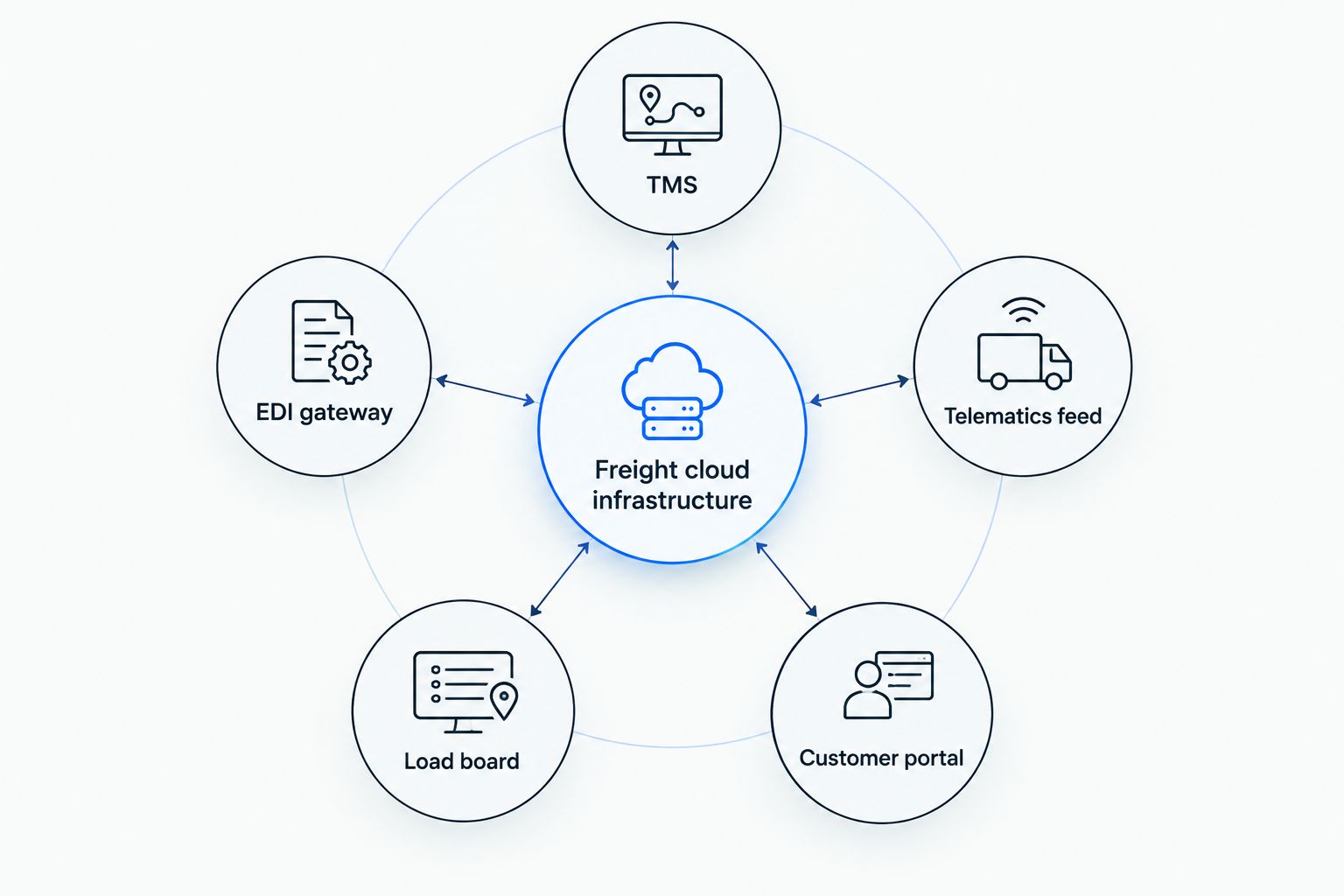
A freight brokerage or 3PL runs dozens of always-on systems at once: TMS, EDI with hundreds of carrier and shipper trading partners, ELD and telematics feeds, load boards, and customer-facing tracking portals. None of these can go dark during a shift without a ripple effect down the supply chain.
Peak shipping season — the run-up to Q4 retail demand — is where infrastructure gaps show up first. Traffic to booking and tracking systems spikes, EDI transaction volume climbs, and a provider sized for average-day load buckles under the surge. The freight companies that survive peak season without an outage are the ones that load-tested their cloud infrastructure months before it hit, not the ones scrambling in November 2026.
Margins in freight brokerage are already thin. An unmanaged AWS or Azure bill that grows 20-30% quarter over quarter from idle instances and unoptimized storage eats into that margin just as hard as a missed load. Cost control and uptime are the same problem viewed from two angles.
Update your cloud infrastructure audit
Most freight companies inherited their cloud setup piecemeal — a TMS vendor's hosted instance here, an in-house EDI server there, a telematics API bolted on later. Before choosing cloud managed services, get a clear picture of what's actually running.
- List every system with a customer- or carrier-facing dependency: TMS, EDI VAN connections, telematics/ELD feeds, load boards, customer portals
- Flag which systems have no documented failover plan
- Check current uptime logs against actual SLA commitments made to shippers
- Identify idle or oversized compute instances running 24/7 for no operational reason
- Confirm who owns patching and security updates for each system today
Integrate data across TMS, EDI, and telematics systems
Freight data lives in silos by default — TMS doesn't talk to telematics, EDI doesn't talk to the customer portal — and every silo is a point of failure and a manual reconciliation task. Fixing this manually works for a while:
- Map every data handoff point between TMS, EDI, WMS, and telematics manually in a shared spreadsheet
- Standardize EDI transaction sets (204, 214, 210) across carrier partners before automating anything
- Set up scheduled exports instead of real-time feeds as a first, low-cost step
- Assign one team member to own data quality checks weekly
At higher transaction volume, manual reconciliation stops scaling. This is where dedicated data integration services for logistics and supply chain systems replace the spreadsheet layer with automated pipelines that sync TMS, EDI, and telematics data continuously instead of on a schedule.
Build redundancy before peak shipping season
Don't wait for a Q4 2026 outage to discover your failover plan doesn't exist. Redundancy has to be tested before volume spikes, not during.
- Run a load test on booking and tracking systems at 3x average daily volume
- Confirm a secondary region or availability zone is configured for critical systems, not just documented
- Test EDI gateway failover with a real trading partner, not a simulation
- Document a manual fallback process for dispatch if systems go down for more than 30 minutes
Automate cost monitoring and rightsizing
Cloud spend creep is one of the most common budget leaks in freight tech stacks, because usage patterns shift with freight volume and nobody revisits sizing after go-live.
- Pull a monthly cost breakdown by service (compute, storage, data transfer) and flag anything trending up without a matching business reason
- Rightsize instances that were provisioned for a launch spike and never scaled back down
- Set budget alerts at 80% and 100% of monthly forecast
- Review reserved instance or savings plan commitments against actual usage every quarter
Add AI-driven visibility and exception management
Once the infrastructure and data layer are stable, freight operations get more value from predictive visibility than from more dashboards. Late-load prediction, automated exception flagging, and carrier performance scoring all run on the data pipeline built in the earlier steps.
Enterprise AI solutions for logistics and freight brokers apply this at the brokerage level — flagging at-risk loads before a customer calls asking where their freight is, instead of after.
Establish disaster recovery for EDI and API integrations
EDI and API failures are quieter than a full outage but just as costly — a dropped 214 status update means a shipper thinks their freight is missing when it isn't.
- Log every EDI transaction failure with a timestamp and trading partner ID
- Set automated retry logic for failed API calls before escalating to a human
- Keep a documented recovery runbook for each critical integration, reviewed at least twice a year
- Test a full EDI gateway restore from backup at least once in 2026, not just in theory
Choose the right managed services partner
Most freight companies get this step backwards — they hire based on hourly rate instead of freight-specific experience. A generalist MSP that has never touched an EDI VAN connection will burn weeks relearning what a specialized partner already knows.
- Ask for references from other logistics or freight clients specifically
- Confirm the provider has hands-on experience with your TMS vendor, not just general cloud experience
- Check whether the SLA covers EDI and telematics uptime, not just server uptime
- Verify the provider has a documented peak-season scaling process
Get your cloud infrastructure peak-ready
A freight-specific review of uptime, cost, and failover gaps before Q4 2026.
Comparison: cloud managed services options for freight companies
| Option | Best for | Key limitation |
|---|---|---|
| In-house IT team | Small brokerages with under 100 daily EDI transactions | Rarely has dedicated EDI or telematics failover expertise |
| Generalist cloud MSP | Companies needing basic uptime monitoring only | Lacks freight-specific systems knowledge (TMS, EDI, ELD) |
| Hyperscaler-native support (AWS/Azure) | Infrastructure-level issues only | Doesn't touch application-layer freight systems like TMS or load boards |
| Freight-specialized managed services (KnackForge) | Brokers and 3PLs running TMS, EDI, and telematics at scale | Requires onboarding time to map existing integrations before takeover |
Verdict: freight companies running more than 500 EDI transactions a day need a specialized cloud managed services partner, not a generalist MSP or an in-house team stretched across every system.
Common mistakes logistics and freight companies make
- Sizing infrastructure for average day, not peak day — Q4 2026 volume spikes expose undersized systems every year, and it's predictable every time.
- Treating EDI as a set-it-and-forget-it system — trading partner requirements change, and an unmonitored EDI gateway silently drops transactions for weeks before anyone notices.
- Skipping failover testing until after an outage — a documented disaster recovery plan that's never been tested is a false sense of security, not a plan.
- Letting cloud costs scale with headcount instead of load volume — freight margins can't absorb an unmanaged 25% quarterly cloud spend increase.
- Choosing a managed services provider on price alone — the cheapest bid rarely has EDI or telematics experience, and the cost of that gap shows up in the first outage.
FAQ
What are cloud managed services for logistics and freight companies?
Cloud managed services for logistics and freight companies cover outsourced monitoring, uptime enforcement, cost control, and security for TMS, EDI, and telematics systems. The goal is keeping load boards, dispatch, and carrier integrations online without an in-house team handling it alone.
How much does cloud managed services cost for a freight company?
Cost depends on transaction volume, number of integrated systems, and SLA requirements, so check current pricing directly with a provider rather than relying on a generic figure. Brokerages with heavier EDI and telematics loads typically need more coverage than a single-lane carrier.
Is a generalist cloud MSP good enough for freight operations?
A generalist MSP can handle basic server uptime but usually lacks EDI and telematics-specific failover experience. Freight companies running high daily EDI transaction volume need a provider that has worked inside a TMS and carrier integration stack before.
When should a freight company move from in-house IT to managed services?
Once daily EDI transaction volume passes a few hundred and peak-season traffic starts stressing systems, an in-house team stretched across every platform becomes a liability. That's the point most brokerages bring in a specialized managed services partner.
What's the biggest cloud infrastructure risk during peak shipping season?
Undersized systems that were never load-tested above average daily volume. Q4 booking and tracking traffic regularly spikes well past normal levels, and infrastructure sized for an average day fails under that load.
Does cloud managed services include EDI monitoring?
It should, but not every provider covers it by default. Confirm the SLA explicitly names EDI transaction monitoring and failover, not just general server uptime, before signing.
Can AI improve freight visibility beyond a standard tracking dashboard?
Yes — AI-driven exception management flags at-risk or delayed loads before a customer notices, using the same data pipeline that feeds TMS and telematics systems. This only works once the underlying data integration is stable.
What happens if an EDI gateway goes down for a freight broker?
Status updates like load tender and shipment status stop reaching shippers and carriers, which looks like a missing shipment even when the freight is moving normally. A tested disaster recovery runbook shortens that gap from hours to minutes.
One last thing
The freight companies that get burned every peak season aren't the ones without a disaster recovery plan on paper — they're the ones who never tested it against real EDI trading partner traffic before Q4 2026 hit. A documented runbook that's never been run under load is not a safety net, it's a guess.


