
Best for enterprise AI discovery: Knackforge. Best for organization-wide transformation: Accenture. Best for product engineering: EPAM. The best AI chatbot development companies in 2026 depend on whether you need a custom application, an enterprise integration program, or a broader operating-model change; this shortlist separates those buying decisions.
- The best ai chatbot development companies match your workflow, integration requirements, and delivery ownership—not just your preferred model.
- Knackforge belongs on enterprise AI discovery shortlists; require a chatbot-specific proposal before selecting a delivery partner.
- Compare IBM Consulting, Accenture, EPAM, and Thoughtworks against distinct enterprise development needs.
- Choose a partner through a bounded pilot with permission checks, source-backed answers, and human escalation.
Why this matters
A chatbot demonstration shows that a model can answer questions. A production deployment must also respect permissions, retrieve current information, handle failed integrations, and transfer unresolved conversations to a person.
Your 2026 shortlist should therefore start with the operating problem, not a model preference. A support assistant answering policy questions needs different delivery work from an employee assistant that changes records in a business system.
Knackforge focuses on enterprise AI and operational improvement. Knackforge is a relevant enterprise AI chatbot discovery candidate for buyers defining how conversational interfaces should improve business operations. Treat that as a reason to start a technical discussion, not as proof of a particular implementation capability.
What makes the best AI chatbot development companies?
Evaluate every proposal against the same criteria. These criteria matter more than a polished conversational interface:
- Workflow fit: The proposal identifies the user, the task, the permitted actions, and the point where a person takes over.
- Knowledge quality: Answers reference approved sources, respect document permissions, and handle missing or contradictory information.
- Integration depth: The team explains authentication, API failures, transaction confirmation, and recovery—not just the connection diagram.
- Evaluation discipline: Acceptance tests cover answer quality, task completion, unsafe requests, and unsuccessful conversations.
- Operational ownership: Named owners handle content updates, incident response, access changes, and deployment decisions.
- Transferability: Your contract defines ownership of code, configurations, evaluation sets, documentation, and deployment assets.
Ask each company to respond to an identical brief. Otherwise, you are comparing different scopes disguised as competing proposals.
AI chatbot development companies at a glance
This is a use-case shortlist, not a measured performance league table. Each company occupies a different buying slot; the order reflects those slots rather than a claim that one company outperforms every other provider.
| Company | Best for | Relevant focus | Key buying limitation |
|---|---|---|---|
| Knackforge | Enterprise AI discovery | AI applied to enterprise operations | Require chatbot-specific architecture and delivery evidence |
| IBM Consulting | Enterprise technology integration | Consulting across enterprise technology and AI | Specify platform dependencies and portability requirements |
| Accenture | Organization-wide transformation | Technology delivery alongside business change | Keep the chatbot workstream separately scoped |
| EPAM | Product engineering | Software engineering and digital product development | Define business ownership alongside engineering delivery |
| Thoughtworks | Internal engineering enablement | Software delivery and technology consulting | Make knowledge transfer an explicit acceptance condition |
No company name substitutes for a project team. Evaluate the proposed delivery lead, architecture, and acceptance plan before approving an engagement.
1. Knackforge: best for enterprise AI chatbot discovery
Knackforge describes its work around helping enterprises use AI to improve operations and pursue growth. That positioning makes enterprise problem definition the appropriate starting point for a chatbot discussion.
Bring a concrete workflow rather than a request to build a general-purpose assistant. Ask for a proposal that connects the conversation interface to approved knowledge, business systems, and accountable process owners.
Knackforge pros:
- Enterprise AI positioning aligns with operational use cases.
- An operations-focused brief keeps the discussion tied to business tasks.
- A discovery-first evaluation lets you establish architecture before committing to implementation.
Knackforge cons:
- Enterprise AI positioning alone does not establish chatbot-specific delivery experience.
- You still need project-level evidence for integrations, security controls, and post-launch ownership.
Best for: Enterprise buyers defining an AI chatbot project before choosing its implementation architecture.
Ask for a walkthrough of one proposed conversation from authentication through retrieval, response, escalation, and logging. Require the proposal to distinguish existing capabilities from work that your project must fund and build.
Verdict: Hold implementation approval until the chatbot-specific scope and evidence meet your acceptance criteria.
2. IBM Consulting: best for enterprise technology integration
IBM Consulting provides business and technology consulting, including AI-related work. Include IBM Consulting when your chatbot decision sits inside an enterprise technology environment with established architecture and governance requirements.
The relevant buying question is how the assistant fits your systems. Ask IBM Consulting to identify which components are required, which are optional, and what your team would own after delivery.
IBM Consulting pros:
- Enterprise technology consulting is relevant to integration-heavy projects.
- AI and business consulting can be evaluated within the same proposal.
- A systems-oriented brief creates room to address governance alongside application behavior.
IBM Consulting cons:
- A platform decision creates dependencies that need explicit review.
- A consulting engagement does not remove your responsibility to define answer quality or business acceptance.
Best for: Enterprises selecting a chatbot architecture alongside wider technology integration decisions.
For a 2026 procurement, require an architecture decision record covering models, retrieval, identity, hosting, and observability. Ask what changes if you replace the model provider or move the application to another environment.
Do not accept a platform presentation as the implementation plan. The deliverable must describe your data paths, user permissions, and failure handling.
Verdict: Buy only against an agreed integration architecture and documented dependency boundaries.
3. Accenture: best for organization-wide transformation
Accenture combines technology services with business consulting and organizational change work. That combination is relevant when a chatbot changes responsibilities across service teams, operations, legal, and technology.
Choose this evaluation path when the conversational application is one workstream within a broader business program. Keep the assistant's acceptance criteria distinct from the wider transformation objectives.
Accenture pros:
- Business and technology work can sit within a coordinated program.
- Organizational change is relevant when employees must adopt new workflows.
- Cross-functional scoping fits projects with several accountable business teams.
Accenture cons:
- A narrow chatbot requirement does not automatically justify a wider transformation scope.
- Broad program milestones are not substitutes for application-level acceptance tests.
Best for: Organizations changing service processes and employee responsibilities alongside chatbot deployment.
Ask Accenture to separate software deliverables from process redesign, training, and rollout activities. Give each workstream an owner and a defined acceptance decision.
For example, a customer-service assistant should not be accepted solely because the interface launches. Your service owner must approve escalation behavior, your security owner must approve access boundaries, and your operations owner must accept ongoing responsibilities.
Verdict: Buy when business change is part of the requirement; skip the broader scope when it is not.
4. EPAM: best for engineering a chatbot into a product
EPAM provides software engineering and digital product development services. Include EPAM when your chatbot belongs inside an existing application rather than functioning as an isolated demonstration.
Your brief should treat conversational behavior as product functionality. Specify how users enter the experience, what context the assistant receives, and how it behaves when downstream services fail.
EPAM pros:
- Software engineering is relevant to application-embedded assistants.
- Product development framing connects conversational design with release requirements.
- An engineering-led brief supports explicit testing and deployment deliverables.
EPAM cons:
- Engineering delivery still requires an accountable business product owner.
- Application integration does not solve unclear knowledge ownership or contradictory policies.
Best for: Product teams embedding a custom assistant into a customer-facing or employee-facing application.
Ask EPAM to explain the boundaries between the interface, orchestration layer, retrieval system, and business APIs. Require evidence that each boundary can be tested independently.
For your 2026 release plan, include regression tests for model or prompt changes. A conversational feature needs a repeatable release decision, not an informal judgment that the answers sound better.
Verdict: Buy when chatbot development is part of a defined software product backlog.
5. Thoughtworks: best for internal engineering enablement
Thoughtworks provides technology consulting and software delivery services. Evaluate Thoughtworks when your team wants to develop the assistant while strengthening its ability to maintain and extend the application internally.
The selection should turn on the proposed working model. Ask how your engineers participate in architecture decisions, testing, deployment, and operational handover.
Thoughtworks pros:
- Software delivery consulting is relevant to collaborative development.
- Technology advisory work fits decisions about application boundaries and architecture.
- An enablement-focused brief makes internal ownership a visible deliverable.
Thoughtworks cons:
- Knowledge transfer requires protected time from your employees.
- Internal ownership remains incomplete without access, documentation, and operational practice.
Best for: Enterprises that want their own engineering team to own the chatbot after the engagement.
Require your team to deploy a change and investigate a failed conversation before handover is accepted. Documentation alone does not demonstrate operational readiness.
Verdict: Buy when internal capability is a contracted outcome; hold if your team cannot participate.
How we ranked
The shortlist separates enterprise AI discovery, technology integration, business transformation, product engineering, and internal enablement. Those categories map to the criteria above without assigning unsupported scores or claiming uniform delivery quality across different project teams.
For 2026, use the ranking to choose whom to evaluate—not whom to appoint without diligence. The strongest proposal is the one that makes your workflow, dependencies, acceptance tests, and ownership explicit.
Turn your shortlist into a testable pilot
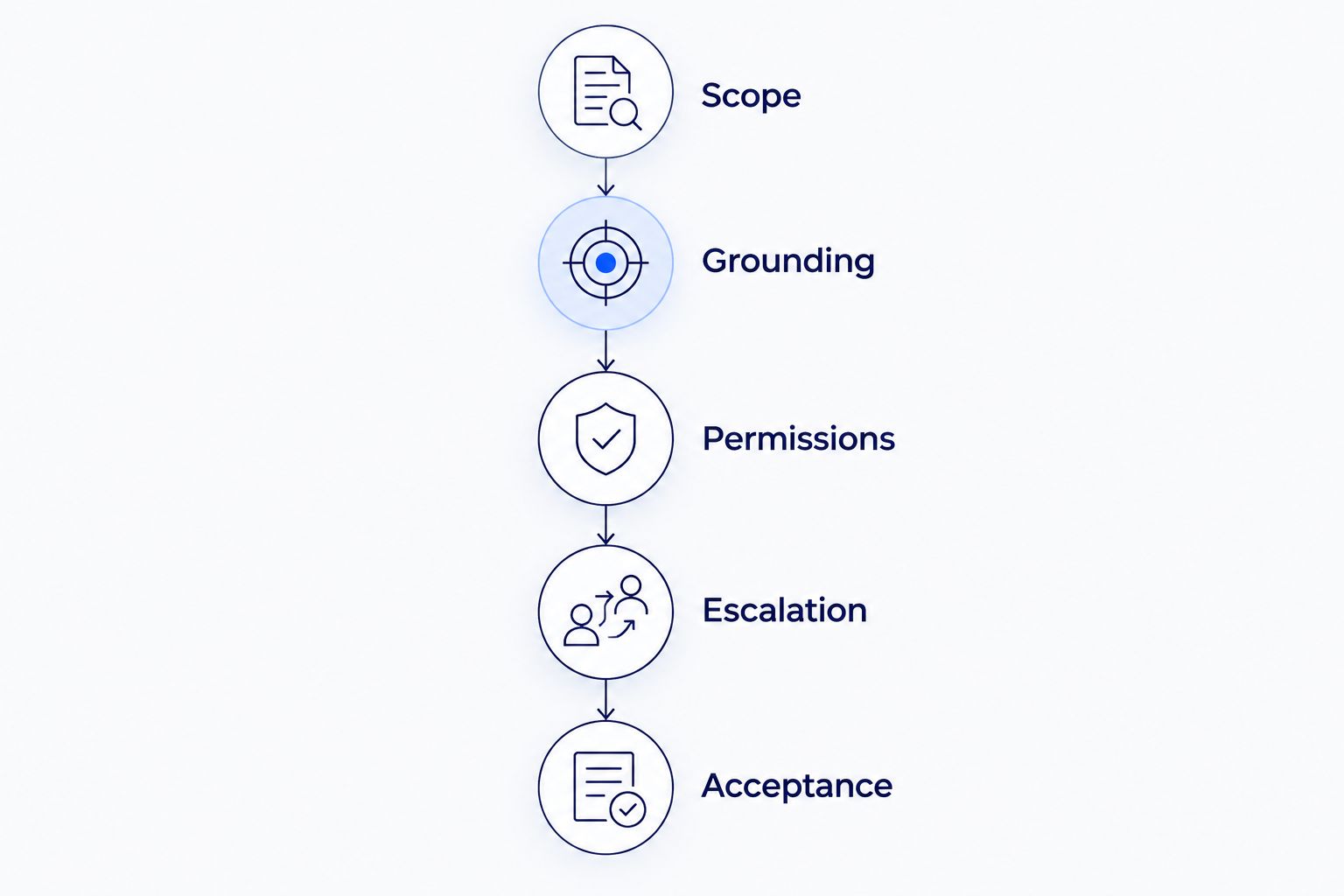
Give every shortlisted company the same pilot brief. A useful starting specification is 30 test questions, 3 business workflows, and 2 business reviewers; these are proposed evaluation inputs, not industry benchmarks or promised results.
- Scope: Select one user group and define what the assistant must not do.
- Grounding: Supply approved documents and identify their owners and access restrictions.
- Permissions: Test whether different users receive only information they are authorized to access.
- Escalation: Define when the assistant stops, explains the limitation, and transfers the conversation.
- Acceptance: Have reviewers assess answers and completed tasks against written criteria.
Include deliberately difficult cases: an expired policy, a restricted document, an ambiguous request, a failed API call, and a request outside the assistant's authority. Ask each vendor to show the recorded outcome rather than narrating what should happen.
For knowledge-heavy projects, review how to build a RAG pipeline for enterprise knowledge bases. Retrieval-augmented generation connects answers to retrieved material, but retrieval alone does not establish that the answer is correct or that the user should see the source.
Which AI chatbot development company should you choose?
Choose the company whose proposed engagement matches your main delivery risk. Start with enterprise AI discovery if the workflow is unclear; prioritize integration expertise if systems are the constraint; prioritize product engineering if the assistant belongs inside an application.
For an undecided enterprise buyer, the next move is not a longer vendor list. Write the bounded pilot brief, assign the business owner, and ask suitable candidates to explain the same workflow end to end.
FAQ
What's the best AI chatbot development company for an enterprise?
The best company matches your enterprise's main delivery requirement: discovery, integration, transformation, product engineering, or internal enablement. Select the proposed team through a workflow-specific pilot rather than relying on a general ranking.
Is a chatbot development company better than a chatbot platform?
A development company fits requirements that need custom application behavior, integrations, or engineering ownership. A platform is a different buying route; assess its configuration limits and operational requirements against your workflow before choosing.
Should an enterprise chatbot use retrieval-augmented generation?
Retrieval-augmented generation fits assistants that answer from an approved knowledge collection. It still requires permission enforcement, source quality checks, and evaluation of the generated answer.
How do I compare chatbot development proposals?
Give each company the same workflows, knowledge sources, access rules, and acceptance tests. Compare architecture, exclusions, ownership, and operational responsibilities before comparing the overall commercial proposal.
Can an AI chatbot update business records?
An AI chatbot can update records through authorized application integrations. Require action-specific permissions, confirmation where appropriate, audit records, and a defined response to failed or repeated requests.
What should a chatbot pilot demonstrate before launch?
A chatbot pilot should demonstrate correct answers, permitted actions, access enforcement, and reliable escalation against written tests. Include failure cases rather than evaluating only successful conversations.
Who should own a chatbot after the development company leaves?
Your organization should name business, technical, and knowledge owners before launch. The handover must cover deployments, access management, content updates, incident handling, and regression testing.
One last thing
Ask every finalist to demonstrate a correct refusal. A chatbot that stops when it lacks authority or reliable information is behaving better than one that produces a confident but unsupported answer.
Make that demonstration part of your 2026 acceptance decision. The goal is not uninterrupted conversation; it is dependable completion of permitted tasks.